Loading page, please wait…
Swami Vivekananda - UPSC Art And Culture
What is Swami Vivekananda in UPSC Art And Culture?
Swami Vivekananda is a key topic under Art And Culture for UPSC Civil Services Examination. Key points include: Swami Vivekananda's birth anniversary on January 12th is celebrated as National Youth Day.. He was born Narendra Nath Datta and was the chief disciple of Ramakrishna Paramhansa.. He introduced Vedanta and Yoga to the Western world at the 1893 Chicago Parliament of Religions.. Understanding this topic is essential for both UPSC Prelims and Mains preparation.
Why is Swami Vivekananda important for UPSC exam?
Swami Vivekananda is a Medium-level topic in UPSC Art And Culture. It is tested in both Prelims (factual MCQs) and Mains (analytical answer writing). Previous year UPSC questions have frequently covered aspects of Swami Vivekananda, making it essential for comprehensive IAS preparation.
How to prepare Swami Vivekananda for UPSC?
To prepare Swami Vivekananda for UPSC: (1) Study the comprehensive notes covering all key concepts on Vaidra. (2) Practice previous year questions on this topic. (3) Connect it with current affairs using daily updates. (4) Revise using key takeaways and mind maps available for Art And Culture. (5) Write practice answers linking Swami Vivekananda to related GS Paper topics.
Key takeaways of Swami Vivekananda for UPSC
- Swami Vivekananda's birth anniversary on January 12th is celebrated as National Youth Day.
- He was born Narendra Nath Datta and was the chief disciple of Ramakrishna Paramhansa.
- He introduced Vedanta and Yoga to the Western world at the 1893 Chicago Parliament of Religions.
- His 'Neo-Vedanta' combined spirituality with material progress and social service.
- He advocated for 'man-making, character-building education' for national regeneration.
- He founded the Ramakrishna Mission and Belur Math to propagate his ideals.
- His core values included strength, ethics, universal religion, rationality, and humanistic nationalism.
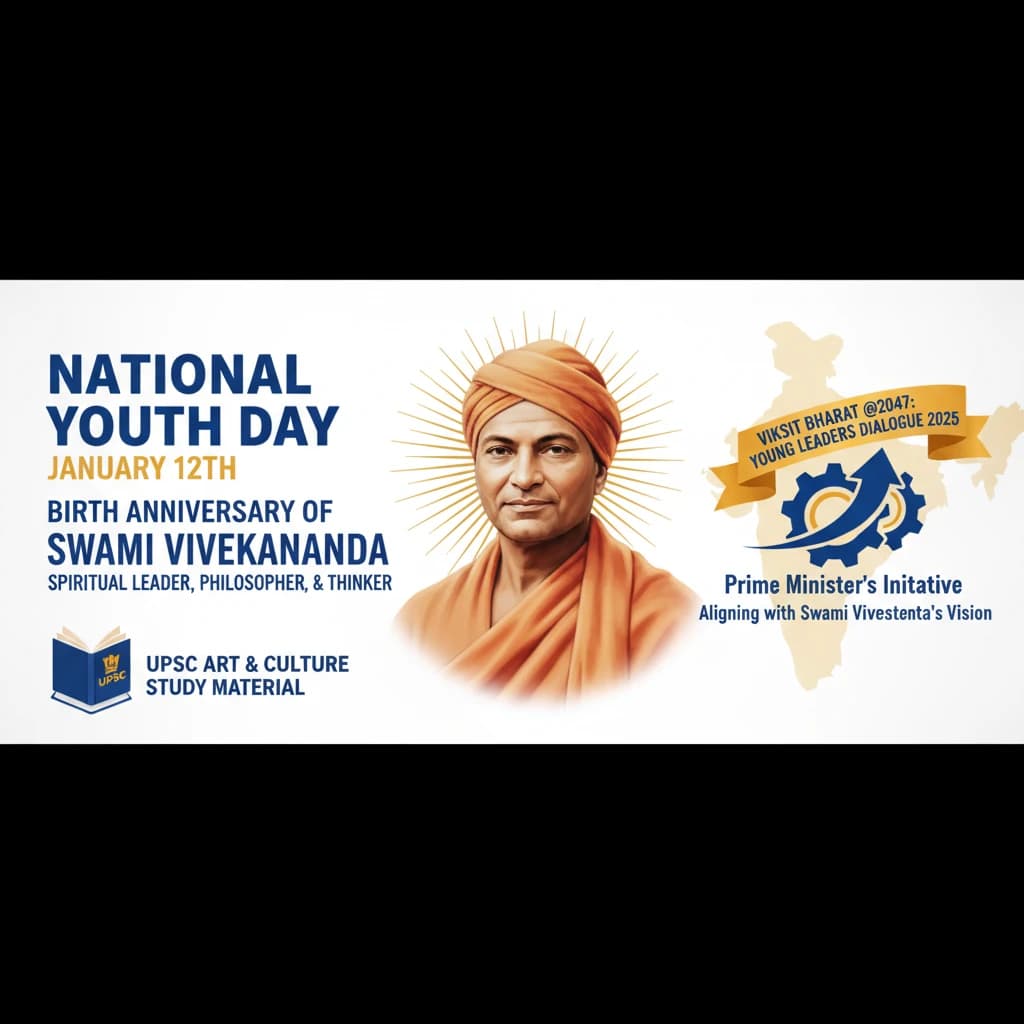
Swami Vivekananda
Medium⏱️ 7 min read
art and culture
📖 Introduction
National Youth Day and Swami Vivekananda's Significance
National Youth Day is celebrated annually on January 12th to commemorate the birth anniversary of Swami Vivekananda. This day honors his legacy as a spiritual leader, philosopher, and thinker.
Recently, the Prime Minister participated in the Viksit Bharat @2047: Young Leaders Dialogue 2025, aligning with the spirit of youth empowerment championed by Swami Vivekananda.
National Youth Day: Celebrated on January 12th (Swami Vivekananda's 162nd birth anniversary).
National Youth Policy 2014: Defines youth as persons in the age group of 15-29 years, constituting nearly 40% of India’s total population.
National Youth Policy 2014: Defines youth as persons in the age group of 15-29 years, constituting nearly 40% of India’s total population.
Early Life and Enlightenment
Swami Vivekananda was born as Narendra Nath Datta on January 12th, 1863. He became a monk and was the chief disciple of Ramakrishna Paramhansa.
In 1893, at the request of Maharaja Ajit Singh of Khetri State, he adopted the name ‘Vivekananda’, replacing his previous name ‘Sachidananda’.
The Enlightenment: In 1892, Swami Vivekananda meditated for three days and nights on a rock in the Indian Ocean off Kanyakumari, which led to his spiritual enlightenment. This site is now known as the Vivekananda Rock Memorial.
Philosophical Contributions
Swami Vivekananda played a pivotal role in introducing the world to the profound Indian philosophies of Vedanta and Yoga. He interpreted Hinduism for a global audience.
He propagated ‘Neo-Vedanta’, which presented an understanding of Hinduism through a Western perspective. He believed in harmonizing spiritual growth with material progress.
Spiritual Contributions
Vivekananda's message on human values drew inspiration from ancient texts like the Upanishads and the Gita, as well as the teachings of figures like Buddha and Jesus.
He emphasized concepts such as self-realization, compassion, and selfless service. He famously advocated the doctrine of service, stating that serving Jiva (living beings) is equivalent to worshipping Shiva.
He outlined four pathways to attain moksha (liberation from worldly pleasure and attachment) in his seminal works:
- Raja-yoga
- Karma-yoga
- Jnana-yoga
- Bhakti-yoga
Revivalism and Education
Vivekananda strongly emphasized the critical role of education for the regeneration and upliftment of India. He believed in a transformative approach to learning.
He advocated for a 'man-making, character-building education', focusing on holistic development rather than mere academic knowledge.
Core Values: Youth and Ethics
Youth: He inspired young people to be dedicated to their goals, emphasizing the importance of unwavering commitment to overcome challenges. He urged them to develop both mental and physical strength, advocating for ‘muscles of iron’ and ‘nerves of steel’.
Ethics: Vivekananda viewed ethics as a fundamental code of conduct guiding individuals towards responsible citizenship. He stressed that purity, reflecting our true living Self or Atman, is our real nature.
Core Values: Religion and Education
Religion: His vision of religion was universal, seeing it as an experience of transcendent reality. He sought to free religion from superstition, dogma, priestcraft, and intolerance.
Education: Vivekananda believed education should reveal students’ inherent knowledge and power. Its primary aim was character-building and making individuals self-reliant to navigate life’s complexities.
Core Values: Rationality and Nationalism
Rationality: He fully supported the methodologies and findings of modern science. He did not advocate for faith over reason, instead embracing scientific inquiry.
Nationalism: His concept of nationalism was rooted in Humanism and Universalism, which are core tenets of Indian spiritual culture. It was characterized by concern for the masses, pursuit of freedom and equality, and the practice of Karma Yoga as a path to both political and spiritual liberation through selfless service.
Associated Organizations and International Recognition
In 1897, he founded the Ramakrishna Mission to propagate his ideals of service, education, and spiritual upliftment, continuing the legacy of his guru.
He established the Belur Math in 1899, which became his permanent residence and the headquarters of the Ramakrishna Math and Mission.
International Address: Swami Vivekananda famously represented Hinduism at the Parliament of Religions held in Chicago in 1893, where his address garnered widespread acclaim.
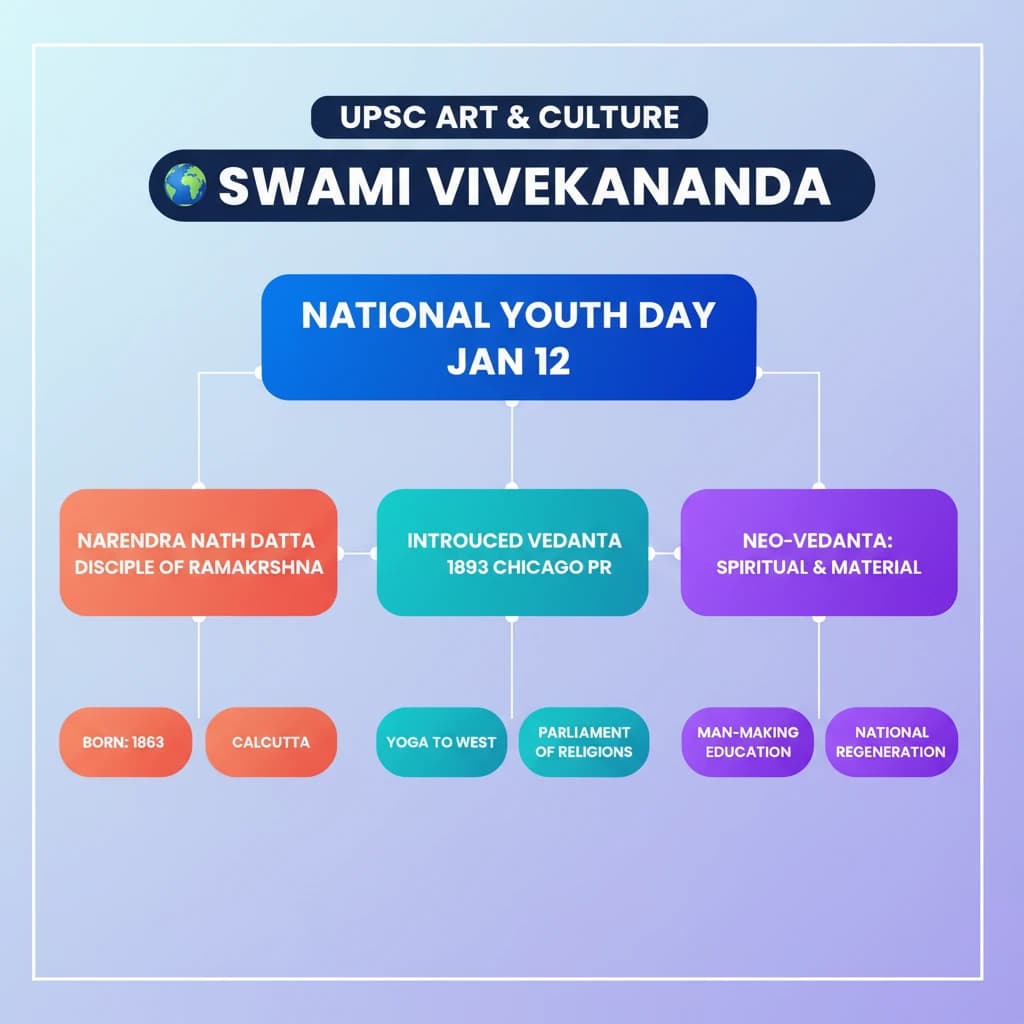
💡 Key Takeaways
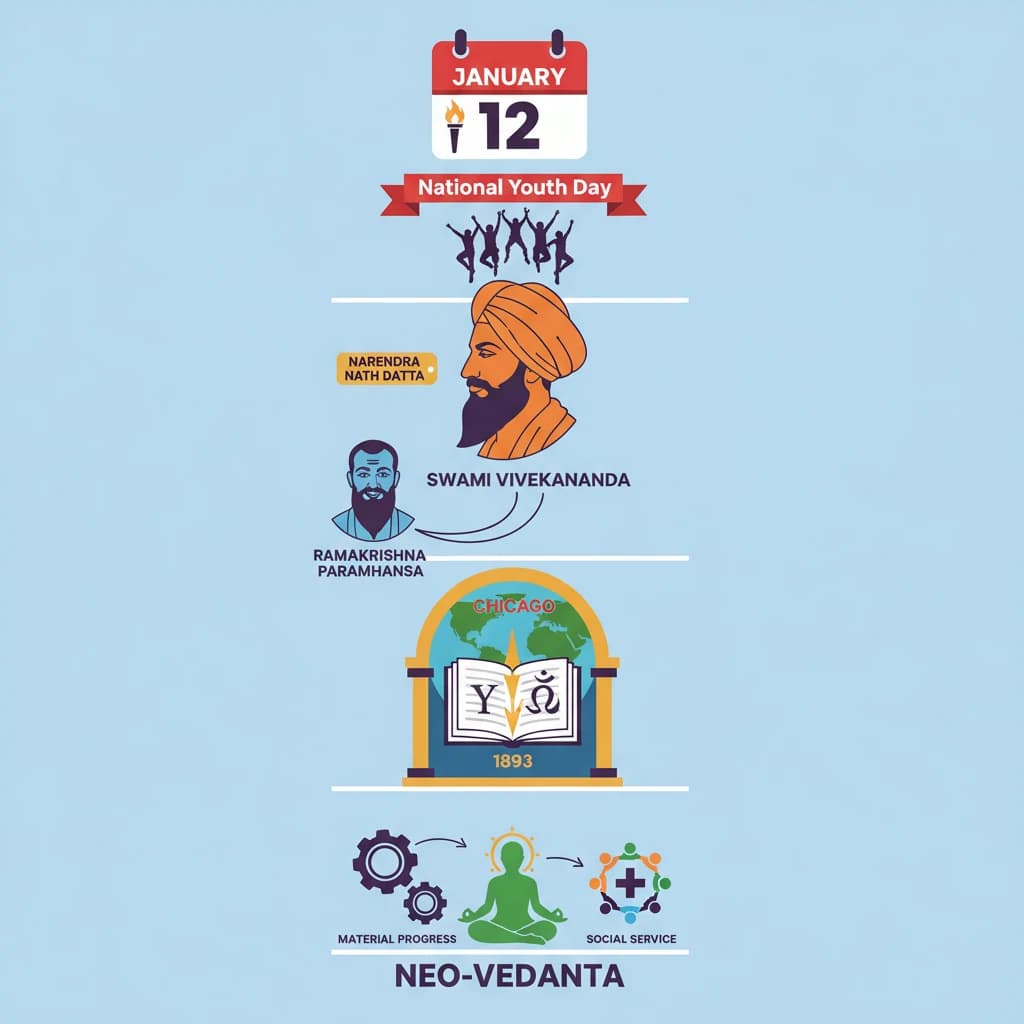
- •Swami Vivekananda's birth anniversary on January 12th is celebrated as National Youth Day.
- •He was born Narendra Nath Datta and was the chief disciple of Ramakrishna Paramhansa.
- •He introduced Vedanta and Yoga to the Western world at the 1893 Chicago Parliament of Religions.
- •His 'Neo-Vedanta' combined spirituality with material progress and social service.
- •He advocated for 'man-making, character-building education' for national regeneration.
- •He founded the Ramakrishna Mission and Belur Math to propagate his ideals.
- •His core values included strength, ethics, universal religion, rationality, and humanistic nationalism.
🧠 Memory Techniques
95% Verified Content