Loading page, please wait…
What are Key Facts about the Sanchi Stupa? - UPSC Art And Culture
What is What are Key Facts about the Sanchi Stupa? in UPSC Art And Culture?
What are Key Facts about the Sanchi Stupa? is a key topic under Art And Culture for UPSC Civil Services Examination. Key points include: Sanchi Stupa was originally built by Emperor Ashoka in the 3rd century BC.. Its significant expansion, including stone casing and a circumambulatory path, occurred during the Shunga period.. The iconic carved gateways (Toranas) were added between the 1st century BC and 2nd century AD.. Understanding this topic is essential for both UPSC Prelims and Mains preparation.
Why is What are Key Facts about the Sanchi Stupa? important for UPSC exam?
What are Key Facts about the Sanchi Stupa? is a Medium-level topic in UPSC Art And Culture. It is tested in both Prelims (factual MCQs) and Mains (analytical answer writing). Previous year UPSC questions have frequently covered aspects of What are Key Facts about the Sanchi Stupa?, making it essential for comprehensive IAS preparation.
How to prepare What are Key Facts about the Sanchi Stupa? for UPSC?
To prepare What are Key Facts about the Sanchi Stupa? for UPSC: (1) Study the comprehensive notes covering all key concepts on Vaidra. (2) Practice previous year questions on this topic. (3) Connect it with current affairs using daily updates. (4) Revise using key takeaways and mind maps available for Art And Culture. (5) Write practice answers linking What are Key Facts about the Sanchi Stupa? to related GS Paper topics.
Key takeaways of What are Key Facts about the Sanchi Stupa? for UPSC
- Sanchi Stupa was originally built by Emperor Ashoka in the 3rd century BC.
- Its significant expansion, including stone casing and a circumambulatory path, occurred during the Shunga period.
- The iconic carved gateways (Toranas) were added between the 1st century BC and 2nd century AD.
- British officer Henry Taylor rediscovered the stupa in 1818, and John Marshall led its major restoration in the 1910s.
- Sanchi Stupa is a UNESCO World Heritage site, inscribed in 1989.
- Its architecture features distinct elements like Anda, Harmika, Chatra, Pradakshina Patha, and Toranas.
- The site showcases early Buddhist art, often using aniconic symbols to represent the Buddha.
What are Key Facts about the Sanchi Stupa?
Medium⏱️ 7 min read
art and culture
📖 Introduction
Construction and Early Development of Sanchi Stupa
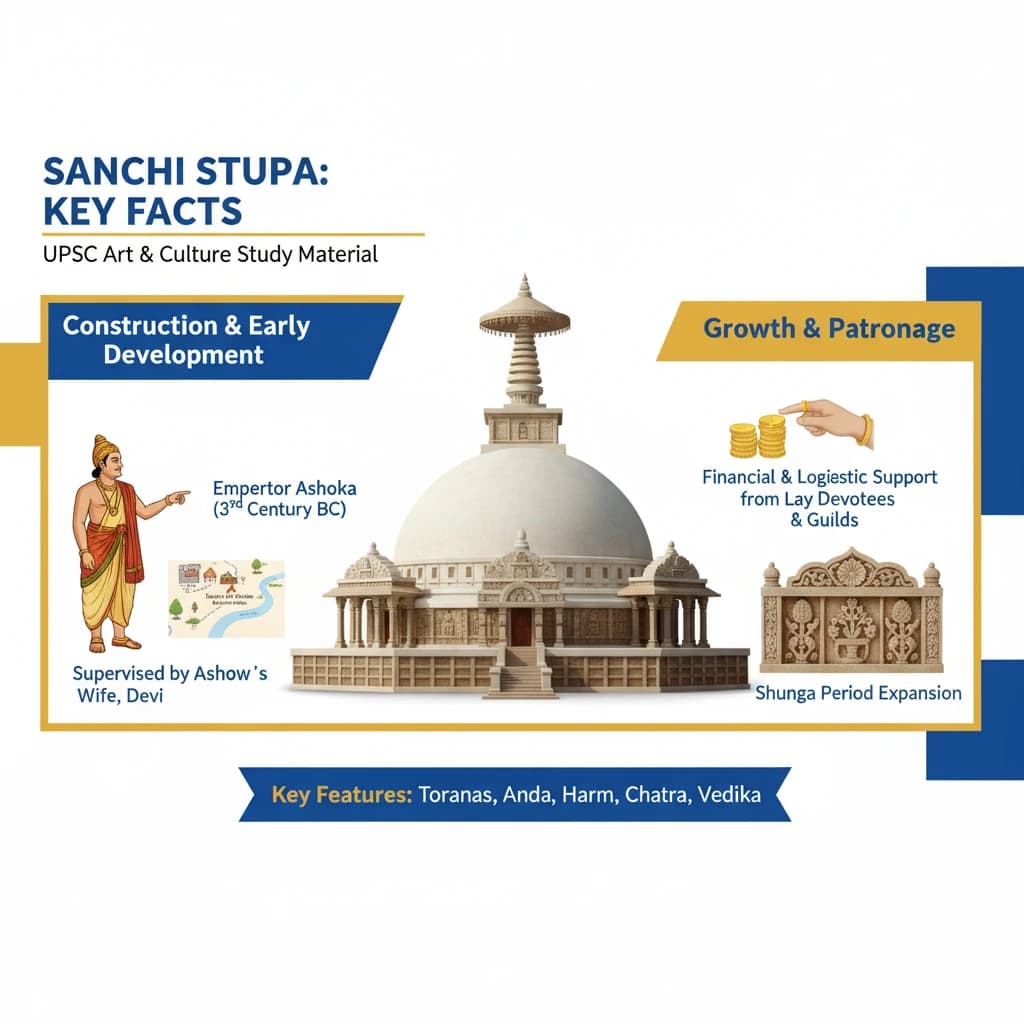
The original Sanchi Stupa was constructed by Emperor Ashoka in the third century BC. This foundational work was notably overseen by Ashoka’s wife, Devi, who originated from the nearby significant trading town of Vidisha.
The continued development and growth of the entire Sanchi complex received substantial financial and logistical support from the thriving mercantile community of Vidisha, highlighting local patronage.
Expansion During the Shunga Period
During the 2nd century BC, coinciding with the Shunga period, the stupa underwent significant expansion. It was enlarged using durable sandstone slabs, enhancing its structural integrity and aesthetic appeal.
Key Additions (Shunga Period):
- Circumambulatory walkway: A path for ritualistic circumambulation.
- Harmika with a Chatra: A square railing atop the dome, crowned by an umbrella structure.
Addition of Toranas and Detailed Carvings
Between the 1st century BC and the 2nd century AD, four magnificent stone gateways, known as Toranas, were added to the stupa. These gateways are renowned for their intricate and detailed carvings.
The carvings on the Toranas vividly depict various aspects of Buddhist iconography and narrate important Jataka stories, offering insights into early Buddhist art and philosophy.
Rediscovery and Initial Surveys
The Sanchi Stupa was found in a state of considerable disrepair and ruins when it was rediscovered by British officer Henry Taylor in 1818. This marked the beginning of its modern recognition.
The first formal survey and subsequent excavations at the Sanchi site were meticulously led by Alexander Cunningham in 1851, laying the groundwork for its eventual restoration.
Preservation Efforts and Bhopal Begums' Role
In 1853, Sikander Begum of Bhopal made an offer to send the valuable gateways of Sanchi to Queen Victoria in England. However, these plans faced delays due to the 1857 revolt and significant transportation challenges.
The offer was renewed by the Begum in 1868, but colonial authorities wisely declined it, opting instead for in-situ preservation. A plaster cast of the eastern gateway was created as an alternative.
John Marshall's Restoration and Museum Establishment
The site was meticulously restored to its current magnificent condition by Archaeological Survey of India (ASI) director-general John Marshall during the 1910s. This extensive restoration was funded by the enlightened begums of nearby Bhopal.
Marshall's dedicated efforts culminated in the establishment of a museum at the Sanchi site in 1919. This museum was crucial for preserving unearthed artefacts and managing ongoing conservation activities.
UNESCO World Heritage Recognition
The Sanchi Stupa received prestigious recognition as a UNESCO World Heritage site in 1989. This status acknowledges its outstanding universal value and cultural significance.
💡 Key Takeaways
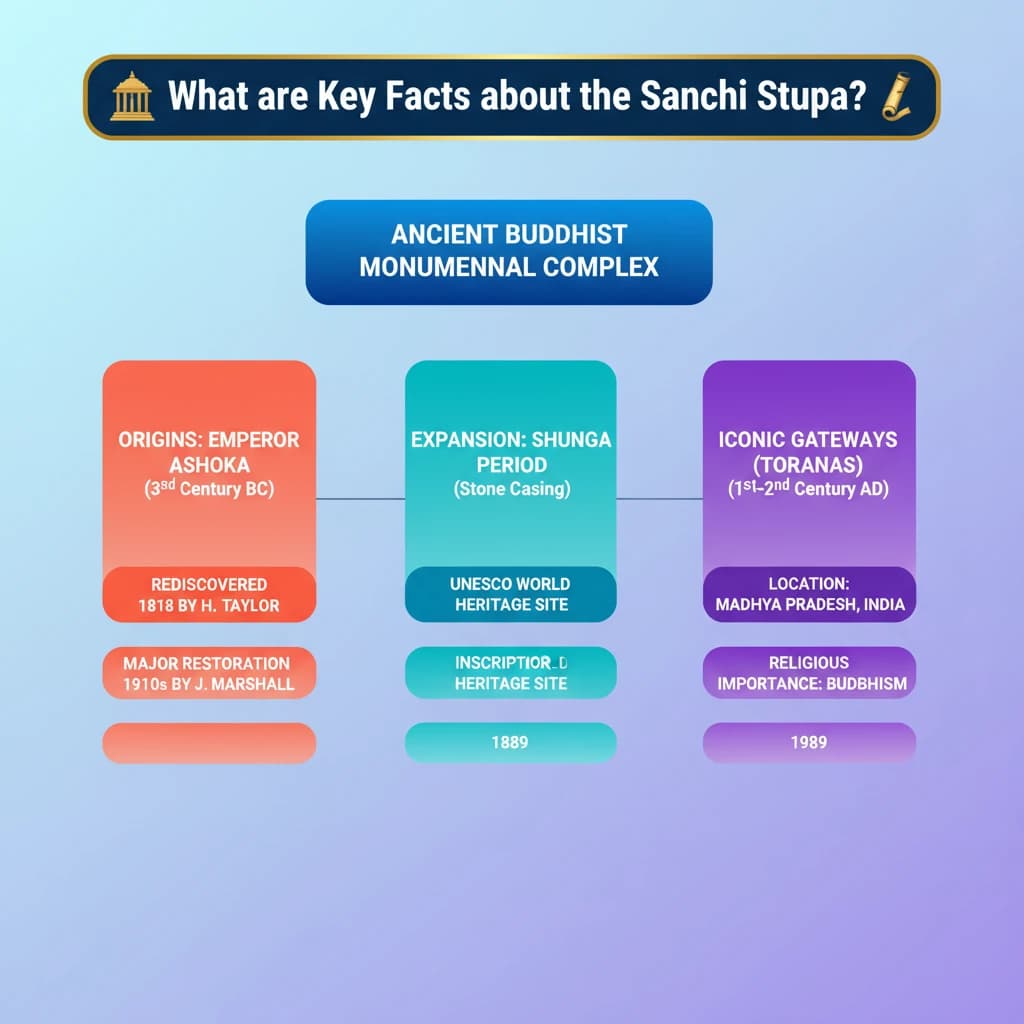
- •Sanchi Stupa was originally built by Emperor Ashoka in the 3rd century BC.
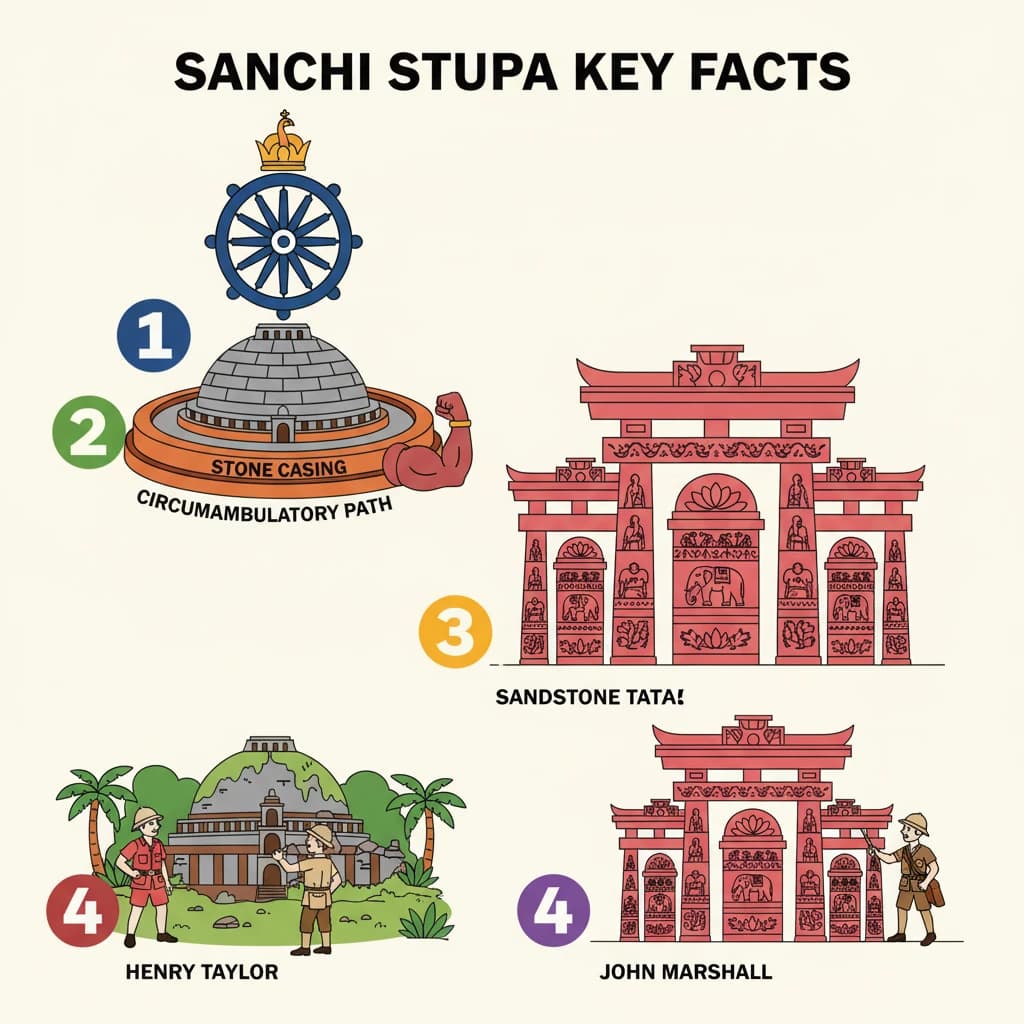
- •Its significant expansion, including stone casing and a circumambulatory path, occurred during the Shunga period.
- •The iconic carved gateways (Toranas) were added between the 1st century BC and 2nd century AD.
- •British officer Henry Taylor rediscovered the stupa in 1818, and John Marshall led its major restoration in the 1910s.
- •Sanchi Stupa is a UNESCO World Heritage site, inscribed in 1989.
- •Its architecture features distinct elements like Anda, Harmika, Chatra, Pradakshina Patha, and Toranas.
- •The site showcases early Buddhist art, often using aniconic symbols to represent the Buddha.
🧠 Memory Techniques
98% Verified Content