Loading page, please wait…
What are the Constitutional Provisions Related to Languages in India - UPSC Art And Culture
What is What are the Constitutional Provisions Related to Languages in India in UPSC Art And Culture?
What are the Constitutional Provisions Related to Languages in India is a key topic under Art And Culture for UPSC Civil Services Examination. Key points include: Article 29 protects the language, script, or culture of any section of citizens.. The Eighth Schedule lists 22 officially recognized languages of India.. Six languages currently hold 'classical language' status, receiving special promotion.. Understanding this topic is essential for both UPSC Prelims and Mains preparation.
Why is What are the Constitutional Provisions Related to Languages in India important for UPSC exam?
What are the Constitutional Provisions Related to Languages in India is a Medium-level topic in UPSC Art And Culture. It is tested in both Prelims (factual MCQs) and Mains (analytical answer writing). Previous year UPSC questions have frequently covered aspects of What are the Constitutional Provisions Related to Languages in India, making it essential for comprehensive IAS preparation.
How to prepare What are the Constitutional Provisions Related to Languages in India for UPSC?
To prepare What are the Constitutional Provisions Related to Languages in India for UPSC: (1) Study the comprehensive notes covering all key concepts on Vaidra. (2) Practice previous year questions on this topic. (3) Connect it with current affairs using daily updates. (4) Revise using key takeaways and mind maps available for Art And Culture. (5) Write practice answers linking What are the Constitutional Provisions Related to Languages in India to related GS Paper topics.
Key takeaways of What are the Constitutional Provisions Related to Languages in India for UPSC
- Article 29 protects the language, script, or culture of any section of citizens.
- The Eighth Schedule lists 22 officially recognized languages of India.
- Six languages currently hold 'classical language' status, receiving special promotion.
- Article 350A mandates primary education in the mother tongue for all states.
- Article 350B provides for a Special Officer to safeguard linguistic minorities.
- Article 351 empowers the Union to promote the development of the Hindi language.
- India's language policy balances national unity with the protection of linguistic diversity.
What are the Constitutional Provisions Related to Languages in India
Medium⏱️ 8 min read
art and culture
📖 Introduction
Overview of Constitutional Provisions on Languages
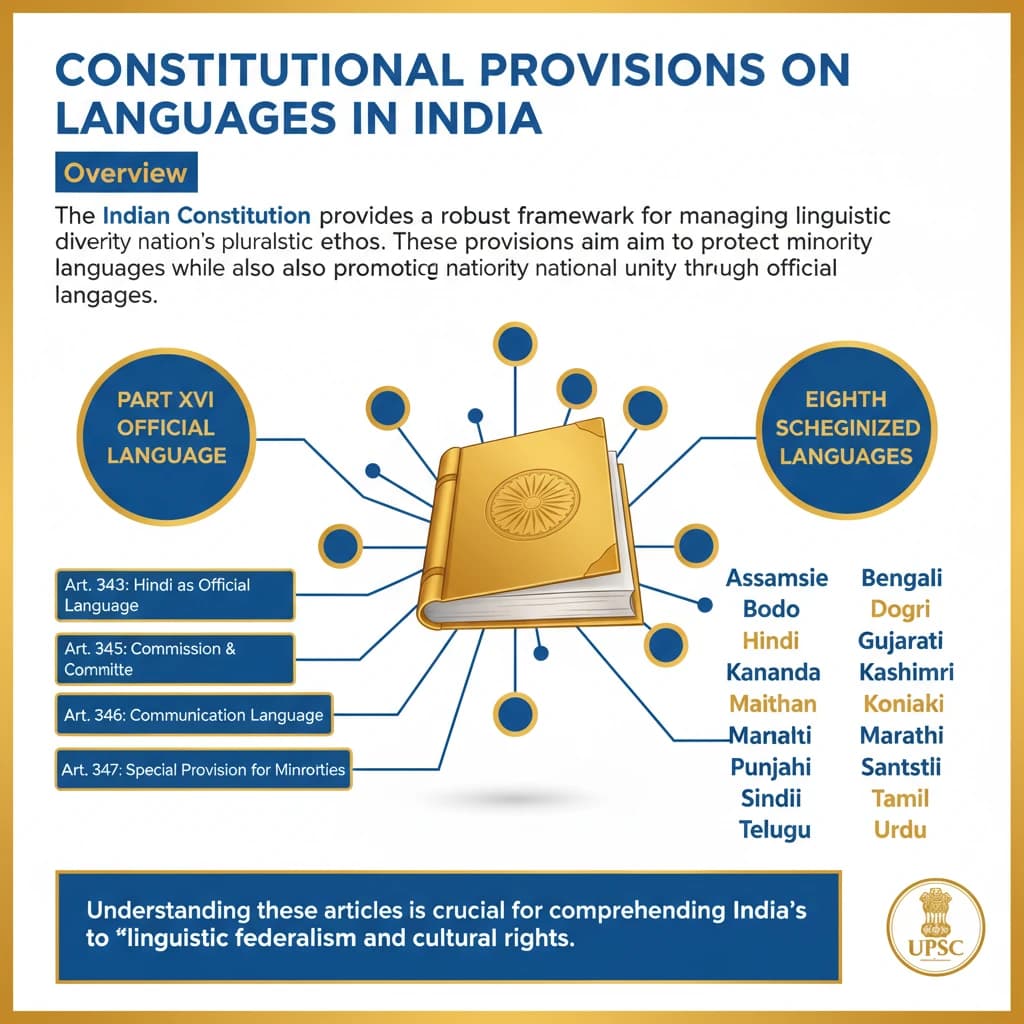
The Indian Constitution provides a robust framework for managing linguistic diversity, reflecting the nation's pluralistic ethos. These provisions aim to protect minority languages while also promoting national unity through official languages.
Understanding these articles is crucial for comprehending India's approach to linguistic federalism and cultural rights.
Article 29: Protection of Minorities' Interests
Article 29 of the Indian Constitution is a fundamental right that safeguards the interests of minorities. It ensures that all citizens have the right to preserve their distinct language, script, or culture.
Key Aspect: This article applies to any section of citizens residing in India having a distinct language, script, or culture. It is not limited to religious minorities.
Eighth Schedule: Recognized Official Languages
Part XVII of the Indian Constitution specifically deals with the official languages of the Union and states. The Eighth Schedule is integral to this part, listing the languages recognized by the Constitution.
Number of Languages: The Eighth Schedule currently recognizes 22 official languages. These include Assamese, Bengali, Bodo, Dogri, Gujarati, Hindi, Kannada, Kashmiri, Konkani, Maithili, Malayalam, Manipuri, Marathi, Nepali, Odia, Punjabi, Sanskrit, Santhali, Sindhi, Tamil, Telugu, and Urdu.
Remember the original number of languages (14) and the amendments that added others (Sindhi, Konkani, Manipuri, Nepali, Bodo, Dogri, Maithili, Santhali) for Prelims.
Classical Language Status
Beyond the Eighth Schedule, the government also confers 'classical language' status to certain languages. This status comes with specific benefits for promotion and preservation.
Current Count: Six languages in India currently have “classical” status. These are Tamil (2004), Sanskrit (2005), Kannada (2008), Telugu (2008), Malayalam (2013), and Odia (2014).
Article 350A: Primary Education in Mother Tongue
Article 350A mandates that every state and every local authority within the state must endeavor to provide adequate facilities for instruction in the mother tongue at the primary stage of education.
This provision is crucial for ensuring that children receive foundational education in a language they understand best, promoting better learning outcomes and cultural continuity.
Article 350B: Special Officer for Linguistic Minorities
Article 350B provides for the appointment of a “Special Officer” for linguistic minorities. This officer's role is to investigate all matters relating to the safeguards provided for linguistic minorities under the Constitution.
The Special Officer reports directly to the President of India, and these reports are then laid before each House of Parliament.
Article 351: Development of Hindi Language
Article 351 empowers the Union government to issue a directive for the development of the Hindi language. The objective is to promote the spread of Hindi and enrich its vocabulary by drawing upon other Indian languages, particularly Sanskrit.
This article highlights the constitutional aspiration for Hindi to serve as a medium of expression for all the elements of the composite culture of India.
💡 Key Takeaways
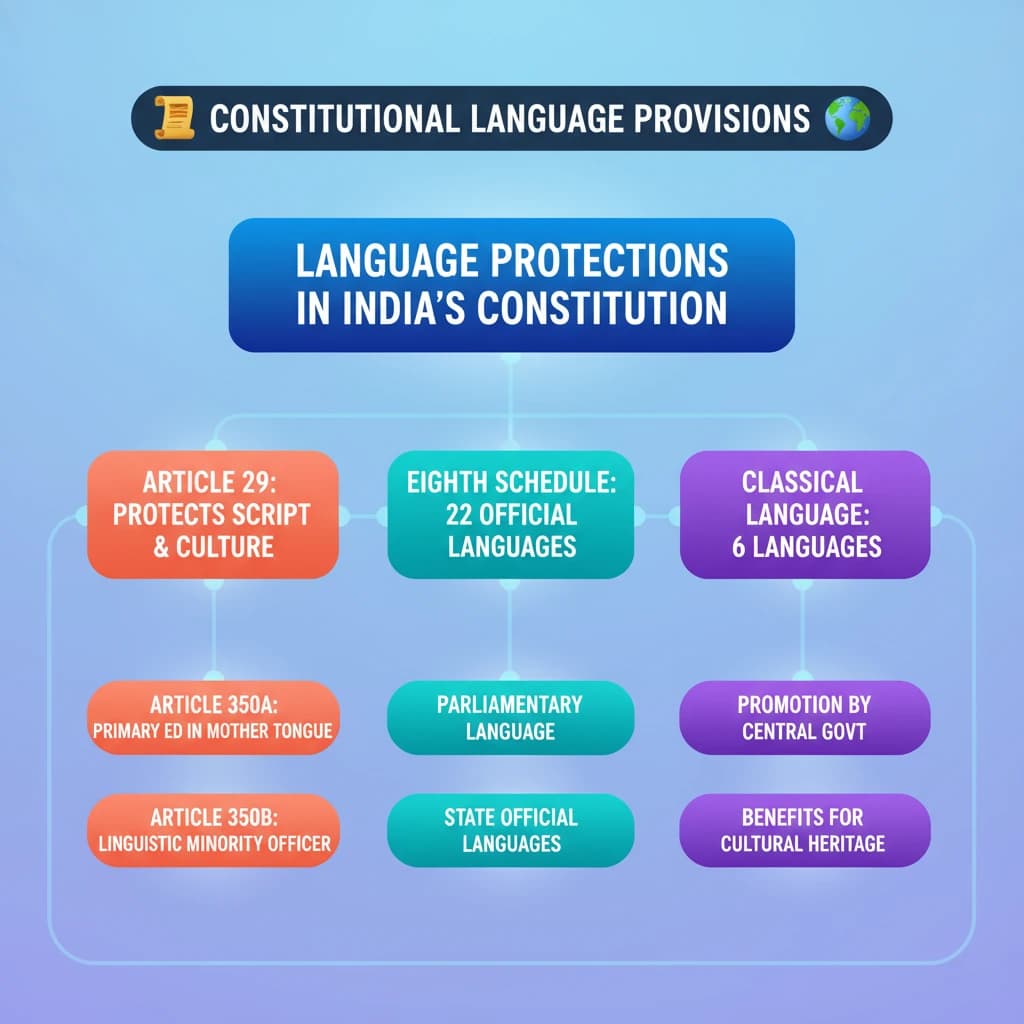
- •Article 29 protects the language, script, or culture of any section of citizens.
- •The Eighth Schedule lists 22 officially recognized languages of India.
- •Six languages currently hold 'classical language' status, receiving special promotion.
- •Article 350A mandates primary education in the mother tongue for all states.
- •Article 350B provides for a Special Officer to safeguard linguistic minorities.
- •Article 351 empowers the Union to promote the development of the Hindi language.
- •India's language policy balances national unity with the protection of linguistic diversity.
🧠 Memory Techniques

98% Verified Content
📚 Reference Sources
•The Constitution of India (as amended)
•National Education Policy (NEP) 2020 document
•Press Information Bureau (PIB) releases on classical languages