Loading page, please wait…
What are the Key Facts About Jagannath Temple? - UPSC Art And Culture
What is What are the Key Facts About Jagannath Temple? in UPSC Art And Culture?
What are the Key Facts About Jagannath Temple? is a key topic under Art And Culture for UPSC Civil Services Examination. Key points include: The Jagannath Temple in Puri, Odisha, is a major Hindu shrine dedicated to Lord Jagannath, Balabhadra, and Subhadra.. It is known as the "White Pagoda" and is one of the four sacred Char Dhams pilgrimage sites.. The temple is a key part of Odisha's Golden Triangle, connecting it with Bhubaneswar and Konark Sun Temple.. Understanding this topic is essential for both UPSC Prelims and Mains preparation.
Why is What are the Key Facts About Jagannath Temple? important for UPSC exam?
What are the Key Facts About Jagannath Temple? is a Easy-level topic in UPSC Art And Culture. It is tested in both Prelims (factual MCQs) and Mains (analytical answer writing). Previous year UPSC questions have frequently covered aspects of What are the Key Facts About Jagannath Temple?, making it essential for comprehensive IAS preparation.
How to prepare What are the Key Facts About Jagannath Temple? for UPSC?
To prepare What are the Key Facts About Jagannath Temple? for UPSC: (1) Study the comprehensive notes covering all key concepts on Vaidra. (2) Practice previous year questions on this topic. (3) Connect it with current affairs using daily updates. (4) Revise using key takeaways and mind maps available for Art And Culture. (5) Write practice answers linking What are the Key Facts About Jagannath Temple? to related GS Paper topics.
Key takeaways of What are the Key Facts About Jagannath Temple? for UPSC
- The Jagannath Temple in Puri, Odisha, is a major Hindu shrine dedicated to Lord Jagannath, Balabhadra, and Subhadra.
- It is known as the "White Pagoda" and is one of the four sacred Char Dhams pilgrimage sites.
- The temple is a key part of Odisha's Golden Triangle, connecting it with Bhubaneswar and Konark Sun Temple.
- It was constructed in the 12th century by King Ananta Varman Chodaganga Deva of the Ganga Dynasty.
- The temple is a prime example of Kalinga architecture, characterized by curvilinear towers and intricate carvings.
- It features four gates facing cardinal directions, each named after an animal.
- The annual Rath Yatra festival is a globally significant event associated with the temple, drawing millions of devotees.
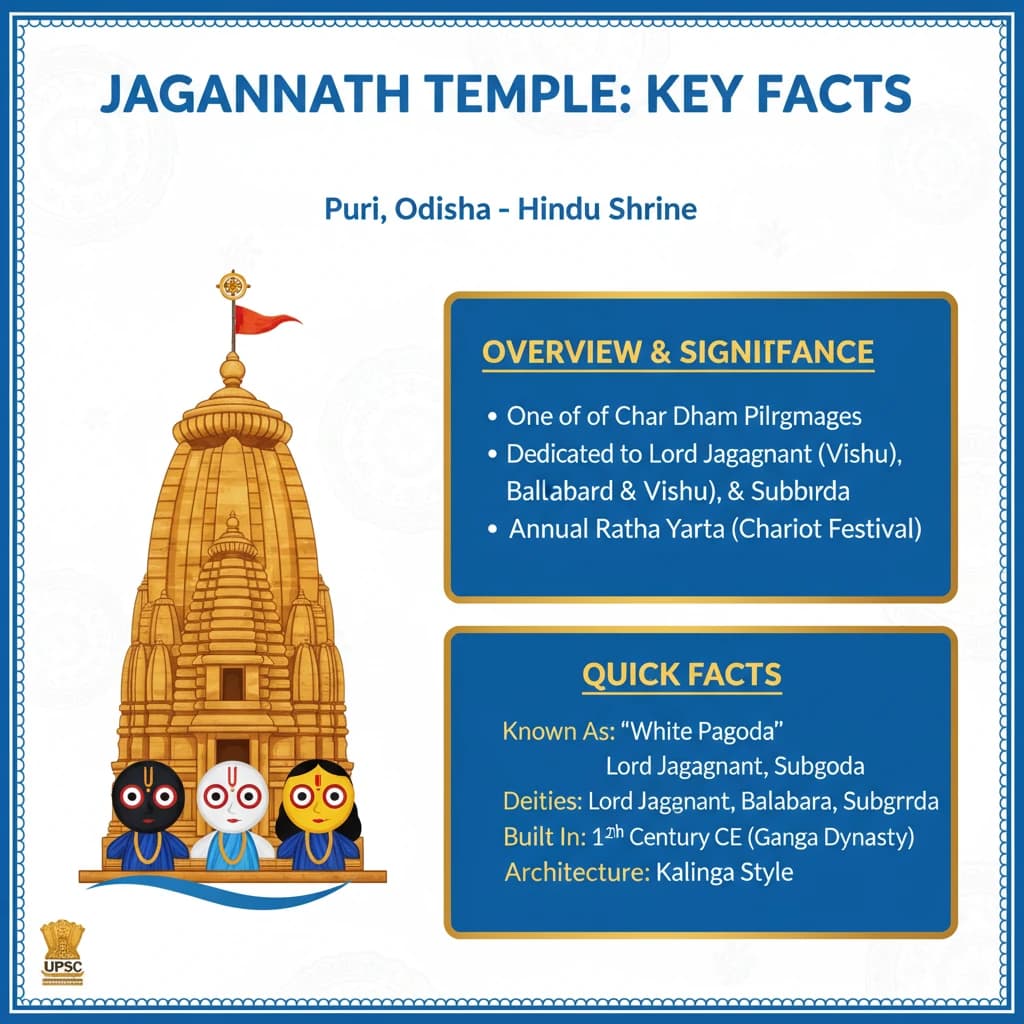
What are the Key Facts About Jagannath Temple?
Easy⏱️ 6 min read
art and culture
📖 Introduction
Overview and Significance of Jagannath Temple
The Jagannath Temple in Puri, Odisha, is one of India's most revered Hindu shrines. It is dedicated to Lord Jagannath, believed to be an incarnation of Vishnu, along with his elder brother Balabhadra and sister Subhadra.
Known As: "White Pagoda"
Deities: Lord Jagannath (Vishnu), Balabhadra, Subhadra
Deities: Lord Jagannath (Vishnu), Balabhadra, Subhadra
Part of Char Dhams and Golden Triangle
The temple holds immense spiritual importance as one of the Char Dhams, the four most sacred Hindu pilgrimage sites for Hindus. This status makes it a critical destination for devotees.
The Char Dhams are:
- Badrinath
- Dwarka
- Rameswaram
- Puri (Jagannath Temple)
It is also a key component of Odisha's Golden Triangle, a circuit connecting major tourist destinations in the state. This highlights its cultural and economic significance.
Odisha's Golden Triangle:
- Puri (Jagannath Temple)
- Bhubaneswar (City of Temples)
- Konark Sun Temple (Black Pagoda)
Historical Background of Jagannath Temple
The construction of the Jagannath Temple dates back to the 12th century CE. It was built by the renowned king Ananta Varman Chodaganga Deva of the Ganga Dynasty.
Builder: King Ananta Varman Chodaganga Deva
Dynasty: Ganga Dynasty
Period: 12th century CE
Dynasty: Ganga Dynasty
Period: 12th century CE
Key Architectural Features: Kalinga Style
The temple stands as an outstanding example of Kalinga architecture, a distinctive style prevalent in Odisha. This architectural form is known for its unique characteristics.
Kalinga Architecture Characteristics:
- Distinctive curvilinear towers (Shikhara)
- Intricate carvings
- Ornate sculptures
Temple Gates and Cardinal Directions
The temple's boundary wall features four gates, strategically located at its mid-points. Each gate faces one of the four cardinal directions and is named after different animals.
Gates: Four gates, facing North, South, East, West
Naming Convention: Named after animals (e.g., Lion Gate, Elephant Gate)
Naming Convention: Named after animals (e.g., Lion Gate, Elephant Gate)
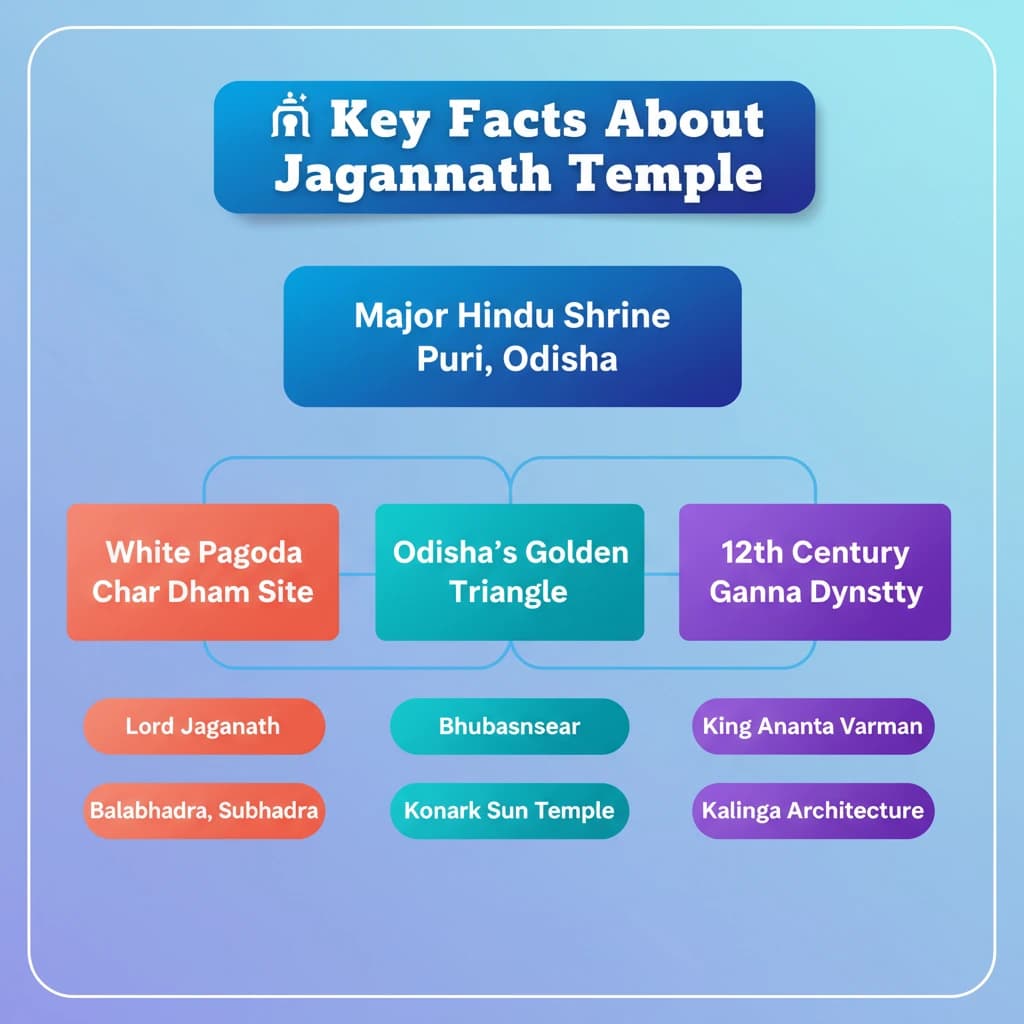
💡 Key Takeaways
- •The Jagannath Temple in Puri, Odisha, is a major Hindu shrine dedicated to Lord Jagannath, Balabhadra, and Subhadra.
- •It is known as the "White Pagoda" and is one of the four sacred Char Dhams pilgrimage sites.
- •The temple is a key part of Odisha's Golden Triangle, connecting it with Bhubaneswar and Konark Sun Temple.
- •It was constructed in the 12th century by King Ananta Varman Chodaganga Deva of the Ganga Dynasty.
- •The temple is a prime example of Kalinga architecture, characterized by curvilinear towers and intricate carvings.
- •It features four gates facing cardinal directions, each named after an animal.
- •The annual Rath Yatra festival is a globally significant event associated with the temple, drawing millions of devotees.
🧠 Memory Techniques
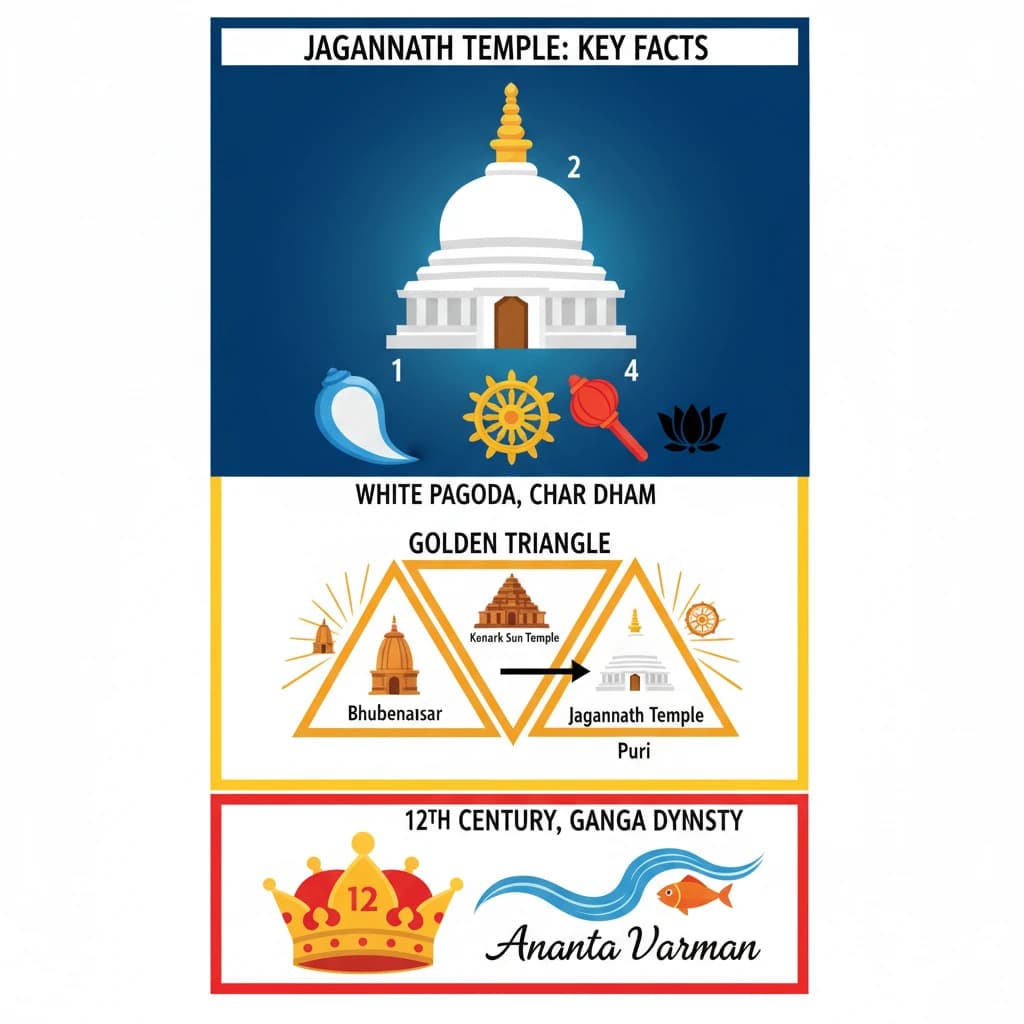
95% Verified Content
📚 Reference Sources
•NCERT Fine Arts textbooks (Class 11)
•Cultural India (online resource for cross-referencing)