Loading page, please wait…
What are the Key Facts About the Madhava Perumal Temple? - UPSC Art And Culture
What is What are the Key Facts About the Madhava Perumal Temple? in UPSC Art And Culture?
What are the Key Facts About the Madhava Perumal Temple? is a key topic under Art And Culture for UPSC Civil Services Examination. Key points include: The Madhava Perumal Temple is dedicated to Vishnu, located in Mylapore, Chennai.. It was constructed in the Dravidian style during the Hoysala rule, inside Dhandayudapani Fort.. The temple is believed to be the birthplace of Peyalvar, one of the first three Alwar saints.. Understanding this topic is essential for both UPSC Prelims and Mains preparation.
Why is What are the Key Facts About the Madhava Perumal Temple? important for UPSC exam?
What are the Key Facts About the Madhava Perumal Temple? is a Medium-level topic in UPSC Art And Culture. It is tested in both Prelims (factual MCQs) and Mains (analytical answer writing). Previous year UPSC questions have frequently covered aspects of What are the Key Facts About the Madhava Perumal Temple?, making it essential for comprehensive IAS preparation.
How to prepare What are the Key Facts About the Madhava Perumal Temple? for UPSC?
To prepare What are the Key Facts About the Madhava Perumal Temple? for UPSC: (1) Study the comprehensive notes covering all key concepts on Vaidra. (2) Practice previous year questions on this topic. (3) Connect it with current affairs using daily updates. (4) Revise using key takeaways and mind maps available for Art And Culture. (5) Write practice answers linking What are the Key Facts About the Madhava Perumal Temple? to related GS Paper topics.
Key takeaways of What are the Key Facts About the Madhava Perumal Temple? for UPSC
- The Madhava Perumal Temple is dedicated to Vishnu, located in Mylapore, Chennai.
- It was constructed in the Dravidian style during the Hoysala rule, inside Dhandayudapani Fort.
- The temple is believed to be the birthplace of Peyalvar, one of the first three Alwar saints.
- It was submerged by the Bhavanisagar dam in Erode district and recently became visible.
- Inscriptions revealed the ancient village of Thuruvalur and historical trade routes.
- The construction of Bhavanisagar dam in 1948 led to relocation of residents and temple idols in 1953.
What are the Key Facts About the Madhava Perumal Temple?
Medium⏱️ 6 min read
art and culture
📖 Introduction
Introduction to Madhava Perumal Temple
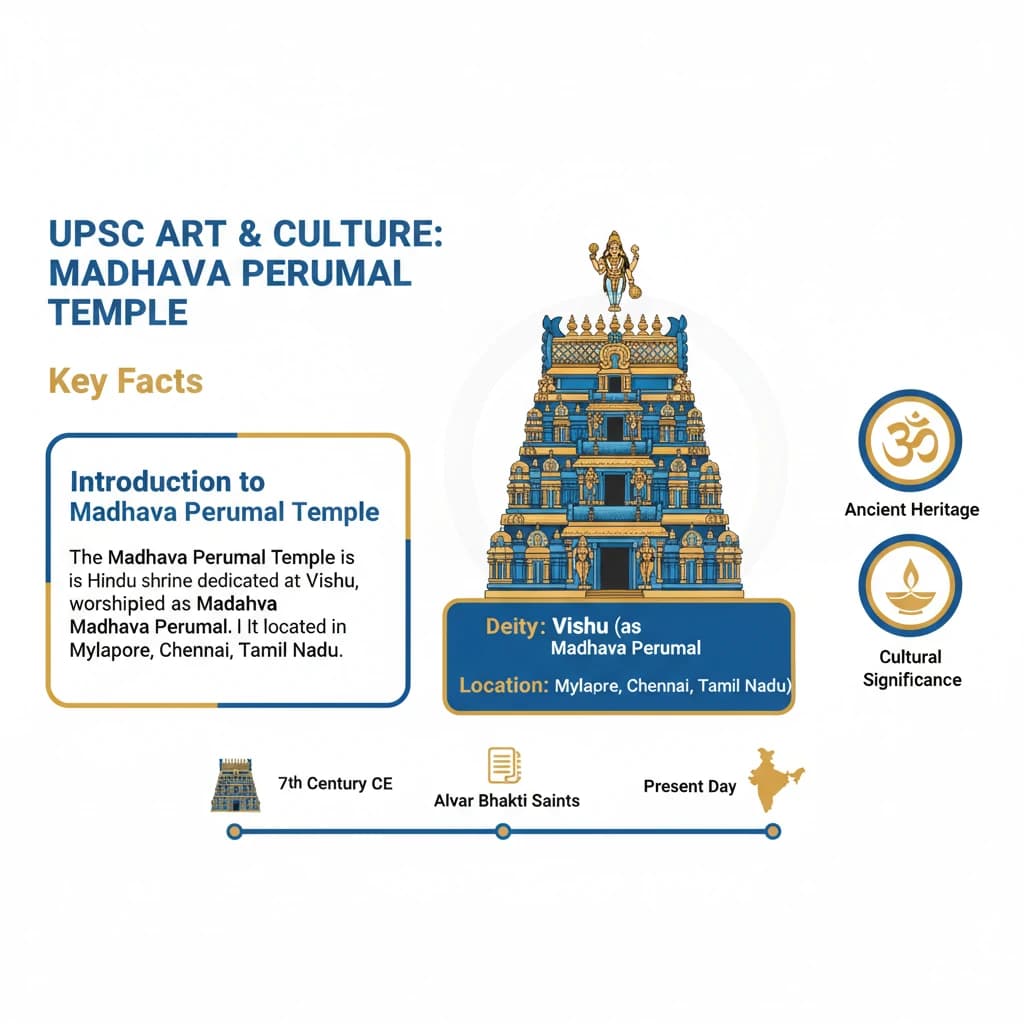
The Madhava Perumal Temple is a significant Hindu shrine dedicated to the deity Vishnu, worshipped in his form as Madhava Perumal. It is prominently located in Mylapore, Chennai, Tamil Nadu, a region steeped in rich cultural and historical heritage.
Deity: Vishnu (as Madhava Perumal)
Location: Mylapore, Chennai, Tamil Nadu
Location: Mylapore, Chennai, Tamil Nadu
Historical Rule and Architectural Style
The Mylapore region, where the temple stands, once came under the dominion of the powerful Hoysala dynasty. Specifically, King Veera Ballala III played a role in the region's history.
Approximately 680 years ago, a general of the Hoysala army undertook the construction of the Dhandayudapani Fort. The Madhava Perumal Temple, characterized by its distinctive Dravidian style of architecture, was subsequently built within the confines of this fort.
The temple exemplifies Dravidian architecture, a hallmark of South Indian temple construction.
Subsequent Rulers and Conflicts
Following the Hoysala period, the area experienced further shifts in power, coming under the rule of the illustrious Vijayanagara Empire. Later, it was controlled by Tipu Sultan, a prominent figure in South Indian history.
The region near the fort was also a site of historical conflict, notably the Battle of Sathamangalam in 1790. This battle was a significant event during the Third Anglo-Mysore War (1790–1792), highlighting the strategic importance of the area.
Spiritual Significance: Birthplace of Peyalvar
The Madhava Perumal Temple holds profound spiritual significance as it is traditionally believed to be the birthplace of Peyalvar. Peyalvar is revered as one of the first three among the twelve Alwar saints.
These Alwar saints were influential Vaishnavite poet-saints who lived between the 8th and 9th century CE, contributing immensely to the Bhakti movement in South India.
Peyalvar, one of the first three Alwars, is believed to have been born here, underscoring the temple's spiritual importance.
Rediscovery and Impact of Bhavanisagar Dam
A unique aspect of the temple's modern history is its recent rediscovery. The temple was largely submerged within the water-spread area of the Bhavanisagar dam, located in Erode district.
It became visible again only when the water level in the dam significantly dipped, revealing its ancient structure to the modern world.
Insights from Temple Inscriptions
The inscriptions found within the temple premises have provided valuable historical and geographical information. They revealed the past existence of a village known as Thuruvalur in the vicinity.
Furthermore, these inscriptions indicate that the area served as a vital trunk road. Traders frequently traversed this route, crossing the River Bhavani and the River Moyar, to reach important trade centers like Wayanad in Kerala and various destinations in Karnataka.
Consequences of Bhavanisagar Dam Construction
The construction of the Bhavanisagar dam in 1948 had a significant impact on the surrounding communities and the temple itself. The project necessitated the relocation of nearby residents.
As a direct consequence of the dam's construction and the subsequent submergence, the idols from the Madhava Perumal Temple were carefully shifted to new locations in 1953 to ensure their preservation.
💡 Key Takeaways
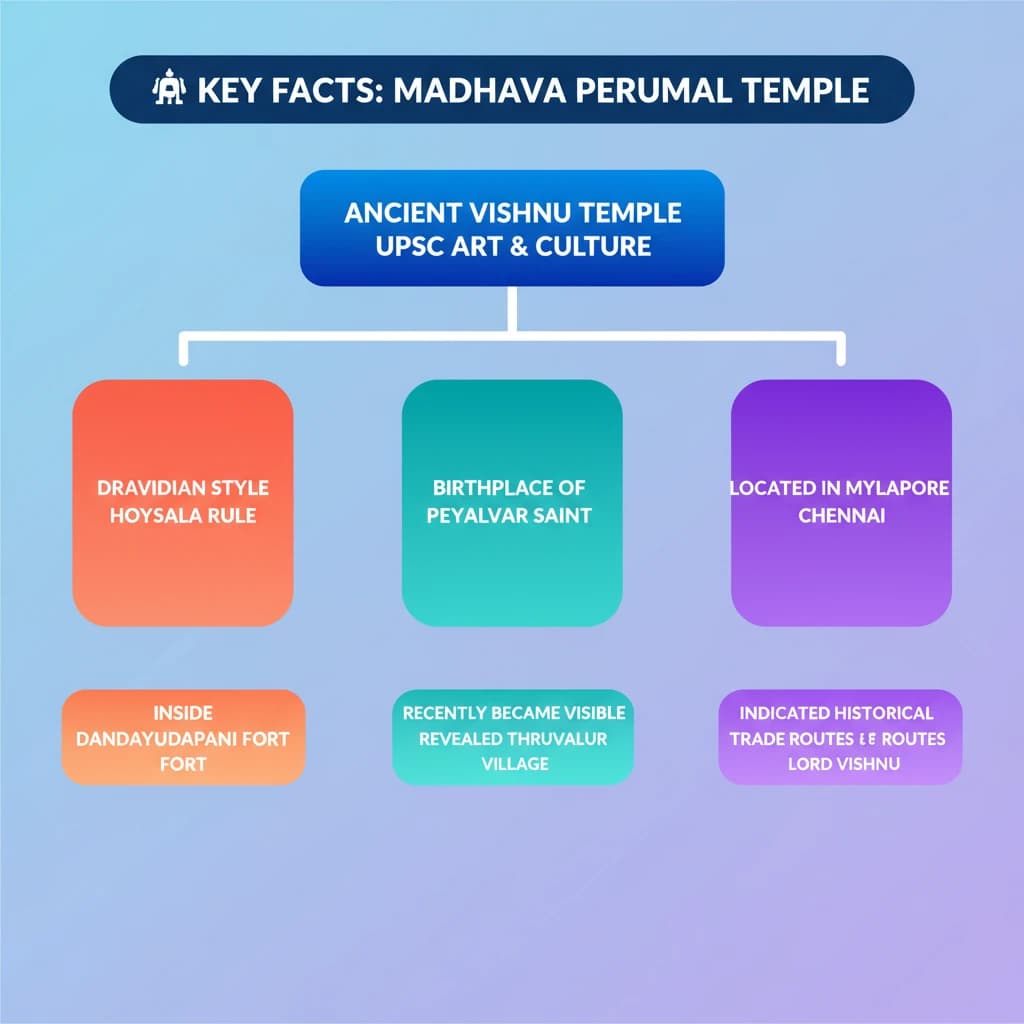
- •The Madhava Perumal Temple is dedicated to Vishnu, located in Mylapore, Chennai.
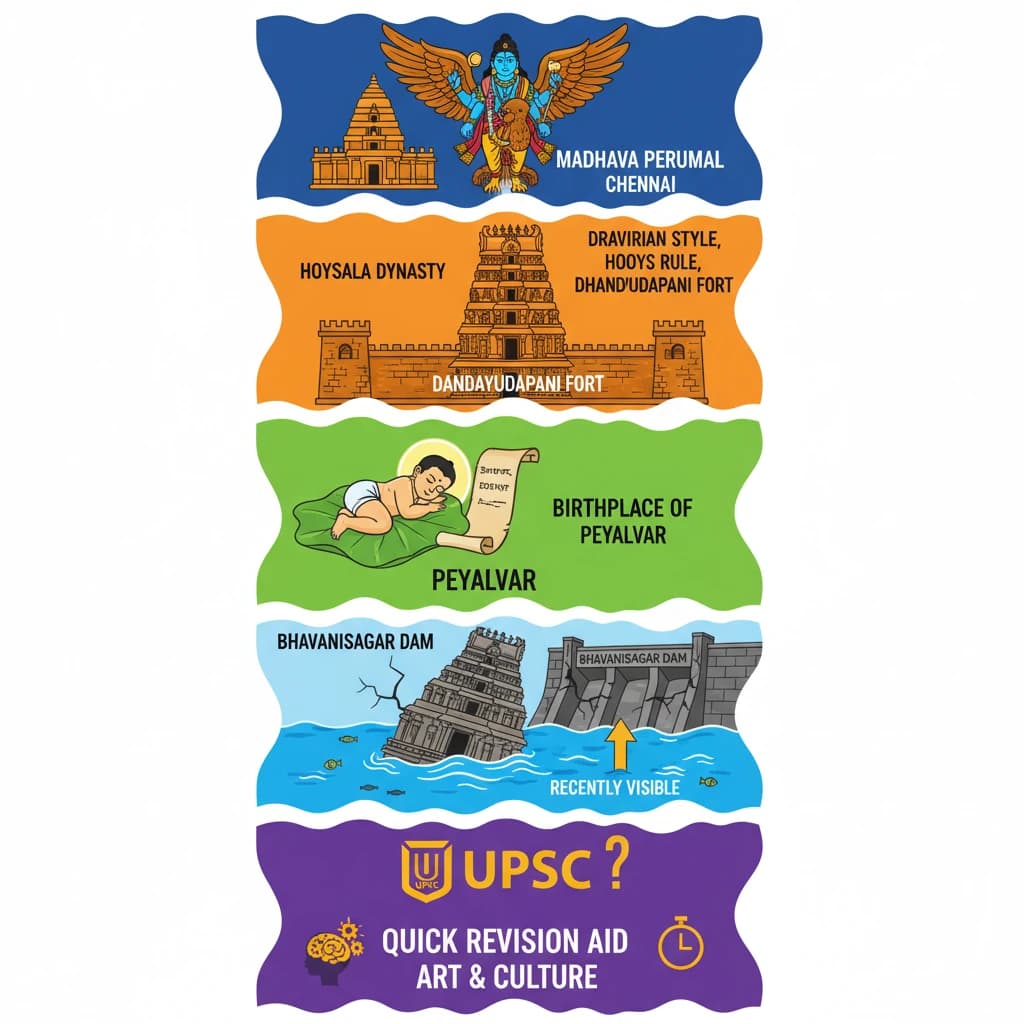
- •It was constructed in the Dravidian style during the Hoysala rule, inside Dhandayudapani Fort.
- •The temple is believed to be the birthplace of Peyalvar, one of the first three Alwar saints.
- •It was submerged by the Bhavanisagar dam in Erode district and recently became visible.
- •Inscriptions revealed the ancient village of Thuruvalur and historical trade routes.
- •The construction of Bhavanisagar dam in 1948 led to relocation of residents and temple idols in 1953.
🧠 Memory Techniques
98% Verified Content
📚 Reference Sources
•General knowledge of South Indian history and architecture (Hoysala, Vijayanagara, Dravidian style)
•Information on Bhavanisagar Dam (publicly available data)