Loading page, please wait…
Vaidra Logo
Vaidra

Top 4 items + smart groups

UPSC GPT
New
Current Affairs
Daily Solutions
Daily Puzzle
Mains Evaluator

Version 2.0.0 • Built with ❤️ for UPSC aspirants

Loading...
Loading...
Loading...
Loading...
Loading...
Loading...
Loading...
Loading...
Loading...
Loading...
Loading...
Loading...
Loading...
Back
All Subjects

Topics

0 topics • 0 completed

Loading topics...
Loading...
Loading...
Loading...
Loading...
Loading...
Overall Progress0%

Initiatives to Tackle Drug Abuse - UPSC Defence And Security

What is Initiatives to Tackle Drug Abuse in UPSC Defence And Security?

Initiatives to Tackle Drug Abuse is a key topic under Defence And Security for UPSC Civil Services Examination. Key points include: Three major UN Conventions (1961, 1971, 1988) form the global legal framework against drug abuse.. India is a signatory to all UN drug conventions and enacted the NDPS Act, 1985, as its primary domestic law.. The UN World Drug Report and Global Drug Policy Index monitor global drug trends and inform policy.. Understanding this topic is essential for both UPSC Prelims and Mains preparation.

Why is Initiatives to Tackle Drug Abuse important for UPSC exam?

Initiatives to Tackle Drug Abuse is a Medium-level topic in UPSC Defence And Security. It is tested in both Prelims (factual MCQs) and Mains (analytical answer writing). Previous year UPSC questions have frequently covered aspects of Initiatives to Tackle Drug Abuse, making it essential for comprehensive IAS preparation.

How to prepare Initiatives to Tackle Drug Abuse for UPSC?

To prepare Initiatives to Tackle Drug Abuse for UPSC: (1) Study the comprehensive notes covering all key concepts on Vaidra. (2) Practice previous year questions on this topic. (3) Connect it with current affairs using daily updates. (4) Revise using key takeaways and mind maps available for Defence And Security. (5) Write practice answers linking Initiatives to Tackle Drug Abuse to related GS Paper topics.

Key takeaways of Initiatives to Tackle Drug Abuse for UPSC

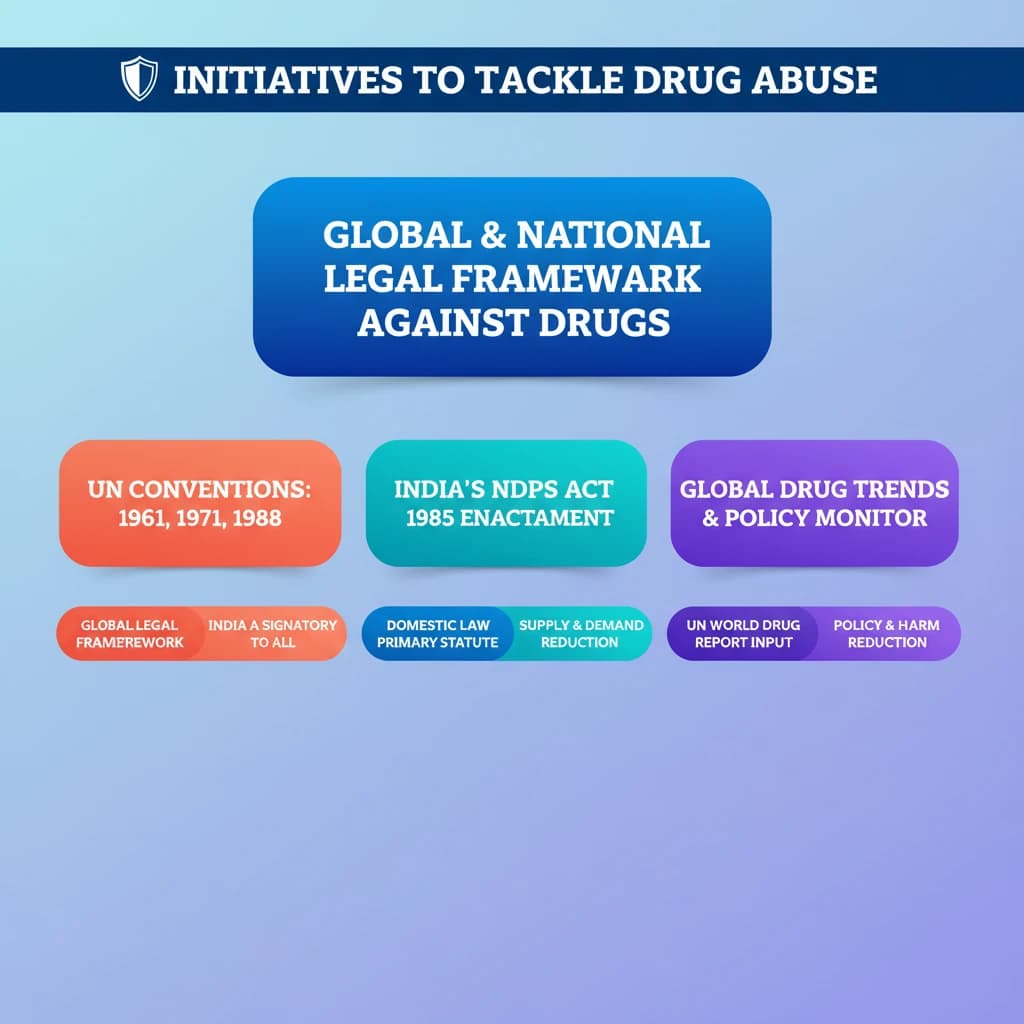
  • Three major UN Conventions (1961, 1971, 1988) form the global legal framework against drug abuse.
  • India is a signatory to all UN drug conventions and enacted the NDPS Act, 1985, as its primary domestic law.
  • The UN World Drug Report and Global Drug Policy Index monitor global drug trends and inform policy.
  • International cooperation and robust national legislation are crucial for tackling the complex issue of drug abuse and trafficking.
  • Drug control initiatives address both supply and demand reduction, alongside harm reduction strategies.
Initiatives to Tackle Drug Abuse

Initiatives to Tackle Drug Abuse

Medium⏱️ 9 min read✓ 100% Verified
defence and security

📖 Introduction

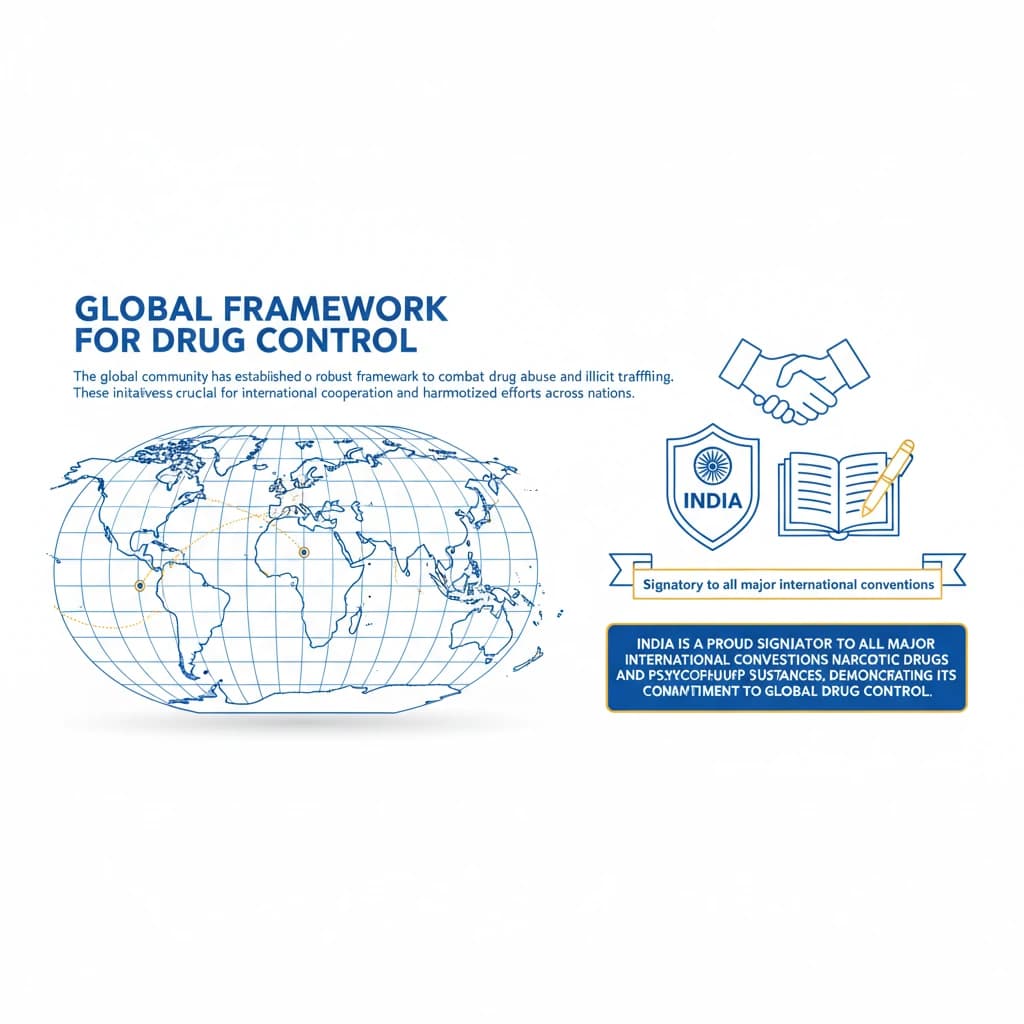
<h4>Global Framework for Drug Control</h4><p>The global community has established a robust framework to combat <strong>drug abuse</strong> and <strong>illicit trafficking</strong>. These initiatives are crucial for international cooperation and harmonized efforts across nations.</p><div class='key-point-box'><p>India is a proud <strong>signatory</strong> to all major international conventions addressing narcotic drugs and psychotropic substances, demonstrating its commitment to global drug control efforts.</p></div><h4>Key International Conventions</h4><p>Three principal <strong>United Nations Conventions</strong> form the bedrock of international drug control law. These treaties guide national legislation and foster multilateral collaboration.</p><ul><li><strong>Single Convention on Narcotic Drugs, 1961</strong>: This convention aims to limit the production and distribution of narcotic drugs exclusively for medical and scientific purposes, while preventing illicit cultivation and trafficking.</li><li><strong>The Convention on Psychotropic Substances, 1971</strong>: This treaty extends control to a wider range of psychoactive substances that are not covered by the 1961 Convention, focusing on substances with abuse potential.</li><li><strong>The UN Convention against Illicit Traffic in Narcotic Drugs and Psychotropic Substances, 1988</strong>: This convention provides comprehensive measures against drug trafficking, including provisions for money laundering, asset forfeiture, and extradition.</li></ul><h4>India's National Legislation</h4><p>In consonance with its international commitments, India enacted the <strong>Narcotic Drugs and Psychotropic Substances (NDPS) Act, 1985</strong>. This Act provides for the penalty, control, and regulation of operations relating to narcotic drugs and psychotropic substances.</p><div class='info-box'><p>The <strong>NDPS Act, 1985</strong> is the primary legislation in India that prohibits the production, possession, sale, purchase, transport, storage, and consumption of any narcotic drug or psychotropic substance, except for medical or scientific purposes.</p></div><h4>Global Monitoring and Reporting</h4><p>To monitor the global drug situation and inform policy, the <strong>United Nations</strong> publishes key reports annually. These documents provide critical data and analysis on drug trends worldwide.</p><div class='info-box'><ul><li><strong>World Drug Report</strong>: Published annually by the <strong>UNODC (United Nations Office on Drugs and Crime)</strong>, this report offers a comprehensive overview of the international drug situation.</li><li><strong>Global Drug Policy Index</strong>: This index assesses and ranks countries' drug policies based on various criteria, promoting evidence-based and human rights-centered approaches.</li></ul></div><div class='exam-tip-box'><p>Understanding these global and national initiatives is vital for questions on <strong>Internal Security (GS Paper III)</strong> and <strong>International Relations (GS Paper II)</strong>, especially concerning global governance and India's role.</p></div>
Concept Diagram

💡 Key Takeaways

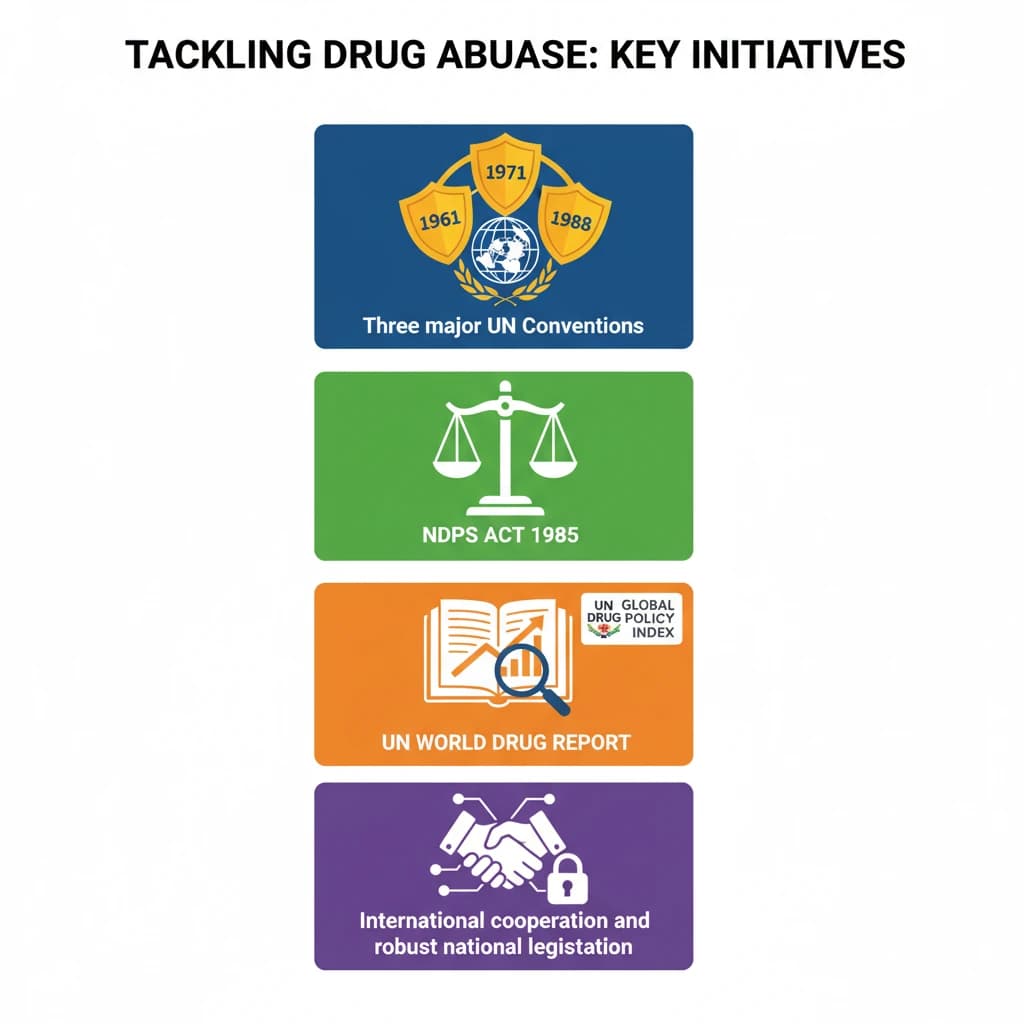
  • •Three major UN Conventions (1961, 1971, 1988) form the global legal framework against drug abuse.
  • •India is a signatory to all UN drug conventions and enacted the NDPS Act, 1985, as its primary domestic law.
  • •The UN World Drug Report and Global Drug Policy Index monitor global drug trends and inform policy.
  • •International cooperation and robust national legislation are crucial for tackling the complex issue of drug abuse and trafficking.
  • •Drug control initiatives address both supply and demand reduction, alongside harm reduction strategies.

🧠 Memory Techniques
Memory Aid
100% Verified Content

📚 Reference Sources

•United Nations Office on Drugs and Crime (UNODC)
•Ministry of Home Affairs, Government of India

Related Topics

Loading related topics...
Explore:Defence And Security Topics·All Subjects·Daily Current Affairs·Editorial Analysis·Previous Year Questions·UPSC GPT
Initiatives to Tackle Drug Abuse - UPSC Defence And Security