Loading page, please wait…
Vaidra Logo
Vaidra

Top 4 items + smart groups

UPSC GPT
New
Current Affairs
Daily Solutions
Daily Puzzle
Mains Evaluator

Version 2.0.0 • Built with ❤️ for UPSC aspirants

Loading...
Loading...
Loading...
Loading...
Loading...
Loading...
Loading...
Loading...
Loading...
Loading...
Loading...
Loading...
Loading...
Back
All Subjects

Topics

0 topics • 0 completed

Loading topics...
Loading...
Loading...
Loading...
Loading...
Loading...
Overall Progress0%

Concerns Regarding Opium Stockpiles in Afghanistan - UPSC Defence And Security

What is Concerns Regarding Opium Stockpiles in Afghanistan in UPSC Defence And Security?

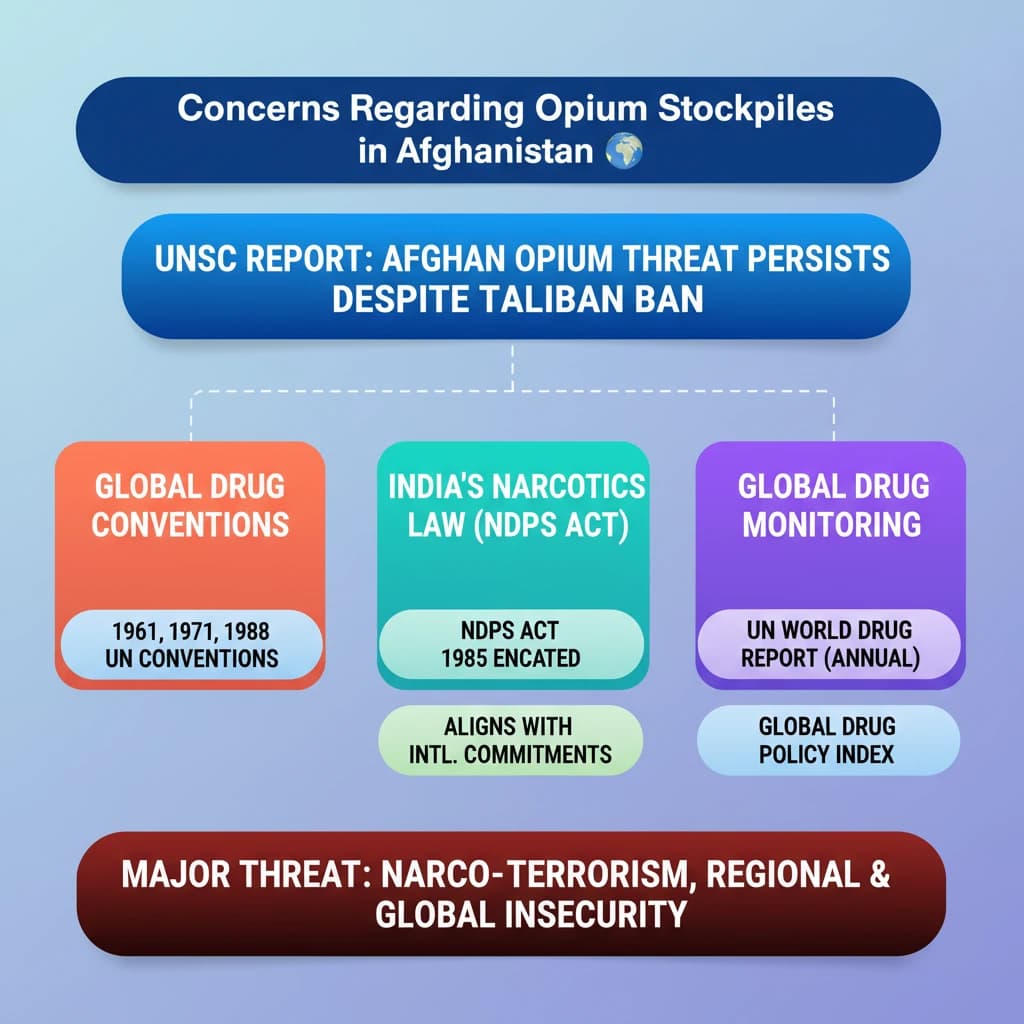
Concerns Regarding Opium Stockpiles in Afghanistan is a key topic under Defence And Security for UPSC Civil Services Examination. Key points include: UNSC report highlights significant concerns over Afghanistan's opium stockpiles despite the Taliban's ban on poppy cultivation.. Global efforts to tackle drug abuse are guided by three key UN conventions (1961, 1971, 1988), to which India is a signatory.. India has enacted the Narcotic Drugs and Psychotropic Substances (NDPS) Act, 1985, to align with international commitments.. Understanding this topic is essential for both UPSC Prelims and Mains preparation.

Why is Concerns Regarding Opium Stockpiles in Afghanistan important for UPSC exam?

Concerns Regarding Opium Stockpiles in Afghanistan is a Medium-level topic in UPSC Defence And Security. It is tested in both Prelims (factual MCQs) and Mains (analytical answer writing). Previous year UPSC questions have frequently covered aspects of Concerns Regarding Opium Stockpiles in Afghanistan, making it essential for comprehensive IAS preparation.

How to prepare Concerns Regarding Opium Stockpiles in Afghanistan for UPSC?

To prepare Concerns Regarding Opium Stockpiles in Afghanistan for UPSC: (1) Study the comprehensive notes covering all key concepts on Vaidra. (2) Practice previous year questions on this topic. (3) Connect it with current affairs using daily updates. (4) Revise using key takeaways and mind maps available for Defence And Security. (5) Write practice answers linking Concerns Regarding Opium Stockpiles in Afghanistan to related GS Paper topics.

Key takeaways of Concerns Regarding Opium Stockpiles in Afghanistan for UPSC

  • UNSC report highlights significant concerns over Afghanistan's opium stockpiles despite the Taliban's ban on poppy cultivation.
  • Global efforts to tackle drug abuse are guided by three key UN conventions (1961, 1971, 1988), to which India is a signatory.
  • India has enacted the Narcotic Drugs and Psychotropic Substances (NDPS) Act, 1985, to align with international commitments.
  • The UN annually publishes the World Drug Report and Global Drug Policy Index to monitor global drug trends.
  • Afghan opium stockpiles pose a significant threat, fueling narco-terrorism and impacting regional and international security.
Concerns Regarding Opium Stockpiles in Afghanistan

Concerns Regarding Opium Stockpiles in Afghanistan

Medium⏱️ 7 min read✓ 95% Verified
defence and security

📖 Introduction

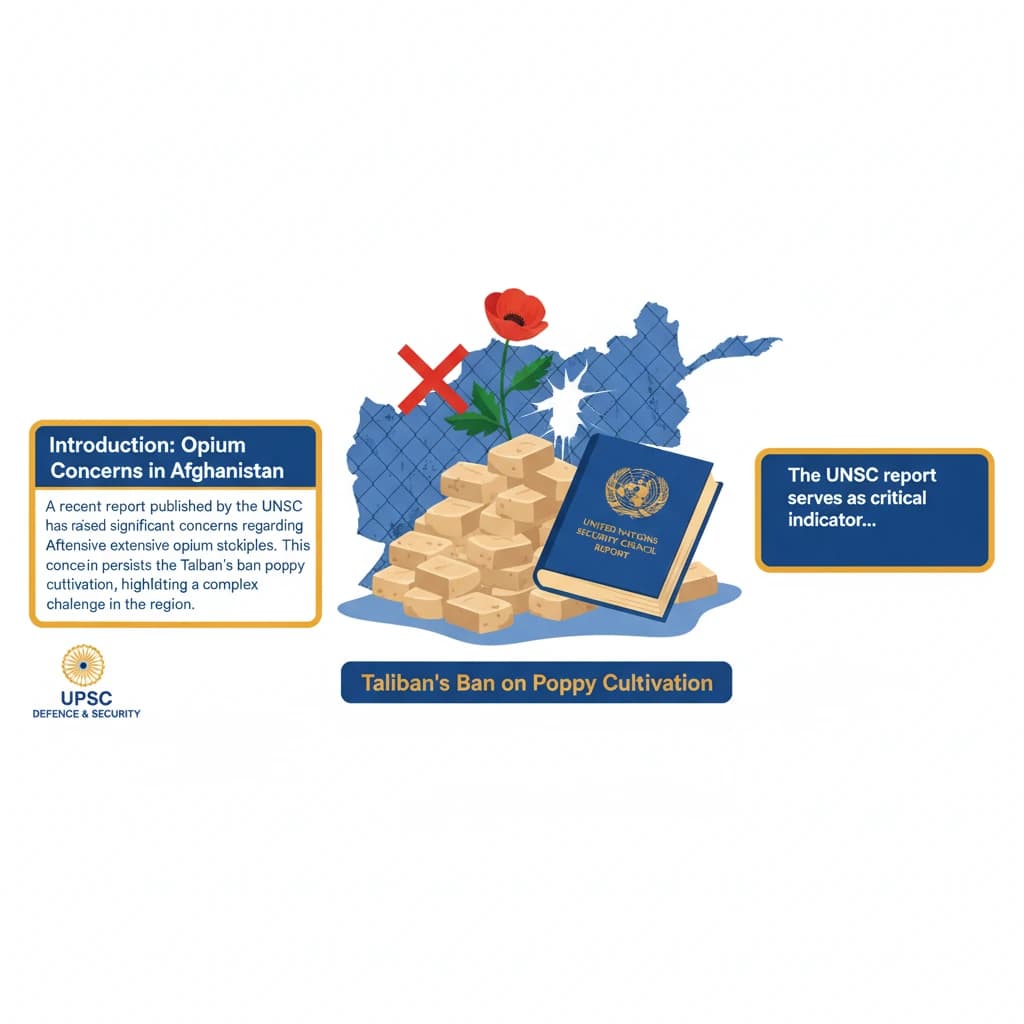
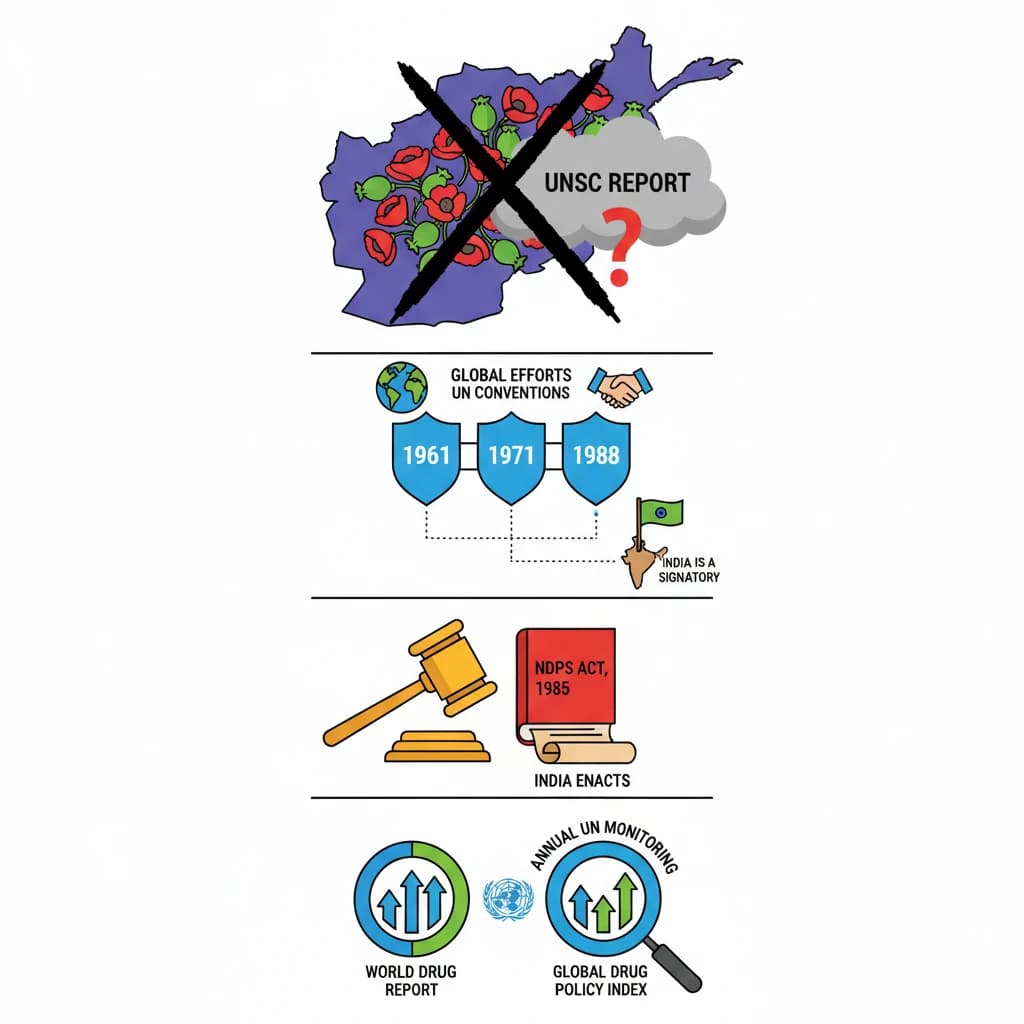
<h4>Introduction: Opium Concerns in Afghanistan</h4><p>A recent report published by the <strong>United Nations Security Council (UNSC)</strong> has raised significant concerns regarding Afghanistan’s extensive <strong>opium stockpiles</strong>.</p><p>This concern persists despite the <strong>Taliban's ban</strong> on <strong>poppy cultivation</strong>, highlighting a complex challenge in the region.</p><div class='info-box'><p>The <strong>UNSC report</strong> serves as a critical indicator of the ongoing illicit drug trade and its potential implications for regional and global security.</p></div><h4>Global Frameworks Against Drug Abuse</h4><p>The international community has established several key conventions to combat drug abuse and illicit trafficking. These frameworks provide a legal and operational basis for global cooperation.</p><ul><li><strong>Single Convention on Narcotic Drugs, 1961</strong>: Focuses on controlling narcotic drugs.</li><li><strong>The Convention on Psychotropic Substances, 1971</strong>: Aims to control psychotropic substances.</li><li><strong>The UN Convention against Illicit Traffic in Narcotic Drugs and Psychotropic Substances, 1988</strong>: Targets illicit trafficking, money laundering, and precursor chemicals.</li></ul><div class='key-point-box'><p>These three conventions form the bedrock of the <strong>international drug control system</strong>, promoting coordinated efforts among member states.</p></div><h4>India's Commitment to Drug Control</h4><p><strong>India</strong> is a committed signatory to all three major <strong>UN conventions</strong> on drug control. This commitment underscores its dedication to combating drug abuse and trafficking both domestically and internationally.</p><p>To implement these international obligations and address internal drug challenges, India enacted the <strong>Narcotic Drugs and Psychotropic Substances (NDPS) Act, 1985</strong>.</p><div class='exam-tip-box'><p><strong>UPSC Insight (GS-2, GS-3)</strong>: India's role as a signatory and its domestic legislation like the <strong>NDPS Act</strong> are crucial points for demonstrating its commitment to international law and internal security challenges.</p></div><h4>International Reporting on Drug Policy</h4><p>The <strong>United Nations</strong> regularly monitors and reports on global drug trends and policies to inform international efforts and policy-making.</p><div class='info-box'><ul><li>Every year, the <strong>UN</strong> publishes the <strong>World Drug Report</strong>, which provides comprehensive statistics and analysis on global drug markets.</li><li>The <strong>Global Drug Policy Index</strong> is another key publication, assessing national drug policies against international standards.</li></ul></div>
Concept Diagram

💡 Key Takeaways

  • •UNSC report highlights significant concerns over Afghanistan's opium stockpiles despite the Taliban's ban on poppy cultivation.
  • •Global efforts to tackle drug abuse are guided by three key UN conventions (1961, 1971, 1988), to which India is a signatory.
  • •India has enacted the Narcotic Drugs and Psychotropic Substances (NDPS) Act, 1985, to align with international commitments.
  • •The UN annually publishes the World Drug Report and Global Drug Policy Index to monitor global drug trends.
  • •Afghan opium stockpiles pose a significant threat, fueling narco-terrorism and impacting regional and international security.

🧠 Memory Techniques
Memory Aid
95% Verified Content

📚 Reference Sources

•United Nations Security Council (UNSC) Reports on Afghanistan
•United Nations Office on Drugs and Crime (UNODC) World Drug Reports
•The Narcotic Drugs and Psychotropic Substances (NDPS) Act, 1985

Related Topics

Loading related topics...
Explore:Defence And Security Topics·All Subjects·Daily Current Affairs·Editorial Analysis·Previous Year Questions·UPSC GPT
Concerns Regarding Opium Stockpiles in Afghanistan - UPSC Defence And Security