Loading page, please wait…
Vaidra Logo
Vaidra

Top 4 items + smart groups

UPSC GPT
New
Current Affairs
Daily Solutions
Daily Puzzle
Mains Evaluator

Version 2.0.0 • Built with ❤️ for UPSC aspirants

Loading...
Loading...
Loading...
Loading...
Loading...
Loading...
Loading...
Loading...
Loading...
Loading...
Loading...
Loading...
Loading...
Back
All Subjects

Topics

0 topics • 0 completed

Loading topics...
Loading...
Loading...
Loading...
Loading...
Loading...
Overall Progress0%
What are the Key Facts of the Case and the Supreme Court’s Ruling? - UPSC Defence And Security

What are the Key Facts of the Case and the Supreme Court’s Ruling? - UPSC Defence And Security

What is What are the Key Facts of the Case and the Supreme Court’s Ruling? in UPSC Defence And Security?

What are the Key Facts of the Case and the Supreme Court’s Ruling? is a key topic under Defence And Security for UPSC Civil Services Examination. Key points include: Supreme Court halted proceedings in 2021 Nagaland civilian deaths case.. Ruling based on lack of Central Government (MHA) sanction for prosecution.. Sanction is mandated by Section 6 of the Armed Forces Special Powers Act (AFSPA), 1958.. Understanding this topic is essential for both UPSC Prelims and Mains preparation.

Why is What are the Key Facts of the Case and the Supreme Court’s Ruling? important for UPSC exam?

What are the Key Facts of the Case and the Supreme Court’s Ruling? is a Medium-level topic in UPSC Defence And Security. It is tested in both Prelims (factual MCQs) and Mains (analytical answer writing). Previous year UPSC questions have frequently covered aspects of What are the Key Facts of the Case and the Supreme Court’s Ruling?, making it essential for comprehensive IAS preparation.

How to prepare What are the Key Facts of the Case and the Supreme Court’s Ruling? for UPSC?

To prepare What are the Key Facts of the Case and the Supreme Court’s Ruling? for UPSC: (1) Study the comprehensive notes covering all key concepts on Vaidra. (2) Practice previous year questions on this topic. (3) Connect it with current affairs using daily updates. (4) Revise using key takeaways and mind maps available for Defence And Security. (5) Write practice answers linking What are the Key Facts of the Case and the Supreme Court’s Ruling? to related GS Paper topics.

Key takeaways of What are the Key Facts of the Case and the Supreme Court’s Ruling? for UPSC

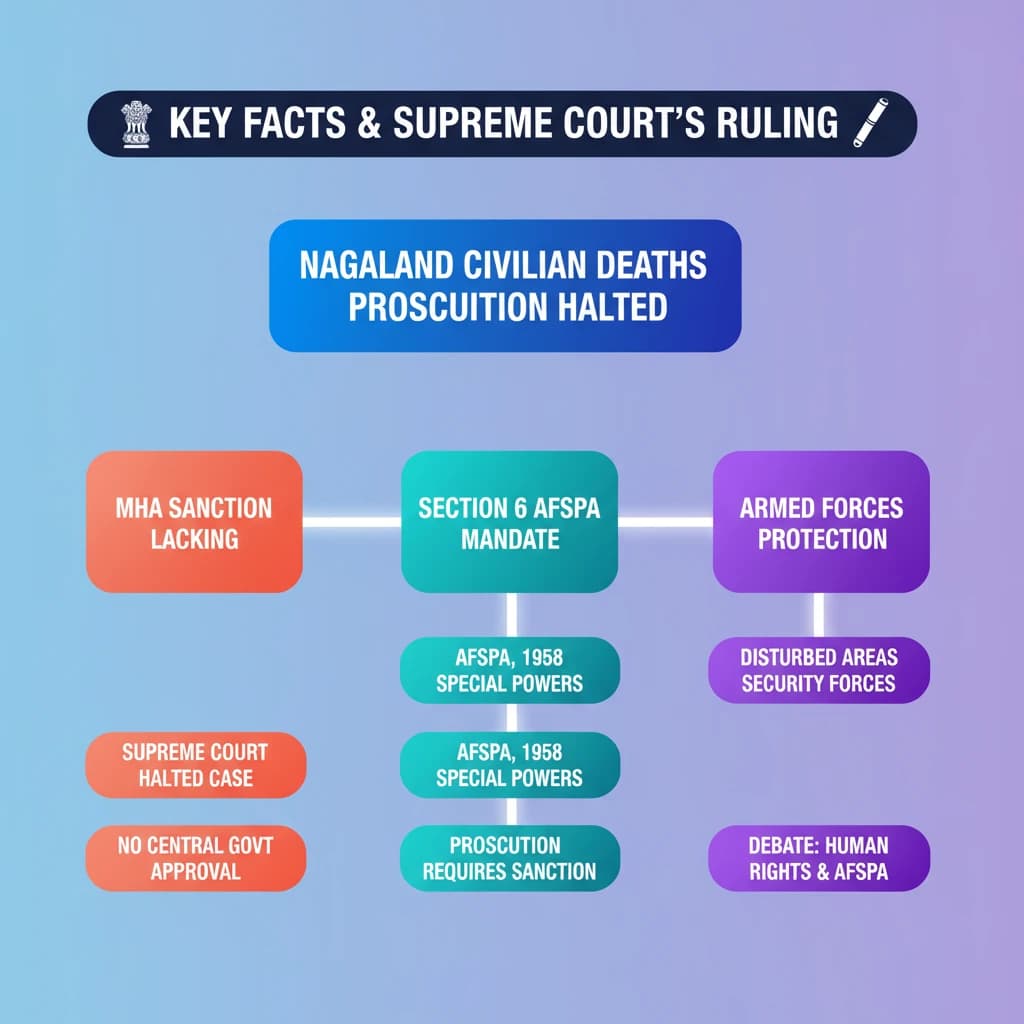
  • Supreme Court halted proceedings in 2021 Nagaland civilian deaths case.
  • Ruling based on lack of Central Government (MHA) sanction for prosecution.
  • Sanction is mandated by Section 6 of the Armed Forces Special Powers Act (AFSPA), 1958.
  • AFSPA grants special powers to armed forces in 'disturbed areas' but requires sanction for legal action against personnel.
  • The case highlights the ongoing debate on AFSPA, human rights, and accountability of security forces.
What are the Key Facts of the Case and the Supreme Court’s Ruling?

What are the Key Facts of the Case and the Supreme Court’s Ruling?

Medium⏱️ 8 min read✓ 95% Verified
defence and security

📖 Introduction

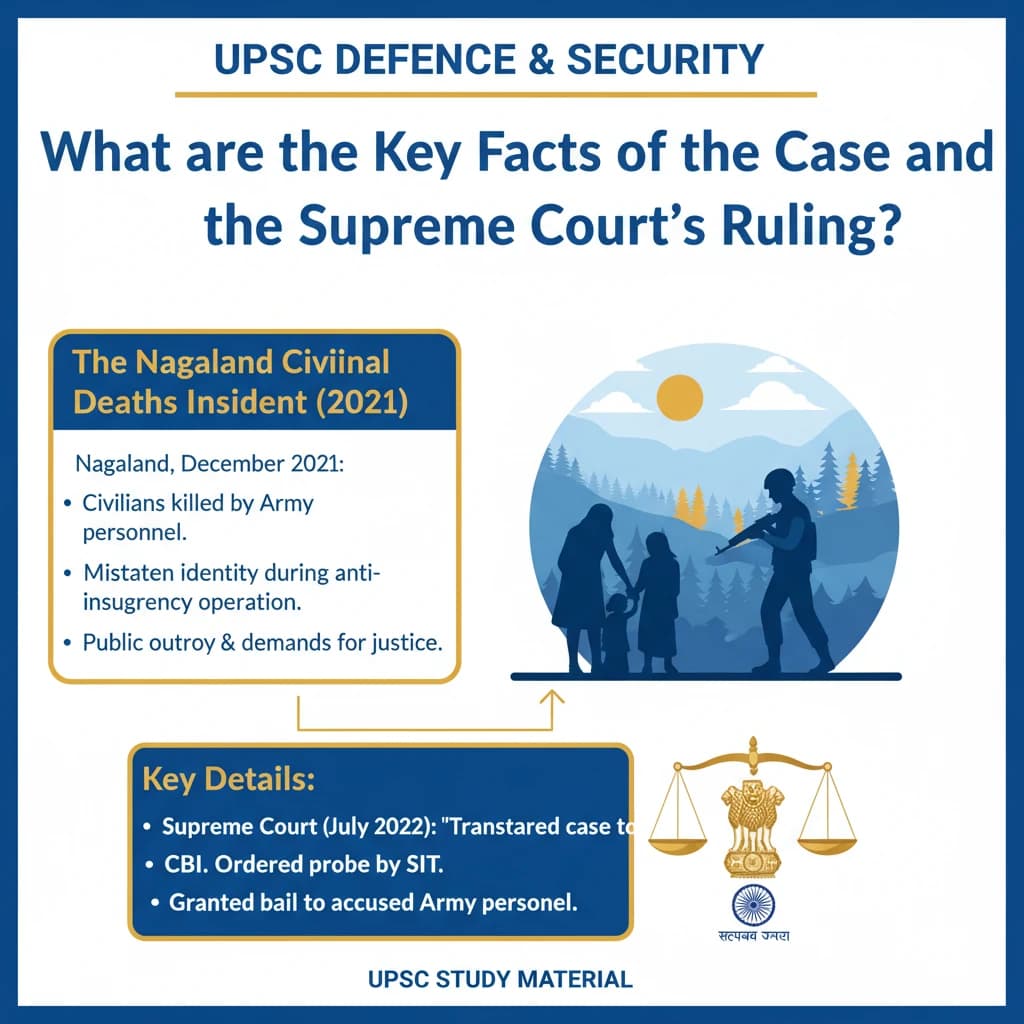
<h4>The Nagaland Civilian Deaths Incident (2021)</h4><p>The case revolves around a tragic incident in <strong>Nagaland</strong> in <strong>December 2021</strong>, where <strong>civilians were killed</strong> by <strong>Army personnel</strong>.</p><p>This unfortunate event occurred due to a grave instance of <strong>mistaken identity</strong> during an anti-insurgency operation, leading to significant public outcry and demands for justice.</p><div class="info-box"><p><strong>Key Details:</strong></p><ul><li><strong>Location:</strong> Oting, Mon district, Nagaland.</li><li><strong>Date:</strong> December 4-5, 2021.</li><li><strong>Cause:</strong> Ambush by security forces mistaking coal miners for insurgents.</li><li><strong>Outcome:</strong> 14 civilians and 1 soldier killed.</li></ul></div><h4>Supreme Court's Intervention and Ruling</h4><p>Following the incident, legal proceedings were initiated against the Army personnel involved. However, these proceedings faced a crucial legal hurdle.</p><p>The <strong>Supreme Court of India</strong> subsequently intervened and <strong>halted the legal proceedings</strong> against the accused Army personnel.</p><div class="key-point-box"><p>The primary reason for the Supreme Court's decision was the <strong>absence of the mandatory sanction</strong> from the <strong>Central Government</strong> (specifically the <strong>Ministry of Home Affairs - MHA</strong>).</p></div><h4>Understanding Section 6 of AFSPA, 1958</h4><p>The requirement for prior sanction stems from <strong>Section 6</strong> of the <strong>Armed Forces Special Powers Act (AFSPA), 1958</strong>.</p><p>This section provides a degree of immunity to armed forces personnel operating in <strong>"disturbed areas"</strong>, protecting them from prosecution without prior government approval.</p><div class="info-box"><p><strong>Section 6 of AFSPA states:</strong> "No prosecution, suit or other legal proceeding shall be instituted, except with the previous sanction of the Central Government, against any person in respect of anything done or purported to be done in exercise of the powers conferred by this Act."</p></div><div class="exam-tip-box"><p><strong>UPSC Insight:</strong> Understanding <strong>AFSPA's provisions</strong>, especially <strong>Section 6</strong>, is crucial for topics related to <strong>internal security</strong>, <strong>human rights</strong>, and the <strong>role of the judiciary</strong> in sensitive matters. Questions often revolve around its necessity, controversies, and proposed reforms.</p></div>
Concept Diagram

💡 Key Takeaways

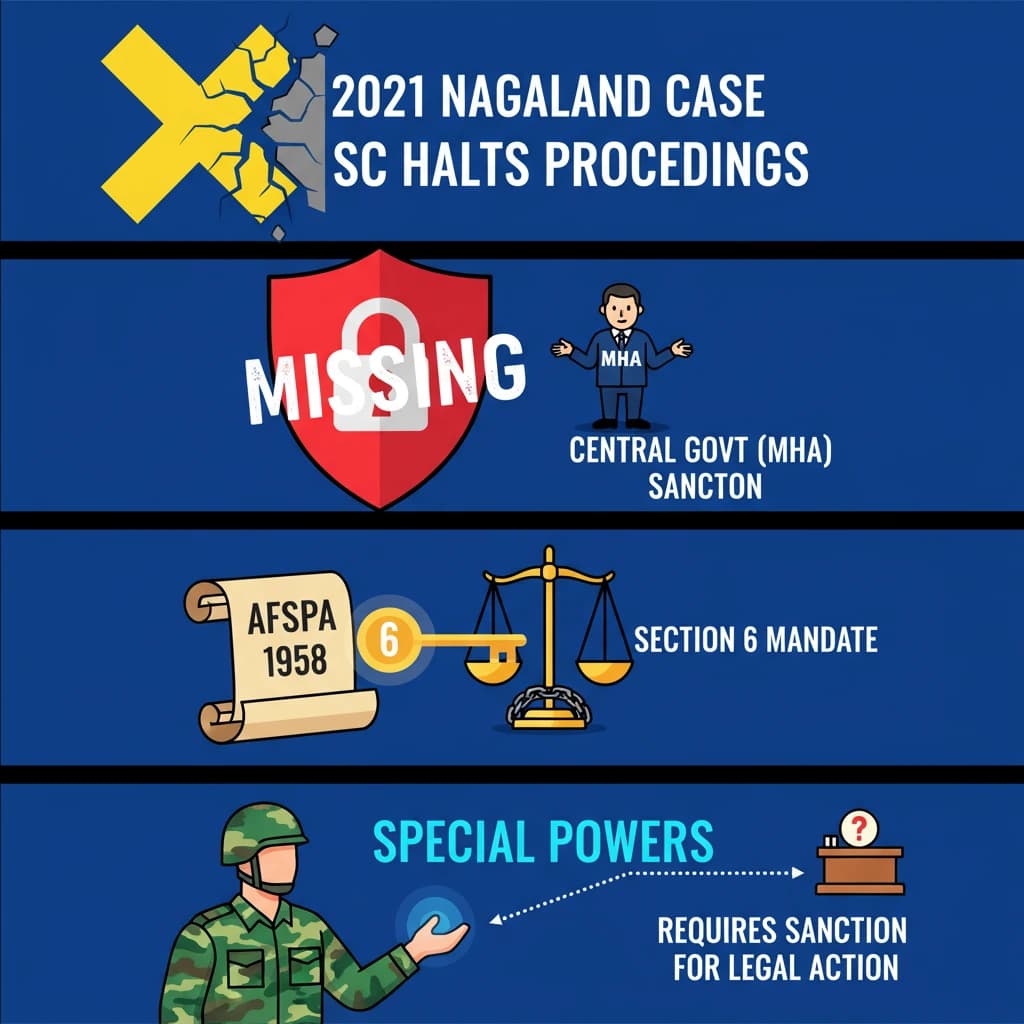
  • •Supreme Court halted proceedings in 2021 Nagaland civilian deaths case.
  • •Ruling based on lack of Central Government (MHA) sanction for prosecution.
  • •Sanction is mandated by Section 6 of the Armed Forces Special Powers Act (AFSPA), 1958.
  • •AFSPA grants special powers to armed forces in 'disturbed areas' but requires sanction for legal action against personnel.
  • •The case highlights the ongoing debate on AFSPA, human rights, and accountability of security forces.

🧠 Memory Techniques
Memory Aid
95% Verified Content

📚 Reference Sources

•Armed Forces (Special Powers) Act, 1958
•Supreme Court of India judgments (general understanding of sanction provisions)
•Ministry of Home Affairs reports (general knowledge of AFSPA application)

Related Topics

Loading related topics...
Explore:Defence And Security Topics·All Subjects·Daily Current Affairs·Editorial Analysis·Previous Year Questions·UPSC GPT