Loading page, please wait…
Vaidra Logo
Vaidra

Top 4 items + smart groups

UPSC GPT
New
Current Affairs
Daily Solutions
Daily Puzzle
Mains Evaluator

Version 2.0.0 • Built with ❤️ for UPSC aspirants

Loading...
Loading...
Loading...
Loading...
Loading...
Loading...
Loading...
Loading...
Loading...
Loading...
Loading...
Loading...
Loading...
Rise of Minilateralism - UPSC Defence And Security

Rise of Minilateralism - UPSC Defence And Security

What is Rise of Minilateralism in UPSC Defence And Security?

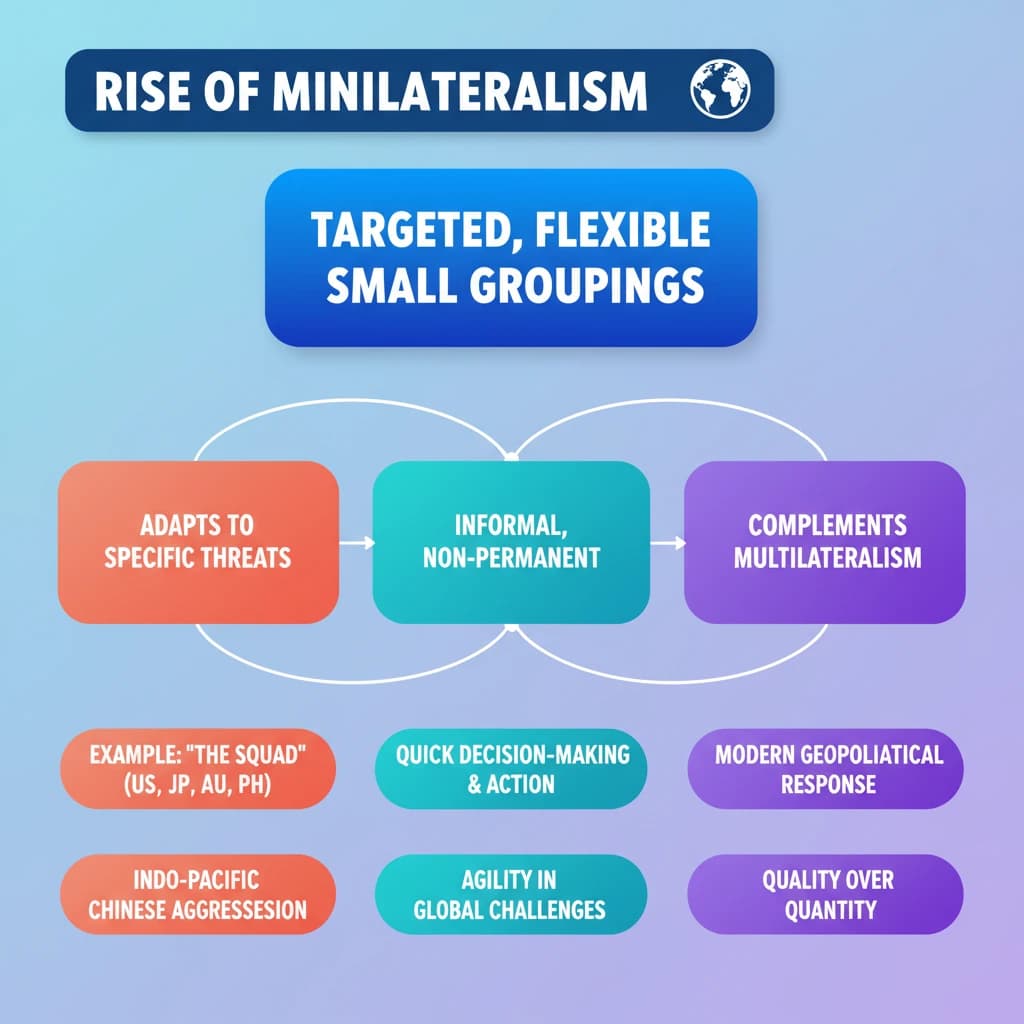
Rise of Minilateralism is a key topic under Defence And Security for UPSC Civil Services Examination. Key points include: Minilateralism involves small, informal groups addressing specific threats or issues.. It is a targeted, flexible approach, often without permanent institutional structures.. The "Squad" (US, Japan, Australia, Philippines) is a key example, formed due to Chinese aggression in the Indo-Pacific.. Understanding this topic is essential for both UPSC Prelims and Mains preparation.

Why is Rise of Minilateralism important for UPSC exam?

Rise of Minilateralism is a Medium-level topic in UPSC Defence And Security. It is tested in both Prelims (factual MCQs) and Mains (analytical answer writing). Previous year UPSC questions have frequently covered aspects of Rise of Minilateralism, making it essential for comprehensive IAS preparation.

How to prepare Rise of Minilateralism for UPSC?

To prepare Rise of Minilateralism for UPSC: (1) Study the comprehensive notes covering all key concepts on Vaidra. (2) Practice previous year questions on this topic. (3) Connect it with current affairs using daily updates. (4) Revise using key takeaways and mind maps available for Defence And Security. (5) Write practice answers linking Rise of Minilateralism to related GS Paper topics.

Key takeaways of Rise of Minilateralism for UPSC

  • Minilateralism involves small, informal groups addressing specific threats or issues.
  • It is a targeted, flexible approach, often without permanent institutional structures.
  • The "Squad" (US, Japan, Australia, Philippines) is a key example, formed due to Chinese aggression in the Indo-Pacific.
  • It complements, rather than replaces, traditional multilateralism by offering agility.
  • It is a contemporary response to complex global challenges and geopolitical shifts.
Rise of Minilateralism

Rise of Minilateralism

Medium⏱️ 7 min read✓ 95% Verified
defence and security

📖 Introduction

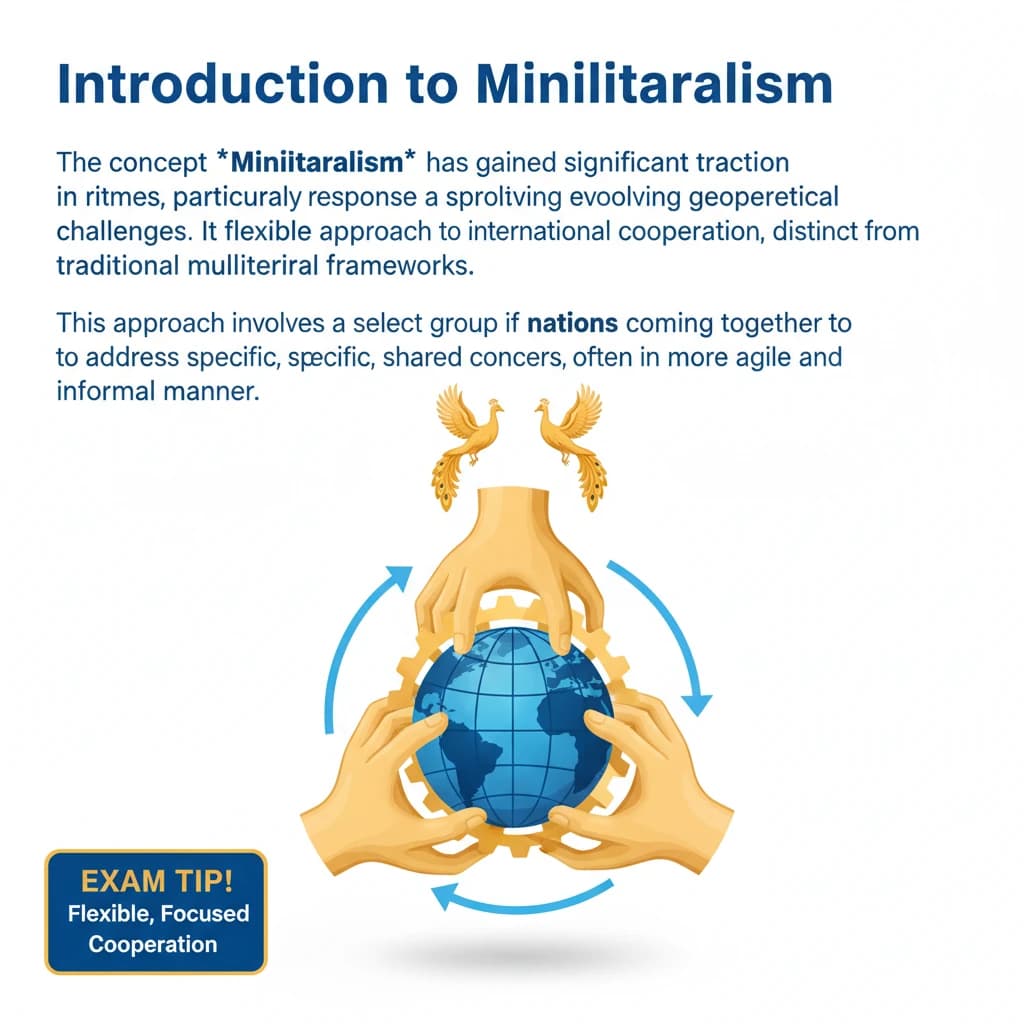
<h4>Introduction to Minilateralism</h4><p>The concept of <strong>Minilateralism</strong> has gained significant traction in recent times, particularly in response to evolving geopolitical challenges. It represents a flexible approach to international cooperation, distinct from traditional multilateral frameworks.</p><p>This approach involves a select group of nations coming together to address specific, shared concerns, often in a more agile and informal manner.</p><div class='exam-tip-box'><p>For <strong>UPSC Mains GS Paper 2</strong> (International Relations), understanding <strong>Minilateralism</strong> is crucial for analyzing contemporary global governance and security architectures. It's often contrasted with <strong>Multilateralism</strong> and <strong>Bilateralism</strong>.</p></div><h4>Why Minilateralism is in the News</h4><p>Recently, the increasing <strong>Chinese aggression</strong> in the <strong>Indo-Pacific region</strong> has been a primary driver for the emergence and emphasis on minilateral groupings. This assertive posture by China has necessitated new forms of cooperation among concerned nations.</p><p>A notable example highlighting this trend is the formation of "the <strong>Squad</strong>". This grouping underscores the growing importance of <strong>minilateralism</strong> as a strategic response to regional security dynamics.</p><div class='info-box'><p>The <strong>Squad</strong> is an informal multilateral group comprising the <strong>United States</strong>, <strong>Japan</strong>, <strong>Australia</strong>, and the <strong>Philippines</strong>. Its formation directly reflects the need for focused cooperation in the Indo-Pacific.</p></div><h4>Defining Minilateralism</h4><p><strong>Minilateralism</strong> refers to international cooperation initiatives that are both <strong>informal</strong> and highly <strong>targeted</strong>. These arrangements are designed to address particular challenges or security issues effectively.</p><div class='key-point-box'><p>Key characteristics include a <strong>small number of states</strong> (typically three or four) involved, all sharing a common interest in resolving a specific issue within a <strong>finite period</strong>.</p></div><p>Unlike broader multilateral organizations, minilateral arrangements prioritize a <strong>specific purpose</strong> over extensive inclusivity. They are characterized by their lack of a <strong>permanent</strong> or <strong>formal institutional structure</strong>.</p>
Concept Diagram

💡 Key Takeaways

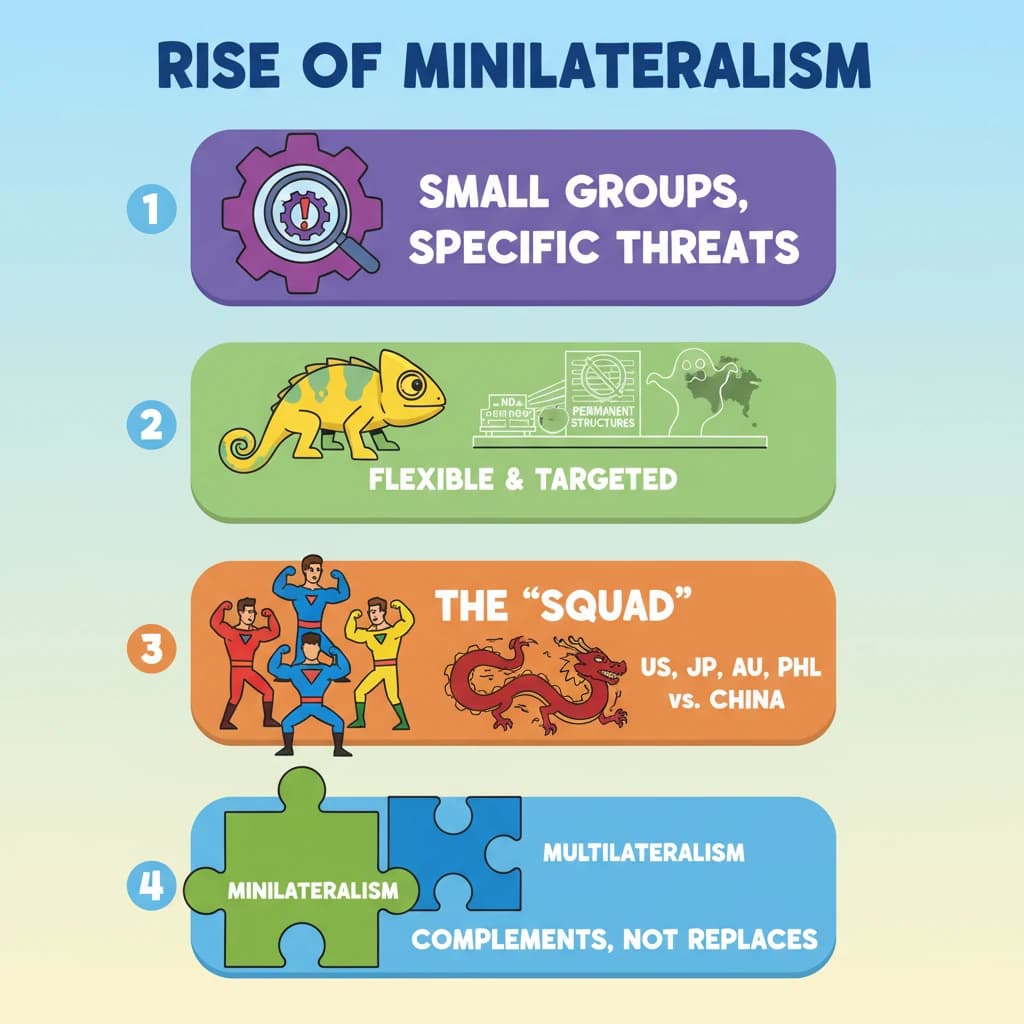
  • •Minilateralism involves small, informal groups addressing specific threats or issues.
  • •It is a targeted, flexible approach, often without permanent institutional structures.
  • •The "Squad" (US, Japan, Australia, Philippines) is a key example, formed due to Chinese aggression in the Indo-Pacific.
  • •It complements, rather than replaces, traditional multilateralism by offering agility.
  • •It is a contemporary response to complex global challenges and geopolitical shifts.

🧠 Memory Techniques
Memory Aid
95% Verified Content

Related Topics

Loading related topics...
Explore:Defence And Security Topics·All Subjects·Daily Current Affairs·Editorial Analysis·Previous Year Questions·UPSC GPT
Back
All Subjects

Topics

0 topics • 0 completed

Loading topics...
Loading...
Loading...
Loading...
Loading...
Loading...
Overall Progress0%