Loading page, please wait…
Vaidra Logo
Vaidra

Top 4 items + smart groups

UPSC GPT
New
Current Affairs
Daily Solutions
Daily Puzzle
Mains Evaluator

Version 2.0.0 • Built with ❤️ for UPSC aspirants

Loading...
Loading...
Loading...
Loading...
Loading...
Loading...
Loading...
Loading...
Loading...
Loading...
Loading...
Loading...
Loading...
Back
All Subjects

Topics

0 topics • 0 completed

Loading topics...
Loading...
Loading...
Loading...
Loading...
Loading...
Overall Progress0%

What is Armed Forces Special Powers Act (AFSPA), 1958? - UPSC Defence And Security

What is What is Armed Forces Special Powers Act (AFSPA), 1958? in UPSC Defence And Security?

What is Armed Forces Special Powers Act (AFSPA), 1958? is a key topic under Defence And Security for UPSC Civil Services Examination. Key points include: AFSPA, 1958, grants special powers to armed forces in 'disturbed areas' to maintain public order.. Its origins trace back to the British colonial era (1942 Ordinance) and post-independence challenges in the Northeast.. Key powers include firing on law violators, warrant-less arrests/searches, and protection from prosecution.. Understanding this topic is essential for both UPSC Prelims and Mains preparation.

Why is What is Armed Forces Special Powers Act (AFSPA), 1958? important for UPSC exam?

What is Armed Forces Special Powers Act (AFSPA), 1958? is a Medium-level topic in UPSC Defence And Security. It is tested in both Prelims (factual MCQs) and Mains (analytical answer writing). Previous year UPSC questions have frequently covered aspects of What is Armed Forces Special Powers Act (AFSPA), 1958?, making it essential for comprehensive IAS preparation.

How to prepare What is Armed Forces Special Powers Act (AFSPA), 1958? for UPSC?

To prepare What is Armed Forces Special Powers Act (AFSPA), 1958? for UPSC: (1) Study the comprehensive notes covering all key concepts on Vaidra. (2) Practice previous year questions on this topic. (3) Connect it with current affairs using daily updates. (4) Revise using key takeaways and mind maps available for Defence And Security. (5) Write practice answers linking What is Armed Forces Special Powers Act (AFSPA), 1958? to related GS Paper topics.

Key takeaways of What is Armed Forces Special Powers Act (AFSPA), 1958? for UPSC

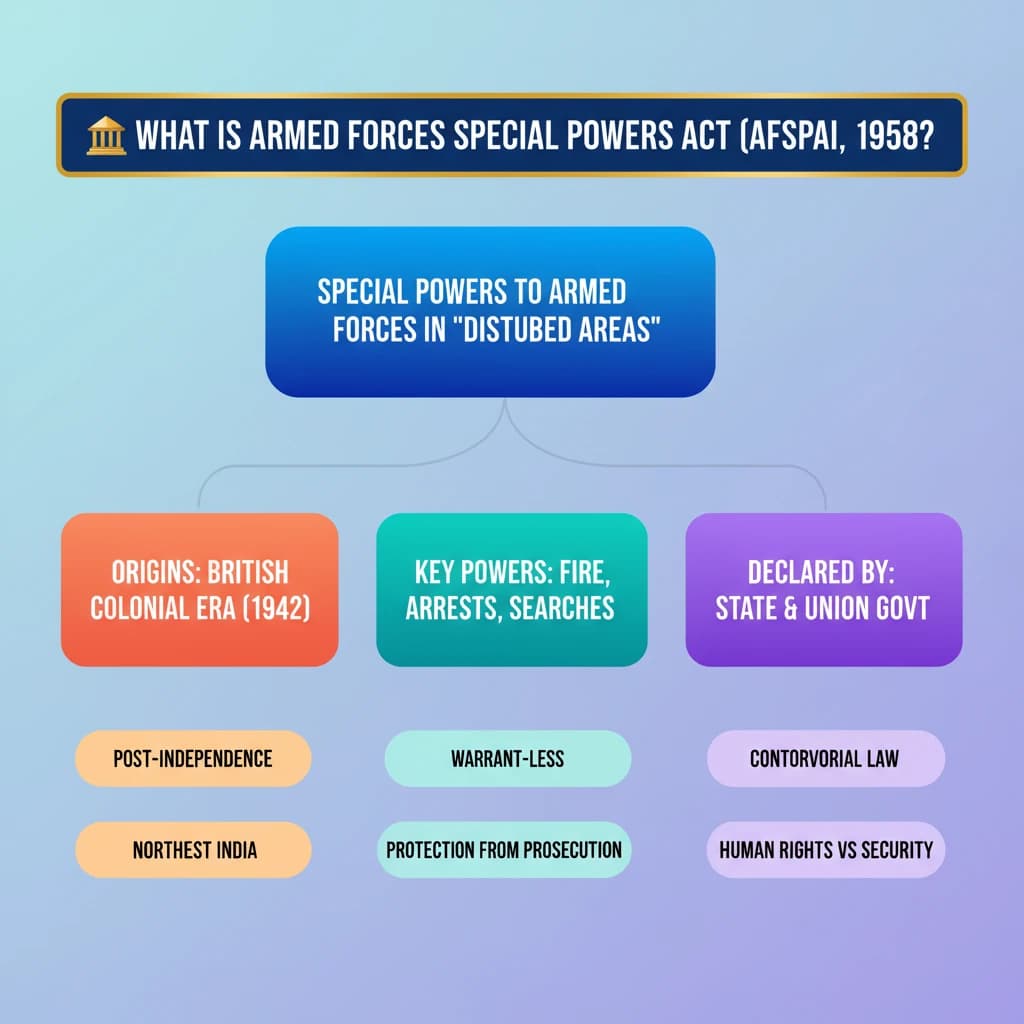
  • AFSPA, 1958, grants special powers to armed forces in 'disturbed areas' to maintain public order.
  • Its origins trace back to the British colonial era (1942 Ordinance) and post-independence challenges in the Northeast.
  • Key powers include firing on law violators, warrant-less arrests/searches, and protection from prosecution.
  • Both State and Union governments can declare an area 'disturbed' for AFSPA's application.
  • AFSPA remains controversial due to human rights concerns vs. its perceived necessity for internal security.
What is Armed Forces Special Powers Act (AFSPA), 1958?

What is Armed Forces Special Powers Act (AFSPA), 1958?

Medium⏱️ 8 min read✓ 95% Verified
defence and security

📖 Introduction

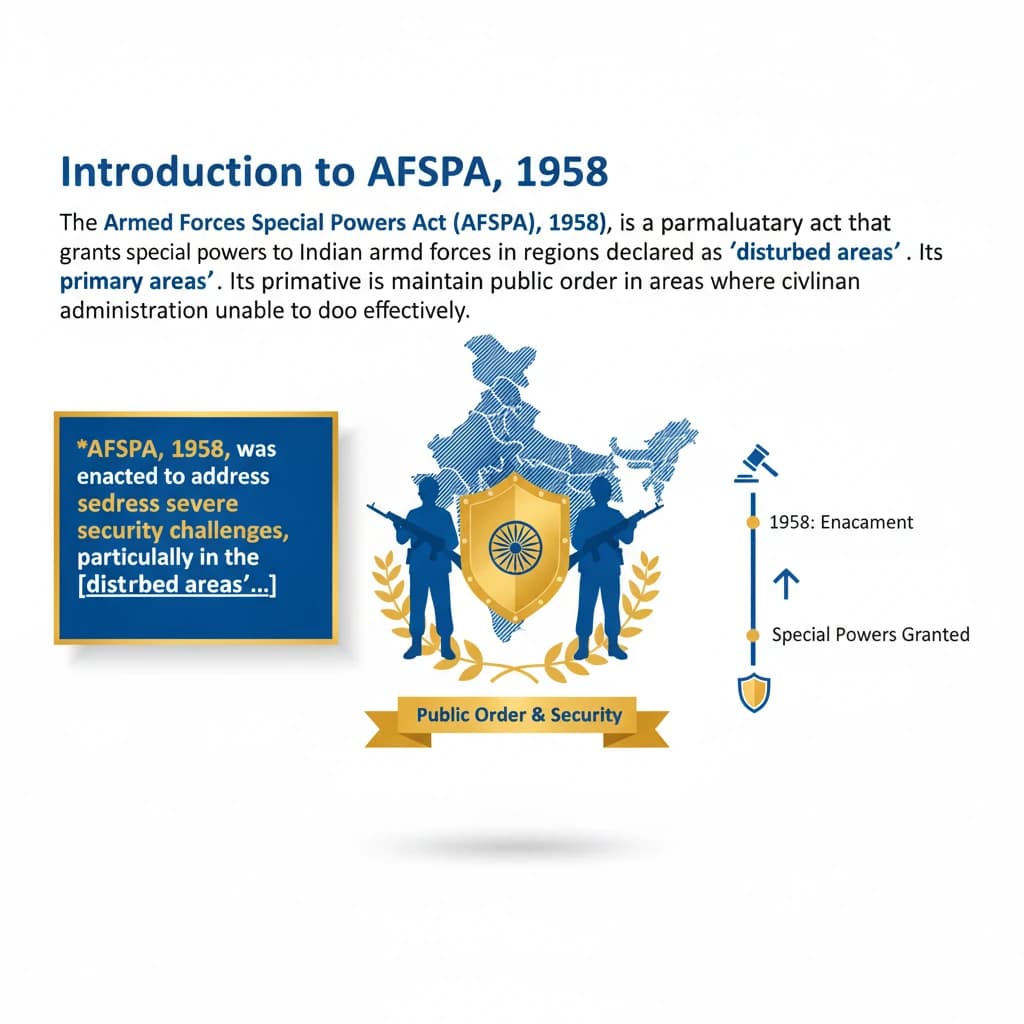
<h4>Introduction to AFSPA, 1958</h4><p>The <strong>Armed Forces Special Powers Act (AFSPA), 1958</strong>, is a parliamentary act that grants special powers to the Indian armed forces in regions declared as <strong>"disturbed areas"</strong>. Its primary objective is to maintain public order in areas where civilian administration is unable to do so effectively.</p><div class='key-point-box'><p><strong>AFSPA, 1958</strong>, was enacted to address severe security challenges, particularly in the <strong>North-eastern States</strong>, where state governments struggled to manage escalating violence. It became law on <strong>11th September 1958</strong>.</p></div><h4>Historical Genesis of AFSPA</h4><p>The origins of AFSPA can be traced back to the <strong>British colonial government</strong>. On <strong>15th August 1942</strong>, they introduced the <strong>Armed Forces Special Powers Ordinance</strong> to suppress the widespread <strong>Quit India Movement</strong>.</p><p>Following India's independence and partition in <strong>1947</strong>, the Indian government passed several ordinances, including one for <strong>"Assam disturbed areas"</strong>, to tackle emerging security challenges in the region.</p><p>The <strong>Armed Forces (Assam and Manipur) Special Powers Act, 1958</strong>, succeeded the <strong>Assam Disturbed Areas Act of 1955</strong>. This was specifically enacted to address significant unrest in the <strong>Naga hills</strong>. The current <strong>AFSPA</strong> later replaced this act for broader application.</p><h4>Key Provisions and Powers under AFSPA</h4><p>AFSPA grants <strong>extensive powers</strong> to both the <strong>armed forces</strong> and <strong>Central Armed Police Forces</strong> operating in declared disturbed areas. These powers are designed to enable them to effectively counter insurgency and maintain law and order.</p><div class='info-box'><p>Key powers granted under AFSPA include:</p><ul><li>Authority to <strong>fire upon individuals</strong> violating law or acting against public order, even causing death, if deemed necessary for maintaining peace.</li><li>Power to <strong>arrest and search premises without a warrant</strong>, based on reasonable suspicion, and to use force for such actions.</li><li><strong>Protection from prosecution and legal suits</strong> for actions taken under the Act, unless specifically sanctioned by the <strong>Central government</strong>.</li></ul></div><h4>Declaration of 'Disturbed Areas'</h4><p>An area can be declared <strong>"disturbed"</strong> by either the <strong>State government</strong> or the <strong>Union government</strong> through an official notification. This declaration is a prerequisite for the armed forces to exercise authority under AFSPA in that specific region.</p>
Concept Diagram

💡 Key Takeaways

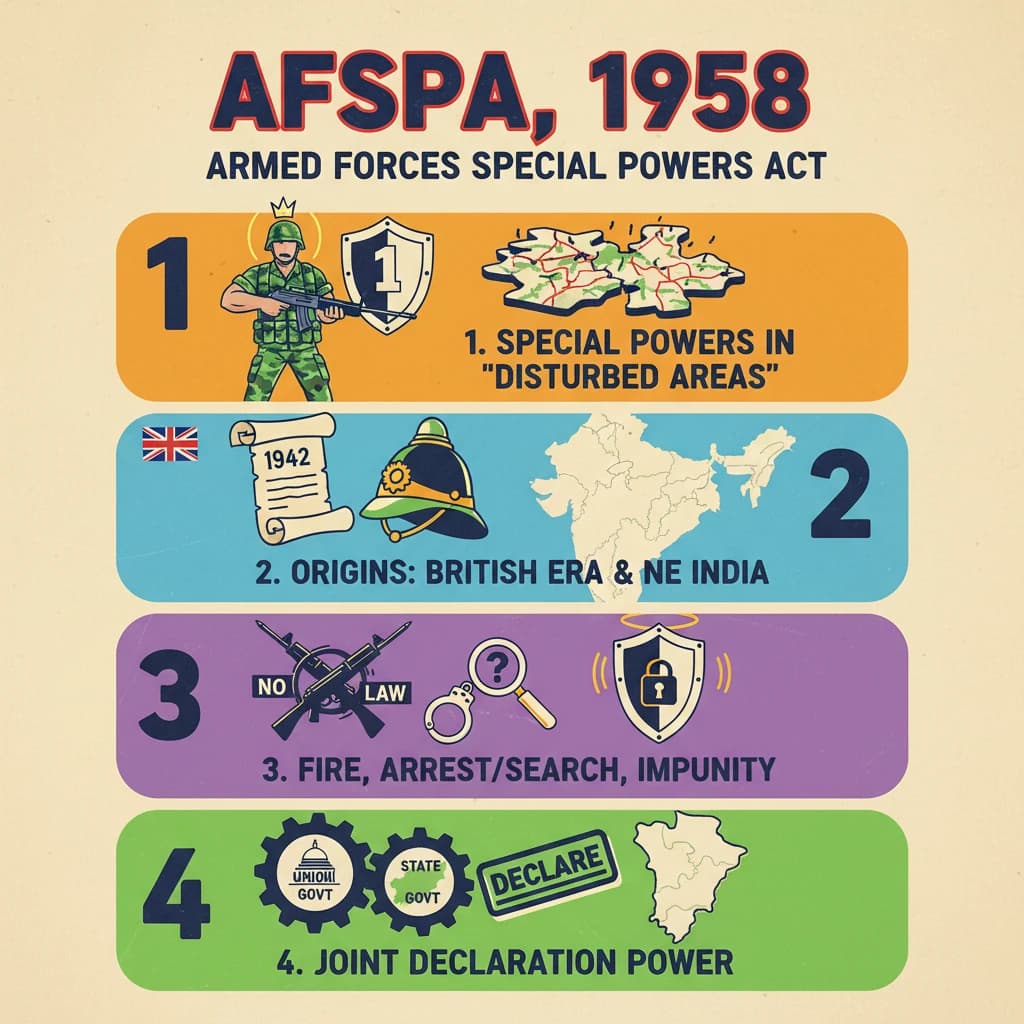
  • •AFSPA, 1958, grants special powers to armed forces in 'disturbed areas' to maintain public order.
  • •Its origins trace back to the British colonial era (1942 Ordinance) and post-independence challenges in the Northeast.
  • •Key powers include firing on law violators, warrant-less arrests/searches, and protection from prosecution.
  • •Both State and Union governments can declare an area 'disturbed' for AFSPA's application.
  • •AFSPA remains controversial due to human rights concerns vs. its perceived necessity for internal security.

🧠 Memory Techniques
Memory Aid
95% Verified Content

📚 Reference Sources

•Official parliamentary records for AFSPA enactment date
•Government of India notifications regarding 'disturbed areas' and withdrawals

Related Topics

Loading related topics...
Explore:Defence And Security Topics·All Subjects·Daily Current Affairs·Editorial Analysis·Previous Year Questions·UPSC GPT
What is Armed Forces Special Powers Act (AFSPA), 1958? - UPSC Defence And Security