Loading page, please wait…
Vaidra Logo
Vaidra

Top 4 items + smart groups

UPSC GPT
New
Current Affairs
Daily Solutions
Daily Puzzle
Mains Evaluator

Version 2.0.0 • Built with ❤️ for UPSC aspirants

Loading...
Loading...
Loading...
Loading...
Loading...
Loading...
Loading...
Loading...
Loading...
Loading...
Loading...
Loading...
Loading...
Back
All Subjects

Topics

0 topics • 0 completed

Loading topics...
Loading...
Loading...
Loading...
Loading...
Loading...
Overall Progress0%

Islamic State-Khorasan - UPSC Defence And Security

What is Islamic State-Khorasan in UPSC Defence And Security?

Islamic State-Khorasan is a key topic under Defence And Security for UPSC Civil Services Examination. Key points include: IS-K is the Afghanistan-Pakistan branch of the Islamic State, formed in Nangarhar in 2015.. It gained significant prominence after the Taliban's return to power in Afghanistan in 2021.. Recent major attacks attributed to IS-K include the Moscow Crocus City Hall bombing (March 2024) and the Kerman bombings in Iran (January 2024).. Understanding this topic is essential for both UPSC Prelims and Mains preparation.

Why is Islamic State-Khorasan important for UPSC exam?

Islamic State-Khorasan is a Medium-level topic in UPSC Defence And Security. It is tested in both Prelims (factual MCQs) and Mains (analytical answer writing). Previous year UPSC questions have frequently covered aspects of Islamic State-Khorasan, making it essential for comprehensive IAS preparation.

How to prepare Islamic State-Khorasan for UPSC?

To prepare Islamic State-Khorasan for UPSC: (1) Study the comprehensive notes covering all key concepts on Vaidra. (2) Practice previous year questions on this topic. (3) Connect it with current affairs using daily updates. (4) Revise using key takeaways and mind maps available for Defence And Security. (5) Write practice answers linking Islamic State-Khorasan to related GS Paper topics.

Key takeaways of Islamic State-Khorasan for UPSC

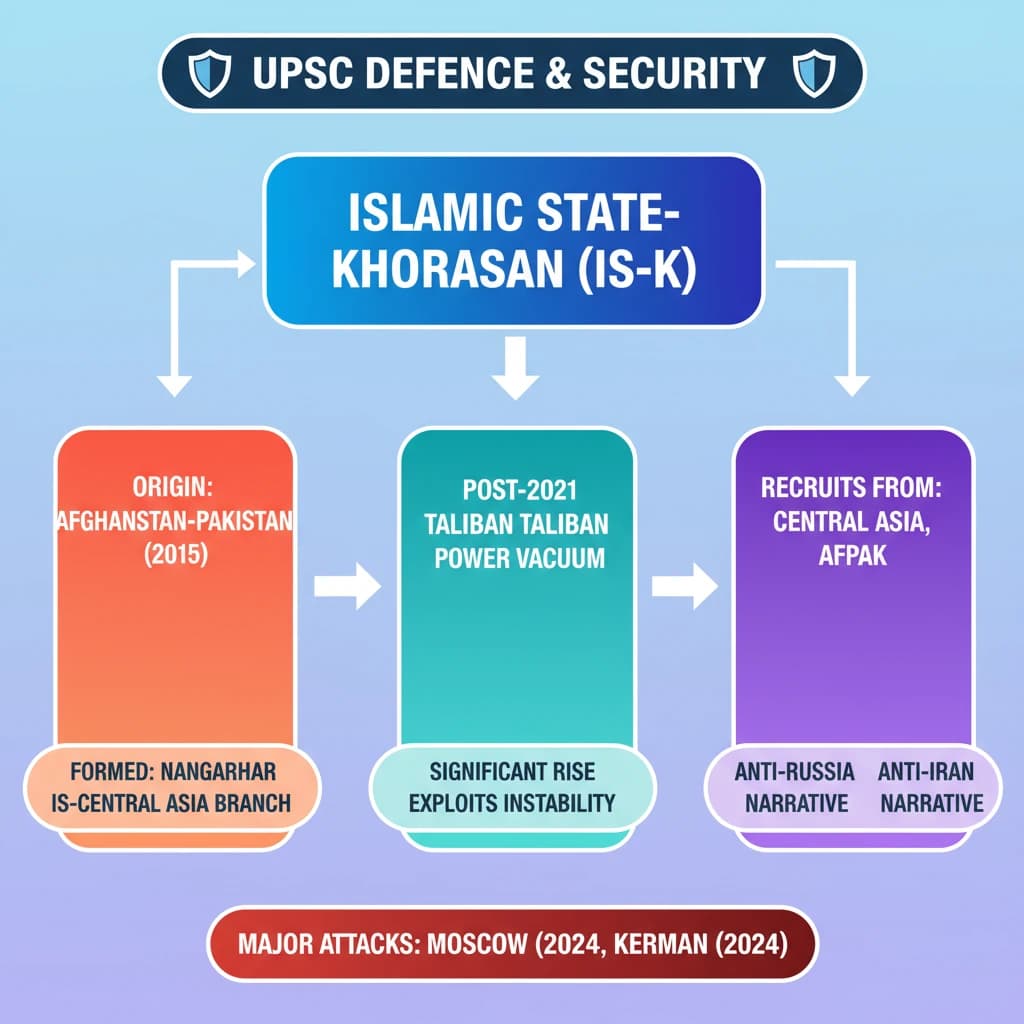
  • IS-K is the Afghanistan-Pakistan branch of the Islamic State, formed in Nangarhar in 2015.
  • It gained significant prominence after the Taliban's return to power in Afghanistan in 2021.
  • Recent major attacks attributed to IS-K include the Moscow Crocus City Hall bombing (March 2024) and the Kerman bombings in Iran (January 2024).
  • IS-K exploits anti-Russian and anti-Iranian narratives to recruit from Central Asia, Afghanistan, and Pakistan.
  • Regional instability in Afghanistan and Pakistan is a key enabler for IS-K's expansion and operational capabilities.
Islamic State-Khorasan

Islamic State-Khorasan

Medium⏱️ 6 min read✓ 95% Verified
defence and security

📖 Introduction

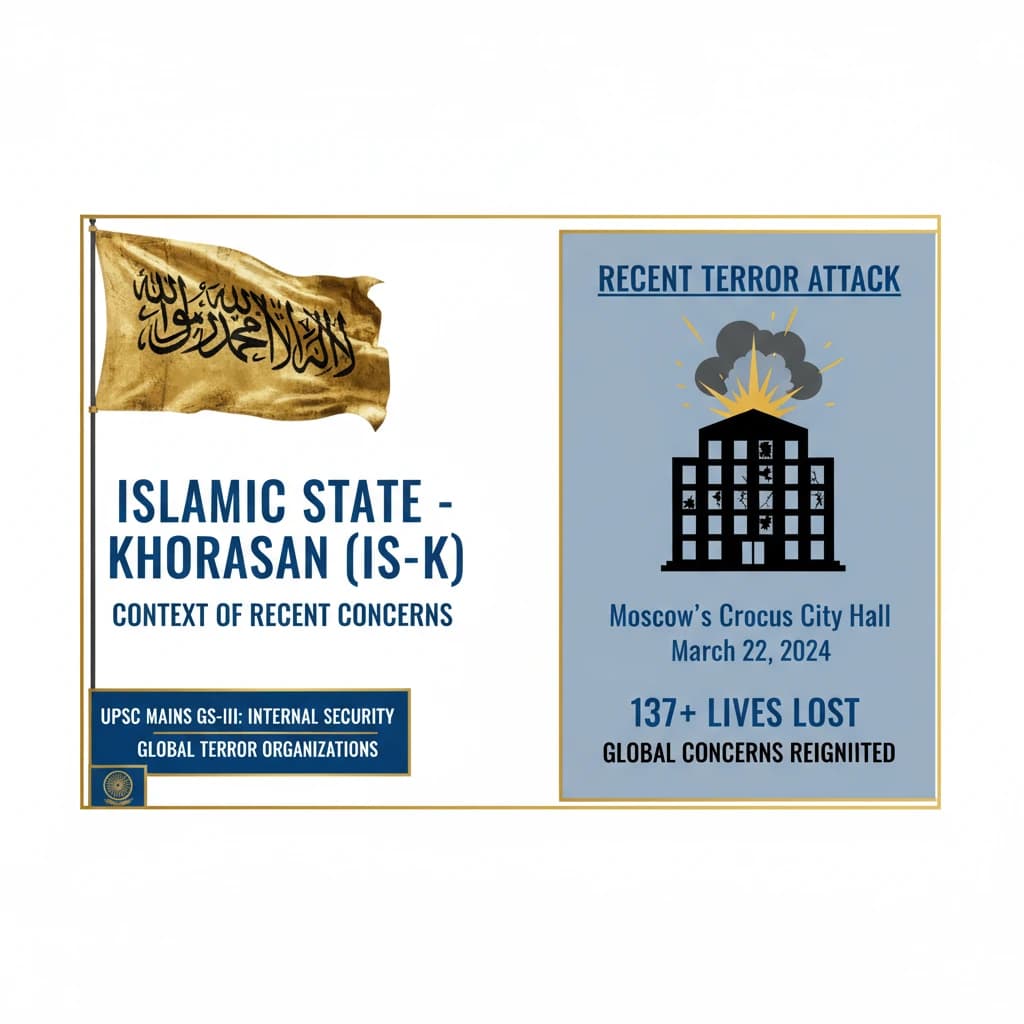
<h4>Context of Recent Concerns</h4><p>Recently, a devastating <strong>terror attack</strong> at <strong>Moscow’s Crocus City Hall</strong> tragically claimed over <strong>137 lives</strong>. This incident has significantly reignited global concerns regarding the persistent presence and escalating terror capabilities of the <strong>Islamic State (IS)</strong>.</p><div class='exam-tip-box'><p><strong>UPSC Mains GS-III: Internal Security</strong> often covers topics related to global terror organizations and their impact. Understanding recent attacks and group capabilities is crucial for contemporary issues.</p></div><h4>Understanding Islamic State-Khorasan (IS-K)</h4><p>Experts widely believe that the <strong>Moscow attack</strong> was likely orchestrated by <strong>IS Khorasan (IS-K)</strong>. This group is recognized as the <strong>Afghanistan-Pakistan branch</strong> of the broader <strong>Islamic State</strong> network.</p><div class='key-point-box'><p><strong>IS-K</strong> represents a significant regional threat, operating primarily from the <strong>Afghanistan-Pakistan</strong> border areas.</p></div><h4>Origins and Formation of IS-K</h4><p><strong>IS-K</strong> is an <strong>Afghanistan-based militant group</strong> that was officially formed in <strong>Nangarhar province</strong> in <strong>2015</strong>. Its emergence marked a new phase of extremist activity in the region.</p><div class='info-box'><p><strong>Formation:</strong> <strong>IS-K</strong> was established in <strong>Nangarhar, Afghanistan</strong>, in <strong>2015</strong>.</p></div><h4>Rise to Prominence and Key Attacks</h4><p>The group has witnessed a significant surge in prominence and operational capability since the <strong>Taliban’s return to power</strong> in <strong>Afghanistan</strong>. This period of instability has provided fertile ground for its expansion.</p><p><strong>IS-K</strong> has claimed responsibility for several high-profile attacks, including the recent <strong>Kerman bombings</strong> in <strong>Iran</strong>. These attacks demonstrate its reach and intent to destabilize the region.</p><h4>Recruitment Strategies and Geopolitical Exploitation</h4><p><strong>IS-K</strong> actively exploits prevailing <strong>anti-Russian</strong> and <strong>anti-Iranian narratives</strong> to bolster its recruitment efforts. This ideological appeal targets disaffected individuals across various demographics.</p><p>The group primarily recruits from <strong>Central Asia</strong>, <strong>Afghanistan</strong>, and <strong>Pakistan</strong>. Its propaganda resonates with specific grievances and political sentiments in these areas.</p><h4>Regional Instability and Expansion</h4><p>Persistent <strong>instability</strong> across the <strong>Afghanistan-Pakistan</strong> region plays a crucial role in enabling <strong>IS-K’s expansion</strong>. This chaotic environment allows the group to operate with relative impunity and plan complex attacks.</p><div class='info-box'><p><strong>Key Factors for IS-K's Growth:</strong><ul><li><strong>Regional Instability:</strong> Post-Taliban Afghanistan.</li><li><strong>Anti-Narratives:</strong> Exploiting sentiments against <strong>Russia</strong> and <strong>Iran</strong>.</li><li><strong>Recruitment Base:</strong> <strong>Central Asia</strong>, <strong>Afghanistan</strong>, <strong>Pakistan</strong>.</li></ul></p></div>
Concept Diagram

💡 Key Takeaways

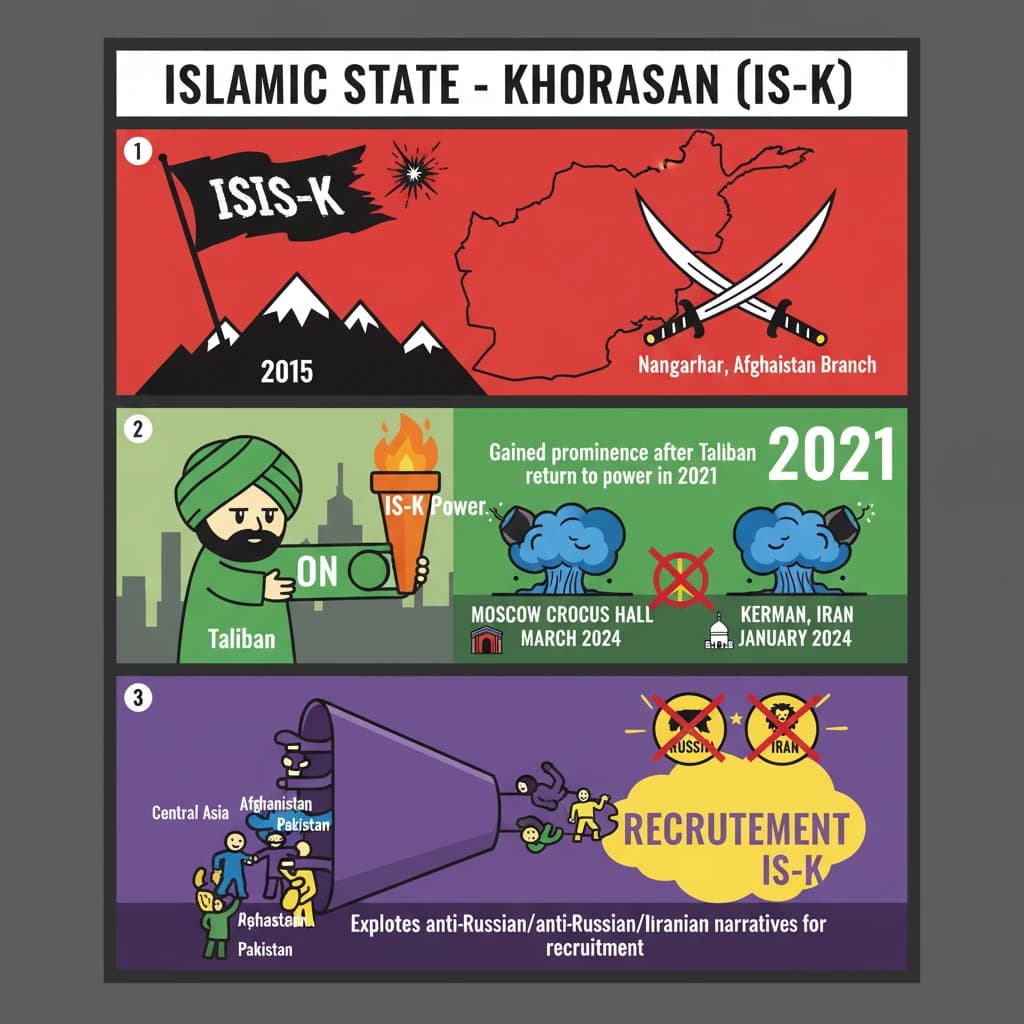
  • •IS-K is the Afghanistan-Pakistan branch of the Islamic State, formed in Nangarhar in 2015.
  • •It gained significant prominence after the Taliban's return to power in Afghanistan in 2021.
  • •Recent major attacks attributed to IS-K include the Moscow Crocus City Hall bombing (March 2024) and the Kerman bombings in Iran (January 2024).
  • •IS-K exploits anti-Russian and anti-Iranian narratives to recruit from Central Asia, Afghanistan, and Pakistan.
  • •Regional instability in Afghanistan and Pakistan is a key enabler for IS-K's expansion and operational capabilities.

🧠 Memory Techniques
Memory Aid
95% Verified Content

📚 Reference Sources

•Reputable news agencies (e.g., Reuters, AP, BBC) for attack details
•Think tank reports on counter-terrorism and regional security

Related Topics

Loading related topics...
Explore:Defence And Security Topics·All Subjects·Daily Current Affairs·Editorial Analysis·Previous Year Questions·UPSC GPT
Islamic State-Khorasan - UPSC Defence And Security