Loading page, please wait…
Vaidra Logo
Vaidra

Top 4 items + smart groups

UPSC GPT
New
Current Affairs
Daily Solutions
Daily Puzzle
Mains Evaluator

Version 2.0.0 • Built with ❤️ for UPSC aspirants

Loading...
Loading...
Loading...
Loading...
Loading...
Loading...
Loading...
Loading...
Loading...
Loading...
Loading...
Loading...
Loading...
Disturbed Area AFSPA - UPSC Defence And Security
Back
All Subjects

Topics

0 topics • 0 completed

Loading topics...
Loading...
Loading...
Loading...
Loading...
Loading...
Overall Progress0%

Disturbed Area AFSPA - UPSC Defence And Security

What is Disturbed Area AFSPA in UPSC Defence And Security?

Disturbed Area AFSPA is a key topic under Defence And Security for UPSC Civil Services Examination. Key points include: A 'disturbed area' is a legal designation under AFSPA (Section 3) for deploying armed forces.. The 1972 amendment empowered both Central and State governments to declare such areas.. Designation criteria include conflicts based on religious, racial, linguistic, regional, or caste communities.. Understanding this topic is essential for both UPSC Prelims and Mains preparation.

Why is Disturbed Area AFSPA important for UPSC exam?

Disturbed Area AFSPA is a Medium-level topic in UPSC Defence And Security. It is tested in both Prelims (factual MCQs) and Mains (analytical answer writing). Previous year UPSC questions have frequently covered aspects of Disturbed Area AFSPA, making it essential for comprehensive IAS preparation.

How to prepare Disturbed Area AFSPA for UPSC?

To prepare Disturbed Area AFSPA for UPSC: (1) Study the comprehensive notes covering all key concepts on Vaidra. (2) Practice previous year questions on this topic. (3) Connect it with current affairs using daily updates. (4) Revise using key takeaways and mind maps available for Defence And Security. (5) Write practice answers linking Disturbed Area AFSPA to related GS Paper topics.

Key takeaways of Disturbed Area AFSPA for UPSC

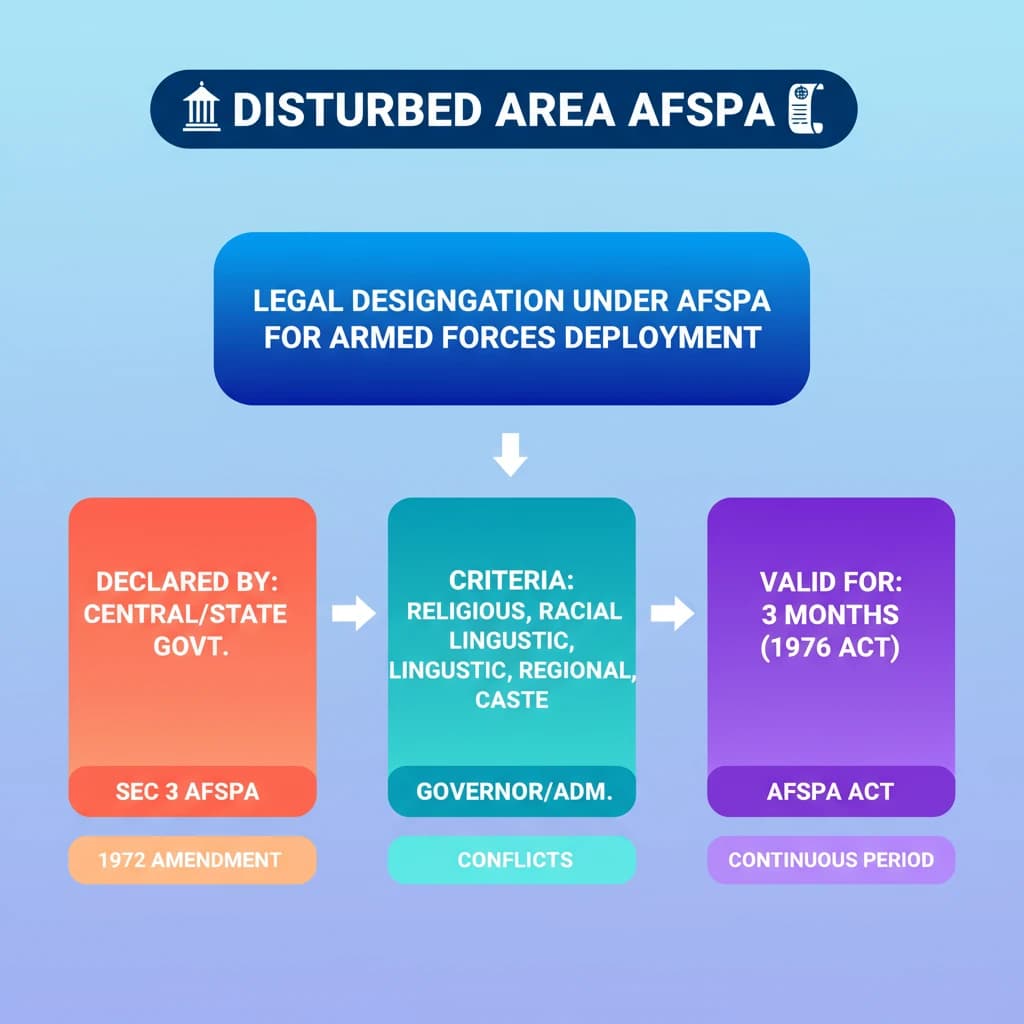
  • A 'disturbed area' is a legal designation under AFSPA (Section 3) for deploying armed forces.
  • The 1972 amendment empowered both Central and State governments to declare such areas.
  • Designation criteria include conflicts based on religious, racial, linguistic, regional, or caste communities.
  • The Central Government, Governor of a State, or Administrator of a UT can make the declaration.
  • Once declared, the status remains for a continuous period of 3 months, as per the 1976 Act.
  • State governments can recommend the continuation or withdrawal of the 'disturbed area' status.
Disturbed Area AFSPA

Disturbed Area AFSPA

Medium⏱️ 6 min read✓ 95% Verified
defence and security

📖 Introduction

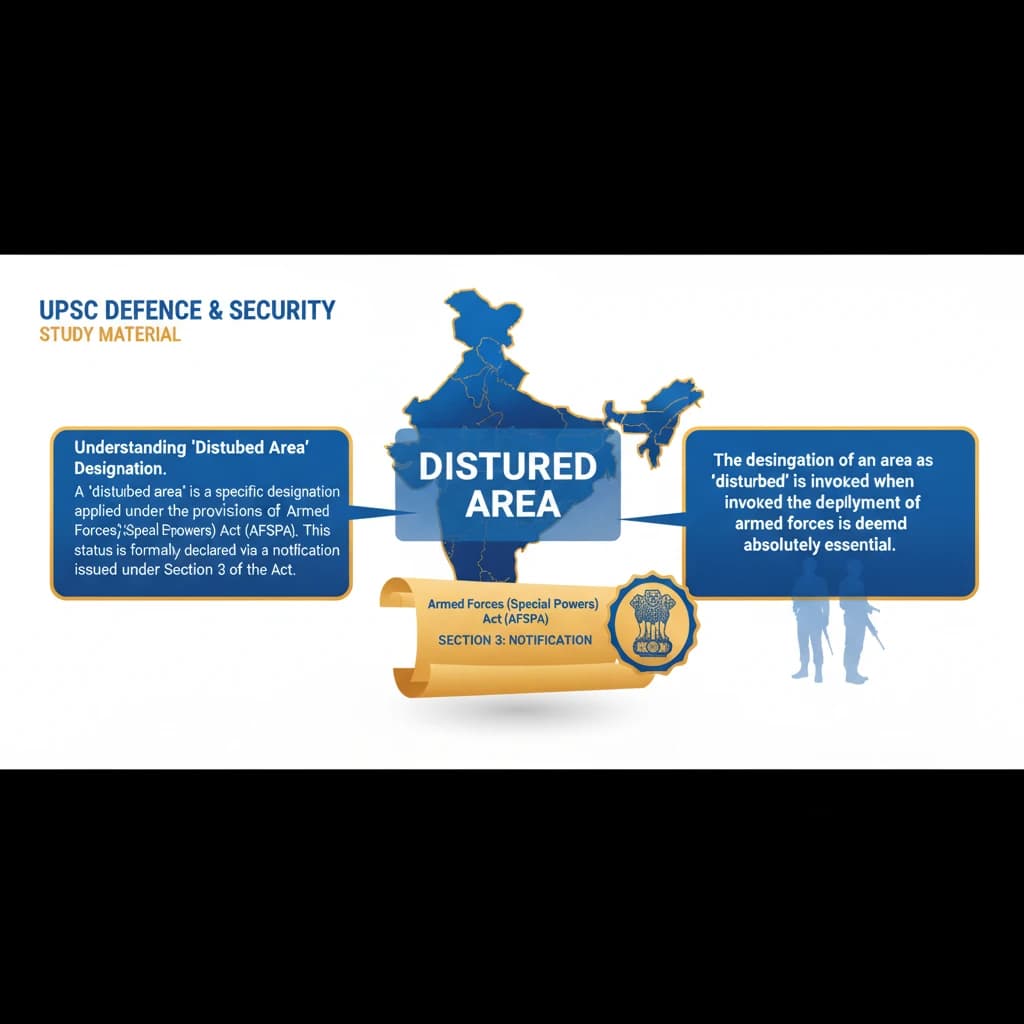
<h4>Understanding 'Disturbed Area' Designation</h4><p>A <strong>“disturbed area”</strong> is a specific designation applied under the provisions of the <strong>Armed Forces (Special Powers) Act (AFSPA)</strong>. This status is formally declared via a <strong>notification</strong> issued under <strong>Section 3</strong> of the Act.</p><div class='info-box'><p>The designation of an area as <strong>'disturbed'</strong> is invoked when the <strong>deployment of armed forces</strong> is deemed absolutely necessary to assist the <strong>civil power</strong> in maintaining law and order. This signifies a breakdown of normal administrative control.</p></div><h4>Evolution of Declaring Authority</h4><p>Initially, the authority to declare an area as <strong>'disturbed'</strong> was more restricted. However, a significant change occurred with the <strong>1972 amendment</strong> to the AFSPA.</p><div class='key-point-box'><p>The <strong>1972 amendment</strong> expanded the authority, allowing <strong>both the Central government and State governments</strong> to independently declare an area as 'disturbed'. This change introduced a dual power structure in the declaration process.</p></div><h4>Criteria for Designation</h4><p>The decision to designate an area as <strong>'disturbed'</strong> is not arbitrary. It is based on specific grounds related to severe public disorder and conflict.</p><div class='info-box'><p>Such a designation can arise from conflicts or disputes between various communities, specifically those based on <strong>religious, racial, linguistic, regional, or caste</strong> identities. These conflicts must be significant enough to necessitate military aid to civil administration.</p></div><h4>Authorities Empowered to Declare</h4><p>Multiple authorities are empowered to issue the notification for a <strong>'disturbed area'</strong> status, reflecting the federal structure of India.</p><div class='info-box'><p>The declaration can be made by the <strong>Central Government</strong>. Additionally, the <strong>Governor of a State</strong> or the <strong>Administrator of a Union Territory</strong> holds the power to declare any part, or the entirety, of their respective State or Union Territory as 'disturbed'.</p></div><h4>Duration of 'Disturbed Area' Status</h4><p>Once an area is declared <strong>'disturbed'</strong>, this status is not indefinite. There is a specified minimum duration for which the declaration remains in effect.</p><div class='info-box'><p>As per the provisions of the <strong>Disturbed Areas (Special Courts) Act, 1976</strong>, an area, once declared 'disturbed', maintains this status for a <strong>continuous period of 3 months</strong>. This ensures a review mechanism, albeit after a fixed term.</p></div><h4>Role of State Government in Continuation</h4><p>While the initial declaration can be made by various authorities, the <strong>State government</strong> plays a crucial role in the ongoing assessment of the situation.</p><p>The <strong>State government</strong> has the power to recommend whether the <strong>AFSPA</strong>, and thus the 'disturbed area' status, should continue in the region beyond the initial period. This recommendation is vital for democratic oversight and local input.</p><div class='exam-tip-box'><p><strong>UPSC Insight:</strong> Understanding the role of the <strong>State government</strong> in recommending continuation highlights the importance of <strong>Centre-State relations</strong> and the balance of power in internal security matters. This is a frequently debated aspect in <strong>GS Paper II (Polity)</strong> and <strong>GS Paper III (Internal Security)</strong>.</p></div>
Concept Diagram

💡 Key Takeaways

  • •A 'disturbed area' is a legal designation under AFSPA (Section 3) for deploying armed forces.
  • •The 1972 amendment empowered both Central and State governments to declare such areas.
  • •Designation criteria include conflicts based on religious, racial, linguistic, regional, or caste communities.
  • •The Central Government, Governor of a State, or Administrator of a UT can make the declaration.
  • •Once declared, the status remains for a continuous period of 3 months, as per the 1976 Act.
  • •State governments can recommend the continuation or withdrawal of the 'disturbed area' status.

🧠 Memory Techniques
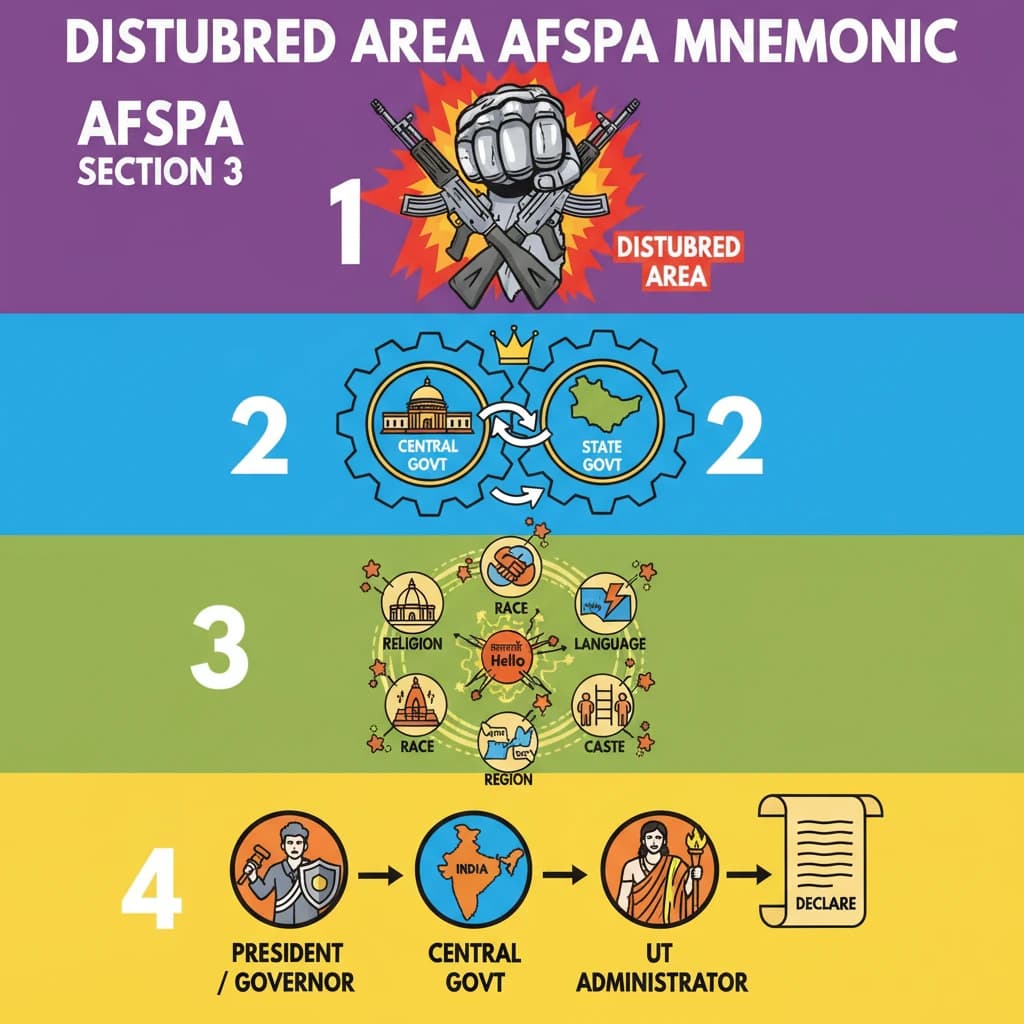
Memory Aid
95% Verified Content

Related Topics

Loading related topics...
Explore:Defence And Security Topics·All Subjects·Daily Current Affairs·Editorial Analysis·Previous Year Questions·UPSC GPT