Loading page, please wait…
Vaidra Logo
Vaidra

Top 4 items + smart groups

UPSC GPT
New
Current Affairs
Daily Solutions
Daily Puzzle
Mains Evaluator

Version 2.0.0 • Built with ❤️ for UPSC aspirants

Loading...
Loading...
Loading...
Loading...
Loading...
Loading...
Loading...
Loading...
Loading...
Loading...
Loading...
Loading...
Loading...
Back
All Subjects

Topics

0 topics • 0 completed

Loading topics...
Loading...
Loading...
Loading...
Loading...
Loading...
Overall Progress0%

Joint Doctrine for Amphibious and Cyberspace Operations - UPSC Defence And Security

What is Joint Doctrine for Amphibious and Cyberspace Operations in UPSC Defence And Security?

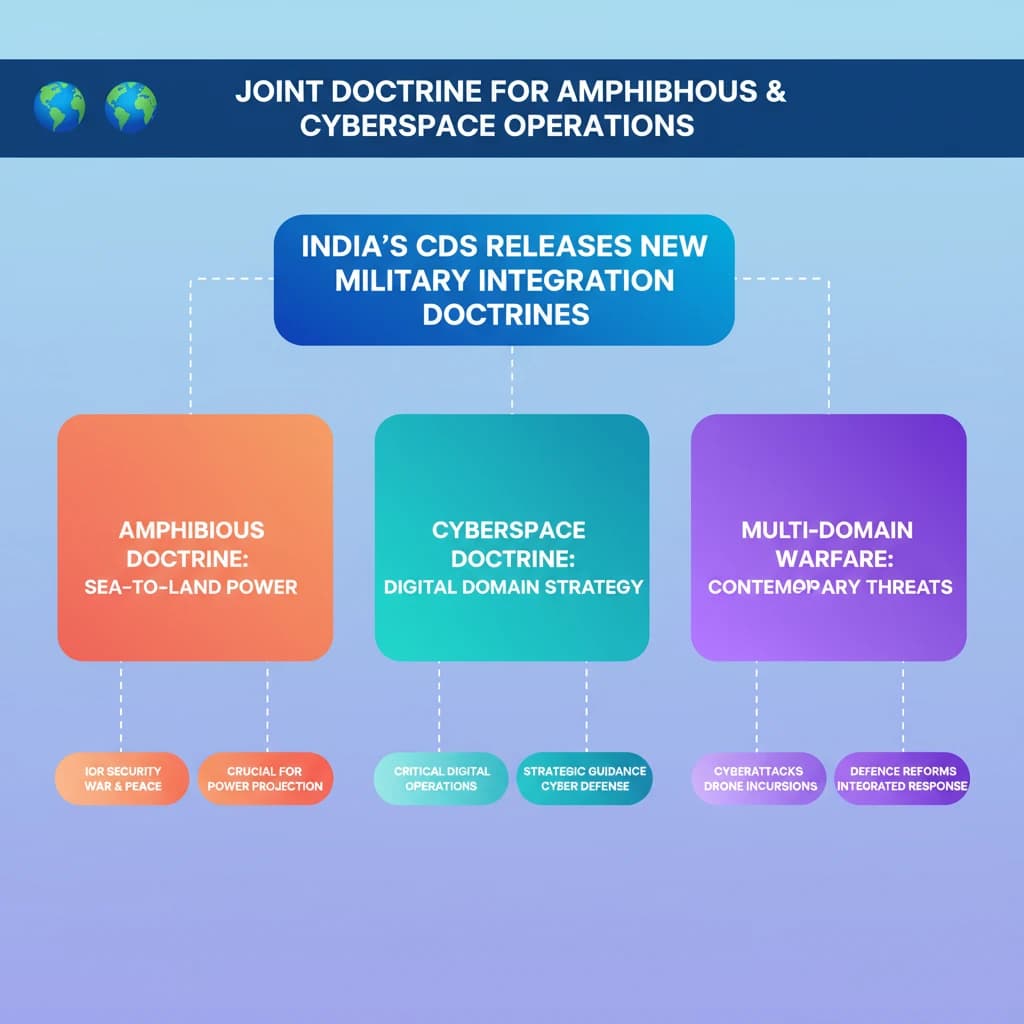
Joint Doctrine for Amphibious and Cyberspace Operations is a key topic under Defence And Security for UPSC Civil Services Examination. Key points include: India's CDS released Joint Doctrines for Amphibious and Cyberspace Operations, enhancing military integration.. Amphibious Doctrine guides sea-to-land power projection, crucial for IOR security in war and peace.. Cyberspace Doctrine provides strategic guidance for military operations in the critical digital domain.. Understanding this topic is essential for both UPSC Prelims and Mains preparation.

Why is Joint Doctrine for Amphibious and Cyberspace Operations important for UPSC exam?

Joint Doctrine for Amphibious and Cyberspace Operations is a Medium-level topic in UPSC Defence And Security. It is tested in both Prelims (factual MCQs) and Mains (analytical answer writing). Previous year UPSC questions have frequently covered aspects of Joint Doctrine for Amphibious and Cyberspace Operations, making it essential for comprehensive IAS preparation.

How to prepare Joint Doctrine for Amphibious and Cyberspace Operations for UPSC?

To prepare Joint Doctrine for Amphibious and Cyberspace Operations for UPSC: (1) Study the comprehensive notes covering all key concepts on Vaidra. (2) Practice previous year questions on this topic. (3) Connect it with current affairs using daily updates. (4) Revise using key takeaways and mind maps available for Defence And Security. (5) Write practice answers linking Joint Doctrine for Amphibious and Cyberspace Operations to related GS Paper topics.

Key takeaways of Joint Doctrine for Amphibious and Cyberspace Operations for UPSC

  • India's CDS released Joint Doctrines for Amphibious and Cyberspace Operations, enhancing military integration.
  • Amphibious Doctrine guides sea-to-land power projection, crucial for IOR security in war and peace.
  • Cyberspace Doctrine provides strategic guidance for military operations in the critical digital domain.
  • These doctrines are vital for addressing multi-domain warfare and contemporary threats like cyberattacks and drone incursions.
  • The initiatives underscore India's commitment to defence reforms and integrated security responses.
Joint Doctrine for Amphibious and Cyberspace Operations

Joint Doctrine for Amphibious and Cyberspace Operations

Medium⏱️ 8 min read✓ 90% Verified
defence and security

📖 Introduction

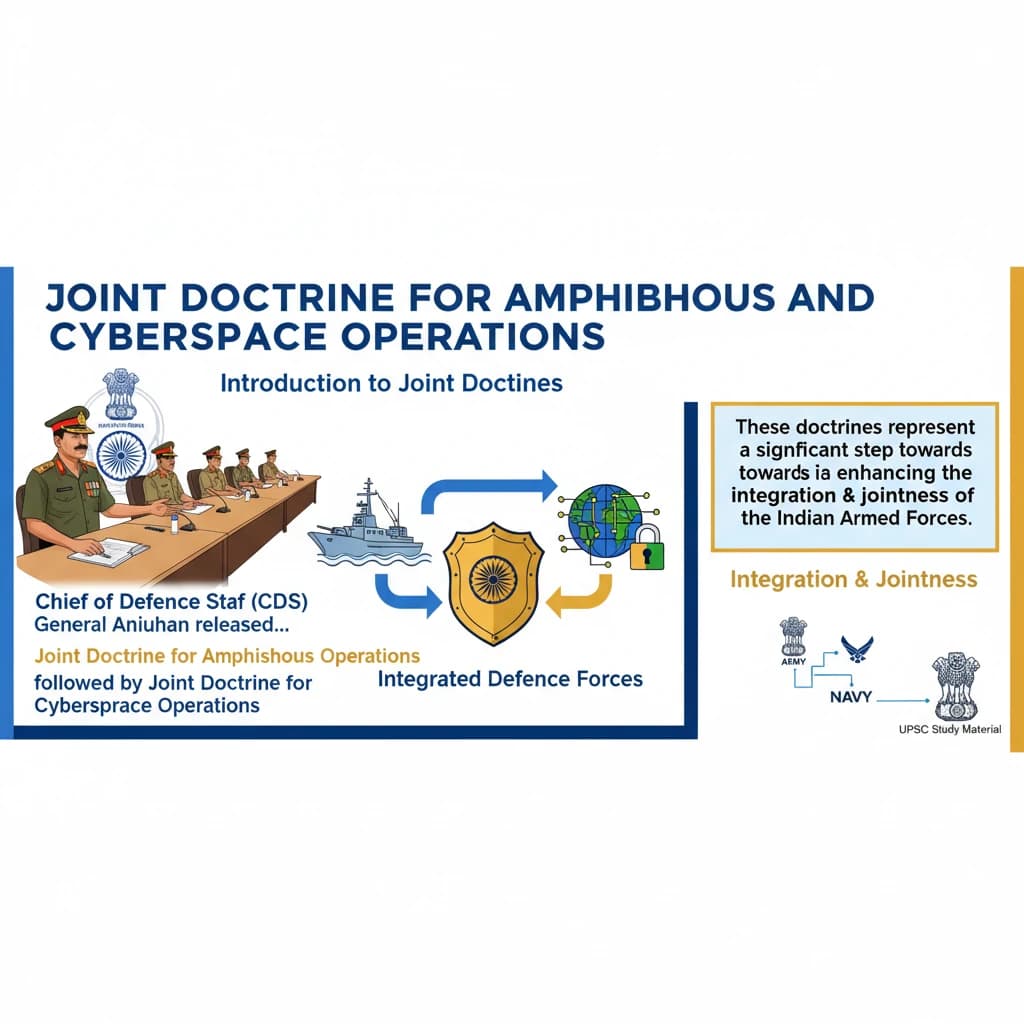
<h4>Introduction to Joint Doctrines</h4><p>The <strong>Chief of Defence Staff (CDS) General Anil Chauhan</strong> recently released the <strong>Joint Doctrine for Amphibious Operations</strong> during a <strong>Chiefs of Staff Committee (COSC)</strong> meeting. This follows the earlier release of the <strong>Joint Doctrine for Cyberspace Operations</strong> by the CDS.</p><div class='key-point-box'><p>These doctrines represent a significant step towards enhancing the <strong>integration</strong> and <strong>coordination</strong> among India's Armed Forces in modern warfare domains.</p></div><h4>Joint Doctrine for Amphibious Operations</h4><p>This doctrine serves as a foundational publication, offering crucial guidance to commanders for executing <strong>Amphibious Operations</strong> within complex maritime environments. It underscores the importance of seamless coordination across different service branches.</p><p>The capability for amphibious operations significantly boosts the <strong>Armed Forces' capacity</strong> to undertake a broad spectrum of missions. These operations are vital for both <strong>wartime</strong> and <strong>peacetime scenarios</strong> within the <strong>Indian Ocean Region (IOR)</strong>.</p><div class='info-box'><p><strong>Amphibious Operations:</strong> These are military operations launched from the sea by naval and landing forces, supported by air, to land on a hostile or potentially hostile shore.</p></div><p>They are a critical component of <strong>multi-domain military engagements</strong>, demonstrating the highest level of synergy and combined effort among the Army, Navy, and Air Force.</p><h4>Joint Doctrine for Cyberspace Operations</h4><p>The <strong>Cyberspace Doctrine</strong> addresses the military dimensions of this increasingly critical domain. It provides strategic guidance for commanders, staff, and practitioners involved in planning and executing <strong>cyberspace operations</strong>.</p><div class='info-box'><p><strong>Cyberspace:</strong> Defined as the global network of entities, including <strong>Information and Communication Technology (ICT) systems</strong>, that process, store, and transmit digital information and code, whether connected or independent.</p></div><p>Beyond traditional domains of <strong>land, sea, and air warfare</strong>, cyberspace has emerged as a complex and crucial domain. It demands dedicated strategic focus and a comprehensive approach for effective military engagement.</p><p>This doctrine also aims to raise <strong>awareness</strong> among military personnel at all levels regarding the intricacies and importance of cyberspace in modern conflict.</p><h4>Context of Contemporary Security Challenges</h4><p>The development of these doctrines is set against a backdrop of evolving security threats. These challenges necessitate a robust and integrated defence strategy, encompassing both traditional and non-traditional domains.</p><ul><li><strong>Narcotics and Trafficking:</strong> This remains a major internal security concern, significantly impacting <strong>social and economic stability</strong> within the nation.</li><li><strong>Non-Major Ports and Fishing Harbours:</strong> These areas pose substantial risks due to their vulnerability to <strong>smuggling</strong> and other <strong>illegal activities</strong>, requiring enhanced security measures.</li></ul><h4>Emerging Threats and Technological Challenges</h4><p>Recent discussions, such as those at the COSC meeting, have explored several contemporary security threats driven by technological advancements.</p><ul><li><strong>Fintech Fraud:</strong> There is a growing emphasis on how <strong>financial technologies</strong> are being exploited for various <strong>criminal activities</strong>, posing economic and security risks.</li><li><strong>Rogue Drones:</strong> Countermeasures against <strong>rogue drones</strong>, which are increasingly used for <strong>smuggling</strong> and <strong>surveillance</strong>, have become a focal point of security sessions.</li><li><strong>Exploitation of App Ecosystems:</strong> Criminal elements are increasingly leveraging <strong>mobile applications</strong> for illicit activities, necessitating vigilance and defensive strategies in the digital space.</li></ul><div class='exam-tip-box'><p><strong>UPSC Insight:</strong> Joint Doctrines reflect India's evolving defence strategy to address <strong>multi-domain warfare</strong> and <strong>hybrid threats</strong>. Questions can link these doctrines to India's geopolitical ambitions in the <strong>IOR</strong>, internal security challenges, and the role of the <strong>CDS</strong> in defence reforms. Focus on the 'why' and 'how' of such integrations.</p></div>
Concept Diagram

💡 Key Takeaways

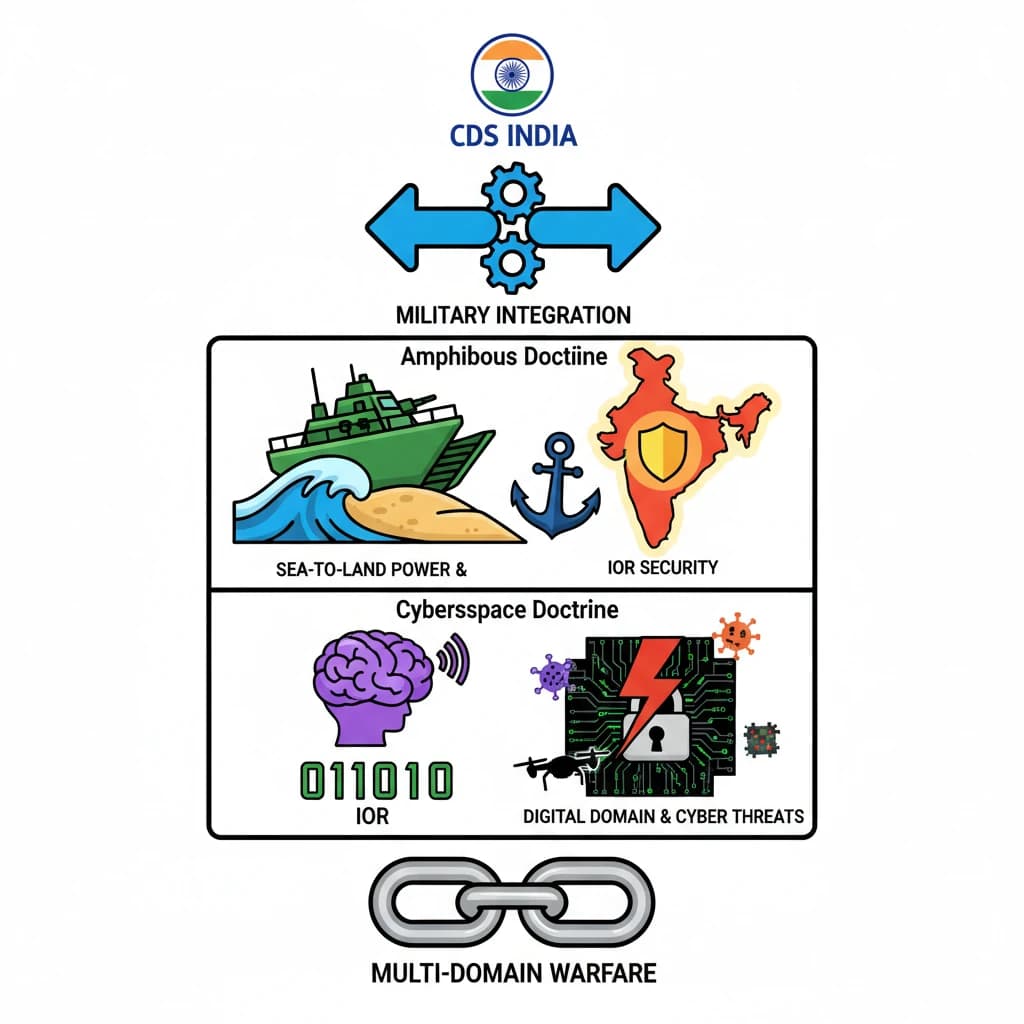
  • •India's CDS released Joint Doctrines for Amphibious and Cyberspace Operations, enhancing military integration.
  • •Amphibious Doctrine guides sea-to-land power projection, crucial for IOR security in war and peace.
  • •Cyberspace Doctrine provides strategic guidance for military operations in the critical digital domain.
  • •These doctrines are vital for addressing multi-domain warfare and contemporary threats like cyberattacks and drone incursions.
  • •The initiatives underscore India's commitment to defence reforms and integrated security responses.

🧠 Memory Techniques
Memory Aid
90% Verified Content

Related Topics

Loading related topics...
Explore:Defence And Security Topics·All Subjects·Daily Current Affairs·Editorial Analysis·Previous Year Questions·UPSC GPT
Joint Doctrine for Amphibious and Cyberspace Operations - UPSC Defence And Security