Loading page, please wait…
7th National Security Strategies Conference 2024 - UPSC Defence And Security
What is 7th National Security Strategies Conference 2024 in UPSC Defence And Security?
7th National Security Strategies Conference 2024 is a key topic under Defence And Security for UPSC Civil Services Examination. Key points include: The 7th NSSC 2024 focused on strategic solutions for national security challenges, led by the Union Home Minister.. Key reform areas for 2025 ('Year of Reforms') include Jointness & Integration (ITCs), Emerging Technologies, Simplifying Acquisition, and Defence Exports.. The conference emphasised a 'non-colonial approach' to addressing tribal issues, promoting respect and empowerment.. Understanding this topic is essential for both UPSC Prelims and Mains preparation.
Why is 7th National Security Strategies Conference 2024 important for UPSC exam?
7th National Security Strategies Conference 2024 is a Medium-level topic in UPSC Defence And Security. It is tested in both Prelims (factual MCQs) and Mains (analytical answer writing). Previous year UPSC questions have frequently covered aspects of 7th National Security Strategies Conference 2024, making it essential for comprehensive IAS preparation.
How to prepare 7th National Security Strategies Conference 2024 for UPSC?
To prepare 7th National Security Strategies Conference 2024 for UPSC: (1) Study the comprehensive notes covering all key concepts on Vaidra. (2) Practice previous year questions on this topic. (3) Connect it with current affairs using daily updates. (4) Revise using key takeaways and mind maps available for Defence And Security. (5) Write practice answers linking 7th National Security Strategies Conference 2024 to related GS Paper topics.
Key takeaways of 7th National Security Strategies Conference 2024 for UPSC
- The 7th NSSC 2024 focused on strategic solutions for national security challenges, led by the Union Home Minister.
- Key reform areas for 2025 ('Year of Reforms') include Jointness & Integration (ITCs), Emerging Technologies, Simplifying Acquisition, and Defence Exports.
- The conference emphasised a 'non-colonial approach' to addressing tribal issues, promoting respect and empowerment.
- New technologies like AI, ML, Cyber, and Space are critical for future warfare, driving the Indian Army's 'Year of Technology Absorption' in 2024.
- India's defence exports have significantly grown, positioning it as a credible global defence supplier.
- Combating youth radicalisation via social media, particularly Islamic and Khalistani ideologies, was a major concern.
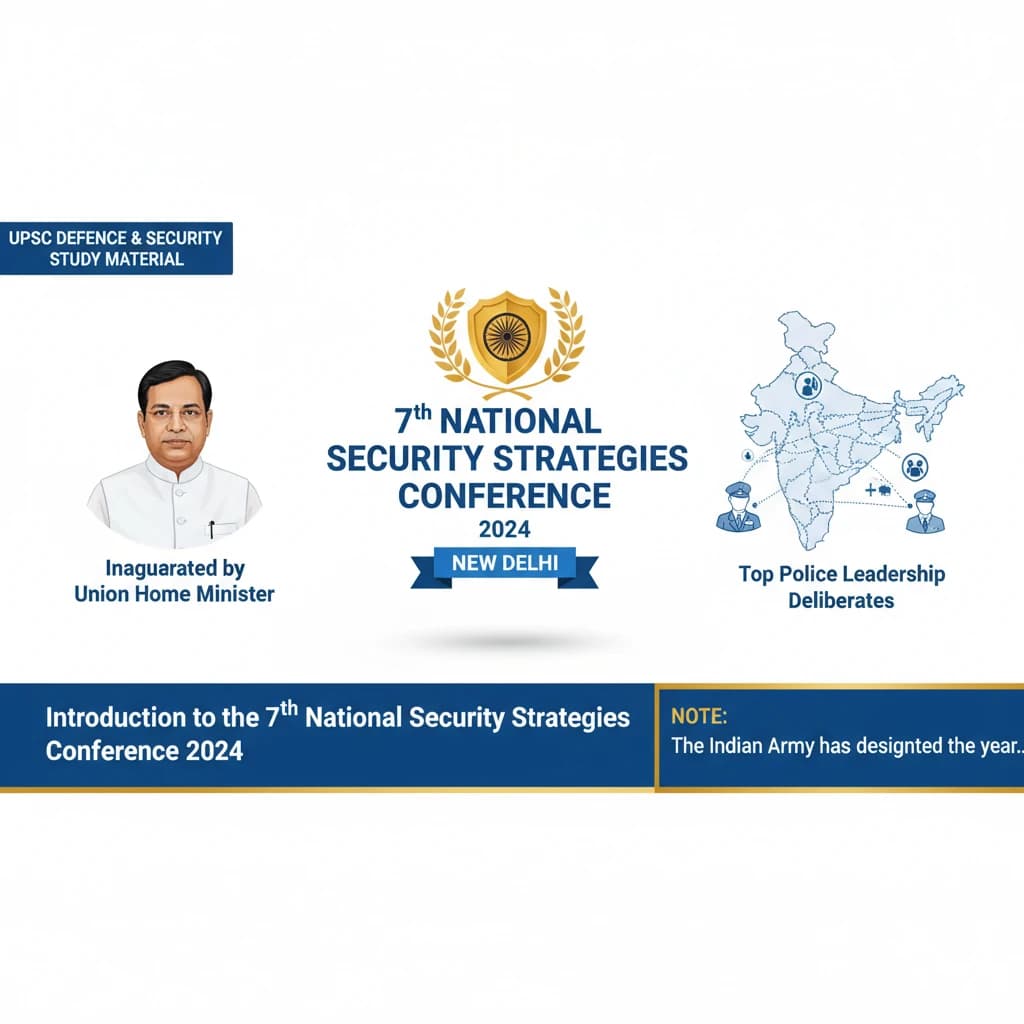
7th National Security Strategies Conference 2024
Medium⏱️ 10 min read
defence and security
📖 Introduction
Introduction to the 7th National Security Strategies Conference 2024
The 7th National Security Strategies Conference (NSSC) 2024 was recently inaugurated by the Union Home Minister in New Delhi. This significant event brought together top police leadership to deliberate on emerging national security challenges facing India.
Note: The Indian Army has designated the year 2024 as the 'Year of Technology Absorption', underscoring the critical role of technological advancement in defence preparedness.
Purpose and Genesis of NSSC
The National Security Strategies Conference (NSSC) was conceptualised by the Prime Minister during the annual DGsP/IGsP Conference. Its primary objective is to identify and formulate solutions for major national security challenges through collaborative discussions.
The NSSC serves as a crucial platform for strategic dialogue, bringing together diverse perspectives to enhance India's security framework.
Diversity of Participants
The conference is unique in its participant mix, which includes senior police leadership actively managing national security issues, young police officers working at the cutting-edge level, and various domain experts from specialised fields. This diversity ensures a holistic approach to problem-solving.
Key Highlights of NSSC 2024
The NSSC 2024 focused on several critical areas, fostering discussions to develop a robust roadmap for national security.
DGsP/IGsP Conference Recommendations Dashboard: A new dashboard, developed by the National Crime Records Bureau (NCRB), was launched. This tool is designed to facilitate the effective implementation of decisions made during the annual Directors and Inspectors General of Police (DGsP/IGsP) conference, chaired by the Prime Minister.
Focus on Tribal Issues with a Non-Colonial Approach: A significant emphasis was placed on adopting a non-colonial perspective when addressing the grievances and issues of tribal communities. This approach advocates for respect, inclusion, and empowerment, moving away from historical models of control and exclusion.
Discussion on Multiple Security Challenges: The conference addressed a range of contemporary security threats, including the radicalisation of youth via social media. Specific concerns were raised regarding 'Islamic and Khalistani radicalisation'.
Areas Identified for the 'Year of Reforms' in 2025
Looking ahead, the conference outlined key areas for reform in 2025, designated as the 'Year of Reforms'. These reforms aim to strengthen India's defence and security apparatus comprehensively.
Jointness & Integration
This area focuses on enhancing cooperation among different military services. A key objective is to promote the establishment of Integrated Theatre Commands (ITCs) to streamline operations and command structures.
Integrated Theatre Commands (ITCs) are proposed for specific geographical or operational areas. Examples include a China-focused northern command in Lucknow, a Pakistan-focused western command in Jaipur, and a dedicated maritime command in Thiruvananthapuram.
The strategy involves developing joint operational capabilities through intensified inter-service cooperation and combined training exercises.
Emerging Technologies
Reforms in this domain are centred on new warfare areas such as Cyber and Space. It also prioritises the integration of cutting-edge technologies like Artificial Intelligence (AI), Machine Learning (ML), Hypersonics, and Robotics into defence capabilities.
Developing associated tactics, techniques, and procedures (TTPs) is crucial to effectively leverage these technologies for future warfare scenarios.
Promoting technology transfer, knowledge sharing, and fostering public-private partnerships are vital. This includes improving the ease of doing business between the defence and civil sectors to accelerate innovation.
Simplifying Acquisition
To accelerate and strengthen capability development, acquisition procedures need to be streamlined and time-bound. This reform aims to reduce delays and enhance efficiency in procuring defence equipment and technologies.
Defence Exporter
India aims to position itself as a credible exporter of defence products on the global stage. This involves fostering robust Research & Development (R&D) and establishing partnerships between Indian industries and foreign Original Equipment Manufacturers (OEMs).
India's defence exports have seen significant growth, rising to over Rs 21,000 crore in recent times, a substantial increase from Rs 2,000 crore in 2014.
Veteran Welfare and Indigenous Culture
Ensuring the comprehensive welfare of veterans is a priority, alongside leveraging their invaluable expertise for national development and security initiatives.
Additionally, the reforms seek to foster pride in Indian culture and build confidence in achieving global standards through indigenous capabilities, while also adapting best practices from modern militaries worldwide.
For UPSC Mains GS Paper 3 (Internal Security), understanding the 'Year of Reforms' and the NSSC's focus areas provides crucial points for questions on defence modernisation, internal security challenges, and strategic policy. The emphasis on tribal issues and a non-colonial approach is also relevant for GS Paper 1 (Social Issues) and GS Paper 2 (Governance).
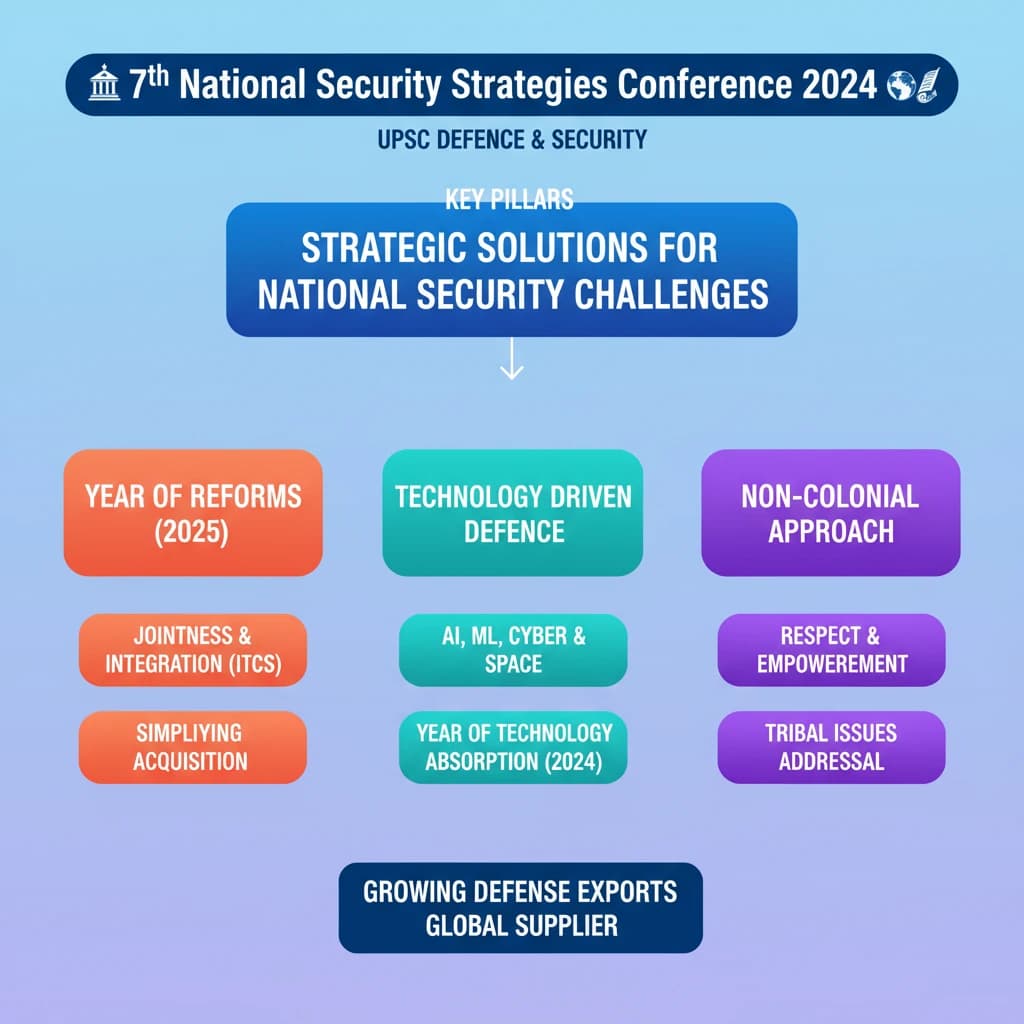
💡 Key Takeaways
- •The 7th NSSC 2024 focused on strategic solutions for national security challenges, led by the Union Home Minister.
- •Key reform areas for 2025 ('Year of Reforms') include Jointness & Integration (ITCs), Emerging Technologies, Simplifying Acquisition, and Defence Exports.
- •The conference emphasised a 'non-colonial approach' to addressing tribal issues, promoting respect and empowerment.
- •New technologies like AI, ML, Cyber, and Space are critical for future warfare, driving the Indian Army's 'Year of Technology Absorption' in 2024.
- •India's defence exports have significantly grown, positioning it as a credible global defence supplier.
- •Combating youth radicalisation via social media, particularly Islamic and Khalistani ideologies, was a major concern.
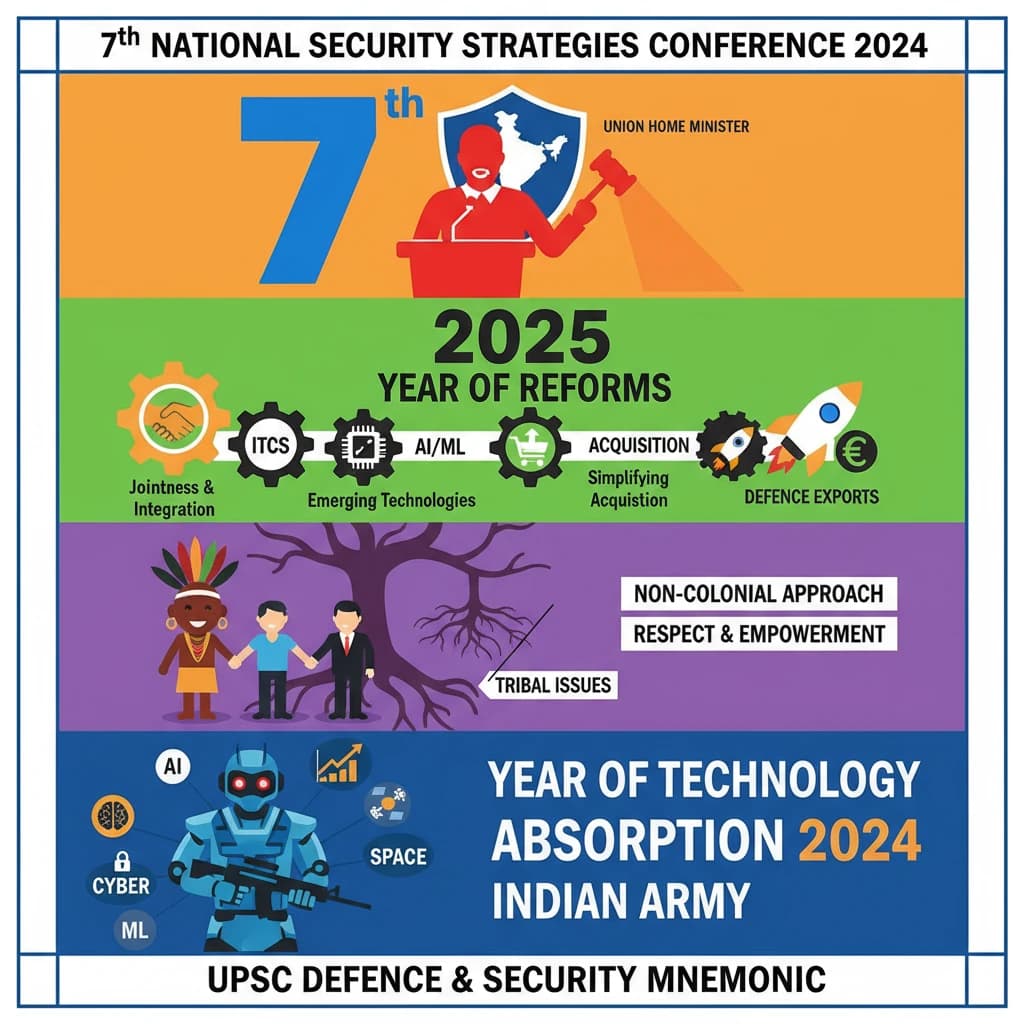
🧠 Memory Techniques
95% Verified Content