Loading page, please wait…
Vaidra Logo
Vaidra

Top 4 items + smart groups

UPSC GPT
New
Current Affairs
Daily Solutions
Daily Puzzle
Mains Evaluator

Version 2.0.0 • Built with ❤️ for UPSC aspirants

Loading...
Loading...
Loading...
Loading...
Loading...
Loading...
Loading...
Loading...
Loading...
Loading...
Loading...
Loading...
Loading...
Back
All Subjects

Topics

0 topics • 0 completed

Loading topics...
Loading...
Loading...
Loading...
Loading...
Loading...
Overall Progress0%
NIA’s Combat Against the Terror-Gangster Nexus - UPSC Defence And Security

NIA’s Combat Against the Terror-Gangster Nexus - UPSC Defence And Security

What is NIA’s Combat Against the Terror-Gangster Nexus in UPSC Defence And Security?

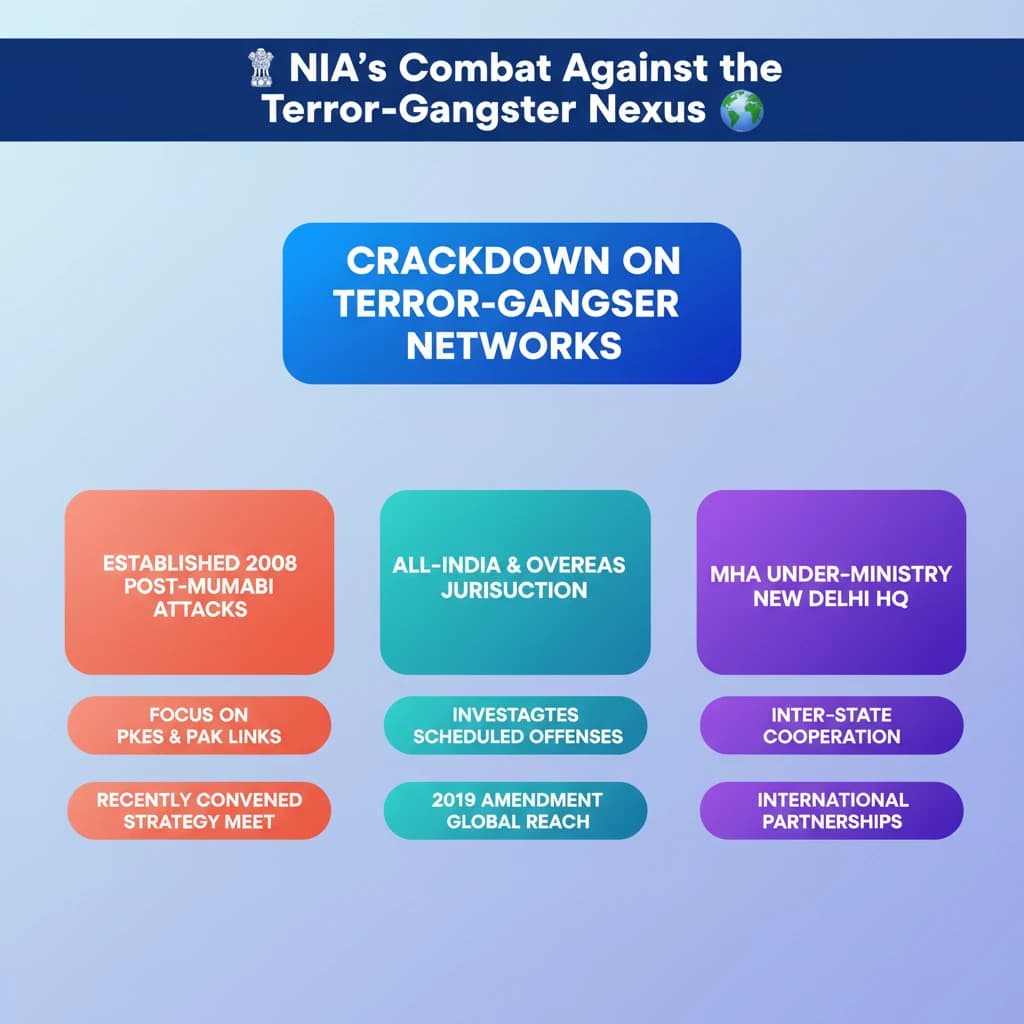
NIA’s Combat Against the Terror-Gangster Nexus is a key topic under Defence And Security for UPSC Civil Services Examination. Key points include: NIA was established in 2008 post-Mumbai attacks to combat terrorism.. It recently convened a meeting to address the growing terror-gangster nexus, especially with PKEs and Pakistan links.. NIA operates under the Ministry of Home Affairs with headquarters in New Delhi.. Understanding this topic is essential for both UPSC Prelims and Mains preparation.

Why is NIA’s Combat Against the Terror-Gangster Nexus important for UPSC exam?

NIA’s Combat Against the Terror-Gangster Nexus is a Medium-level topic in UPSC Defence And Security. It is tested in both Prelims (factual MCQs) and Mains (analytical answer writing). Previous year UPSC questions have frequently covered aspects of NIA’s Combat Against the Terror-Gangster Nexus, making it essential for comprehensive IAS preparation.

How to prepare NIA’s Combat Against the Terror-Gangster Nexus for UPSC?

To prepare NIA’s Combat Against the Terror-Gangster Nexus for UPSC: (1) Study the comprehensive notes covering all key concepts on Vaidra. (2) Practice previous year questions on this topic. (3) Connect it with current affairs using daily updates. (4) Revise using key takeaways and mind maps available for Defence And Security. (5) Write practice answers linking NIA’s Combat Against the Terror-Gangster Nexus to related GS Paper topics.

Key takeaways of NIA’s Combat Against the Terror-Gangster Nexus for UPSC

  • NIA was established in 2008 post-Mumbai attacks to combat terrorism.
  • It recently convened a meeting to address the growing terror-gangster nexus, especially with PKEs and Pakistan links.
  • NIA operates under the Ministry of Home Affairs with headquarters in New Delhi.
  • It has broad jurisdiction, including investigating scheduled offenses outside India (post-2019 Amendment).
  • The nexus poses a significant threat, requiring strong inter-state and international cooperation.
NIA’s Combat Against the Terror-Gangster Nexus

NIA’s Combat Against the Terror-Gangster Nexus

Medium⏱️ 7 min read✓ 95% Verified
defence and security

📖 Introduction

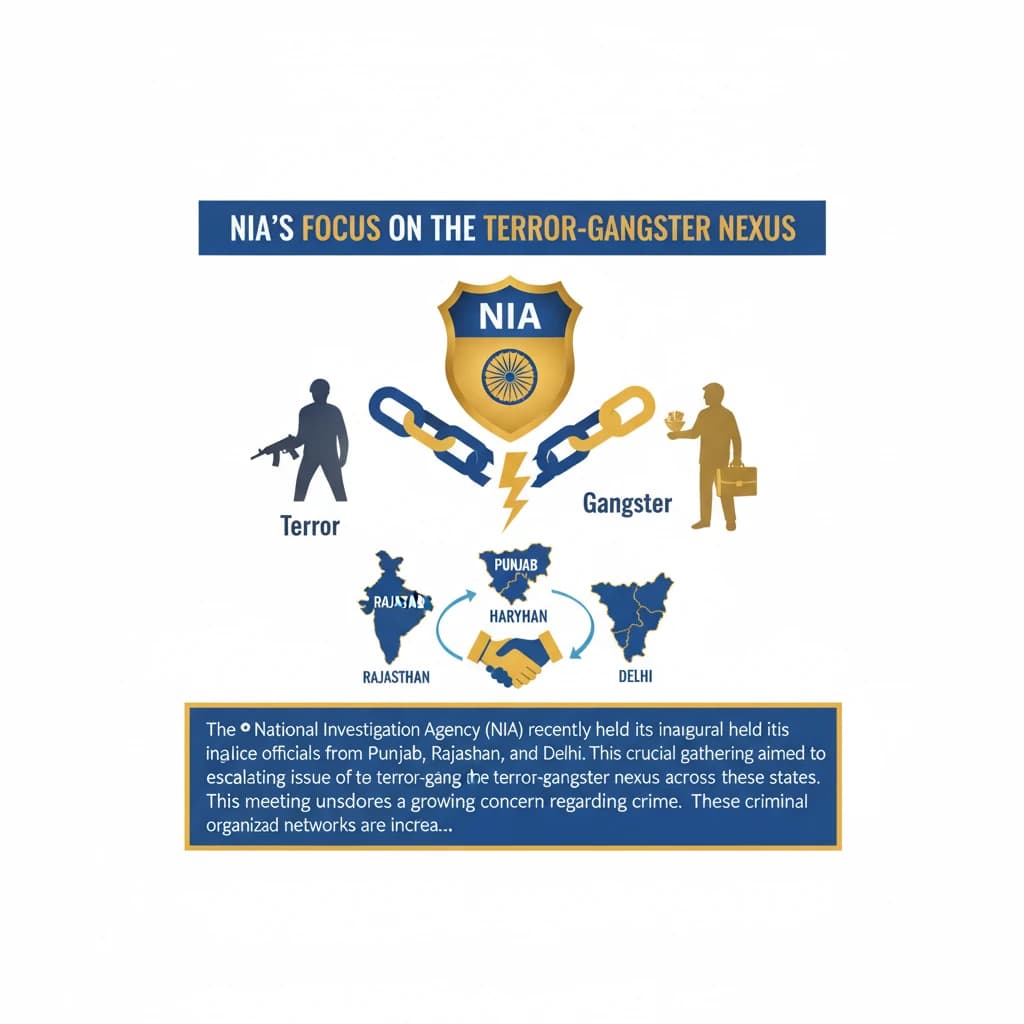
<h4>NIA's Focus on the Terror-Gangster Nexus</h4><p>The <strong>National Investigation Agency (NIA)</strong> recently held its inaugural meeting with police officials from <strong>Punjab, Rajasthan, Haryana</strong>, and <strong>Delhi</strong>. This crucial gathering aimed to address the escalating issue of the <strong>terror-gangster nexus</strong> across these states.</p><p>This meeting underscores a growing concern regarding <strong>organized crime</strong>. These criminal networks are increasingly linked to <strong>terror groups</strong>, particularly those associated with <strong>Pro-Khalistan Elements (PKEs)</strong> and having direct connections to <strong>Pakistan</strong>.</p><div class='key-point-box'><p>The convergence of <strong>terrorist organizations</strong> and <strong>organized criminal gangs</strong> poses a significant and evolving threat to India's internal security, demanding a coordinated and robust response.</p></div><h4>Establishment of the National Investigation Agency (NIA)</h4><p>The <strong>National Investigation Agency (NIA)</strong> was established by the Indian government in <strong>2008</strong>. Its primary mandate is to combat the complex and multifaceted threats of <strong>terrorism</strong>, especially those involving inter-State and international linkages.</p><div class='info-box'><p><strong>Formation Catalyst:</strong> The NIA was formed directly in response to the devastating <strong>2008 Mumbai terror attacks</strong>.</p><p><strong>Legal Basis:</strong> It was constituted under the <strong>National Investigation Agency Act, 2008</strong>.</p></div><p>The establishment of the NIA was based on recommendations from various experts and committees. Notably, the <strong>Administrative Reforms Commission</strong> played a role in advocating for such a specialized agency.</p><h4>NIA's Organisational Framework</h4><p>The <strong>National Investigation Agency (NIA)</strong> operates under the direct purview of the <strong>Union Ministry of Home Affairs</strong>, which serves as its parent ministry.</p><div class='info-box'><p><strong>Headquarters:</strong> The primary headquarters of the NIA is located in <strong>New Delhi</strong>.</p></div><h4>NIA's Investigation Procedures</h4><p>State governments possess the authority to refer specific cases to the <strong>NIA</strong>. This process is facilitated through the <strong>Central Government</strong>, specifically the <strong>Union Home Ministry</strong>.</p><p>Beyond referrals, the NIA also has the power to initiate investigations <strong>suo motu</strong>, meaning on its own accord. Alternatively, it can take up cases if explicitly directed by the <strong>Central Government</strong>.</p><div class='key-point-box'><p>A significant aspect of NIA's jurisdiction is its ability to investigate <strong>scheduled offenses</strong> committed outside India. This capability is crucial for addressing cross-border terrorism and related crimes.</p></div><h4>Mandate and Jurisdiction of NIA</h4><p>The <strong>NIA's mandate</strong> is broad, empowering it to investigate and prosecute offenses that directly affect <strong>national security, sovereignty, and international relations</strong> of India.</p><p>Its jurisdiction is unique, allowing it to operate across all Indian states <strong>without needing special permission</strong> from individual state governments. This ensures swift and unhindered investigations into complex terror cases.</p><div class='info-box'><p><strong>Expanded Scope:</strong> Under the <strong>NIA (Amendment) Act, 2019</strong>, the agency's jurisdiction was further expanded, explicitly allowing it to investigate crimes committed <strong>outside India</strong>, enhancing its capability to tackle global terror networks.</p></div><div class='exam-tip-box'><p>For <strong>UPSC Mains GS Paper III (Internal Security)</strong>, understanding the NIA's role, its legal framework (Acts and Amendments), and its operational challenges (like the terror-gangster nexus) is critical. Questions often revolve around institutional mechanisms to combat terrorism.</p></div>
Concept Diagram

💡 Key Takeaways

  • •NIA was established in 2008 post-Mumbai attacks to combat terrorism.
  • •It recently convened a meeting to address the growing terror-gangster nexus, especially with PKEs and Pakistan links.
  • •NIA operates under the Ministry of Home Affairs with headquarters in New Delhi.
  • •It has broad jurisdiction, including investigating scheduled offenses outside India (post-2019 Amendment).
  • •The nexus poses a significant threat, requiring strong inter-state and international cooperation.

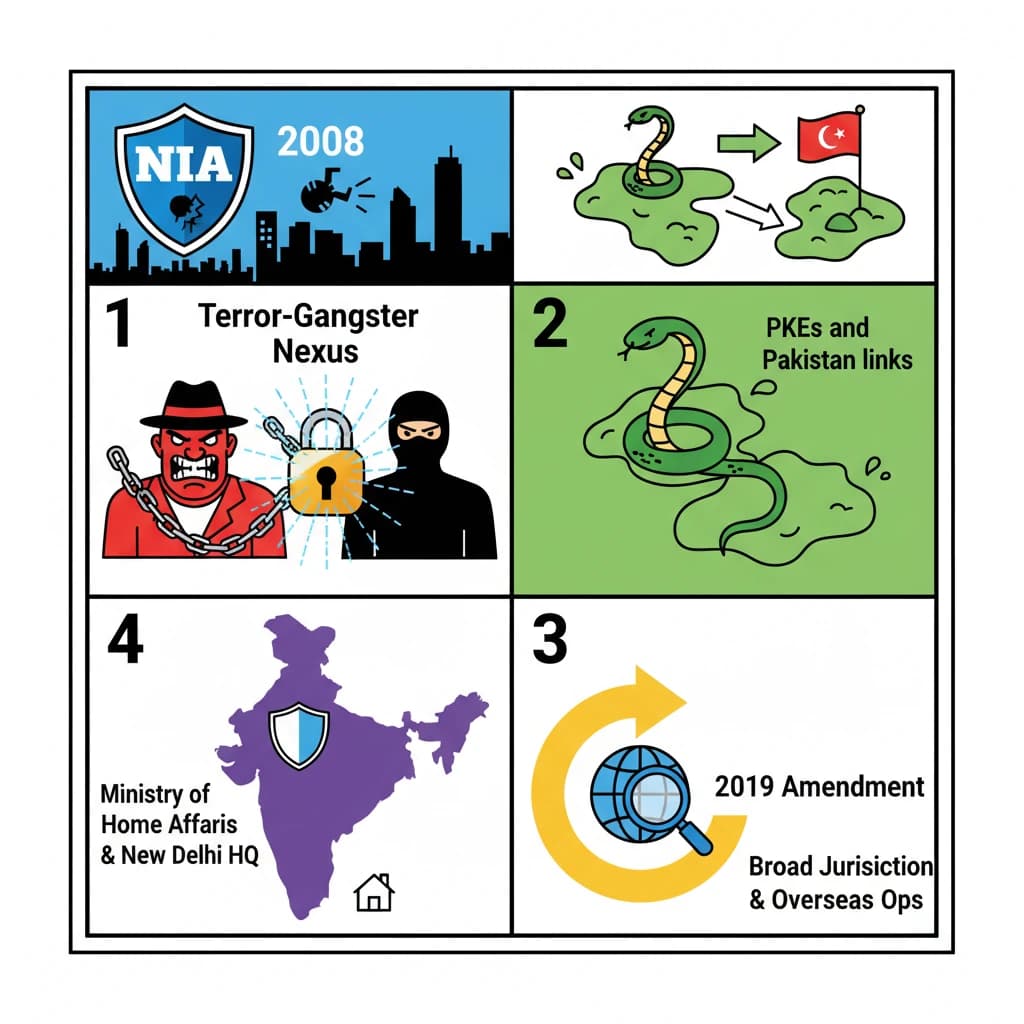
🧠 Memory Techniques
Memory Aid
95% Verified Content

Related Topics

Loading related topics...
Explore:Defence And Security Topics·All Subjects·Daily Current Affairs·Editorial Analysis·Previous Year Questions·UPSC GPT