Loading page, please wait…
Vaidra Logo
Vaidra

Top 4 items + smart groups

UPSC GPT
New
Current Affairs
Daily Solutions
Daily Puzzle
Mains Evaluator

Version 2.0.0 • Built with ❤️ for UPSC aspirants

Loading...
Loading...
Loading...
Loading...
Loading...
Loading...
Loading...
Loading...
Loading...
Loading...
Loading...
Loading...
Loading...
Back
All Subjects

Topics

0 topics • 0 completed

Loading topics...
Loading...
Loading...
Loading...
Loading...
Loading...
Overall Progress0%

Launch of Samudra Pratap - UPSC Defence And Security

What is Launch of Samudra Pratap in UPSC Defence And Security?

Launch of Samudra Pratap is a key topic under Defence And Security for UPSC Civil Services Examination. Key points include: Samudra Pratap is India's first indigenously built Pollution Control Vessel (PCV).. It was launched in Goa and built by Goa Shipyard Limited (GSL) for the Indian Coast Guard (ICG).. Its primary purpose is to check and control oil spillage in India's sea coast.. Understanding this topic is essential for both UPSC Prelims and Mains preparation.

Why is Launch of Samudra Pratap important for UPSC exam?

Launch of Samudra Pratap is a Medium-level topic in UPSC Defence And Security. It is tested in both Prelims (factual MCQs) and Mains (analytical answer writing). Previous year UPSC questions have frequently covered aspects of Launch of Samudra Pratap, making it essential for comprehensive IAS preparation.

How to prepare Launch of Samudra Pratap for UPSC?

To prepare Launch of Samudra Pratap for UPSC: (1) Study the comprehensive notes covering all key concepts on Vaidra. (2) Practice previous year questions on this topic. (3) Connect it with current affairs using daily updates. (4) Revise using key takeaways and mind maps available for Defence And Security. (5) Write practice answers linking Launch of Samudra Pratap to related GS Paper topics.

Key takeaways of Launch of Samudra Pratap for UPSC

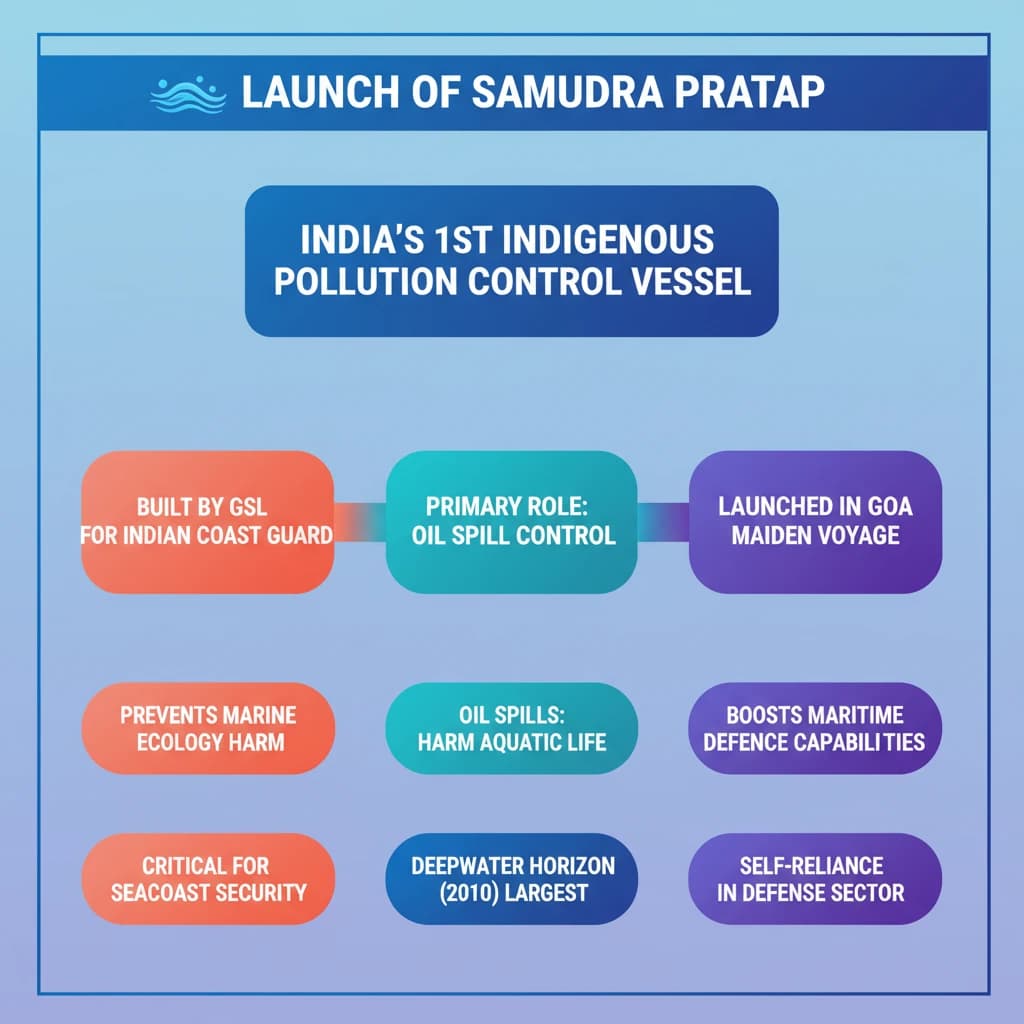
  • Samudra Pratap is India's first indigenously built Pollution Control Vessel (PCV).
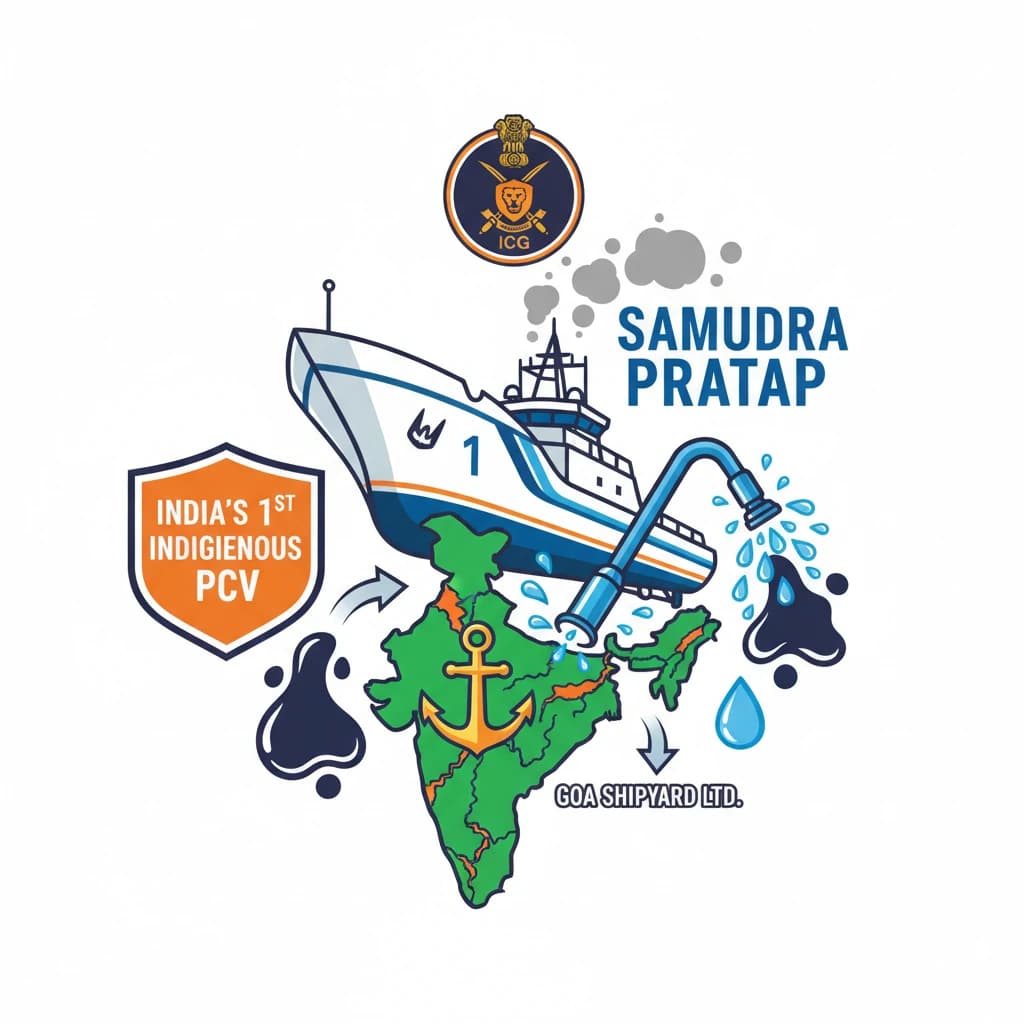
  • It was launched in Goa and built by Goa Shipyard Limited (GSL) for the Indian Coast Guard (ICG).
  • Its primary purpose is to check and control oil spillage in India's sea coast.
  • Oil spills are releases of liquid petroleum hydrocarbons into marine environments, harming aquatic life.
  • The Deepwater Horizon (2010) was the largest oil spill in history.
  • Oilsheening is a new technique using bacteria to mitigate oil spills.
Launch of Samudra Pratap

Launch of Samudra Pratap

Medium⏱️ 6 min read✓ 95% Verified
defence and security

📖 Introduction

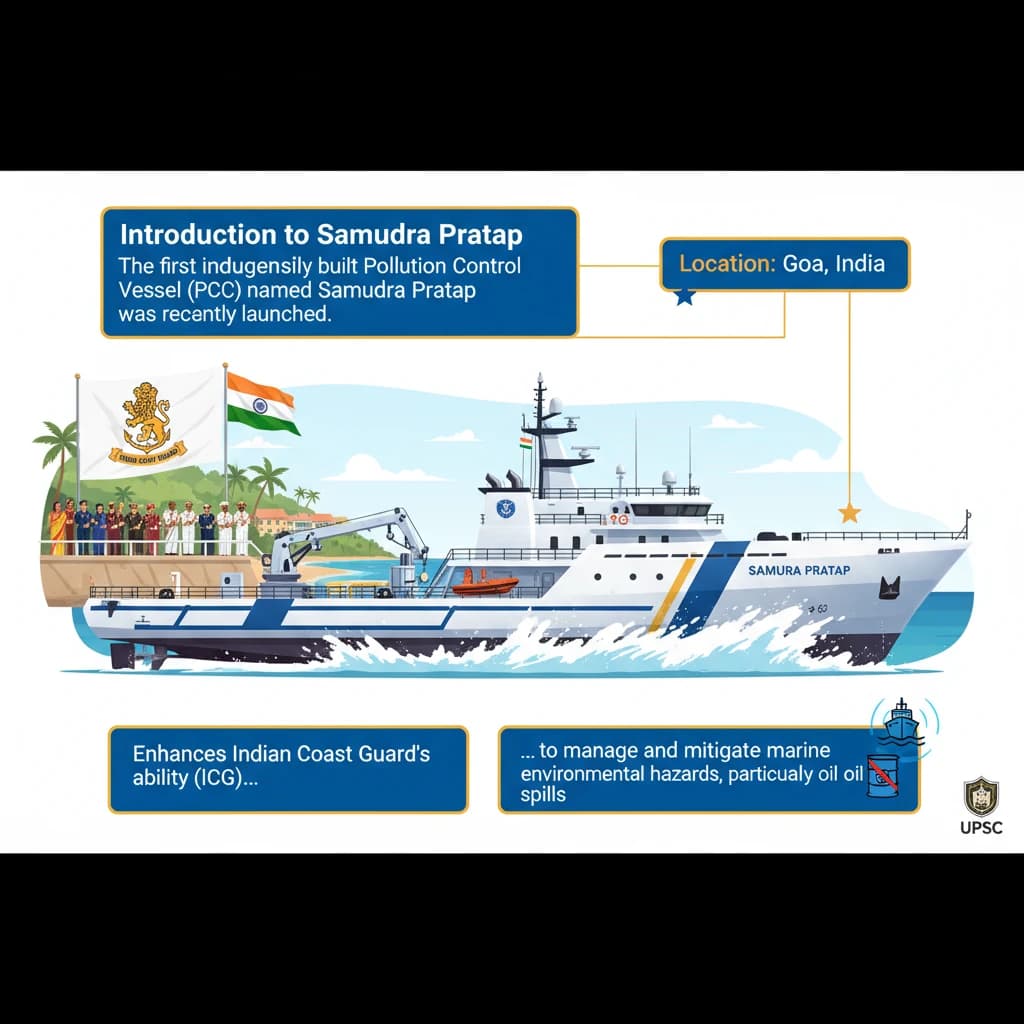
<h4>Introduction to Samudra Pratap</h4><p>The <strong>first indigenously built Pollution Control Vessel (PCV)</strong> named <strong>Samudra Pratap</strong> was recently launched. This significant event took place in <strong>Goa</strong>, marking a crucial step in India's maritime capabilities.</p><p>The vessel is designed to enhance the <strong>Indian Coast Guard's (ICG)</strong> ability to manage and mitigate marine environmental hazards, particularly <strong>oil spills</strong>.</p><div class='info-box'><p><strong>Key Details of Samudra Pratap:</strong></p><ul><li><strong>Type:</strong> Pollution Control Vessel (PCV)</li><li><strong>Builder:</strong> <strong>Goa Shipyard Limited (GSL)</strong></li><li><strong>Operator:</strong> <strong>Indian Coast Guard (ICG)</strong></li><li><strong>Location of Launch:</strong> Goa</li></ul></div><h4>Significance of Indigenous Design and Construction</h4><p>The construction of <strong>Samudra Pratap</strong> represents a landmark achievement for India. It is the <strong>first time</strong> that such specialized pollution control vessels are being entirely <strong>designed and constructed indigenously</strong> within the country.</p><div class='key-point-box'><p>This indigenous development aligns with the government's <strong>'Make in India'</strong> and <strong>'Atmanirbhar Bharat'</strong> initiatives, bolstering India's self-reliance in defence and maritime technology.</p></div><p>The vessel's primary role will be to effectively check and control <strong>oil spillage</strong> incidents along India's vast coastline and in its Exclusive Economic Zone (EEZ).</p><h4>Understanding Oil Spills</h4><p>An <strong>oil spill</strong> is broadly defined as the release of a <strong>liquid petroleum hydrocarbon</strong> into the environment. This typically occurs in <strong>marine areas</strong> and is a direct consequence of human activity.</p><div class='info-box'><p><strong>Causes of Oil Spills:</strong></p><ul><li>Releases of <strong>crude oil</strong> from <strong>tankers</strong></li><li>Accidents involving <strong>offshore platforms</strong></li><li>Malfunctions in <strong>drilling rigs</strong> or <strong>wells</strong></li><li>Other industrial activities impacting marine ecosystems</li></ul></div><p><strong>Oil on ocean surfaces</strong> poses severe threats to <strong>aquatic life</strong>. It creates a barrier that blocks essential <strong>sunlight</strong> from penetrating the water, which is vital for photosynthetic organisms.</p><p>Furthermore, oil spills significantly <strong>reduce dissolved oxygen levels</strong> in the water, leading to suffocation and death for marine flora and fauna.</p><h4>Notable Oil Spill Incidents</h4><p>History has witnessed several catastrophic oil spills that highlight the devastating environmental and economic impacts of such disasters. These events underscore the critical need for effective pollution control measures.</p><div class='info-box'><p>The <strong>Deepwater Horizon oil spill</strong> in <strong>2010</strong>, occurring in the <strong>Gulf of Mexico</strong>, is widely recognized as the <strong>largest and most famous oil spill in history</strong>. It caused extensive damage to marine life and coastal economies.</p></div><h4>Innovative Oil Spill Mitigation Techniques</h4><p>To combat the challenges posed by oil spills, new technologies and methods are continuously being developed. These innovations aim to provide more efficient and environmentally friendly solutions for cleanup.</p><div class='key-point-box'><p>One such emerging technique is <strong>oilsheening</strong>. This method involves using specialized <strong>bacteria</strong> that are capable of consuming and breaking down petroleum hydrocarbons, effectively helping to rid the environment of oil spills.</p></div><div class='exam-tip-box'><p><strong>UPSC Relevance:</strong> The launch of <strong>Samudra Pratap</strong> is significant for <strong>GS Paper III</strong> (Security, Environment). Questions can relate to <strong>maritime security</strong>, <strong>environmental protection</strong>, <strong>disaster management</strong>, and <strong>indigenisation of defence technology</strong>. Understanding both the vessel's role and the broader context of oil spills is crucial.</p></div>
Concept Diagram

💡 Key Takeaways

  • •Samudra Pratap is India's first indigenously built Pollution Control Vessel (PCV).
  • •It was launched in Goa and built by Goa Shipyard Limited (GSL) for the Indian Coast Guard (ICG).
  • •Its primary purpose is to check and control oil spillage in India's sea coast.
  • •Oil spills are releases of liquid petroleum hydrocarbons into marine environments, harming aquatic life.
  • •The Deepwater Horizon (2010) was the largest oil spill in history.
  • •Oilsheening is a new technique using bacteria to mitigate oil spills.

🧠 Memory Techniques
Memory Aid
95% Verified Content

📚 Reference Sources

•Official statements from the Ministry of Defence, Government of India (implied)
•Reports from Goa Shipyard Limited (GSL) and Indian Coast Guard (ICG) (implied)

Related Topics

Loading related topics...
Explore:Defence And Security Topics·All Subjects·Daily Current Affairs·Editorial Analysis·Previous Year Questions·UPSC GPT
Launch of Samudra Pratap - UPSC Defence And Security