Loading page, please wait…
Developments and Innovation in Defence Sector - UPSC Defence And Security
What is Developments and Innovation in Defence Sector in UPSC Defence And Security?
Developments and Innovation in Defence Sector is a key topic under Defence And Security for UPSC Civil Services Examination. Key points include: Positive Indigenisation Lists (PILs) mandate domestic procurement of specific defence items.. The 5th PIL includes 346 items, targeting Rs 3,048 crore in import substitution.. PILs are a core component of 'Aatmanirbhar Bharat' in defence, boosting local industry, MSMEs, and startups.. Understanding this topic is essential for both UPSC Prelims and Mains preparation.
Why is Developments and Innovation in Defence Sector important for UPSC exam?
Developments and Innovation in Defence Sector is a Medium-level topic in UPSC Defence And Security. It is tested in both Prelims (factual MCQs) and Mains (analytical answer writing). Previous year UPSC questions have frequently covered aspects of Developments and Innovation in Defence Sector, making it essential for comprehensive IAS preparation.
How to prepare Developments and Innovation in Defence Sector for UPSC?
To prepare Developments and Innovation in Defence Sector for UPSC: (1) Study the comprehensive notes covering all key concepts on Vaidra. (2) Practice previous year questions on this topic. (3) Connect it with current affairs using daily updates. (4) Revise using key takeaways and mind maps available for Defence And Security. (5) Write practice answers linking Developments and Innovation in Defence Sector to related GS Paper topics.
Key takeaways of Developments and Innovation in Defence Sector for UPSC
- Positive Indigenisation Lists (PILs) mandate domestic procurement of specific defence items.
- The 5th PIL includes 346 items, targeting Rs 3,048 crore in import substitution.
- PILs are a core component of 'Aatmanirbhar Bharat' in defence, boosting local industry, MSMEs, and startups.
- The concept was introduced in Defence Acquisition Procedure (DAP) 2020.
- Over 4,600 items are listed across all PILs, with significant progress in indigenisation and orders placed on domestic vendors.
Developments and Innovation in Defence Sector
Medium⏱️ 8 min read
defence and security
📖 Introduction
Introduction to Positive Indigenisation Lists
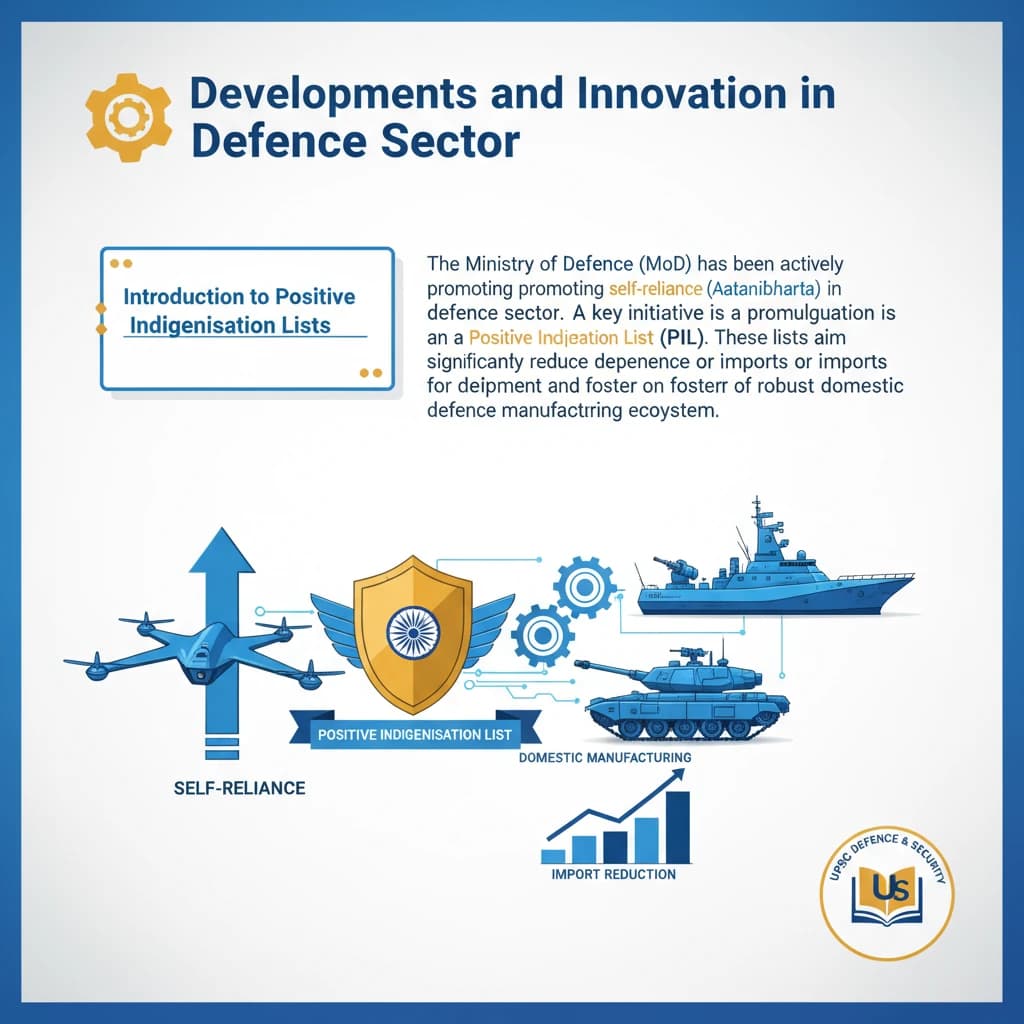
The Ministry of Defence (MoD) has been actively promoting self-reliance (Aatmanirbharta) in the defence sector. A key initiative in this direction is the promulgation of the Positive Indigenisation List (PIL).
These lists aim to significantly reduce dependence on imports for defence equipment and foster a robust domestic defence manufacturing ecosystem.
The Positive Indigenisation List (PIL) specifies defence items that can only be procured from domestic manufacturers, including both private sector entities and Defence Public Sector Undertakings (DPSUs).
The Fifth Positive Indigenisation List
The MoD recently released its fifth Positive Indigenisation List, comprising a significant number of defence items. This move reinforces the government's commitment to boosting indigenous defence production.
The fifth PIL includes 346 items, specifically chosen to enhance Aatmanirbharta and strengthen India's defence export capabilities through DPSUs.
The primary objective is to ensure that these items are sourced exclusively from the Indian industry. This includes vital contributions from Micro, Small, and Medium Enterprises (MSMEs) and innovative startups.
Scope of Items in the Fifth PIL
The items on the list are strategically important and cover a broad spectrum of defence requirements. They are crucial for maintaining and upgrading India's military readiness.
- Line Replacement Units (LRUs)
- Systems and Sub-systems
- Assemblies and Sub-assemblies
- Spares and Components
- Raw Materials
Implementation and Monitoring
The implementation of the PIL is facilitated through dedicated platforms and processes. This ensures transparency and active participation from the domestic industry.
The list is accessible on the MoD’s Srijan portal. This portal serves as a critical interface, allowing DPSUs and Service Headquarters (SHQs) to offer defence items for indigenisation to private industries.
Leading DPSUs such as Hindustan Aeronautics Limited (HAL), Bharat Electronics Ltd (BEL), and Bharat Dynamics Ltd (BDL) have already initiated procedures. These include issuing Expressions of Interest (EoIs) and Requests For Tender or Proposals (RFPs) to engage domestic manufacturers.
Expected Impact of the Fifth PIL
The indigenisation efforts outlined in the fifth PIL are projected to yield substantial economic and strategic benefits for India.
The indigenisation of these 346 items is expected to generate an import substitution value worth approximately Rs 3,048 crore.
This initiative provides a crucial assurance to the domestic defence industry. It encourages them to invest in developing advanced defence products without the competitive threat of imports, fostering long-term growth and innovation.
Future Goals and Incremental Approach
The MoD has a clear long-term vision for the Positive Indigenisation Lists. This involves a sustained and expanding effort to achieve greater self-reliance.
The MoD aims to continuously expand the PIL annually, with a target to increase the number of indigenised items up to 2025.
This incremental strategy is designed to support the overarching goal of achieving comprehensive self-reliance in India's defence production capabilities over time.
Understanding the Positive Indigenisation List (PIL)
The PIL is a fundamental policy tool introduced to transform India's defence procurement landscape. It mandates domestic sourcing for specific items.
The concept of the PIL was formally introduced within the Defence Acquisition Procedure (DAP) 2020. It focuses on replacing imports for major systems, platforms, weapon systems, sensors, and munitions.
The lists encompass a diverse range of items essential for strengthening India's defence capabilities and promoting a self-reliant defence sector.
Evolution and Progress of PILs
The journey of Positive Indigenisation Lists began a few years ago and has shown consistent progress in reducing import dependency.
- The first PIL was promulgated in August 2020.
- Successive lists have been released, bringing the cumulative total to 4,666 items across various categories.
- So far, 2,972 items have been successfully indigenised, resulting in an import substitution value of Rs 3,400 crore.
These initial lists for DPSUs are in addition to the five positive indigenisation lists of 509 items notified by the Department of Military Affairs (DMA). These DMA lists include highly complex systems, sensors, weapons, and ammunition.
More than 36,000 defence items have been offered to the industry for indigenisation. Over 12,300 items have been indigenised in the last three years alone.
As a direct result of these efforts, DPSUs have placed orders with domestic vendors amounting to approximately Rs 7,572 crore, significantly boosting the local economy and manufacturing base.
UPSC Insight: The Positive Indigenisation List is a recurring topic in GS-III (Internal Security & Economy). Understand its mechanism, impact, and connection to 'Aatmanirbhar Bharat' for Mains answers. Prelims might test the number of lists, key items, or associated portals like Srijan.
💡 Key Takeaways
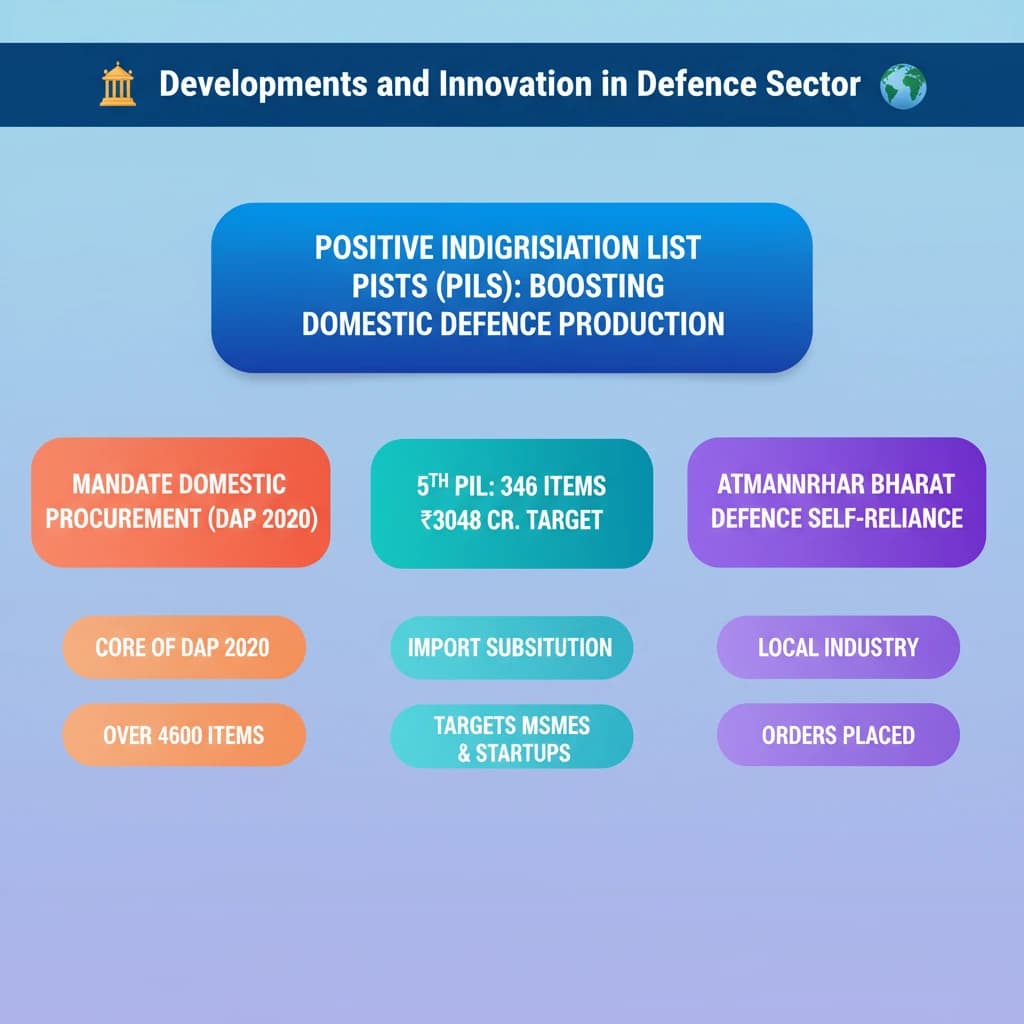
- •Positive Indigenisation Lists (PILs) mandate domestic procurement of specific defence items.
- •The 5th PIL includes 346 items, targeting Rs 3,048 crore in import substitution.
- •PILs are a core component of 'Aatmanirbhar Bharat' in defence, boosting local industry, MSMEs, and startups.
- •The concept was introduced in Defence Acquisition Procedure (DAP) 2020.
- •Over 4,600 items are listed across all PILs, with significant progress in indigenisation and orders placed on domestic vendors.
🧠 Memory Techniques
95% Verified Content
📚 Reference Sources
•Ministry of Defence (MoD) official press releases (implied from summary content)
•Defence Acquisition Procedure (DAP) 2020 documents (implied)