Loading page, please wait…
Exercise Naseem Al Bahr - UPSC Defence And Security
What is Exercise Naseem Al Bahr in UPSC Defence And Security?
Exercise Naseem Al Bahr is a key topic under Defence And Security for UPSC Civil Services Examination. Key points include: Exercise Naseem Al Bahr is a bilateral naval exercise between India and Oman, meaning 'Sea Breeze'.. It commenced in 1993, signifying a long-standing defence partnership.. Key objectives include enhancing interoperability, sharing best practices, and strengthening maritime security.. Understanding this topic is essential for both UPSC Prelims and Mains preparation.
Why is Exercise Naseem Al Bahr important for UPSC exam?
Exercise Naseem Al Bahr is a Medium-level topic in UPSC Defence And Security. It is tested in both Prelims (factual MCQs) and Mains (analytical answer writing). Previous year UPSC questions have frequently covered aspects of Exercise Naseem Al Bahr, making it essential for comprehensive IAS preparation.
How to prepare Exercise Naseem Al Bahr for UPSC?
To prepare Exercise Naseem Al Bahr for UPSC: (1) Study the comprehensive notes covering all key concepts on Vaidra. (2) Practice previous year questions on this topic. (3) Connect it with current affairs using daily updates. (4) Revise using key takeaways and mind maps available for Defence And Security. (5) Write practice answers linking Exercise Naseem Al Bahr to related GS Paper topics.
Key takeaways of Exercise Naseem Al Bahr for UPSC
- Exercise Naseem Al Bahr is a bilateral naval exercise between India and Oman, meaning 'Sea Breeze'.
- It commenced in 1993, signifying a long-standing defence partnership.
- Key objectives include enhancing interoperability, sharing best practices, and strengthening maritime security.
- Oman's strategic location, especially access to Duqm Port, is vital for India's maritime interests in the IOR.
- The exercise aligns with India's 'Act West Policy' and 'SAGAR' vision for regional stability and growth.
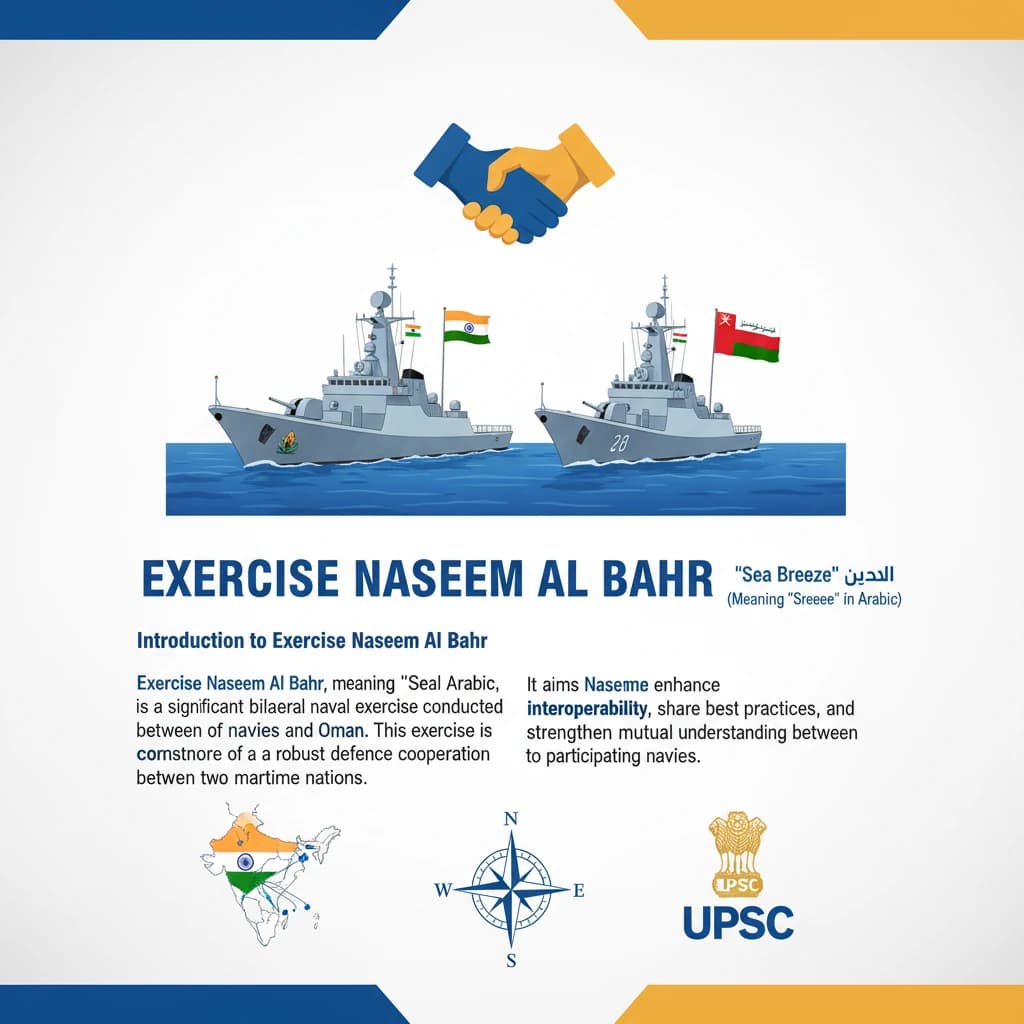
Exercise Naseem Al Bahr
Medium⏱️ 8 min read
defence and security
📖 Introduction
Introduction to Exercise Naseem Al Bahr
Exercise Naseem Al Bahr, meaning 'Sea Breeze' in Arabic, is a significant bilateral naval exercise conducted between the navies of India and Oman. This exercise is a cornerstone of the robust defence cooperation between the two maritime nations.
It aims to enhance interoperability, share best practices, and strengthen mutual understanding between the participating forces. The exercises involve various facets of naval operations, reflecting the evolving complexities of maritime security.
Key Fact: 'Naseem Al Bahr' translates to 'Sea Breeze'. It symbolizes the smooth and cooperative maritime relationship between India and Oman.
Objectives of the Exercise
The primary objectives of Exercise Naseem Al Bahr include fostering closer maritime ties and improving the operational capabilities of both navies. It facilitates joint planning and execution of naval manoeuvres.
Specific goals often involve refining tactics for anti-surface warfare, anti-air warfare, and maritime interdiction operations. These exercises are crucial for maintaining peace and stability in the strategically vital Indian Ocean Region (IOR).
Strategic Importance: The exercise underscores India's commitment to maritime security and its 'SAGAR' (Security and Growth for All in the Region) vision, promoting cooperative engagement with regional partners.
Participating Forces and Activities
Typically, the exercise involves a range of naval assets from both sides, including destroyers, frigates, submarines, and maritime patrol aircraft. Personnel from both navies engage in extensive professional interactions.
Activities encompass complex drills such as cross-deck landings, replenishment at sea (RAS), boarding operations, and simulated combat scenarios. These drills prepare forces for coordinated responses to various maritime threats.
UPSC Insight: Questions on bilateral defence exercises often appear in GS Paper 2 (International Relations) and GS Paper 3 (Internal Security/Defence). Focus on the participants, objectives, and strategic implications.
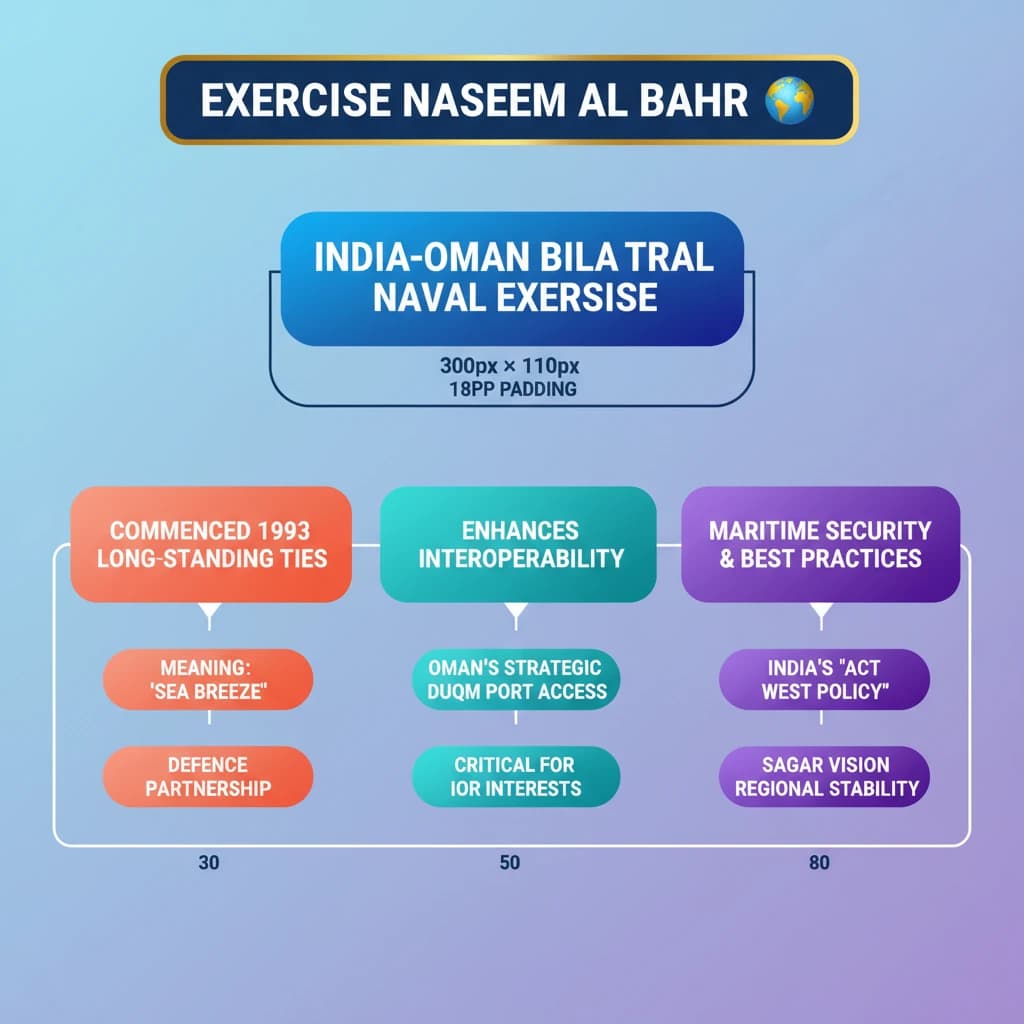
💡 Key Takeaways
- •Exercise Naseem Al Bahr is a bilateral naval exercise between India and Oman, meaning 'Sea Breeze'.
- •It commenced in 1993, signifying a long-standing defence partnership.
- •Key objectives include enhancing interoperability, sharing best practices, and strengthening maritime security.
- •Oman's strategic location, especially access to Duqm Port, is vital for India's maritime interests in the IOR.
- •The exercise aligns with India's 'Act West Policy' and 'SAGAR' vision for regional stability and growth.
🧠 Memory Techniques

95% Verified Content
📚 Reference Sources
•Indian Navy Official Website
•Observer Research Foundation (ORF) publications on India-Oman relations
•Institute for Defence Studies and Analyses (IDSA) reports
•Reputable news agencies covering defence affairs (e.g., The Hindu, PTI)