Loading page, please wait…
Vaidra Logo
Vaidra

Top 4 items + smart groups

UPSC GPT
New
Current Affairs
Daily Solutions
Daily Puzzle
Mains Evaluator

Version 2.0.0 • Built with ❤️ for UPSC aspirants

Loading...
Loading...
Loading...
Loading...
Loading...
Loading...
Loading...
Loading...
Loading...
Loading...
Loading...
Loading...
Loading...
Back
All Subjects

Topics

0 topics • 0 completed

Loading topics...
Loading...
Loading...
Loading...
Loading...
Loading...
Overall Progress0%

India-US Civil Nuclear Cooperation Agreement - UPSC Defence And Security

What is India-US Civil Nuclear Cooperation Agreement in UPSC Defence And Security?

India-US Civil Nuclear Cooperation Agreement is a key topic under Defence And Security for UPSC Civil Services Examination. Key points include: The 123 Agreement allows India access to civil nuclear technology and fuel despite its non-NPT status.. India committed to IAEA safeguards for its civilian nuclear facilities.. The US secured an NSG exemption for India to enable international nuclear trade.. Understanding this topic is essential for both UPSC Prelims and Mains preparation.

Why is India-US Civil Nuclear Cooperation Agreement important for UPSC exam?

India-US Civil Nuclear Cooperation Agreement is a Medium-level topic in UPSC Defence And Security. It is tested in both Prelims (factual MCQs) and Mains (analytical answer writing). Previous year UPSC questions have frequently covered aspects of India-US Civil Nuclear Cooperation Agreement, making it essential for comprehensive IAS preparation.

How to prepare India-US Civil Nuclear Cooperation Agreement for UPSC?

To prepare India-US Civil Nuclear Cooperation Agreement for UPSC: (1) Study the comprehensive notes covering all key concepts on Vaidra. (2) Practice previous year questions on this topic. (3) Connect it with current affairs using daily updates. (4) Revise using key takeaways and mind maps available for Defence And Security. (5) Write practice answers linking India-US Civil Nuclear Cooperation Agreement to related GS Paper topics.

Key takeaways of India-US Civil Nuclear Cooperation Agreement for UPSC

  • The 123 Agreement allows India access to civil nuclear technology and fuel despite its non-NPT status.
  • India committed to IAEA safeguards for its civilian nuclear facilities.
  • The US secured an NSG exemption for India to enable international nuclear trade.
  • It was a landmark agreement that transformed India's nuclear energy prospects and its global standing.
  • The agreement significantly strengthened the India-US strategic partnership.
India-US Civil Nuclear Cooperation Agreement

India-US Civil Nuclear Cooperation Agreement

Medium⏱️ 7 min read✓ 95% Verified
defence and security

📖 Introduction

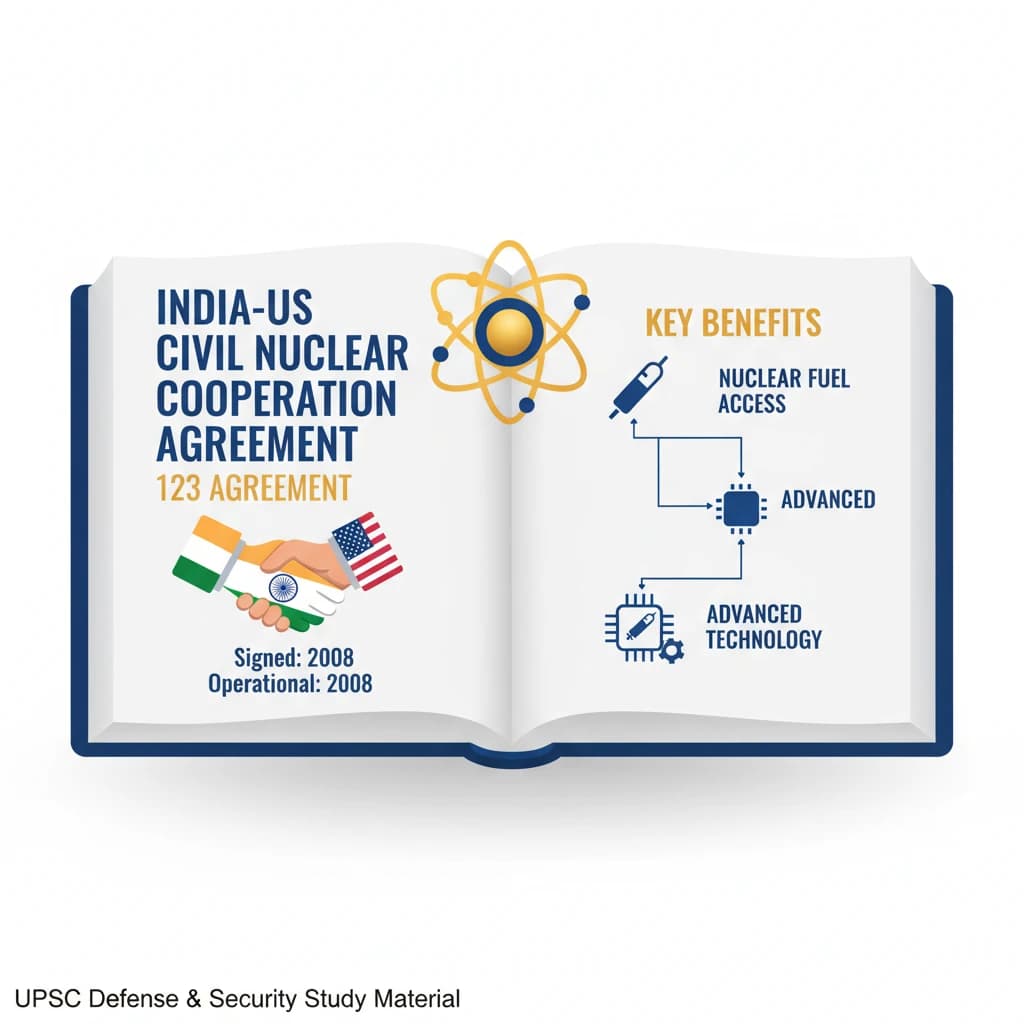
<h4>Introduction to the 123 Agreement</h4><p>The <strong>India-US Civil Nuclear Cooperation Agreement</strong>, often referred to as the <strong>123 Agreement</strong>, is a landmark bilateral accord between <strong>India</strong> and the <strong>United States</strong>. It was signed in <strong>2008</strong> and became operational in <strong>2008</strong>.</p><p>This agreement specifically permits <strong>India</strong> to access crucial <strong>nuclear fuel</strong>, advanced <strong>technology</strong>, and modern <strong>reactors</strong> from the global market. These resources are intended exclusively for <strong>peaceful purposes</strong>, primarily for <strong>energy generation</strong>.</p><div class='key-point-box'><p>A critical aspect of this agreement is that it allows such cooperation despite <strong>India</strong> not being a signatory to the <strong>Nuclear Non-Proliferation Treaty (NPT)</strong>. This grants <strong>India</strong> a unique status in the global nuclear order.</p></div><h4>Key Components and India's Commitments</h4><p>As a core component of the agreement, <strong>India</strong> made a significant commitment. It agreed to place its <strong>civilian nuclear facilities</strong> under the comprehensive safeguards of the <strong>International Atomic Energy Agency (IAEA)</strong>.</p><div class='info-box'><p>These <strong>IAEA safeguards</strong> are crucial mechanisms. They ensure the <strong>peaceful use of nuclear material</strong> and technology transferred under the agreement, preventing diversion for military applications.</p></div><h4>US Role and NSG Exemption</h4><p>The <strong>United States</strong> played a pivotal role in facilitating this cooperation. It actively sought and secured an exemption for <strong>India</strong> from the <strong>Nuclear Suppliers Group (NSG)</strong>.</p><div class='info-box'><p>The <strong>NSG exemption</strong> was essential. It enabled member states of the <strong>Nuclear Suppliers Group</strong> to engage in civil nuclear trade with <strong>India</strong>, recognizing <strong>India's</strong> expanding and responsible <strong>peaceful nuclear sector</strong>.</p></div>
Concept Diagram

💡 Key Takeaways

  • •The 123 Agreement allows India access to civil nuclear technology and fuel despite its non-NPT status.
  • •India committed to IAEA safeguards for its civilian nuclear facilities.
  • •The US secured an NSG exemption for India to enable international nuclear trade.
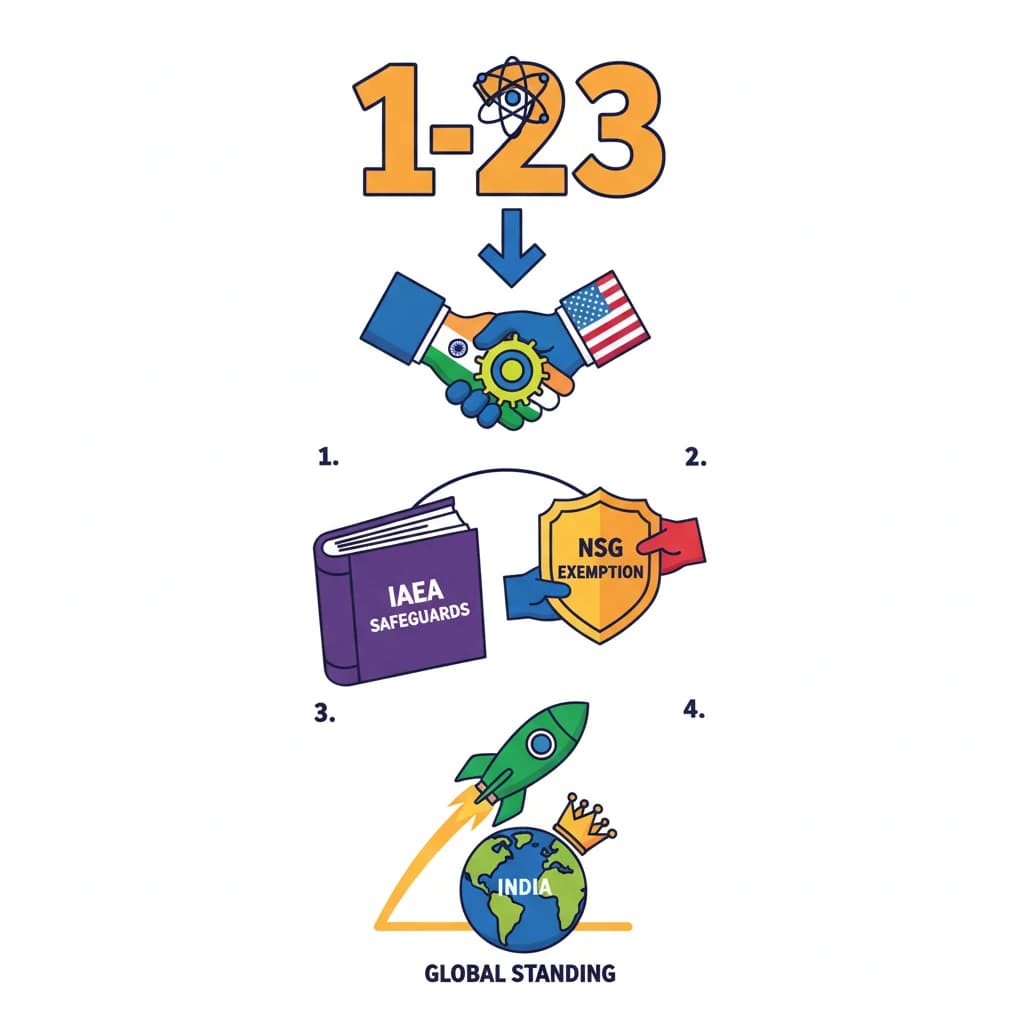
  • •It was a landmark agreement that transformed India's nuclear energy prospects and its global standing.
  • •The agreement significantly strengthened the India-US strategic partnership.

🧠 Memory Techniques
Memory Aid
95% Verified Content

📚 Reference Sources

•International Atomic Energy Agency (IAEA) official website
•Ministry of External Affairs (MEA), Government of India documents
•US Department of State archives and press releases

Related Topics

Loading related topics...
Explore:Defence And Security Topics·All Subjects·Daily Current Affairs·Editorial Analysis·Previous Year Questions·UPSC GPT
India-US Civil Nuclear Cooperation Agreement - UPSC Defence And Security