Loading page, please wait…
Guided Pinaka Weapon System - UPSC Defence And Security
What is Guided Pinaka Weapon System in UPSC Defence And Security?
Guided Pinaka Weapon System is a key topic under Defence And Security for UPSC Civil Services Examination. Key points include: Guided Pinaka is a DRDO-developed multi-barrel rocket launcher system.. It recently completed successful Flight Tests for PSQR validation, confirming range, accuracy, and salvo mode.. Key features include mobility, rapid response, and concentrated firepower.. Understanding this topic is essential for both UPSC Prelims and Mains preparation.
Why is Guided Pinaka Weapon System important for UPSC exam?
Guided Pinaka Weapon System is a Medium-level topic in UPSC Defence And Security. It is tested in both Prelims (factual MCQs) and Mains (analytical answer writing). Previous year UPSC questions have frequently covered aspects of Guided Pinaka Weapon System, making it essential for comprehensive IAS preparation.
How to prepare Guided Pinaka Weapon System for UPSC?
To prepare Guided Pinaka Weapon System for UPSC: (1) Study the comprehensive notes covering all key concepts on Vaidra. (2) Practice previous year questions on this topic. (3) Connect it with current affairs using daily updates. (4) Revise using key takeaways and mind maps available for Defence And Security. (5) Write practice answers linking Guided Pinaka Weapon System to related GS Paper topics.
Key takeaways of Guided Pinaka Weapon System for UPSC
- Guided Pinaka is a DRDO-developed multi-barrel rocket launcher system.
- It recently completed successful Flight Tests for PSQR validation, confirming range, accuracy, and salvo mode.
- Key features include mobility, rapid response, and concentrated firepower.
- Evolved from Mark I (40 km) to Guided Mark II (70-80 km), with plans for 120 km and 300 km ranges.
- Symbolizes India's 'Atmanirbhar Bharat' in defence and strengthens border security.
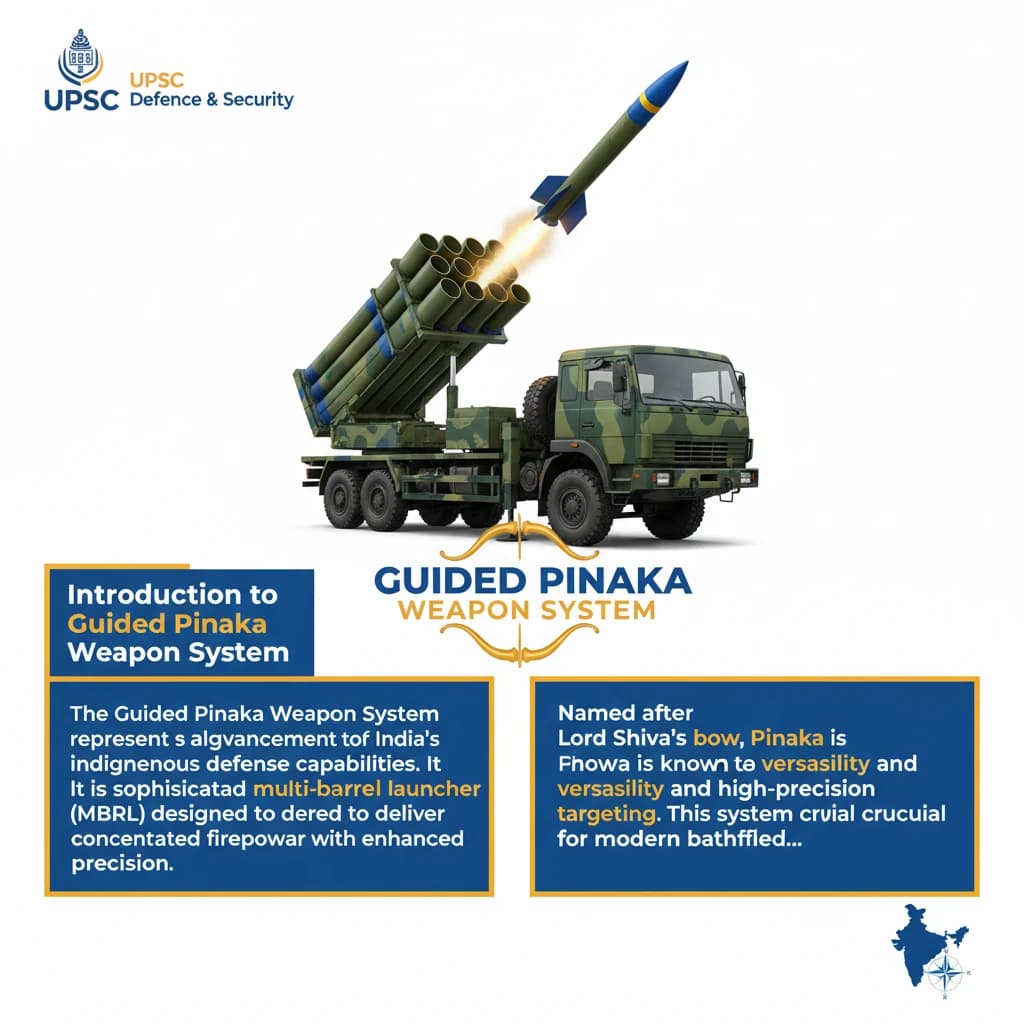
Guided Pinaka Weapon System
Medium⏱️ 6 min read
defence and security
📖 Introduction
Introduction to Guided Pinaka Weapon System
The Guided Pinaka Weapon System represents a significant advancement in India's indigenous defense capabilities. It is a sophisticated multi-barrel rocket launcher system (MBRL) designed to deliver concentrated firepower with enhanced precision.
Named after Lord Shiva’s bow, Pinaka is known for its versatility and high-precision targeting. This system is crucial for modern battlefield scenarios, offering a rapid response capability against enemy targets.
Successful Flight Tests and Validation
The Defence Research and Development Organisation (DRDO) recently achieved a major milestone by successfully completing the Flight Tests of the Guided Pinaka Weapon System.
These tests were conducted as part of the Production Staff Qualitative Requirements (PSQR) Validation Trials. The PSQR parameters ensure the system meets critical operational standards before mass production and deployment.
Key PSQR parameters validated during these trials included range, accuracy, consistency, and the crucial ability to fire multiple rockets simultaneously in salvo mode.
Key Features and Design
The Guided Pinaka Missile System is a testament to India's growing self-reliance in defense technology. It was meticulously designed by the Armament Research and Development Establishment (ARDE), a premier laboratory of the DRDO.
The system is renowned for its exceptional mobility, allowing for quick deployment and redeployment on the battlefield. Its rapid response capability ensures that targets can be engaged swiftly, providing a tactical advantage.
Furthermore, its core strength lies in its capability to deliver concentrated firepower, effectively neutralizing enemy targets across a wide area.
Evolution and Range Upgrades
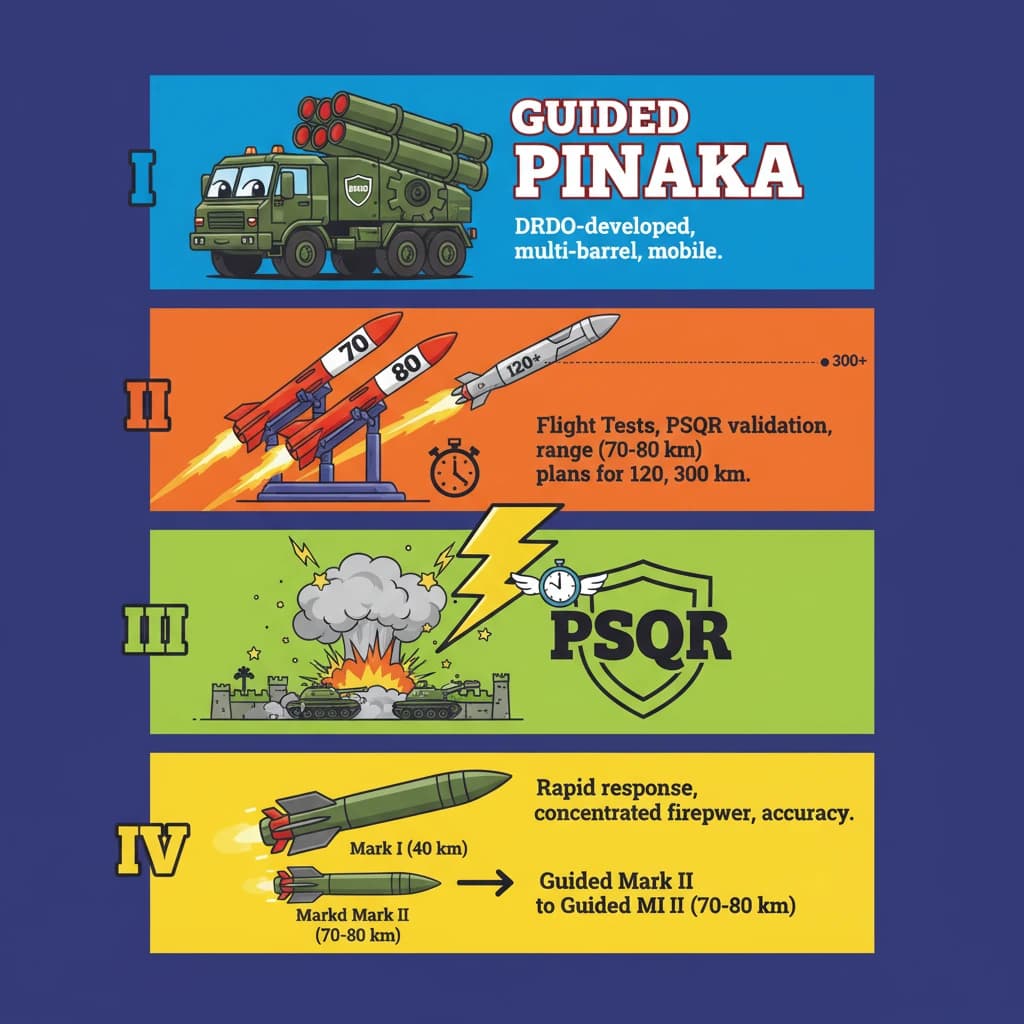
The Pinaka weapon system has undergone continuous development and upgrades since its inception. The initial version, known as Pinaka Mark I, had an effective operational range of 40 km.
The upgraded version, the Pinaka Mark II, significantly extended this range to between 70 to 80 km. This enhancement provides the Indian Army with a much greater standoff capability.
Future plans aim to further increase the range to 120 km and eventually to 300 km, transforming Pinaka into a more strategic weapon system. The recent tests were successfully conducted from upgraded launchers, firing 12 rockets per salvo, demonstrating its enhanced operational readiness.
For UPSC, understanding the evolution of systems like Pinaka highlights India's progress in indigenous defence production (GS-3, Internal Security) and the role of organizations like DRDO in achieving strategic autonomy.
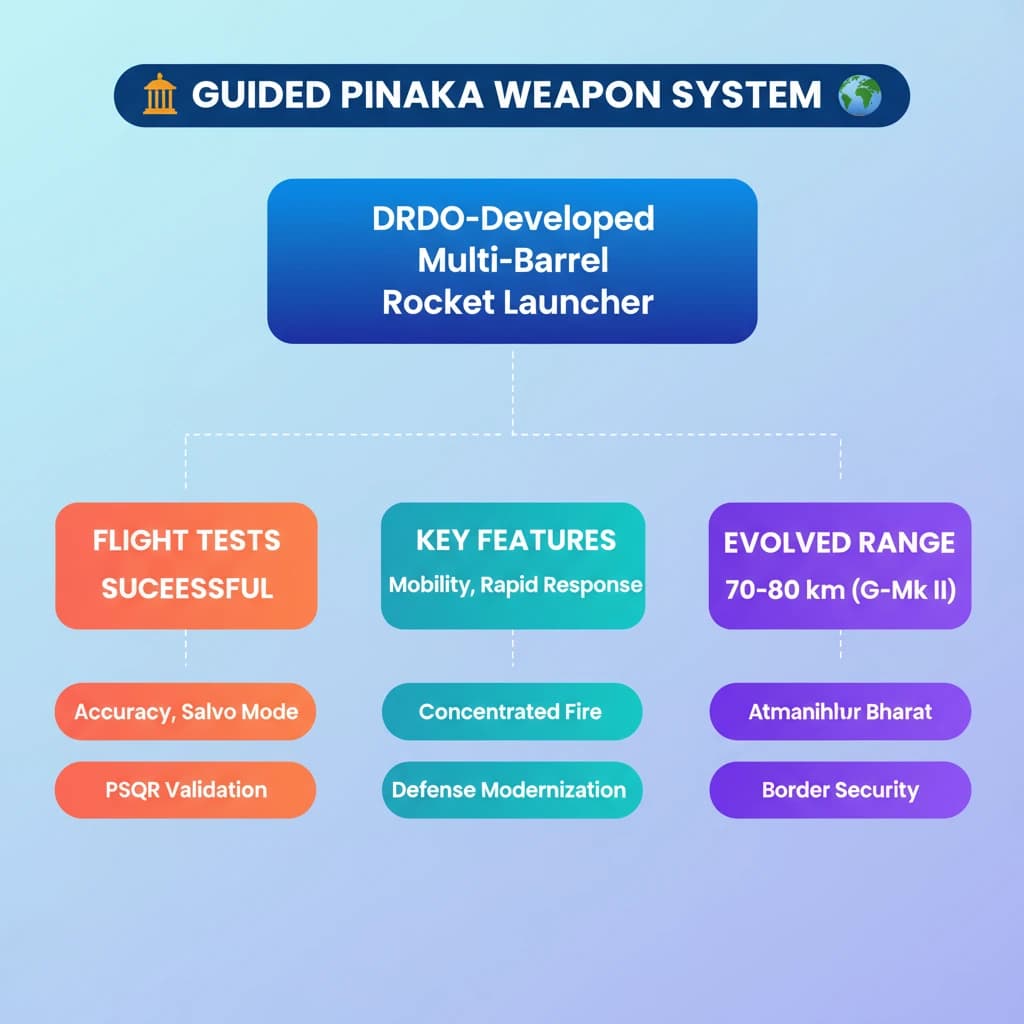
💡 Key Takeaways
- •Guided Pinaka is a DRDO-developed multi-barrel rocket launcher system.
- •It recently completed successful Flight Tests for PSQR validation, confirming range, accuracy, and salvo mode.
- •Key features include mobility, rapid response, and concentrated firepower.
- •Evolved from Mark I (40 km) to Guided Mark II (70-80 km), with plans for 120 km and 300 km ranges.
- •Symbolizes India's 'Atmanirbhar Bharat' in defence and strengthens border security.
🧠 Memory Techniques
95% Verified Content
📚 Reference Sources
•DRDO Official Website (for general information on Pinaka and ARDE)
•Ministry of Defence Press Releases (for flight test confirmations)