Loading page, please wait…
Indian Coast Guard - UPSC Defence And Security
What is Indian Coast Guard in UPSC Defence And Security?
Indian Coast Guard is a key topic under Defence And Security for UPSC Civil Services Examination. Key points include: ICG is an independent Armed Force under Ministry of Defence, established by Coast Guard Act, 1978.. It serves as India's primary Search and Rescue (SAR) and Maritime Law Enforcement (MLE) agency.. Indian SRR is divided into three areas with MRCCs in Mumbai, Chennai, and Port Blair.. Understanding this topic is essential for both UPSC Prelims and Mains preparation.
Why is Indian Coast Guard important for UPSC exam?
Indian Coast Guard is a Medium-level topic in UPSC Defence And Security. It is tested in both Prelims (factual MCQs) and Mains (analytical answer writing). Previous year UPSC questions have frequently covered aspects of Indian Coast Guard, making it essential for comprehensive IAS preparation.
How to prepare Indian Coast Guard for UPSC?
To prepare Indian Coast Guard for UPSC: (1) Study the comprehensive notes covering all key concepts on Vaidra. (2) Practice previous year questions on this topic. (3) Connect it with current affairs using daily updates. (4) Revise using key takeaways and mind maps available for Defence And Security. (5) Write practice answers linking Indian Coast Guard to related GS Paper topics.
Key takeaways of Indian Coast Guard for UPSC
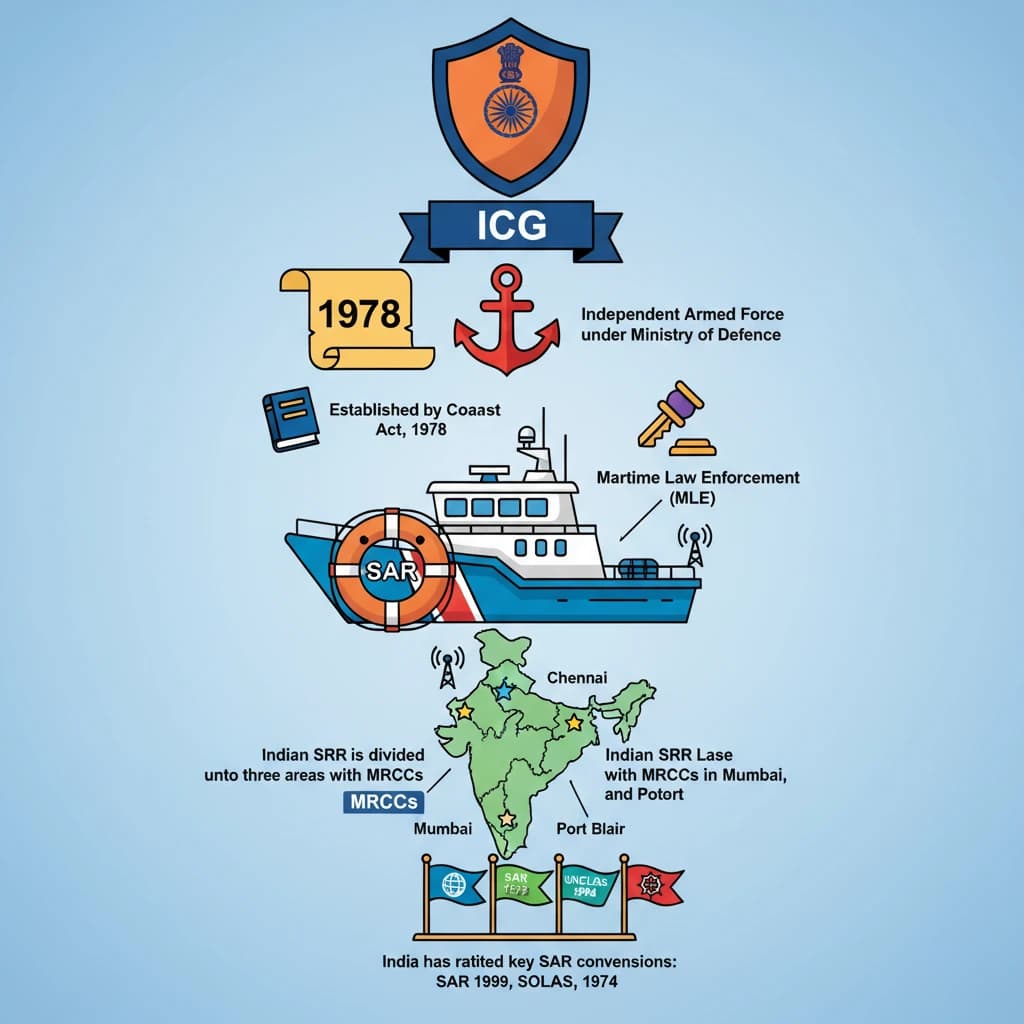
- ICG is an independent Armed Force under Ministry of Defence, established by Coast Guard Act, 1978.
- It serves as India's primary Search and Rescue (SAR) and Maritime Law Enforcement (MLE) agency.
- Indian SRR is divided into three areas with MRCCs in Mumbai, Chennai, and Port Blair.
- India has ratified key SAR conventions: SAR 1979, UNCLOS 1982, SOLAS 1974.
- ICG contributes to India's SAGAR Vision and holds observer status in the Djibouti Code of Conduct (DCoC).
Indian Coast Guard
Medium⏱️ 8 min read
defence and security
📖 Introduction
Introduction to the Indian Coast Guard (ICG)
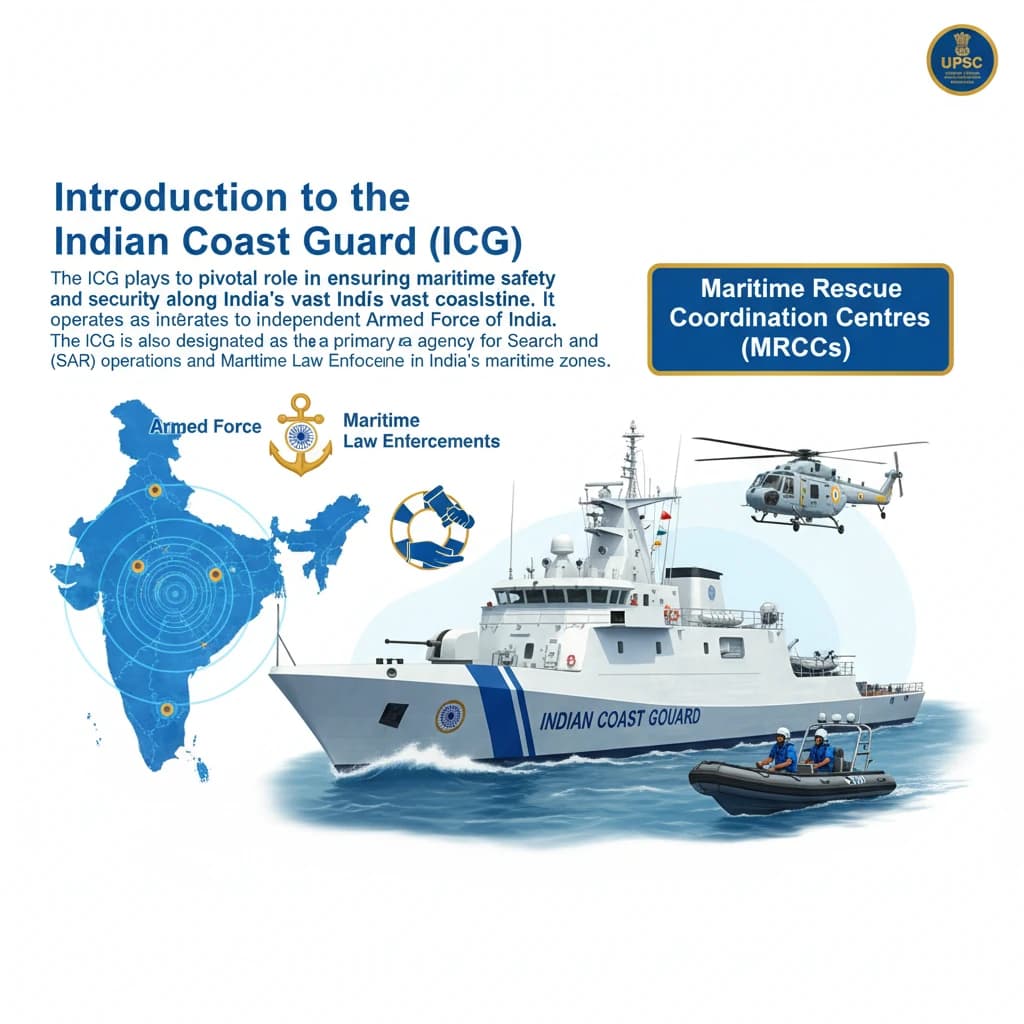
The Indian Coast Guard (ICG) plays a pivotal role in ensuring maritime safety and security along India's vast coastline. It operates as an independent Armed Force of India.
The ICG is also designated as the primary agency for Search and Rescue (SAR) operations and Maritime Law Enforcement in India's maritime zones.
Maritime Rescue Coordination Centres (MRCCs)
Maritime Rescue Coordination Centres (MRCCs) in India are specialized operational units within the Indian Coast Guard. These centres are crucial for coordinating effective SAR missions.
MRCC Function: MRCCs are responsible for receiving distress alerts, coordinating rescue efforts, and deploying resources to assist vessels and personnel in distress at sea.
Search and Rescue Region (SRR)
A Search and Rescue Region (SRR) is a precisely defined geographical area. Within this area, specific SAR services are provided and coordinated by an associated MRCC.
The Indian Coast Guard is tasked with coordinating all SAR missions within the Indian Maritime Search and Rescue Region (ISRR), ensuring comprehensive coverage.
Structure of the Indian SRR
The extensive Indian SRR is strategically divided into three distinct operational areas. Each of these areas is overseen by a dedicated MRCC.
- Mumbai: Covers the western maritime region.
- Chennai: Manages the eastern maritime region.
- Port Blair: Oversees the Andaman and Nicobar Islands and surrounding waters.
International SAR Cooperation: Key Conventions
India actively participates in international efforts to enhance maritime safety and SAR capabilities. It has ratified several crucial international conventions.
Ratified Conventions:
- International Convention on Maritime Search and Rescue (SAR) 1979: Establishes a global framework for SAR operations.
- United Nations Convention on the Law of the Sea (UNCLOS) 1982: Defines the rights and responsibilities of nations in their use of the world's oceans, including SAR.
- International Convention for the Safety of Life at Sea (SOLAS) 1974: Sets minimum safety standards in the construction, equipment, and operation of merchant ships.
Other Initiatives for SAR and Maritime Cooperation
Beyond formal conventions, India engages in various initiatives to bolster maritime security and SAR cooperation with regional and global partners.
- India’s SAGAR Vision: This initiative, standing for "Security and Growth for All in the Region," emphasizes cooperative measures for sustainable development and security in the Indian Ocean.
- Djibouti Code of Conduct (DCoC): This framework is specifically designed to enhance capacity building and cooperation to combat piracy and armed robbery against ships in the Western Indian Ocean and the Gulf of Aden.
DCoC Observer Status: India holds observer status in the Djibouti Code of Conduct, alongside Japan, Norway, the UK, and the USA. This signifies its commitment to regional maritime security.
Establishment and Mandate of the ICG
The Indian Coast Guard was formally established by the Coast Guard Act, 1978. This act provided the legal framework for its creation as a distinct armed force.
The ICG functions under the administrative control of the Ministry of Defence, aligning its operations with national defence strategies.
ICG's Triple Mandate:
- Armed Force: Capable of defending national interests.
- Search and Rescue (SAR) Agency: Primary coordinator for maritime distress.
- Maritime Law Enforcement Agency: Enforces laws in India's maritime zones.
The headquarters of the Indian Coast Guard is located in New Delhi, from where it directs its nationwide operations.
UPSC Insight: Remember the Coast Guard Act, 1978 and its placement under the Ministry of Defence. This distinguishes it from the Navy while highlighting its armed force status. Its multi-faceted role (Armed Force, SAR, MLE) is a crucial point for Mains answers.
💡 Key Takeaways
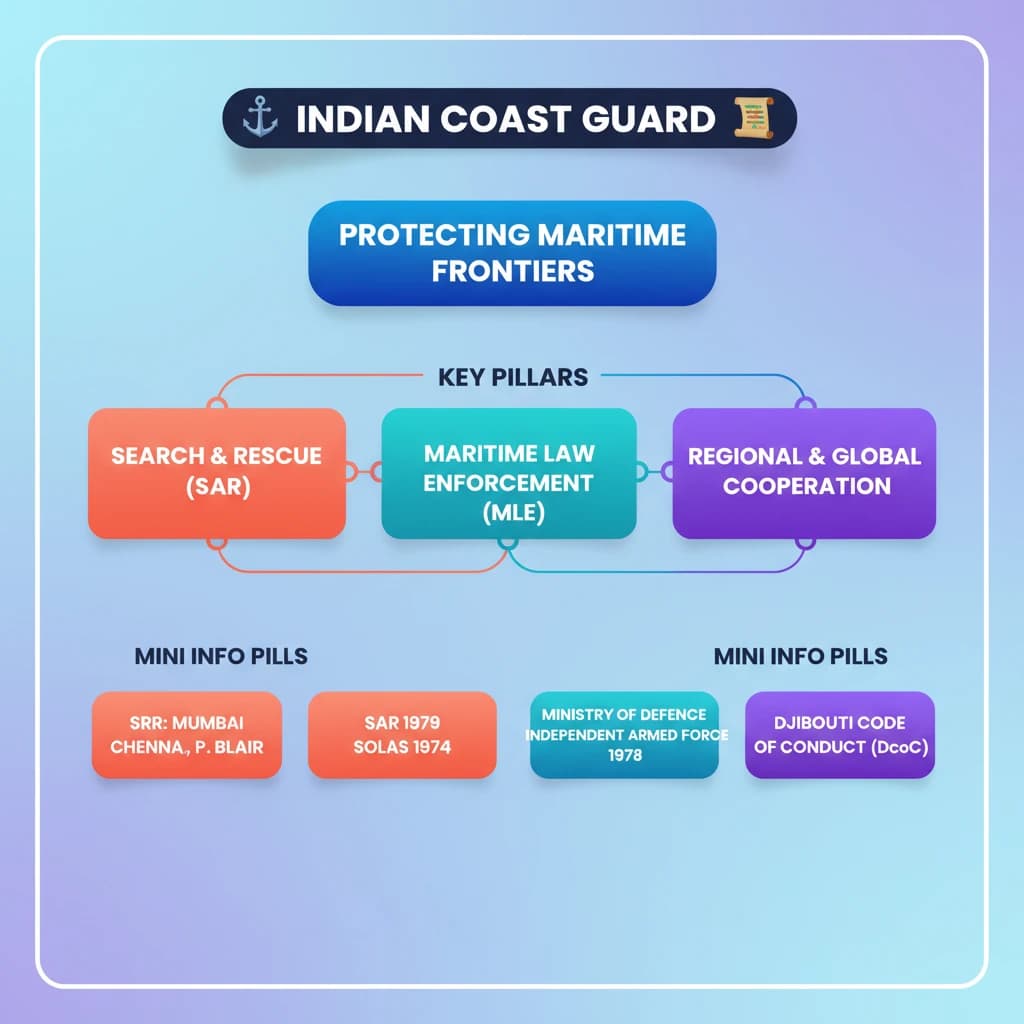
- •ICG is an independent Armed Force under Ministry of Defence, established by Coast Guard Act, 1978.
- •It serves as India's primary Search and Rescue (SAR) and Maritime Law Enforcement (MLE) agency.
- •Indian SRR is divided into three areas with MRCCs in Mumbai, Chennai, and Port Blair.
- •India has ratified key SAR conventions: SAR 1979, UNCLOS 1982, SOLAS 1974.
- •ICG contributes to India's SAGAR Vision and holds observer status in the Djibouti Code of Conduct (DCoC).
🧠 Memory Techniques
95% Verified Content