Loading page, please wait…
National Terrorism Data Fusion & Analysis Centre - UPSC Defence And Security
What is National Terrorism Data Fusion & Analysis Centre in UPSC Defence And Security?
National Terrorism Data Fusion & Analysis Centre is a key topic under Defence And Security for UPSC Civil Services Examination. Key points include: NTDFAC developed by National Investigation Agency (NIA).. Aims to fuse and analyze terrorism data from various sources.. Modelled after the US Global Terrorism Database (GTD).. Understanding this topic is essential for both UPSC Prelims and Mains preparation.
Why is National Terrorism Data Fusion & Analysis Centre important for UPSC exam?
National Terrorism Data Fusion & Analysis Centre is a Medium-level topic in UPSC Defence And Security. It is tested in both Prelims (factual MCQs) and Mains (analytical answer writing). Previous year UPSC questions have frequently covered aspects of National Terrorism Data Fusion & Analysis Centre, making it essential for comprehensive IAS preparation.
How to prepare National Terrorism Data Fusion & Analysis Centre for UPSC?
To prepare National Terrorism Data Fusion & Analysis Centre for UPSC: (1) Study the comprehensive notes covering all key concepts on Vaidra. (2) Practice previous year questions on this topic. (3) Connect it with current affairs using daily updates. (4) Revise using key takeaways and mind maps available for Defence And Security. (5) Write practice answers linking National Terrorism Data Fusion & Analysis Centre to related GS Paper topics.
Key takeaways of National Terrorism Data Fusion & Analysis Centre for UPSC
- NTDFAC developed by National Investigation Agency (NIA).
- Aims to fuse and analyze terrorism data from various sources.
- Modelled after the US Global Terrorism Database (GTD).
- Collects details on diverse terror groups like Indian Mujahideen, LeT, Khalistani militants.
- Enhances India's intelligence capabilities for proactive counter-terrorism.
- Crucial for strengthening national security and disrupting terror networks.
National Terrorism Data Fusion & Analysis Centre
Medium⏱️ 6 min read
defence and security
📖 Introduction
Introduction to NTDFAC
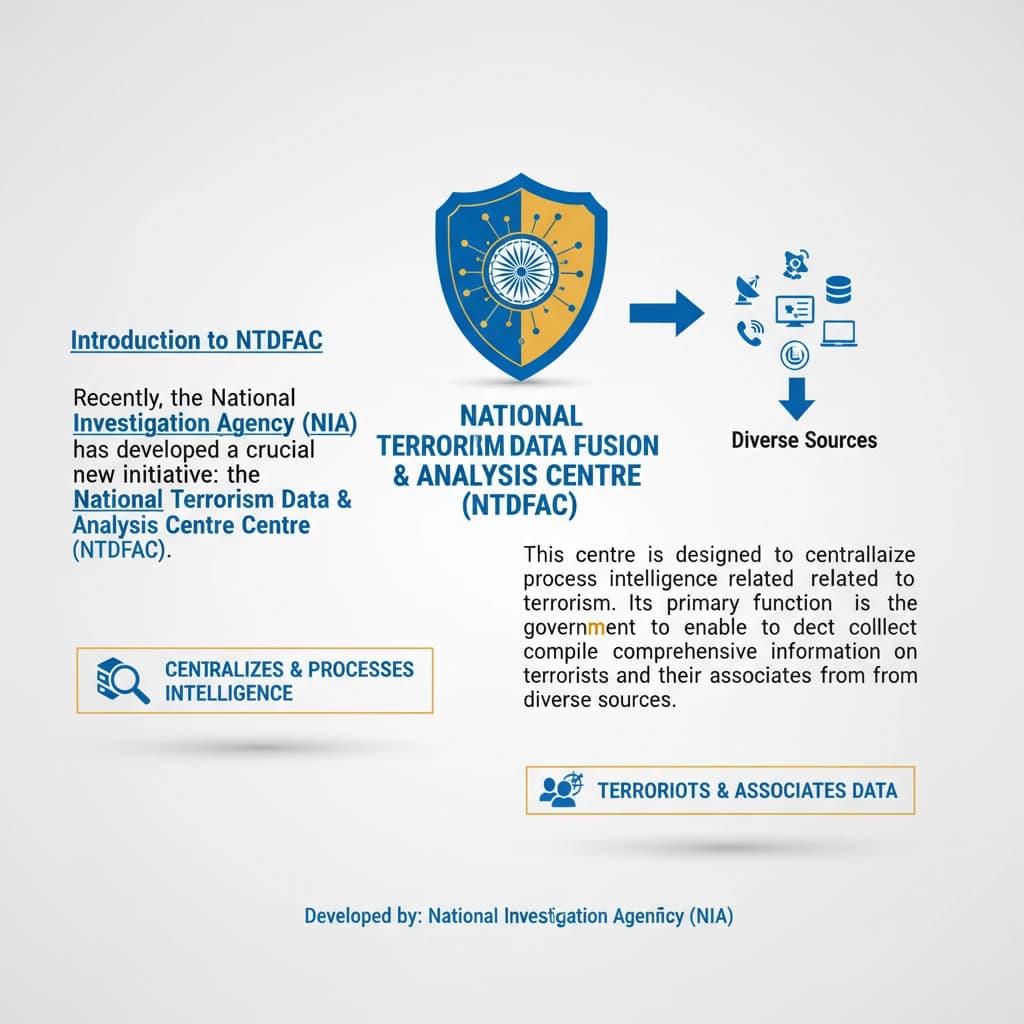
Recently, the National Investigation Agency (NIA) has developed a crucial new initiative: the National Terrorism Data Fusion & Analysis Centre (NTDFAC).
This centre is designed to centralize and process intelligence related to terrorism. Its primary function is to enable the government to collect and compile comprehensive information on terrorists and their associates from diverse sources.
UPSC Insight: Understanding the role of agencies like NIA and initiatives like NTDFAC is vital for GS Paper 3 (Internal Security). It highlights India's evolving counter-terrorism strategy.
Expanded Scope of Data Collection
The NIA has undertaken a significant step by collecting detailed information on a wide array of terrorist groups for the first time.
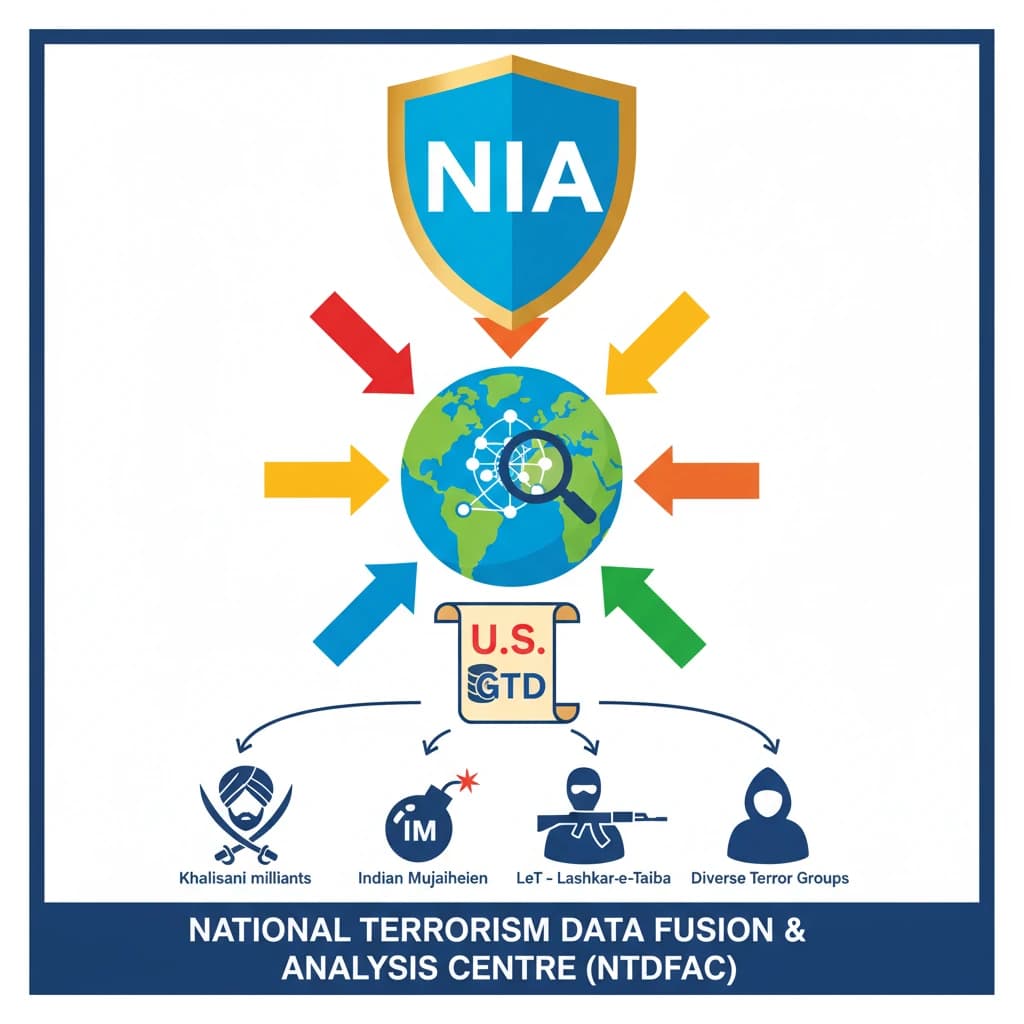
This includes notorious organizations such as Indian Mujahideen and Lashkar-e-Taiba, alongside various Khalistani militant groups.
The collection of such diverse data aims to create a holistic picture of the terrorist landscape, facilitating better threat assessment and proactive counter-measures.
Modelling and Inspiration
The operational framework of the NTDFAC is strategically modelled along the lines of the globally recognized Global Terrorism Database (GTD) of the United States (US).
This international benchmark provides a proven methodology for systematic data collection and analysis in the realm of terrorism.
About GTD: The Global Terrorism Database (GTD) is managed by the National Consortium for the Study of Terrorism and Responses to Terrorism (START). It is based at the University of Maryland in the United States.
The GTD is a publicly accessible database that meticulously collects and analyzes data on terrorist incidents worldwide. Its structure provides a robust blueprint for the NTDFAC's operations.
💡 Key Takeaways
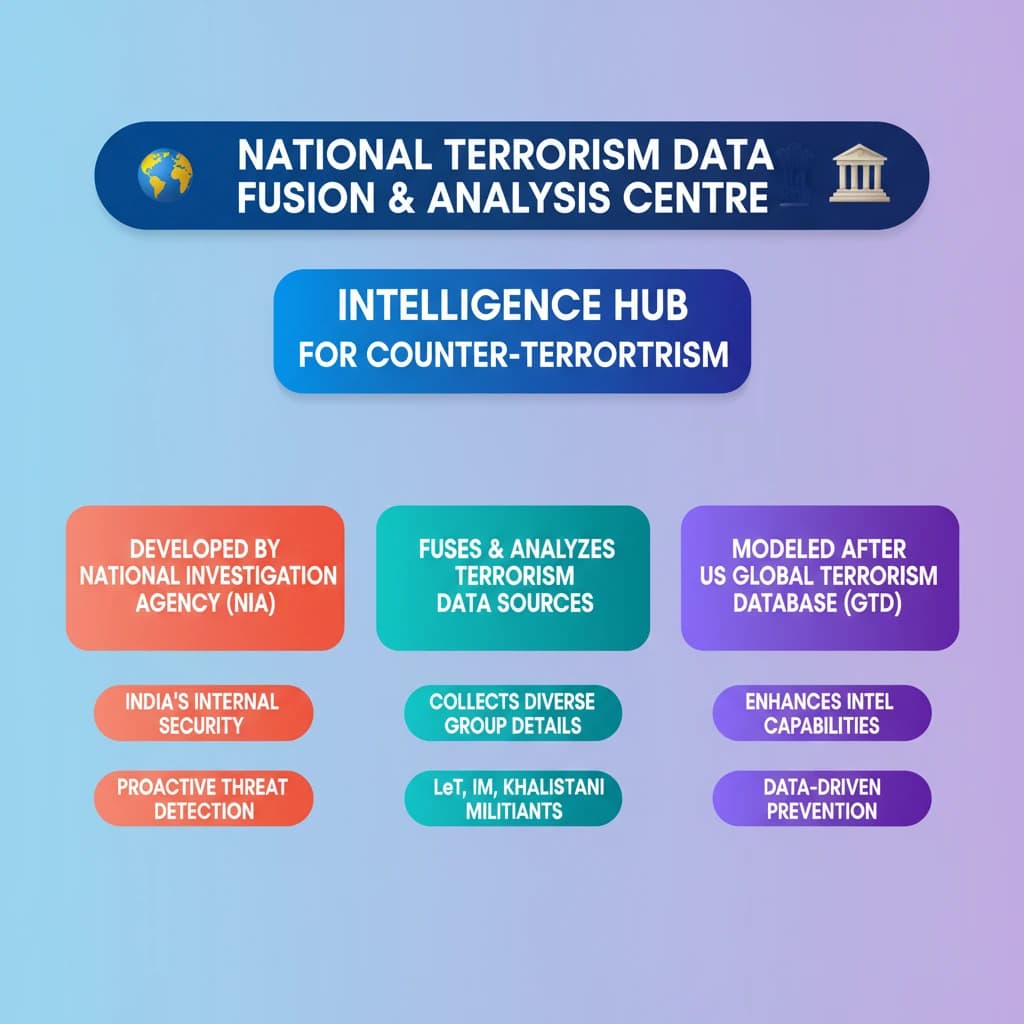
- •NTDFAC developed by National Investigation Agency (NIA).
- •Aims to fuse and analyze terrorism data from various sources.
- •Modelled after the US Global Terrorism Database (GTD).
- •Collects details on diverse terror groups like Indian Mujahideen, LeT, Khalistani militants.
- •Enhances India's intelligence capabilities for proactive counter-terrorism.
- •Crucial for strengthening national security and disrupting terror networks.
🧠 Memory Techniques
95% Verified Content