Loading page, please wait…
Opium Regulation and Uses - UPSC Defence And Security
What is Opium Regulation and Uses in UPSC Defence And Security?
Opium Regulation and Uses is a key topic under Defence And Security for UPSC Civil Services Examination. Key points include: UNODC is the key international body for drug control and crime prevention, established in 1997/2002.. Golden Triangle (Myanmar, Laos, Thailand) and Golden Crescent (Afghanistan, Iran) are major illicit opium production/transit zones.. India regulates opium cultivation under the NDPS Act, 1985, overseen by the Narcotics Commissioner.. Understanding this topic is essential for both UPSC Prelims and Mains preparation.
Why is Opium Regulation and Uses important for UPSC exam?
Opium Regulation and Uses is a Medium-level topic in UPSC Defence And Security. It is tested in both Prelims (factual MCQs) and Mains (analytical answer writing). Previous year UPSC questions have frequently covered aspects of Opium Regulation and Uses, making it essential for comprehensive IAS preparation.
How to prepare Opium Regulation and Uses for UPSC?
To prepare Opium Regulation and Uses for UPSC: (1) Study the comprehensive notes covering all key concepts on Vaidra. (2) Practice previous year questions on this topic. (3) Connect it with current affairs using daily updates. (4) Revise using key takeaways and mind maps available for Defence And Security. (5) Write practice answers linking Opium Regulation and Uses to related GS Paper topics.
Key takeaways of Opium Regulation and Uses for UPSC
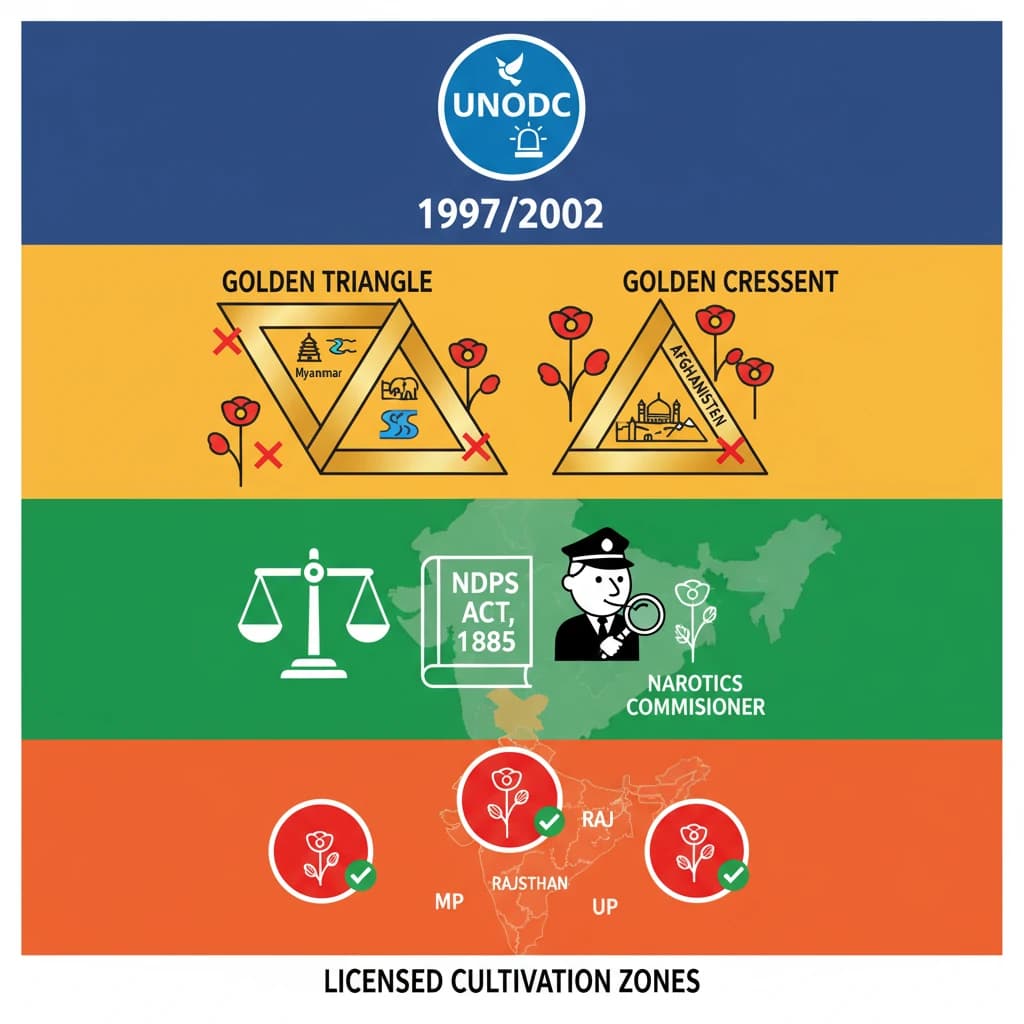
- UNODC is the key international body for drug control and crime prevention, established in 1997/2002.
- Golden Triangle (Myanmar, Laos, Thailand) and Golden Crescent (Afghanistan, Iran) are major illicit opium production/transit zones.
- India regulates opium cultivation under the NDPS Act, 1985, overseen by the Narcotics Commissioner.
- Licensed opium poppy cultivation in India is confined to Madhya Pradesh, Rajasthan, and Uttar Pradesh.
- Opium has vital medicinal uses in modern and traditional systems (Ayurveda, Unani, Homeopathy) alongside its illicit potential.
- India's anti-drug initiatives include Nasha Mukt Bharat Abhiyaan, National Action Plan for Drug Demand Reduction, and Narco-Coordination Centre.
Opium Regulation and Uses
Medium⏱️ 8 min read
defence and security
📖 Introduction
International Efforts Against Drug Trafficking
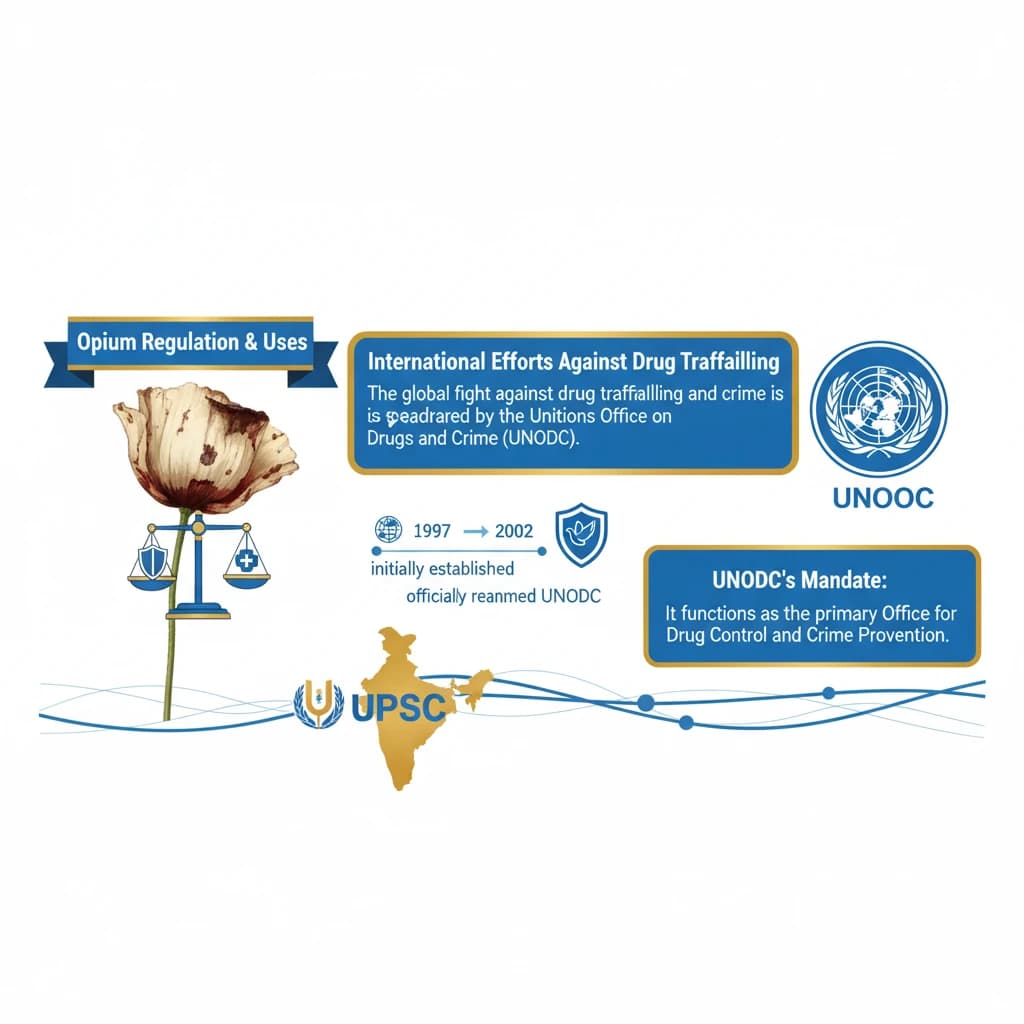
The global fight against drug trafficking and crime is spearheaded by the United Nations Office on Drugs and Crime (UNODC).
This crucial international body was initially established in 1997 and officially renamed UNODC in 2002.
UNODC's Mandate: It functions as the primary Office for Drug Control and Crime Prevention, merging the United Nations International Drug Control Program (UNDCP) with the Crime Prevention and Criminal Justice Division of the United Nations Office in Vienna.
Global Hotspots of Illicit Drug Production
The world's illicit drug trade is heavily influenced by specific geographical regions known for extensive cultivation and production of narcotics, particularly opium.
The Golden Triangle: This notorious region in Southeast Asia is a major source of illicit drugs, predominantly Opium. It encompasses areas where the borders of three countries converge: Myanmar (formerly Burma), Laos, and Thailand.
The Golden Crescent: Also termed the “Death Crescent,” this region is another significant hub for illicit drug production and transit. It primarily includes Afghanistan and Iran, serving as a natural smuggling route for drugs originating from Pakistan.
Opium Regulation Framework in India
In India, the cultivation of opium poppy and the production of opium are strictly regulated under comprehensive legal frameworks.
The primary legislative instruments governing these activities are the Narcotic Drugs & Psychotropic Substances Act, 1985 (NDPS Act) and the Narcotic Drugs & Psychotropic Substances Rules, 1985.
Key Authority: The Narcotics Commissioner is the designated authority responsible for all functions related to the superintendence of opium poppy cultivation and subsequent opium production in India.
Designated Opium Cultivation Tracts in India
To ensure strict control and monitoring, the cultivation of opium poppy is permitted only in specific tracts that are officially notified by the Government of India.
Currently, these designated cultivation areas are concentrated within three Indian states.
- Madhya Pradesh
- Rajasthan
- Uttar Pradesh
Major Contributing Districts: Approximately 80% of the total area cultivated for opium poppy is located in the districts of Mandsaur in Madhya Pradesh, and Chittorgarh and Jhalawar in Rajasthan.
Diverse Uses of Opium
Despite its illicit applications, opium possesses significant therapeutic value and is considered indispensable in the legitimate medical world.
Its unique properties make it a vital component in various healthcare systems.
- Modern Medicine: Opium derivatives are crucial for pain management and other therapeutic applications.
- Indigenous Medicine Systems: It is also utilized in traditional Indian systems such as Homeopathy, Ayurveda, and Unani medicines.
India's Initiatives Against Drug Abuse
The Government of India has launched several initiatives to combat drug abuse and reduce demand for illicit substances across the nation.
These initiatives are crucial for understanding India's strategy in tackling the drug menace, often asked in GS-II and GS-III papers related to social justice and internal security.
- Nasha Mukt Bharat Abhiyaan (Drugs-Free India Campaign): A flagship program aimed at creating awareness and reducing substance abuse.
- National Action Plan for Drug Demand Reduction (NAPDR): Focuses on preventive education, awareness generation, identification, treatment, and rehabilitation of drug dependents.
- Narco-Coordination Centre (NCORD): Established to ensure effective coordination among various central and state agencies to combat drug trafficking.
- National Fund to Control Drug Abuse: Provides financial assistance for activities related to drug abuse prevention, awareness, and rehabilitation.

💡 Key Takeaways
- •UNODC is the key international body for drug control and crime prevention, established in 1997/2002.
- •Golden Triangle (Myanmar, Laos, Thailand) and Golden Crescent (Afghanistan, Iran) are major illicit opium production/transit zones.
- •India regulates opium cultivation under the NDPS Act, 1985, overseen by the Narcotics Commissioner.
- •Licensed opium poppy cultivation in India is confined to Madhya Pradesh, Rajasthan, and Uttar Pradesh.
- •Opium has vital medicinal uses in modern and traditional systems (Ayurveda, Unani, Homeopathy) alongside its illicit potential.
- •India's anti-drug initiatives include Nasha Mukt Bharat Abhiyaan, National Action Plan for Drug Demand Reduction, and Narco-Coordination Centre.
🧠 Memory Techniques
95% Verified Content
📚 Reference Sources
•United Nations Office on Drugs and Crime (UNODC) official website (implied)
•Narcotic Drugs and Psychotropic Substances Act, 1985 (implied)