Loading page, please wait…
TERRORISM AND COUNTER- TERRORISM - UPSC Defence And Security
What is TERRORISM AND COUNTER- TERRORISM in UPSC Defence And Security?
TERRORISM AND COUNTER- TERRORISM is a key topic under Defence And Security for UPSC Civil Services Examination. Key points include: NIA was established in 2008 post-Mumbai attacks to combat inter-state and international terrorism.. NIA operates under MHA, has pan-India jurisdiction, and can investigate scheduled offenses abroad.. Its mandate expanded in 2020 to include NDPS offenses linked to terrorism.. Understanding this topic is essential for both UPSC Prelims and Mains preparation.
Why is TERRORISM AND COUNTER- TERRORISM important for UPSC exam?
TERRORISM AND COUNTER- TERRORISM is a Medium-level topic in UPSC Defence And Security. It is tested in both Prelims (factual MCQs) and Mains (analytical answer writing). Previous year UPSC questions have frequently covered aspects of TERRORISM AND COUNTER- TERRORISM, making it essential for comprehensive IAS preparation.
How to prepare TERRORISM AND COUNTER- TERRORISM for UPSC?
To prepare TERRORISM AND COUNTER- TERRORISM for UPSC: (1) Study the comprehensive notes covering all key concepts on Vaidra. (2) Practice previous year questions on this topic. (3) Connect it with current affairs using daily updates. (4) Revise using key takeaways and mind maps available for Defence And Security. (5) Write practice answers linking TERRORISM AND COUNTER- TERRORISM to related GS Paper topics.
Key takeaways of TERRORISM AND COUNTER- TERRORISM for UPSC
- NIA was established in 2008 post-Mumbai attacks to combat inter-state and international terrorism.
- NIA operates under MHA, has pan-India jurisdiction, and can investigate scheduled offenses abroad.
- Its mandate expanded in 2020 to include NDPS offenses linked to terrorism.
- The 'terror-gangster nexus' involving PKEs and Pakistan links is a significant current threat.
- Operation Dhvast is NIA's specific initiative against this nexus.
- NTDFAC, modeled on the US GTD, is a key intelligence fusion center developed by NIA for data analysis.
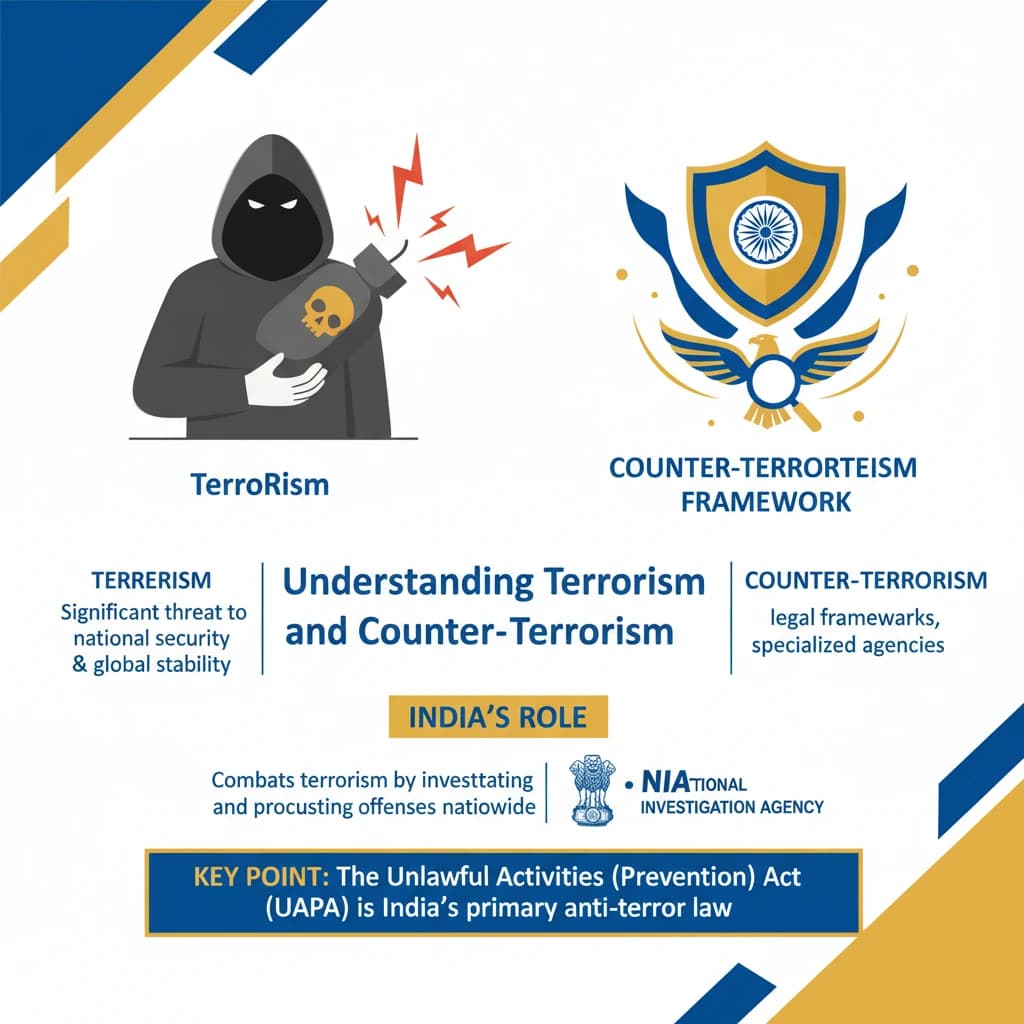
TERRORISM AND COUNTER- TERRORISM
Medium⏱️ 10 min read
defence and security
📖 Introduction
NIA's Recent Focus: Combatting the Terror-Gangster Nexus
The National Investigation Agency (NIA) recently convened its inaugural meeting with police officials from Punjab, Rajasthan, Haryana, and Delhi. This critical gathering aimed to address the escalating concern of the terror-gangster nexus.
This initiative comes amidst increasing reports of organized crime being directly linked to various terror groups. These groups often include Pro-Khalistan Elements (PKEs) and have established significant connections with entities in Pakistan.
UPSC Relevance: This highlights the evolving nature of internal security threats, moving beyond traditional terror groups to complex criminal-terrorist networks. Crucial for GS-III Internal Security.
Establishment of the National Investigation Agency (NIA)
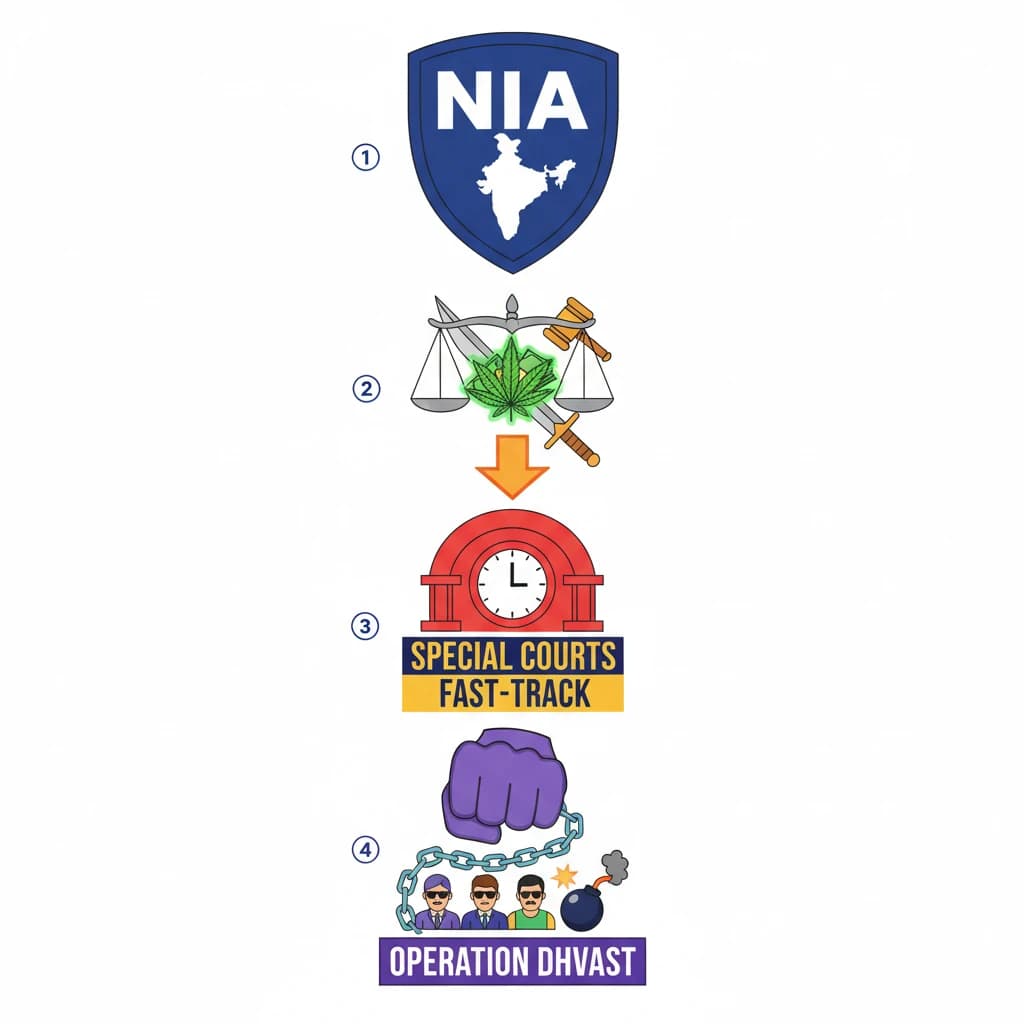
The National Investigation Agency (NIA) was established by the Indian government in 2008. Its primary mandate is to combat the multifaceted threats of terrorism, especially those involving complex inter-State and international linkages.
Key Origin: The NIA was formed directly in response to the devastating 2008 Mumbai terror attacks. This event underscored the urgent need for a dedicated federal agency to investigate terror-related crimes.
The agency was constituted under the provisions of the National Investigation Agency Act, 2008. Its formation was based on recommendations from various experts and committees, including the Administrative Reforms Commission.
Organisational Structure and Headquarters
The NIA operates under the direct administrative control of the Union Ministry of Home Affairs (MHA), which serves as its parent ministry. Its main headquarters is located in New Delhi.
Investigation Process and Jurisdiction
State Governments can refer cases to the NIA, but this must be done through the Central Government (specifically, the Union Home Ministry). The NIA also possesses the authority to take up cases suo motu (on its own initiative) or if directed by the Central Government.
A significant aspect of the NIA's jurisdiction is its ability to investigate scheduled offenses committed outside India. This is permissible if such offenses fall under its specified jurisdiction.
Mandate: The NIA investigates and prosecutes offenses that directly affect national security, sovereignty, and international relations of India.
Jurisdiction: The NIA operates across all states of India without requiring special permission from individual state governments. Its power to investigate crimes committed outside India was further solidified by the NIA (Amendment) Act, 2019.
Scheduled Offences Under NIA's Purview
The NIA is empowered to investigate a wide range of offenses listed under various laws. These are known as scheduled offenses.
- Explosive Substances Act, 1908
- Atomic Energy Act, 1962
- Unlawful Activities (Prevention) Act (UAPA), 1967
- Anti-hijacking Act, 2016
- And several other crucial national security laws.
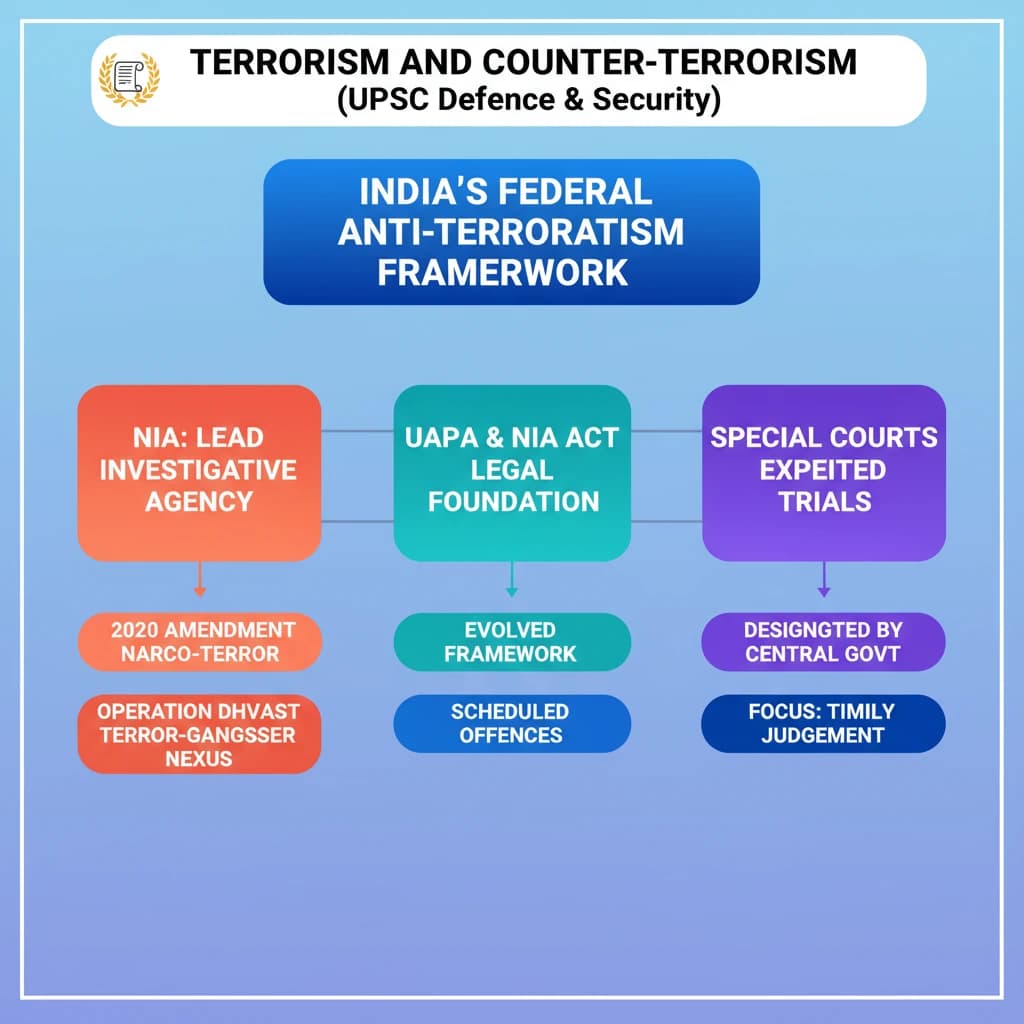
In September 2020, the NIA's mandate was significantly expanded. It now includes offenses under the Narcotic Drugs and Psychotropic Substances (NDPS) Act, specifically if these are found to be connected to terrorism.
Special Courts for NIA Trials
Trials for cases investigated by the NIA are conducted in special courts. These courts are specifically designated by the Central Government.
The designation of these special courts is carried out in consultation with the Chief Justice of the High Court of the respective State where the trial is to take place.
Operation Dhvast: Combating the Terror-Gangster Nexus
The NIA has launched a specific operation named Operation Dhvast. This operation is directly aimed at dismantling and combating the networks associated with the terror-gangster nexus.
National Terrorism Data Fusion & Analysis Centre (NTDFAC)
The National Investigation Agency (NIA) has developed the National Terrorism Data Fusion & Analysis Centre (NTDFAC). This center plays a crucial role in enabling the government to collect and compile comprehensive information on terrorists and their associates from diverse sources.
For the first time, the NIA has utilized the NTDFAC to collect detailed information on all known terrorists. This includes individuals from groups such as the Indian Mujahideen and Lashkar-e-Taiba, as well as various Khalistani militant groups.
About NTDFAC: The NTDFAC has been modeled along the lines of the renowned Global Terrorism Database (GTD) of the United States. This indicates an effort to adopt international best practices in intelligence analysis.
Global Terrorism Database (GTD): The GTD is managed by the National Consortium for the Study of Terrorism and Responses to Terrorism (START), which is based at the University of Maryland in the United States. It is a publicly accessible database that systematically collects and analyzes data on terrorist incidents worldwide.
💡 Key Takeaways
- •NIA was established in 2008 post-Mumbai attacks to combat inter-state and international terrorism.
- •NIA operates under MHA, has pan-India jurisdiction, and can investigate scheduled offenses abroad.
- •Its mandate expanded in 2020 to include NDPS offenses linked to terrorism.
- •The 'terror-gangster nexus' involving PKEs and Pakistan links is a significant current threat.
- •Operation Dhvast is NIA's specific initiative against this nexus.
- •NTDFAC, modeled on the US GTD, is a key intelligence fusion center developed by NIA for data analysis.
🧠 Memory Techniques
98% Verified Content
📚 Reference Sources
•National Investigation Agency (NIA) Official Website
•The National Investigation Agency Act, 2008
•The National Investigation Agency (Amendment) Act, 2019
•Union Ministry of Home Affairs (MHA) publications on internal security