Loading page, please wait…
UNODC Report on Illicit Drugs - UPSC Defence And Security
What is UNODC Report on Illicit Drugs in UPSC Defence And Security?
UNODC Report on Illicit Drugs is a key topic under Defence And Security for UPSC Civil Services Examination. Key points include: Global drug users reached 292 million in 2022, a 20% increase in a decade, as per UNODC.. India has approximately 100 million drug addicts; UP, Maharashtra, Punjab lead in NDPS Act FIRs (2019-2021).. The Golden Crescent (Afghanistan, Iran, Pakistan) is a major opium hub, impacting Indian states like Punjab and J&K.. Understanding this topic is essential for both UPSC Prelims and Mains preparation.
Why is UNODC Report on Illicit Drugs important for UPSC exam?
UNODC Report on Illicit Drugs is a Medium-level topic in UPSC Defence And Security. It is tested in both Prelims (factual MCQs) and Mains (analytical answer writing). Previous year UPSC questions have frequently covered aspects of UNODC Report on Illicit Drugs, making it essential for comprehensive IAS preparation.
How to prepare UNODC Report on Illicit Drugs for UPSC?
To prepare UNODC Report on Illicit Drugs for UPSC: (1) Study the comprehensive notes covering all key concepts on Vaidra. (2) Practice previous year questions on this topic. (3) Connect it with current affairs using daily updates. (4) Revise using key takeaways and mind maps available for Defence And Security. (5) Write practice answers linking UNODC Report on Illicit Drugs to related GS Paper topics.
Key takeaways of UNODC Report on Illicit Drugs for UPSC
- Global drug users reached 292 million in 2022, a 20% increase in a decade, as per UNODC.
- India has approximately 100 million drug addicts; UP, Maharashtra, Punjab lead in NDPS Act FIRs (2019-2021).
- The Golden Crescent (Afghanistan, Iran, Pakistan) is a major opium hub, impacting Indian states like Punjab and J&K.
- The Golden Triangle (Laos, Myanmar, Thailand) is a primary heroin producer, with Myanmar contributing 80% of regional heroin.
- Drug trafficking poses significant threats to public health, internal security, and economic stability, requiring robust national and international responses.
UNODC Report on Illicit Drugs
Medium⏱️ 8 min read
defence and security
📖 Introduction
Context and Release of the UNODC Report
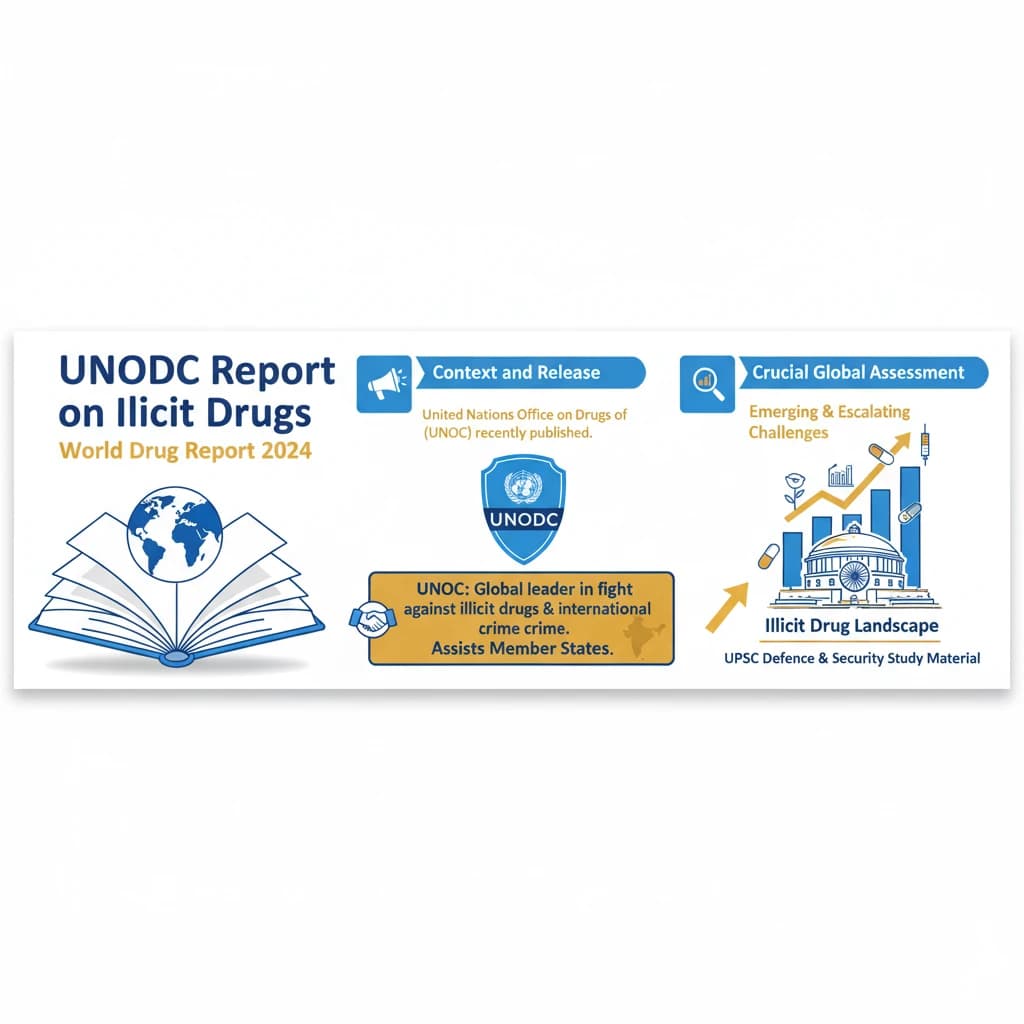
The United Nations Office on Drugs and Crime (UNODC) recently published its World Drug Report 2024. This report serves as a crucial global assessment, highlighting emerging and escalating challenges within the international drug landscape.
UNODC is a global leader in the fight against illicit drugs and international crime. It provides assistance to Member States in their struggle against illicit drugs, crime, and terrorism.
Global Drug Use Trends
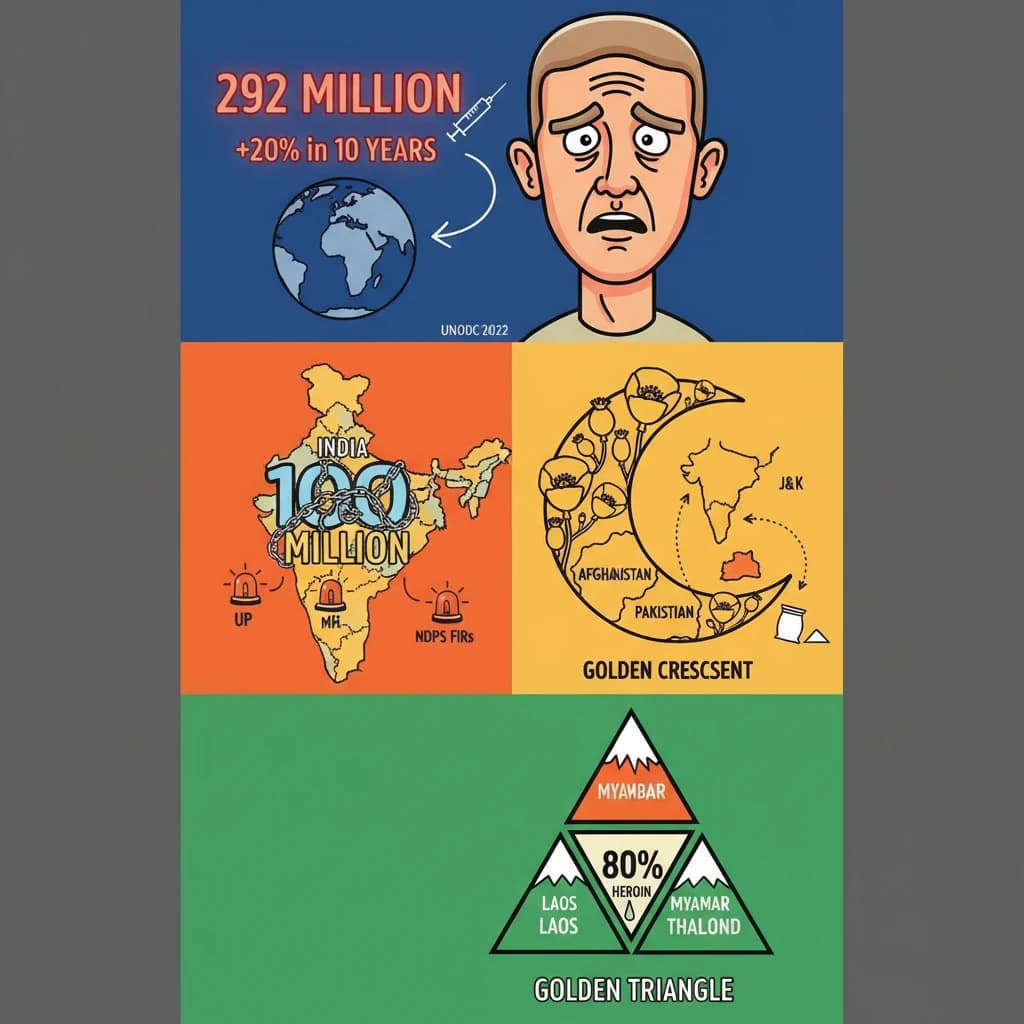
The report indicates a significant rise in drug use worldwide. In 2022, the total number of drug users globally reached an estimated 292 million individuals.
This figure represents a substantial 20% increase over the past decade, underscoring a growing global public health and security concern.
Drug Use Situation in India
India is also experiencing a sharp increase in drug addiction. Data from the Narcotics Control Bureau (NCB) reveals that approximately 100 million people in the country are currently addicted to various narcotic substances.
The Ministry of Home Affairs has identified specific states with high rates of drug-related offenses. Between 2019 and 2021, Uttar Pradesh, Maharashtra, and Punjab registered the highest number of FIRs under the Narcotic Drugs and Psychotropic Substances Act (NDPS Act).
Understanding India's drug situation, including affected states and relevant laws like the NDPS Act, is vital for questions in GS Paper 3 (Internal Security) and GS Paper 1 (Social Issues).
Major Global Drug-Producing Regions
Two primary regions are globally recognized for their significant role in illicit drug production and trafficking. These are the Golden Crescent and the Golden Triangle.
These regions are critical to understanding global drug supply chains and their impact on international and national security.
The Golden Crescent
The Golden Crescent is a major hub for opium production and distribution. It is geographically located at the crossroads of Central, South, and West Asia.
The region comprises three key countries:
- Afghanistan
- Iran
- Pakistan
This region significantly impacts India, with trafficking routes affecting several Indian states. These include Jammu and Kashmir, Punjab, Himachal Pradesh, Rajasthan, and Gujarat.
The Golden Triangle
The Golden Triangle is another crucial region for illicit drug production, primarily known for heroin manufacturing. It is situated in Southeast Asia.
This area is formed by the intersection of territories from:
- Laos
- Myanmar
- Thailand
Myanmar is a particularly dominant producer within this region, accounting for approximately 80% of global heroin production. Trafficking routes from the Golden Triangle often pass through Laos, Vietnam, Thailand, and notably, India.

💡 Key Takeaways
- •Global drug users reached 292 million in 2022, a 20% increase in a decade, as per UNODC.
- •India has approximately 100 million drug addicts; UP, Maharashtra, Punjab lead in NDPS Act FIRs (2019-2021).
- •The Golden Crescent (Afghanistan, Iran, Pakistan) is a major opium hub, impacting Indian states like Punjab and J&K.
- •The Golden Triangle (Laos, Myanmar, Thailand) is a primary heroin producer, with Myanmar contributing 80% of regional heroin.
- •Drug trafficking poses significant threats to public health, internal security, and economic stability, requiring robust national and international responses.
🧠 Memory Techniques
95% Verified Content
📚 Reference Sources
•Narcotics Control Bureau (NCB) official data (as cited in Drishti IAS)
•Ministry of Home Affairs (MHA) data on NDPS Act FIRs (as cited in Drishti IAS)