Loading page, please wait…
Vaidra Logo
Vaidra

Top 4 items + smart groups

UPSC GPT
New
Current Affairs
Daily Solutions
Daily Puzzle
Mains Evaluator

Version 2.0.0 • Built with ❤️ for UPSC aspirants

Loading...
Loading...
Loading...
Loading...
Loading...
Loading...
Loading...
Loading...
Loading...
Loading...
Loading...
Loading...
Loading...
Recent Developments in India Regarding Chipmaking - UPSC Economy
Back
All Subjects

Topics

0 topics • 0 completed

Loading topics...
Loading...
Loading...
Loading...
Loading...
Loading...
Overall Progress0%

Recent Developments in India Regarding Chipmaking - UPSC Economy

What is Recent Developments in India Regarding Chipmaking in UPSC Economy?

Recent Developments in India Regarding Chipmaking is a key topic under Economy for UPSC Civil Services Examination. Key points include: India is actively pursuing self-reliance in chipmaking through global partnerships and domestic investments.. Key collaborations include a chip deal with Singapore for expertise and Tata's partnership with Taiwan's PSMC for India's first commercial fab.. Micron Technology's Rs 22,500 crore investment in Gujarat aims to boost memory chip manufacturing.. Understanding this topic is essential for both UPSC Prelims and Mains preparation.

Why is Recent Developments in India Regarding Chipmaking important for UPSC exam?

Recent Developments in India Regarding Chipmaking is a Medium-level topic in UPSC Economy. It is tested in both Prelims (factual MCQs) and Mains (analytical answer writing). Previous year UPSC questions have frequently covered aspects of Recent Developments in India Regarding Chipmaking, making it essential for comprehensive IAS preparation.

How to prepare Recent Developments in India Regarding Chipmaking for UPSC?

To prepare Recent Developments in India Regarding Chipmaking for UPSC: (1) Study the comprehensive notes covering all key concepts on Vaidra. (2) Practice previous year questions on this topic. (3) Connect it with current affairs using daily updates. (4) Revise using key takeaways and mind maps available for Economy. (5) Write practice answers linking Recent Developments in India Regarding Chipmaking to related GS Paper topics.

Key takeaways of Recent Developments in India Regarding Chipmaking for UPSC

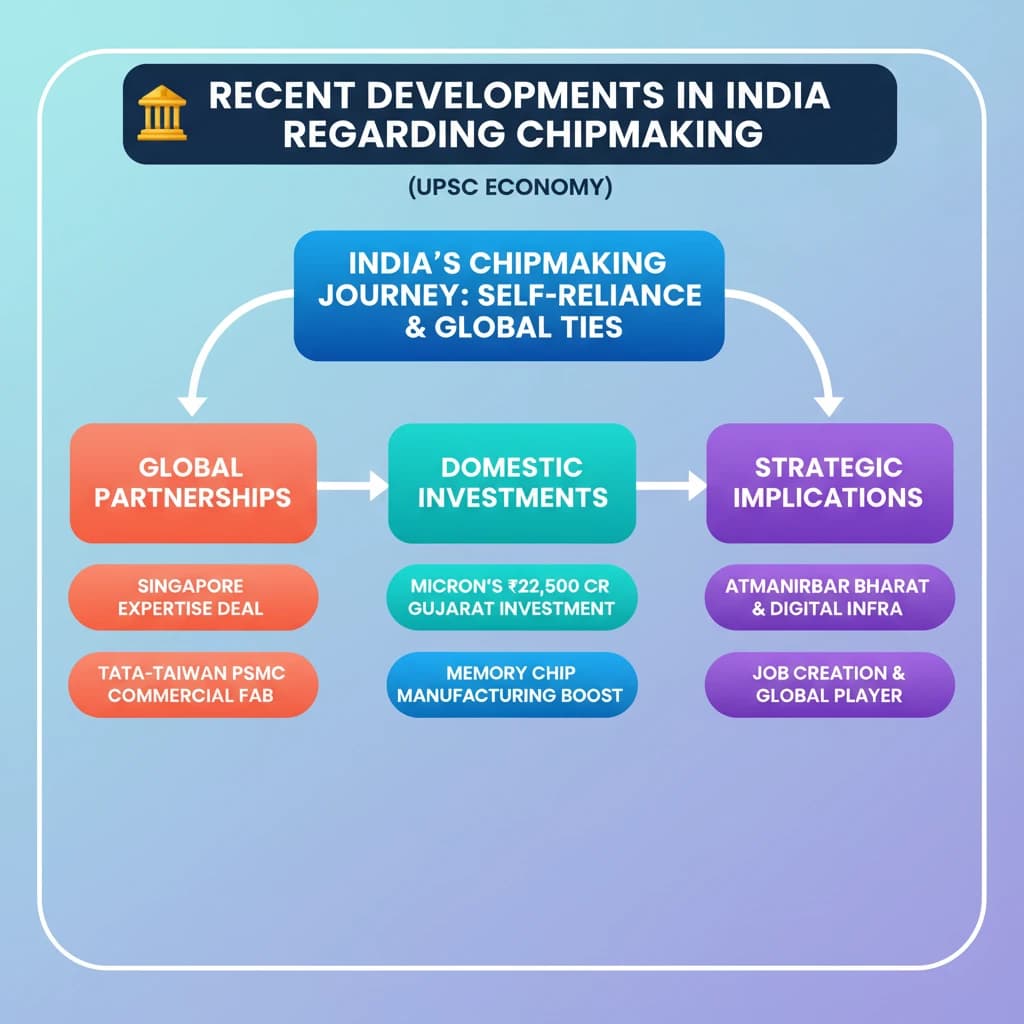
  • India is actively pursuing self-reliance in chipmaking through global partnerships and domestic investments.
  • Key collaborations include a chip deal with Singapore for expertise and Tata's partnership with Taiwan's PSMC for India's first commercial fab.
  • Micron Technology's Rs 22,500 crore investment in Gujarat aims to boost memory chip manufacturing.
  • These initiatives are crucial for India's Atmanirbhar Bharat vision, enhancing strategic autonomy and digital infrastructure.
  • The developments are set to create jobs and position India as a significant player in the global semiconductor ecosystem.
Recent Developments in India Regarding Chipmaking

Recent Developments in India Regarding Chipmaking

Medium⏱️ 8 min read✓ 95% Verified
economy

📖 Introduction

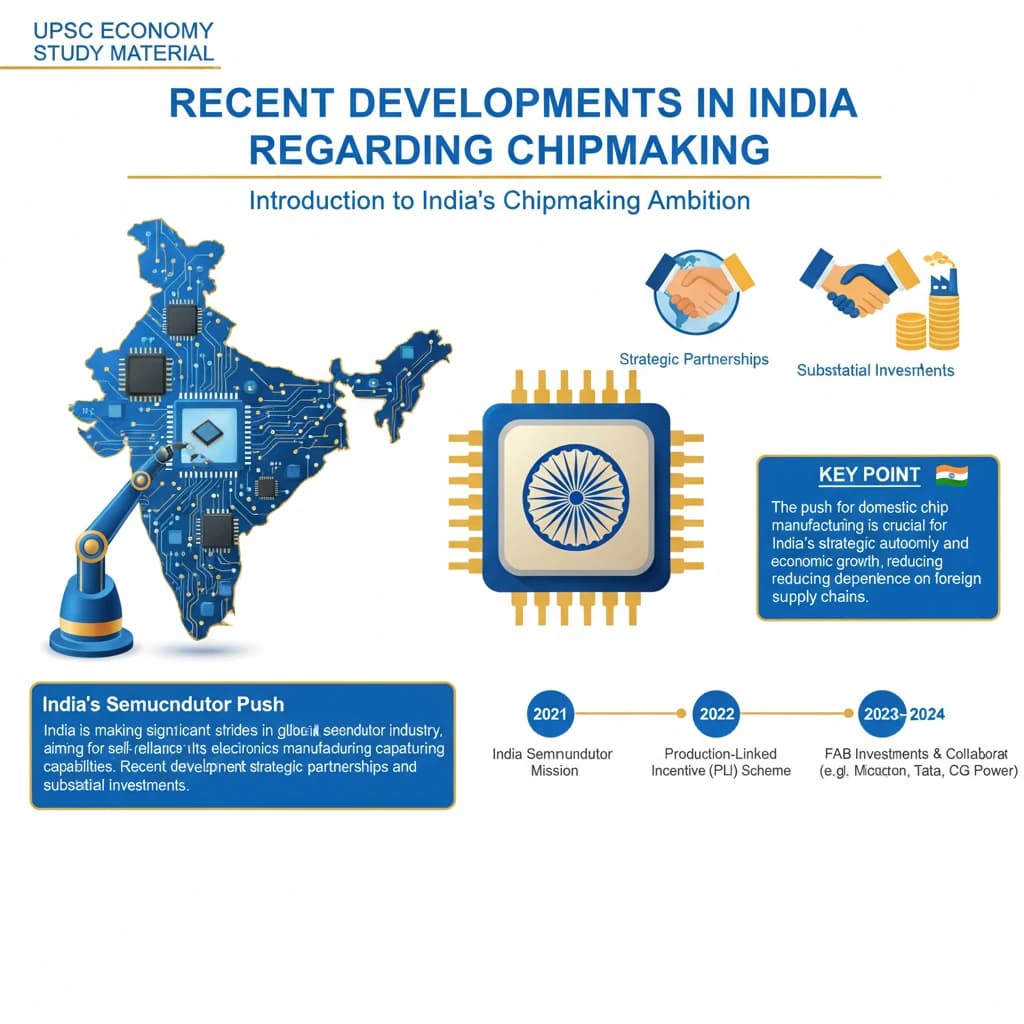
<h4>Introduction to India's Chipmaking Ambition</h4><p><strong>India</strong> is making significant strides in the global <strong>semiconductor industry</strong>, aiming for self-reliance and boosting its electronics manufacturing capabilities. Recent developments highlight strategic partnerships and substantial investments.</p><div class='key-point-box'><p>The push for <strong>domestic chip manufacturing</strong> is crucial for India's strategic autonomy and economic growth, reducing dependence on global supply chains.</p></div><h4>India-Singapore Chip Deal</h4><p><strong>India</strong> recently formalized a <strong>chip deal</strong> with <strong>Singapore</strong>. This collaboration leverages Singapore's established expertise in advanced semiconductor technologies.</p><div class='info-box'><p>Singapore is renowned for its proficiency in manufacturing specific types of chips:</p><ul><li><strong>Memory Chips</strong>: Essential for data storage in electronic devices.</li><li><strong>Logic Processors</strong>: The 'brains' of electronic devices, performing computational tasks.</li></ul></div><p>These critical components are fundamental to a wide array of modern technologies, including consumer electronics and the rapidly expanding automotive sector.</p><h4>Tata's Entry into Commercial Fabrication</h4><p>In a landmark move, the <strong>Tata Group</strong> is embarking on a significant venture by collaborating with <strong>Taiwan’s Powerchip Semiconductor Manufacturing Corporation (PSMC)</strong>.</p><p>This partnership is set to establish <strong>India’s first commercial fabrication plant</strong>, commonly known as a 'fab'. This facility will be crucial for producing semiconductors domestically on a large scale.</p><div class='exam-tip-box'><p><strong>UPSC Mains (GS-III)</strong>: The establishment of India's first commercial fab by <strong>Tata-PSMC</strong> is a key development for questions on industrial policy, 'Make in India', and technological self-reliance.</p></div><h4>Micron Technology's Investment in Gujarat</h4><p>Earlier in <strong>2023</strong>, a major investment was announced by the <strong>US-based company, Micron Technology</strong>. They signed a <strong>Memorandum of Understanding (MoU)</strong> with the <strong>Gujarat state government</strong>.</p><p>This agreement outlines the establishment of a substantial <strong>Semiconductor Unit</strong> near <strong>Ahmedabad</strong>, Gujarat. The project represents a significant financial commitment to India's semiconductor ecosystem.</p><div class='info-box'><p><strong>Micron Technology Project Details:</strong></p><ul><li><strong>Location</strong>: Near <strong>Ahmedabad, Gujarat</strong></li><li><strong>Investment</strong>: Worth <strong>Rs 22,500 crore</strong> (approximately <strong>USD 2.75 billion</strong>)</li><li><strong>Focus</strong>: Primarily on <strong>memory chip manufacturing</strong>.</li></ul></div><h4>Towards Self-Reliance in Memory Chip Manufacturing</h4><p>The overarching goal behind these significant investments and collaborations, particularly the <strong>Micron Technology project</strong>, is to foster <strong>India’s Self-Reliance</strong>.</p><p>Achieving domestic manufacturing capabilities in <strong>memory chips</strong> is vital for national security, economic stability, and positioning India as a global player in high-tech manufacturing.</p>
Concept Diagram

💡 Key Takeaways

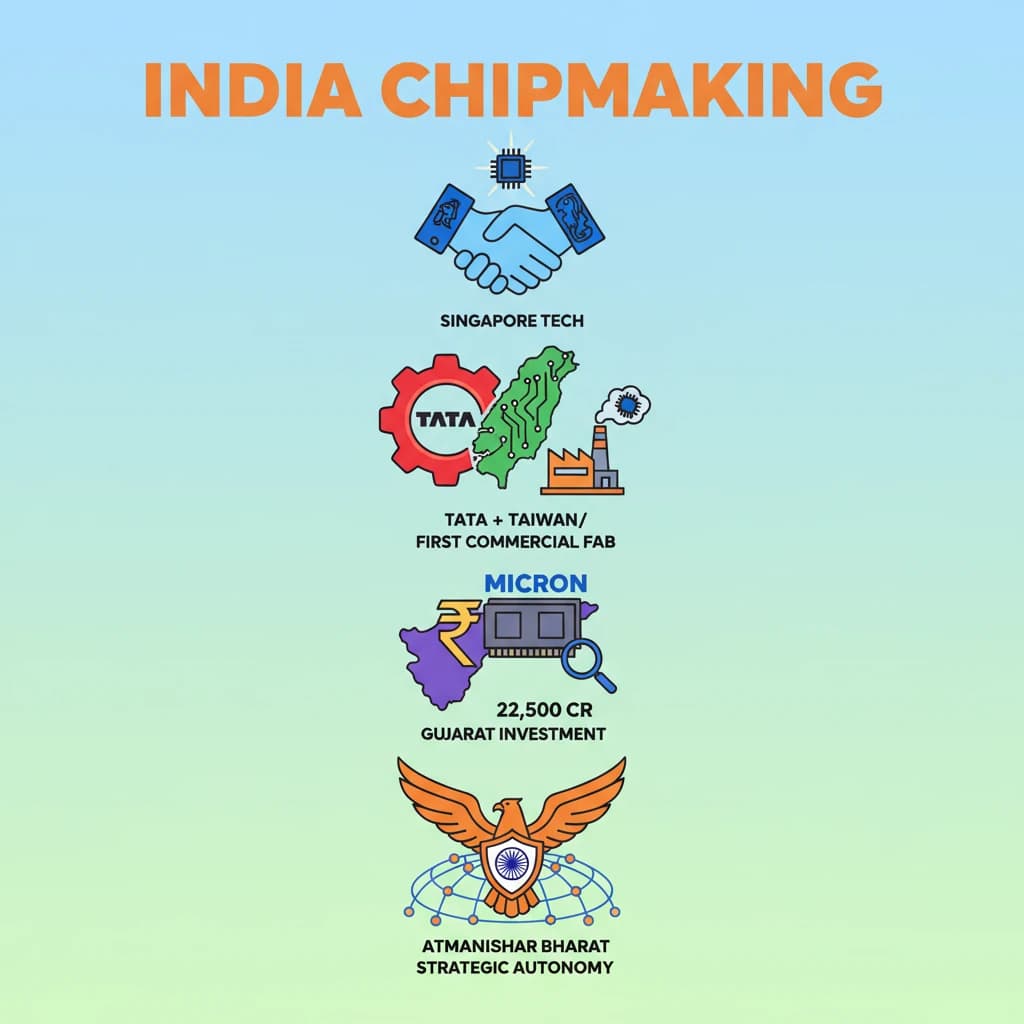
  • •India is actively pursuing self-reliance in chipmaking through global partnerships and domestic investments.
  • •Key collaborations include a chip deal with Singapore for expertise and Tata's partnership with Taiwan's PSMC for India's first commercial fab.
  • •Micron Technology's Rs 22,500 crore investment in Gujarat aims to boost memory chip manufacturing.
  • •These initiatives are crucial for India's Atmanirbhar Bharat vision, enhancing strategic autonomy and digital infrastructure.
  • •The developments are set to create jobs and position India as a significant player in the global semiconductor ecosystem.

🧠 Memory Techniques
Memory Aid
95% Verified Content

📚 Reference Sources

•Ministry of Electronics and Information Technology (MeitY) - India Semiconductor Mission
•Press Information Bureau (PIB) releases on semiconductor investments
•Reputable financial news outlets (e.g., The Economic Times, Livemint) for investment details.

Related Topics

Loading related topics...
Explore:Economy Topics·All Subjects·Daily Current Affairs·Editorial Analysis·Previous Year Questions·UPSC GPT