Loading page, please wait…
Vaidra Logo
Vaidra

Top 4 items + smart groups

UPSC GPT
New
Current Affairs
Daily Solutions
Daily Puzzle
Mains Evaluator

Version 2.0.0 • Built with ❤️ for UPSC aspirants

Loading...
Loading...
Loading...
Loading...
Loading...
Loading...
Loading...
Loading...
Loading...
Loading...
Loading...
Loading...
Loading...
What are the Provisions of the Unified Pension Scheme? - UPSC Economy
Back
All Subjects

Topics

0 topics • 0 completed

Loading topics...
Loading...
Loading...
Loading...
Loading...
Loading...
Overall Progress0%

What are the Provisions of the Unified Pension Scheme? - UPSC Economy

What is What are the Provisions of the Unified Pension Scheme? in UPSC Economy?

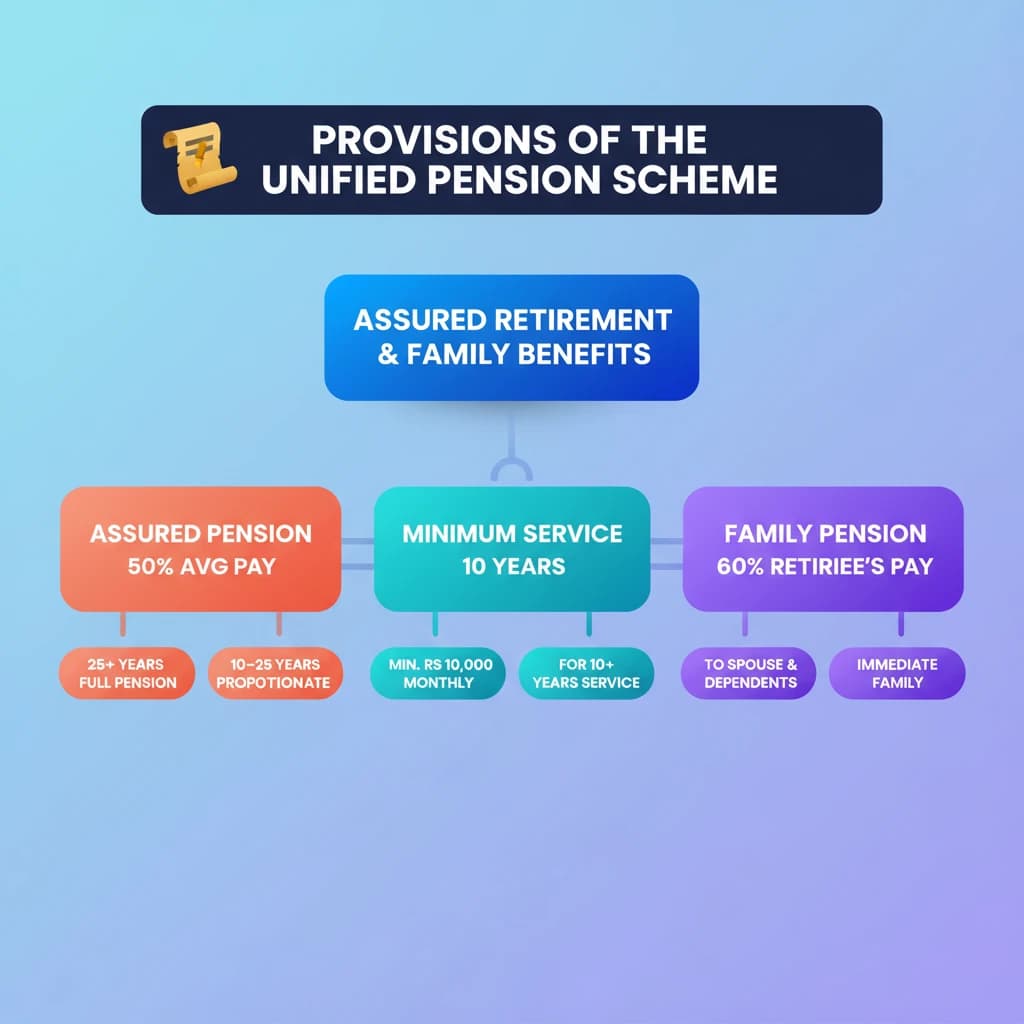
What are the Provisions of the Unified Pension Scheme? is a key topic under Economy for UPSC Civil Services Examination. Key points include: Unified Pension Scheme (UPS) offers assured retirement and family benefits.. Assured Pension: 50% of average basic pay (last 12 months) for 25+ years service.. Proportionate pension for 10-25 years service, with a minimum of 10 years required.. Understanding this topic is essential for both UPSC Prelims and Mains preparation.

Why is What are the Provisions of the Unified Pension Scheme? important for UPSC exam?

What are the Provisions of the Unified Pension Scheme? is a Medium-level topic in UPSC Economy. It is tested in both Prelims (factual MCQs) and Mains (analytical answer writing). Previous year UPSC questions have frequently covered aspects of What are the Provisions of the Unified Pension Scheme?, making it essential for comprehensive IAS preparation.

How to prepare What are the Provisions of the Unified Pension Scheme? for UPSC?

To prepare What are the Provisions of the Unified Pension Scheme? for UPSC: (1) Study the comprehensive notes covering all key concepts on Vaidra. (2) Practice previous year questions on this topic. (3) Connect it with current affairs using daily updates. (4) Revise using key takeaways and mind maps available for Economy. (5) Write practice answers linking What are the Provisions of the Unified Pension Scheme? to related GS Paper topics.

Key takeaways of What are the Provisions of the Unified Pension Scheme? for UPSC

  • Unified Pension Scheme (UPS) offers assured retirement and family benefits.
  • Assured Pension: 50% of average basic pay (last 12 months) for 25+ years service.
  • Proportionate pension for 10-25 years service, with a minimum of 10 years required.
  • Assured Minimum Pension: Rs 10,000/month for 10+ years service.
  • Assured Family Pension: 60% of retiree's last drawn pension to immediate family.
  • Inflation Indexation (Dearness Relief) applies to all three pension types to protect purchasing power.
What are the Provisions of the Unified Pension Scheme?

What are the Provisions of the Unified Pension Scheme?

Medium⏱️ 8 min read✓ 100% Verified
economy

📖 Introduction

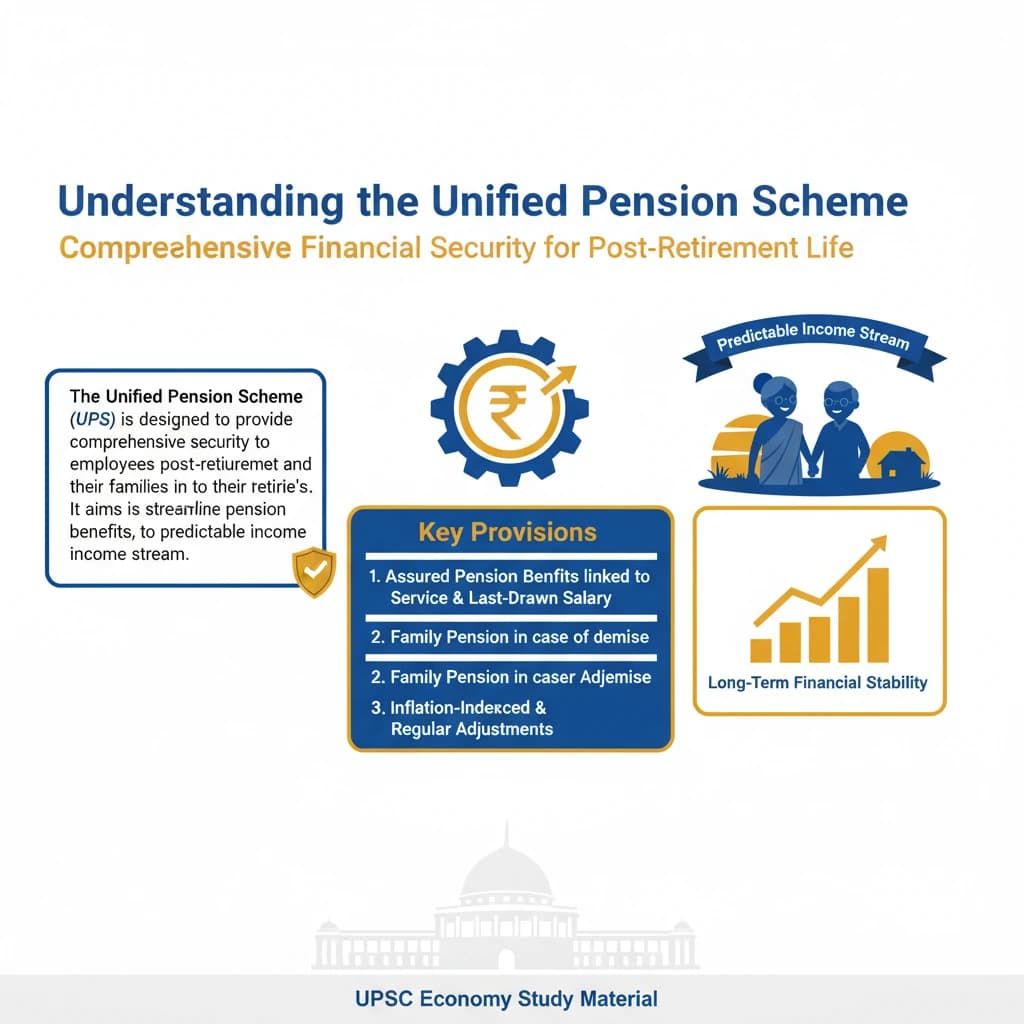
<h4>Understanding the Unified Pension Scheme</h4><p>The <strong>Unified Pension Scheme (UPS)</strong> is designed to provide comprehensive financial security to employees post-retirement and to their families in case of the retiree's demise. It aims to streamline pension benefits, ensuring a predictable income stream.</p><div class='key-point-box'><p>The UPS focuses on providing <strong>assured pension benefits</strong>, linking them to an employee's service period and last-drawn salary, while also incorporating inflation protection.</p></div><h4>Assured Pension Provision</h4><p>Under the UPS, an employee is guaranteed a pension amounting to <strong>50% of their average basic pay</strong>. This average is calculated over the <strong>last 12 months</strong> immediately preceding retirement.</p><p>This benefit is applicable for those with a minimum <strong>qualifying service of 25 years</strong>. It ensures a substantial portion of their working income continues into retirement.</p><div class='info-box'><p><strong>Calculation Basis:</strong> 50% of average <strong>basic pay</strong> from the last 12 months.</p><p><strong>Service Requirement:</strong> Minimum <strong>25 years</strong> of qualifying service.</p></div><p>For employees with a shorter service period, the pension amount will be reduced proportionally. However, there is a lower limit for eligibility.</p><p>The proportionate reduction applies for service periods down to a minimum of <strong>10 years of service</strong>, ensuring that even those with a shorter career span receive some benefit.</p><h4>Assured Minimum Pension</h4><p>The scheme also includes a provision for an <strong>Assured Minimum Pension</strong>, safeguarding retirees with shorter service durations.</p><p>If an employee retires after a minimum of <strong>10 years of service</strong>, they are eligible for a fixed minimum pension amount.</p><div class='info-box'><p><strong>Minimum Pension Amount:</strong> <strong>Rs 10,000 per month</strong>.</p><p><strong>Service Requirement:</strong> Minimum <strong>10 years</strong> of service.</p></div><p>This provision acts as a crucial social safety net, ensuring a basic standard of living for retirees who might not qualify for the full assured pension.</p><h4>Assured Family Pension</h4><p>The UPS extends its benefits to the immediate family of the retiree after their death, through the <strong>Assured Family Pension</strong> provision.</p><p>Upon the demise of a retiree, their eligible immediate family members become entitled to a portion of the pension that the retiree was receiving.</p><div class='info-box'><p><strong>Family Pension Rate:</strong> <strong>60% of the pension last drawn</strong> by the deceased retiree.</p><p><strong>Beneficiaries:</strong> Immediate family of the retiree.</p></div><p>This ensures continued financial support for the family, mitigating the economic impact of the loss of the primary pensioner.</p><h4>Inflation Indexation (Dearness Relief)</h4><p>To protect the purchasing power of pensioners against rising costs, the Unified Pension Scheme incorporates <strong>Inflation Indexation</strong>.</p><p>This is provided in the form of <strong>Dearness Relief (DR)</strong>, which is available on all three types of pensions mentioned above: Assured Pension, Assured Minimum Pension, and Assured Family Pension.</p><div class='exam-tip-box'><p><strong>UPSC Insight:</strong> Understanding <strong>Dearness Relief</strong> and its role in pension schemes is vital for questions on social security and government welfare measures in <strong>GS Paper 2</strong> and <strong>GS Paper 3</strong>.</p></div><p><strong>Dearness Relief</strong> adjustments are made periodically, typically twice a year, to compensate for inflation and ensure the real value of the pension is maintained.</p>
Concept Diagram

💡 Key Takeaways

  • •Unified Pension Scheme (UPS) offers assured retirement and family benefits.
  • •Assured Pension: 50% of average basic pay (last 12 months) for 25+ years service.
  • •Proportionate pension for 10-25 years service, with a minimum of 10 years required.
  • •Assured Minimum Pension: Rs 10,000/month for 10+ years service.
  • •Assured Family Pension: 60% of retiree's last drawn pension to immediate family.
  • •Inflation Indexation (Dearness Relief) applies to all three pension types to protect purchasing power.

🧠 Memory Techniques

Memory Aid
100% Verified Content

Related Topics

Loading related topics...
Explore:Economy Topics·All Subjects·Daily Current Affairs·Editorial Analysis·Previous Year Questions·UPSC GPT