Loading page, please wait…
Vaidra Logo
Vaidra

Top 4 items + smart groups

UPSC GPT
New
Current Affairs
Daily Solutions
Daily Puzzle
Mains Evaluator

Version 2.0.0 • Built with ❤️ for UPSC aspirants

Loading...
Loading...
Loading...
Loading...
Loading...
Loading...
Loading...
Loading...
Loading...
Loading...
Loading...
Loading...
Loading...
Back
All Subjects

Topics

0 topics • 0 completed

Loading topics...
Loading...
Loading...
Loading...
Loading...
Loading...
Overall Progress0%
GDP Base Year Revision - UPSC Economy

GDP Base Year Revision - UPSC Economy

What is GDP Base Year Revision in UPSC Economy?

GDP Base Year Revision is a key topic under Economy for UPSC Civil Services Examination. Key points include: GDP base year is a reference point for calculating economic figures.. MoSPI is discussing the next base year revision, emphasizing wide consultation.. The 2015 revision changed the base year from 2004-05 to 2011-12 but faced criticism.. Understanding this topic is essential for both UPSC Prelims and Mains preparation.

Why is GDP Base Year Revision important for UPSC exam?

GDP Base Year Revision is a Medium-level topic in UPSC Economy. It is tested in both Prelims (factual MCQs) and Mains (analytical answer writing). Previous year UPSC questions have frequently covered aspects of GDP Base Year Revision, making it essential for comprehensive IAS preparation.

How to prepare GDP Base Year Revision for UPSC?

To prepare GDP Base Year Revision for UPSC: (1) Study the comprehensive notes covering all key concepts on Vaidra. (2) Practice previous year questions on this topic. (3) Connect it with current affairs using daily updates. (4) Revise using key takeaways and mind maps available for Economy. (5) Write practice answers linking GDP Base Year Revision to related GS Paper topics.

Key takeaways of GDP Base Year Revision for UPSC

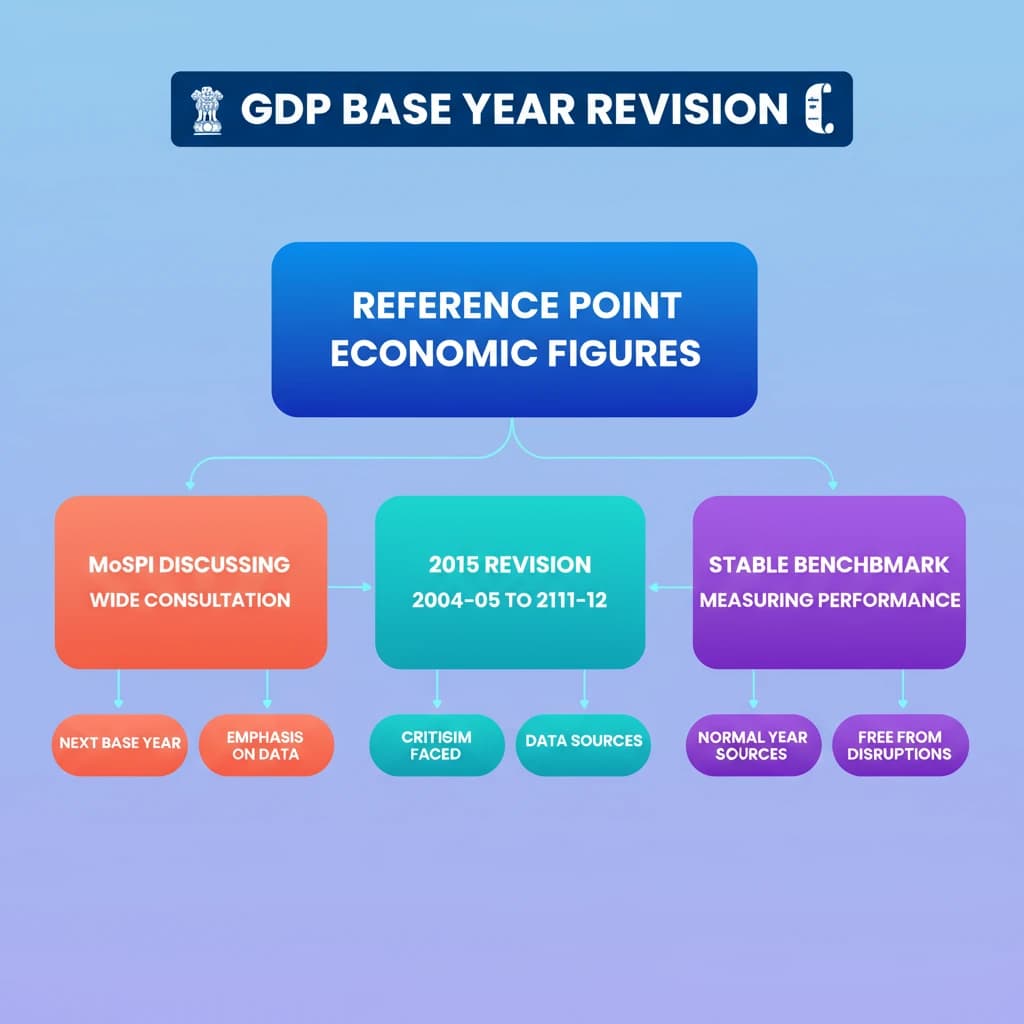
  • GDP base year is a reference point for calculating economic figures.
  • MoSPI is discussing the next base year revision, emphasizing wide consultation.
  • The 2015 revision changed the base year from 2004-05 to 2011-12 but faced criticism.
  • A base year provides a stable benchmark for measuring economic performance over time.
  • An ideal base year should be a 'normal' year, free from major disruptions, and not too old.
GDP Base Year Revision

GDP Base Year Revision

Medium⏱️ 6 min read✓ 98% Verified
economy

📖 Introduction

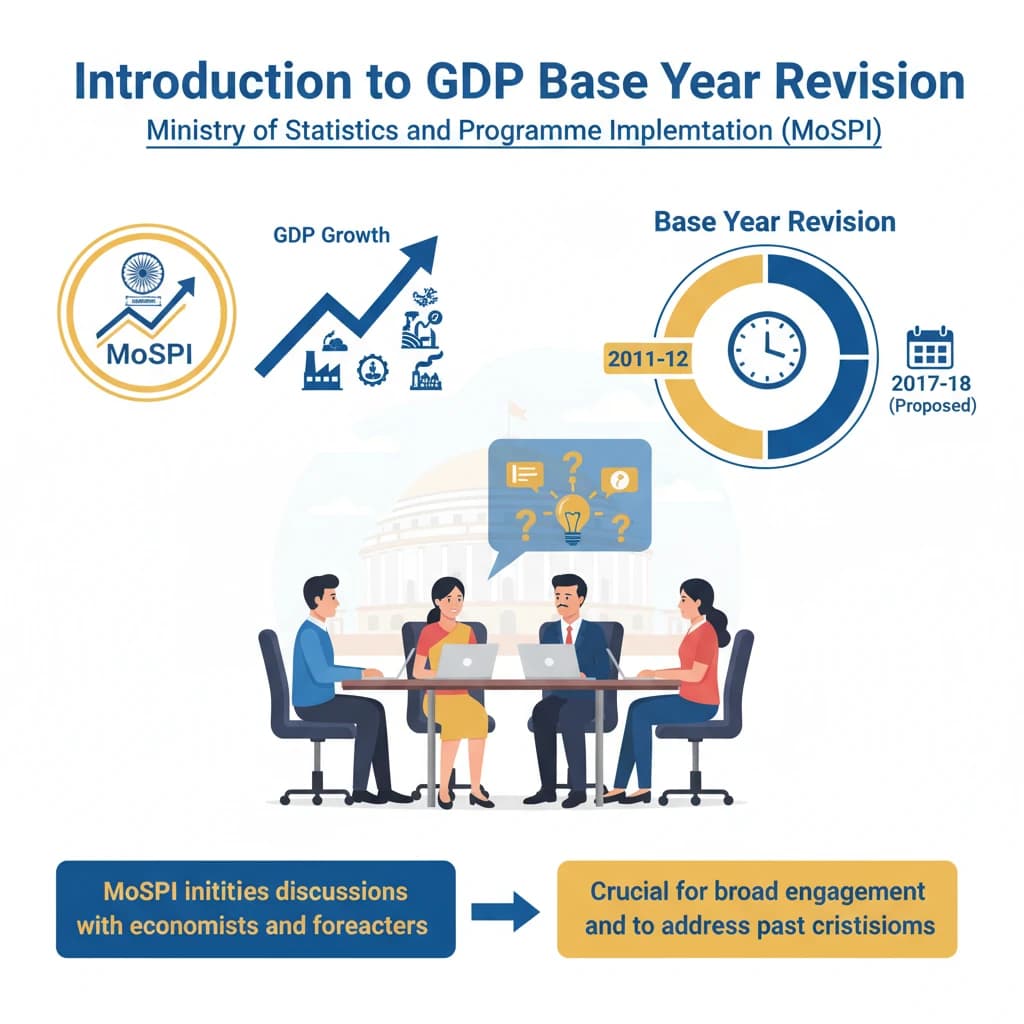
<h4>Introduction to GDP Base Year Revision</h4><p>The <strong>Ministry of Statistics and Programme Implementation (MoSPI)</strong> recently initiated discussions with economists and forecasters regarding the revision of India's <strong>Gross Domestic Product (GDP) base year</strong>.</p><p>This move highlights <strong>MoSPI's</strong> commitment to extensive consultation. Such broad engagement is crucial, especially given the significant debates and criticisms that arose from previous base year revisions.</p><div class='info-box'><p>The last <strong>base year revision</strong> occurred in <strong>2015</strong>. It changed the base year from <strong>2004-05</strong> to <strong>2011-12</strong>. This revision, however, faced considerable criticism due to perceived flaws in the accompanying methodological changes.</p></div><h4>What is a Base Year?</h4><p>A <strong>base year</strong> serves as a fundamental reference point in economic calculations. It is a specific year against which the <strong>GDP figures</strong> for all subsequent and prior years are measured and compared.</p><div class='info-box'><p><strong>Definition:</strong> A <strong>base year</strong> is a fixed reference period used for calculating various economic indices, including <strong>GDP</strong>, to remove the effect of price changes and reflect real economic growth.</p></div><h4>Need for a Base Year</h4><p>The primary purpose of a <strong>base year</strong> is to establish a stable and consistent benchmark. This allows for accurate measurement of a nation's <strong>economic performance</strong> over time.</p><p>By pegging <strong>GDP figures</strong> to a specific reference year, economists and analysts can effectively interpret long-term trends and significant shifts in the country's economic landscape.</p><div class='key-point-box'><p>A <strong>base year</strong> is essential for:<ul><li>Providing a <strong>stable reference point</strong> for economic data.</li><li>Enabling <strong>accurate comparisons</strong> of economic performance across different periods.</li><li>Allowing for the interpretation of <strong>real economic growth</strong> by isolating price effects.</li></ul></p></div><h4>Features of an Ideal Base Year</h4><p>An ideal <strong>base year</strong> should represent a 'normal' economic period. This means it must be free from any major economic or natural disruptions that could skew data.</p><p>Such disruptions include significant events like widespread <strong>droughts</strong>, devastating <strong>floods</strong>, major <strong>earthquakes</strong>, or large-scale <strong>pandemics</strong>.</p><div class='exam-tip-box'><p><strong>UPSC Insight:</strong> When discussing <strong>GDP calculations</strong> or <strong>economic data reliability</strong> in <strong>GS-III</strong>, understanding the criteria for an ideal <strong>base year</strong> is crucial for critical analysis.</p></div><p>Furthermore, an effective <strong>base year</strong> should not be too far removed in the past. Using an outdated base year can lead to inaccurate reflections of the current economic structure and activity.</p>
Concept Diagram

💡 Key Takeaways

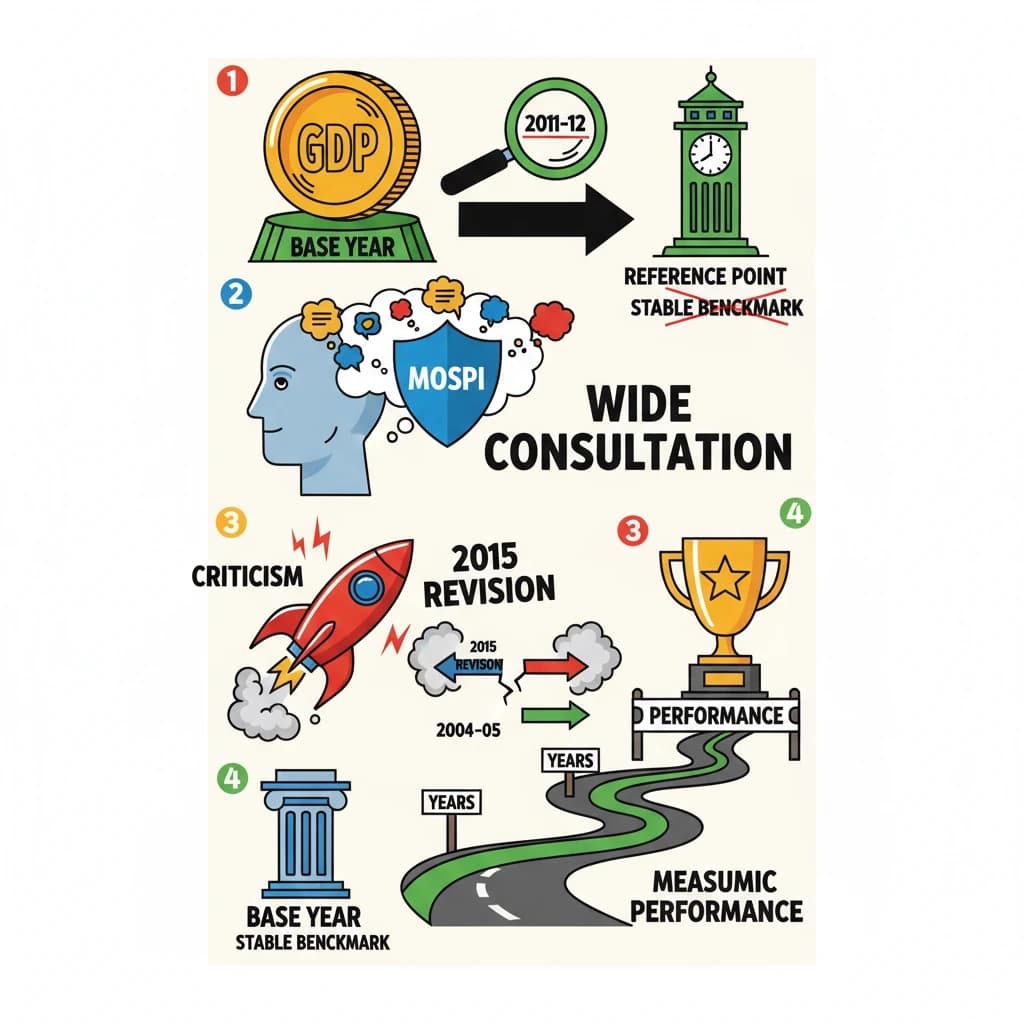
  • •GDP base year is a reference point for calculating economic figures.
  • •MoSPI is discussing the next base year revision, emphasizing wide consultation.
  • •The 2015 revision changed the base year from 2004-05 to 2011-12 but faced criticism.
  • •A base year provides a stable benchmark for measuring economic performance over time.
  • •An ideal base year should be a 'normal' year, free from major disruptions, and not too old.

🧠 Memory Techniques
Memory Aid
98% Verified Content

Related Topics

Loading related topics...
Explore:Economy Topics·All Subjects·Daily Current Affairs·Editorial Analysis·Previous Year Questions·UPSC GPT