Loading page, please wait…
Vaidra Logo
Vaidra

Top 4 items + smart groups

UPSC GPT
New
Current Affairs
Daily Solutions
Daily Puzzle
Mains Evaluator

Version 2.0.0 • Built with ❤️ for UPSC aspirants

Loading...
Loading...
Loading...
Loading...
Loading...
Loading...
Loading...
Loading...
Loading...
Loading...
Loading...
Loading...
Loading...
Microfinance Institutions - UPSC Economy
Back
All Subjects

Topics

0 topics • 0 completed

Loading topics...
Loading...
Loading...
Loading...
Loading...
Loading...
Overall Progress0%

Microfinance Institutions - UPSC Economy

What is Microfinance Institutions in UPSC Economy?

Microfinance Institutions is a key topic under Economy for UPSC Civil Services Examination. Key points include: MFIs provide small loans and financial services to low-income, unbanked individuals, promoting self-sufficiency.. Their core goal is financial inclusion, particularly empowering marginalized groups and women.. MFIs are regulated by the RBI under the 2014 NBFC-MFI framework, which covers client protection and credit pricing.. Understanding this topic is essential for both UPSC Prelims and Mains preparation.

Why is Microfinance Institutions important for UPSC exam?

Microfinance Institutions is a Medium-level topic in UPSC Economy. It is tested in both Prelims (factual MCQs) and Mains (analytical answer writing). Previous year UPSC questions have frequently covered aspects of Microfinance Institutions, making it essential for comprehensive IAS preparation.

How to prepare Microfinance Institutions for UPSC?

To prepare Microfinance Institutions for UPSC: (1) Study the comprehensive notes covering all key concepts on Vaidra. (2) Practice previous year questions on this topic. (3) Connect it with current affairs using daily updates. (4) Revise using key takeaways and mind maps available for Economy. (5) Write practice answers linking Microfinance Institutions to related GS Paper topics.

Key takeaways of Microfinance Institutions for UPSC

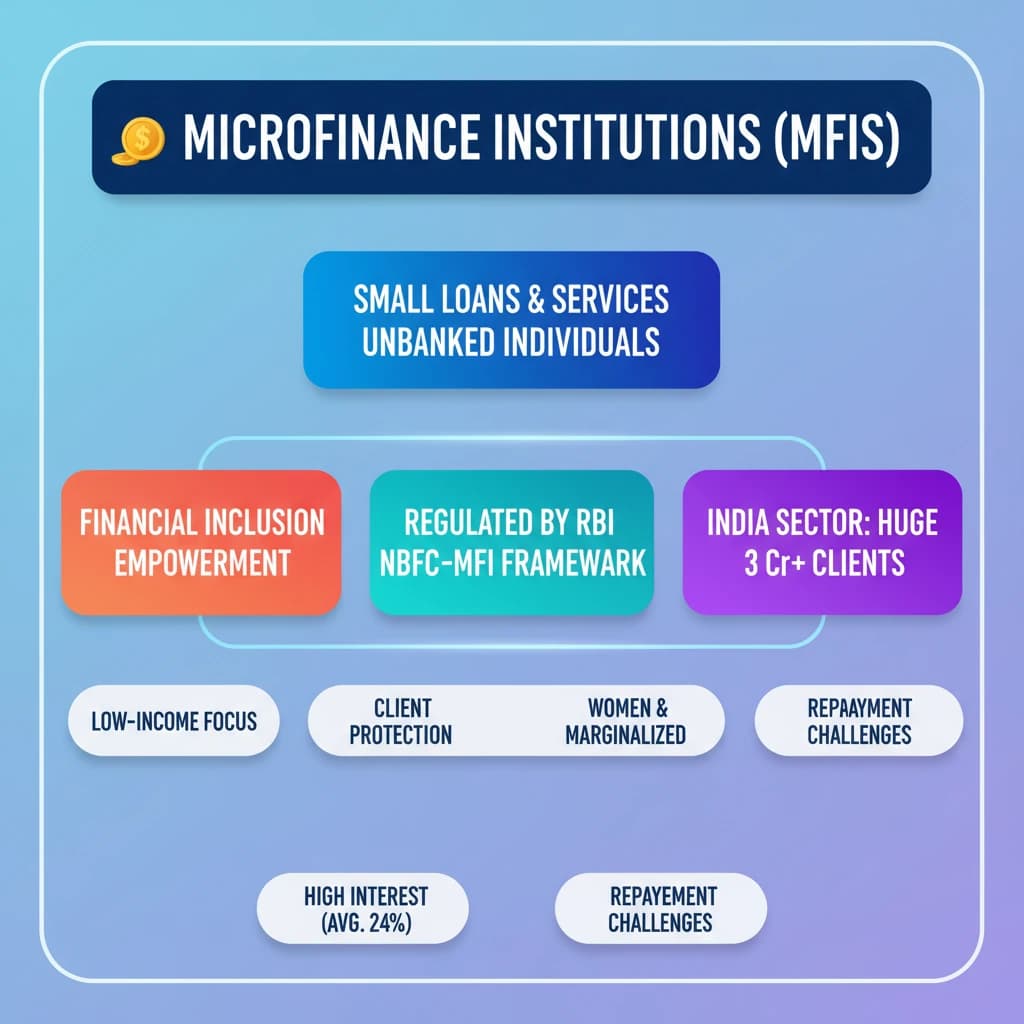
  • MFIs provide small loans and financial services to low-income, unbanked individuals, promoting self-sufficiency.
  • Their core goal is financial inclusion, particularly empowering marginalized groups and women.
  • MFIs are regulated by the RBI under the 2014 NBFC-MFI framework, which covers client protection and credit pricing.
  • India's microfinance sector is significant, with 184 MFIs serving over 3 crore clients across 29 States and 4 UTs.
  • Key challenges include high interest rates (avg. 24%), high processing fees, and non-compliance in assessing borrower repayment capacity.
  • There is a crucial need to balance financial outreach with responsible lending practices and robust regulatory oversight.
Microfinance Institutions

Microfinance Institutions

Medium⏱️ 7 min read✓ 100% Verified
economy

📖 Introduction

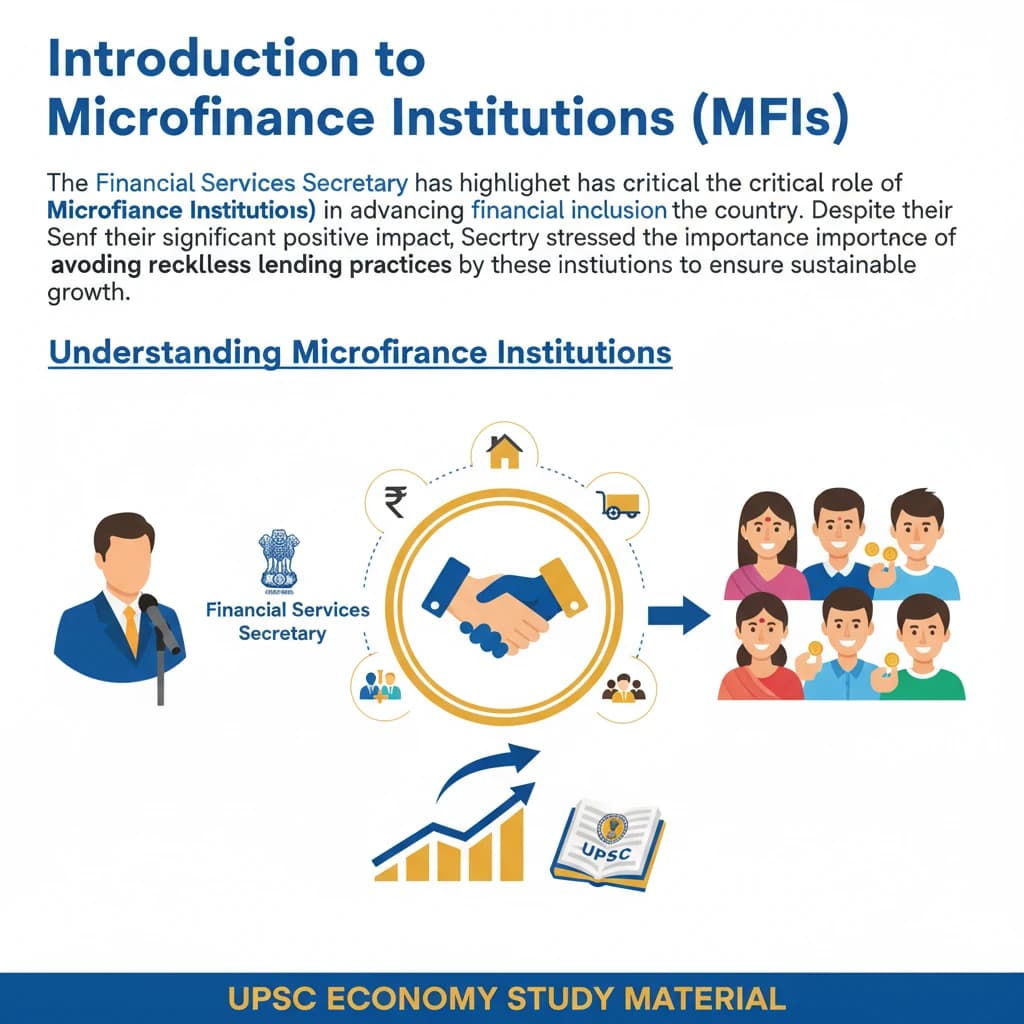
<h4>Introduction to Microfinance Institutions (MFIs)</h4><p>The <strong>Financial Services Secretary</strong> has highlighted the critical role of <strong>Microfinance Institutions (MFIs)</strong> in advancing <strong>financial inclusion</strong> across the country.</p><p>Despite their significant positive impact, the Secretary stressed the importance of <strong>avoiding reckless lending</strong> practices by these institutions to ensure sustainable growth.</p><h4>Understanding Microfinance Institutions</h4><div class='info-box'><p><strong>Definition:</strong> <strong>MFIs</strong> are financial companies that extend <strong>small loans</strong> and provide other financial services.</p><p>They cater specifically to individuals and groups who typically <strong>lack access to conventional banking facilities</strong>.</p></div><p>The primary objective of <strong>microfinance</strong> is to empower <strong>low-income</strong> and <strong>unemployed individuals</strong>, helping them achieve <strong>self-sufficiency</strong>.</p><p>MFIs serve as a vital instrument for <strong>financial inclusion</strong>, particularly benefiting <strong>marginalized groups</strong> and <strong>women</strong>, thereby fostering <strong>social equity</strong> and <strong>empowerment</strong>.</p><h4>Regulatory Framework for MFIs in India</h4><p>The <strong>Reserve Bank of India (RBI)</strong> is the primary regulator for <strong>MFIs</strong> in India, ensuring systematic operation and client protection.</p><p>Regulation is carried out under the <strong>NBFC-MFI framework</strong>, which was established in <strong>2014</strong> to formalize oversight.</p><div class='info-box'><p>The <strong>NBFC-MFI framework</strong> covers crucial aspects such as:</p><ul><li><strong>Client protection</strong> and borrower safeguards.</li><li>Ensuring <strong>privacy</strong> of clients' financial data.</li><li>Guidelines for transparent <strong>credit pricing</strong> and fee structures.</li></ul></div><h4>Current Status and Growth of MFIs in India</h4><p>The <strong>microfinance sector in India</strong> has experienced substantial growth, becoming a significant component of the financial landscape.</p><p>Currently, there are <strong>184 Microfinance Institutions (MFIs)</strong> operating across a wide geographical expanse in the country.</p><div class='info-box'><p><strong>Geographical Reach:</strong> MFIs are present in:</p><ul><li><strong>29 States</strong></li><li><strong>4 Union Territories</strong></li><li><strong>563 districts</strong></li></ul><p>These institutions collectively serve a vast client base of <strong>over 3 crore individuals</strong>, demonstrating their extensive outreach.</p></div><h4>Challenges and Scrutiny Faced by MFIs</h4><p>Many <strong>MFIs</strong> have come under scrutiny due to concerns regarding their lending practices, particularly concerning cost to borrowers.</p><p>One major issue is the charging of <strong>excessive interest rates</strong>, which average around <strong>24% per annum</strong>, making repayments challenging for the poor.</p><div class='key-point-box'><p>Concerns also include <strong>high processing fees</strong> and instances of <strong>non-compliance</strong> in accurately assessing borrowers’ income and repayment capacities, potentially leading to over-indebtedness.</p></div><p>A report by <strong>Sa-Dhan</strong> indicates that minor reductions in interest rates would not significantly alleviate the repayment burden for <strong>low-income households</strong>, suggesting deeper structural issues.</p><div class='exam-tip-box'><p>UPSC often asks about the <strong>challenges of financial inclusion</strong> and the role of various institutions. Understanding the dual role of MFIs – promoting inclusion while facing scrutiny – is crucial for a balanced answer in <strong>GS Paper III (Economy)</strong>.</p></div>
Concept Diagram

💡 Key Takeaways

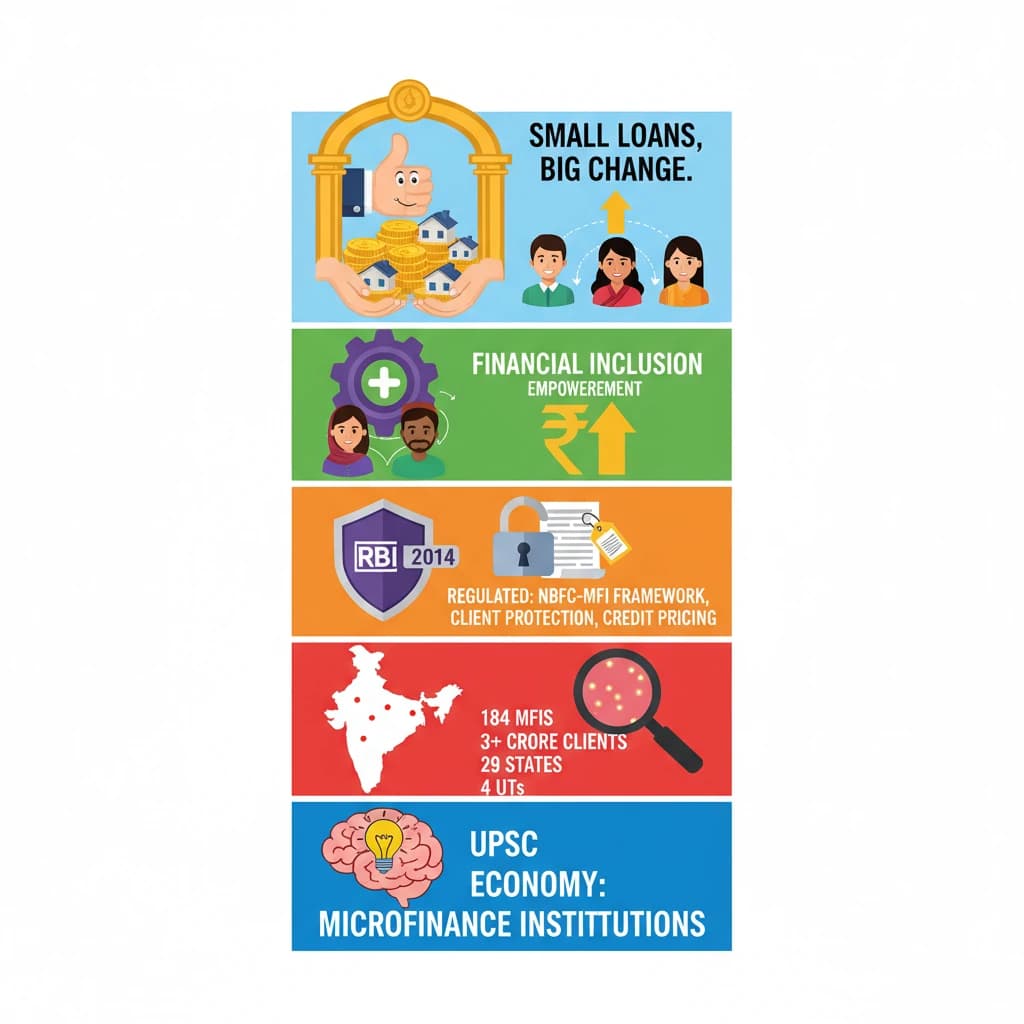
  • •MFIs provide small loans and financial services to low-income, unbanked individuals, promoting self-sufficiency.
  • •Their core goal is financial inclusion, particularly empowering marginalized groups and women.
  • •MFIs are regulated by the RBI under the 2014 NBFC-MFI framework, which covers client protection and credit pricing.
  • •India's microfinance sector is significant, with 184 MFIs serving over 3 crore clients across 29 States and 4 UTs.
  • •Key challenges include high interest rates (avg. 24%), high processing fees, and non-compliance in assessing borrower repayment capacity.
  • •There is a crucial need to balance financial outreach with responsible lending practices and robust regulatory oversight.

🧠 Memory Techniques
Memory Aid
100% Verified Content

Related Topics

Loading related topics...
Explore:Economy Topics·All Subjects·Daily Current Affairs·Editorial Analysis·Previous Year Questions·UPSC GPT