Loading page, please wait…
Vaidra Logo
Vaidra

Top 4 items + smart groups

UPSC GPT
New
Current Affairs
Daily Solutions
Daily Puzzle
Mains Evaluator

Version 2.0.0 • Built with ❤️ for UPSC aspirants

Loading...
Loading...
Loading...
Loading...
Loading...
Loading...
Loading...
Loading...
Loading...
Loading...
Loading...
Loading...
Loading...
Back
All Subjects

Topics

0 topics • 0 completed

Loading topics...
Loading...
Loading...
Loading...
Loading...
Loading...
Overall Progress0%

What is Duty Drawback? - UPSC Economy

What is What is Duty Drawback? in UPSC Economy?

What is Duty Drawback? is a key topic under Economy for UPSC Civil Services Examination. Key points include: Duty Drawback rebates customs/excise duties on materials used in export goods.. Its purpose is to make exports competitive by neutralizing domestic taxes.. It is governed by Section 75 of the Customs Act, 1962.. Understanding this topic is essential for both UPSC Prelims and Mains preparation.

Why is What is Duty Drawback? important for UPSC exam?

What is Duty Drawback? is a Medium-level topic in UPSC Economy. It is tested in both Prelims (factual MCQs) and Mains (analytical answer writing). Previous year UPSC questions have frequently covered aspects of What is Duty Drawback?, making it essential for comprehensive IAS preparation.

How to prepare What is Duty Drawback? for UPSC?

To prepare What is Duty Drawback? for UPSC: (1) Study the comprehensive notes covering all key concepts on Vaidra. (2) Practice previous year questions on this topic. (3) Connect it with current affairs using daily updates. (4) Revise using key takeaways and mind maps available for Economy. (5) Write practice answers linking What is Duty Drawback? to related GS Paper topics.

Key takeaways of What is Duty Drawback? for UPSC

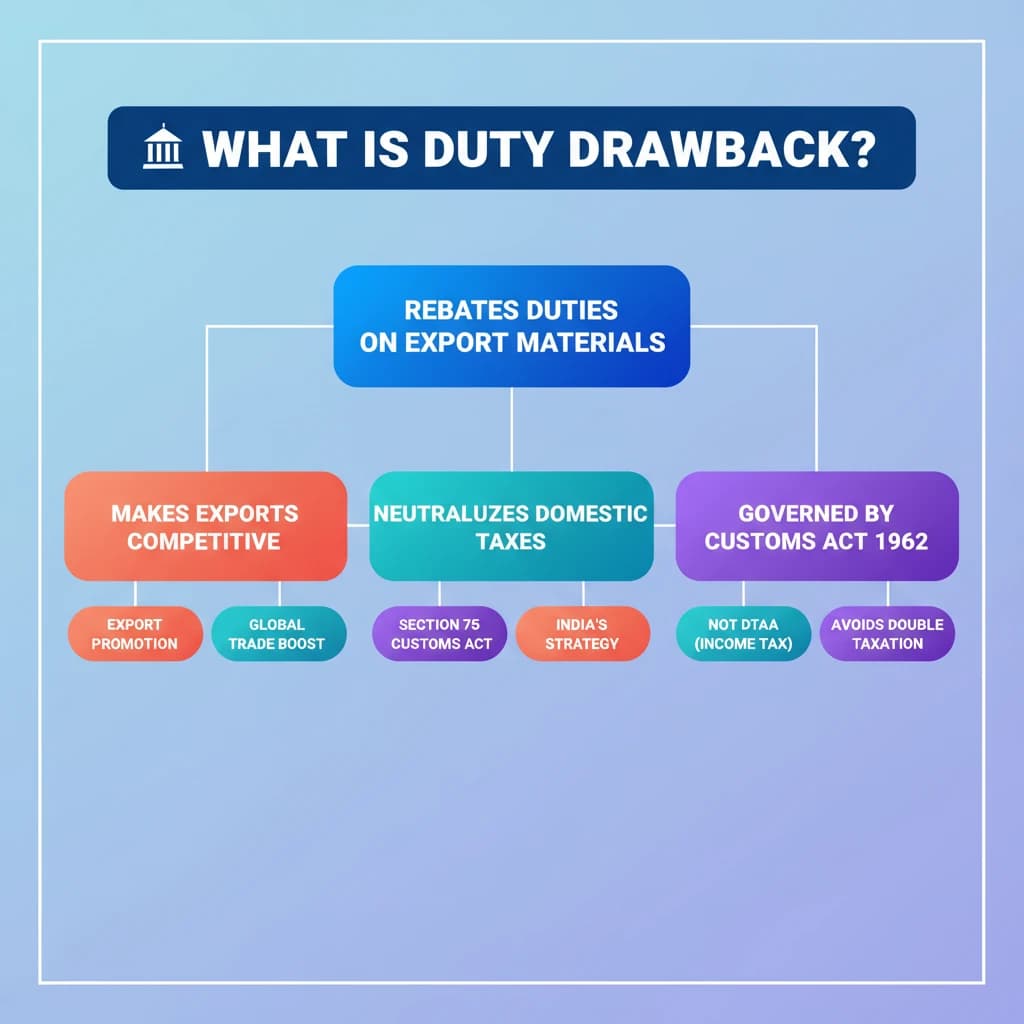
  • Duty Drawback rebates customs/excise duties on materials used in export goods.
  • Its purpose is to make exports competitive by neutralizing domestic taxes.
  • It is governed by Section 75 of the Customs Act, 1962.
  • DTAA is a separate agreement to avoid double taxation on income between countries.
  • Both are crucial for India's export promotion and international investment strategy.
What is Duty Drawback?

What is Duty Drawback?

Medium⏱️ 6 min read✓ 98% Verified
economy

📖 Introduction

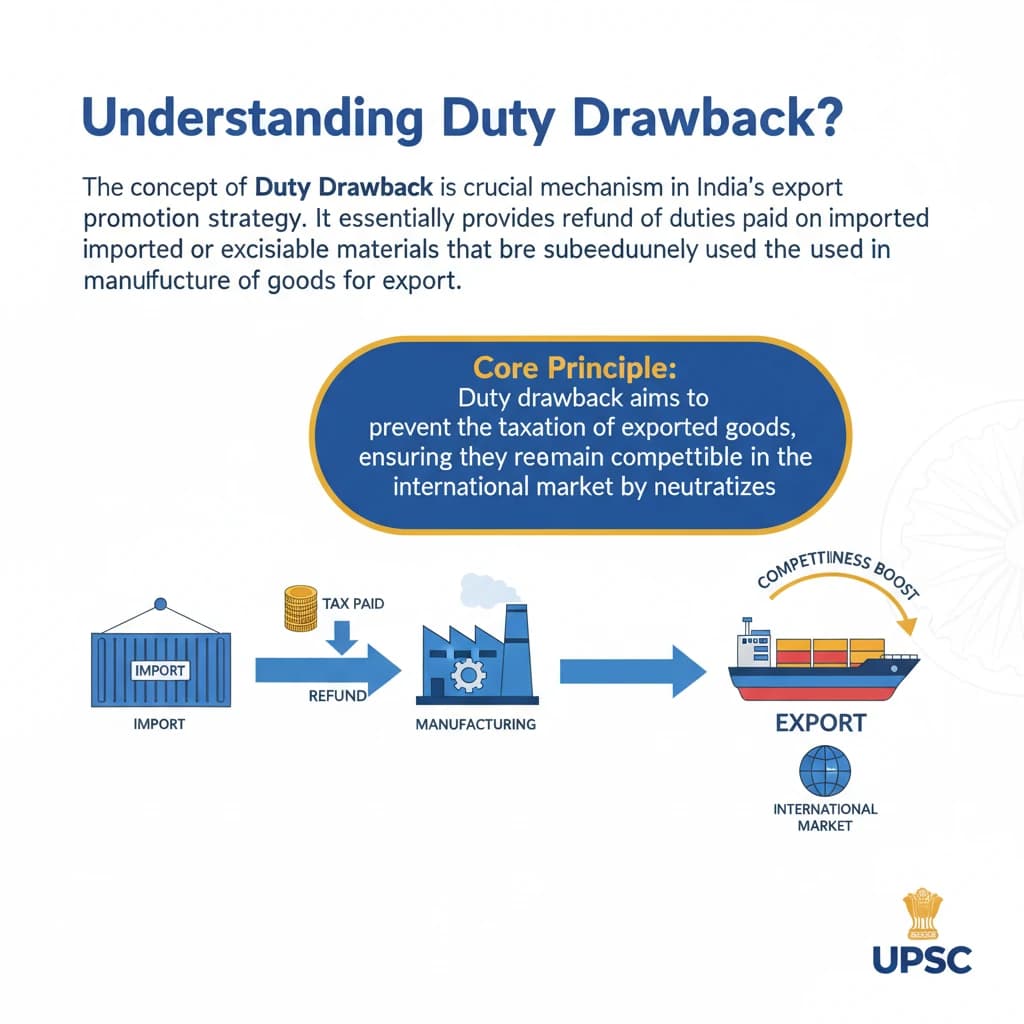
<h4>Understanding Duty Drawback</h4><p>The concept of <strong>Duty Drawback</strong> is a crucial mechanism in India's export promotion strategy. It essentially provides a refund of duties paid on imported or excisable materials that are subsequently used in the manufacture of goods for export.</p><div class='key-point-box'><p><strong>Core Principle:</strong> Duty drawback aims to prevent the taxation of exported goods, ensuring they remain competitive in the international market by neutralizing the impact of domestic duties and taxes.</p></div><h4>Legal Framework of Duty Drawback</h4><p>In India, the provision for <strong>Duty Drawback</strong> is enshrined under <strong>Section 75</strong> of the <strong>Customs Act, 1962</strong>. This legal backing ensures that exporters can claim rebates on specific duties.</p><div class='info-box'><p><strong>Section 75, Customs Act, 1962:</strong> This section specifically deals with the rebate of <strong>customs duty</strong> chargeable on any imported materials or <strong>excisable materials</strong> used in the manufacture of goods that are subsequently exported.</p></div><h4>Purpose and Benefits for Exporters</h4><p>The primary objective of the <strong>Duty Drawback</strong> system is to assist exporters in mitigating various costs incurred during the export process. These costs are particularly significant within the complex supply or value chain of manufactured goods.</p><ul><li>It helps reduce the overall cost of production for export-oriented units.</li><li>It enhances the price competitiveness of Indian goods in global markets.</li><li>It prevents the 'export of taxes', ensuring that only the value of the goods, not the embedded taxes, is reflected in the export price.</li></ul><div class='exam-tip-box'><p><strong>UPSC Insight:</strong> Understanding <strong>Duty Drawback</strong> is vital for questions related to India's <strong>Foreign Trade Policy</strong>, <strong>export promotion schemes</strong>, and the government's efforts to boost manufacturing and trade. It directly impacts India's <strong>Balance of Payments</strong>.</p></div><h4>Distinction: Duty Drawback vs. DTAA (Context from Source)</h4><p>While the source material mentioned <strong>Double Taxation Avoidance Agreement (DTAA)</strong>, it is important to note that <strong>Duty Drawback</strong> and <strong>DTAA</strong> are distinct concepts. <strong>Duty Drawback</strong> deals with duties on materials for exports, whereas <strong>DTAA</strong> addresses income tax for residents earning income across borders.</p>
Concept Diagram

💡 Key Takeaways

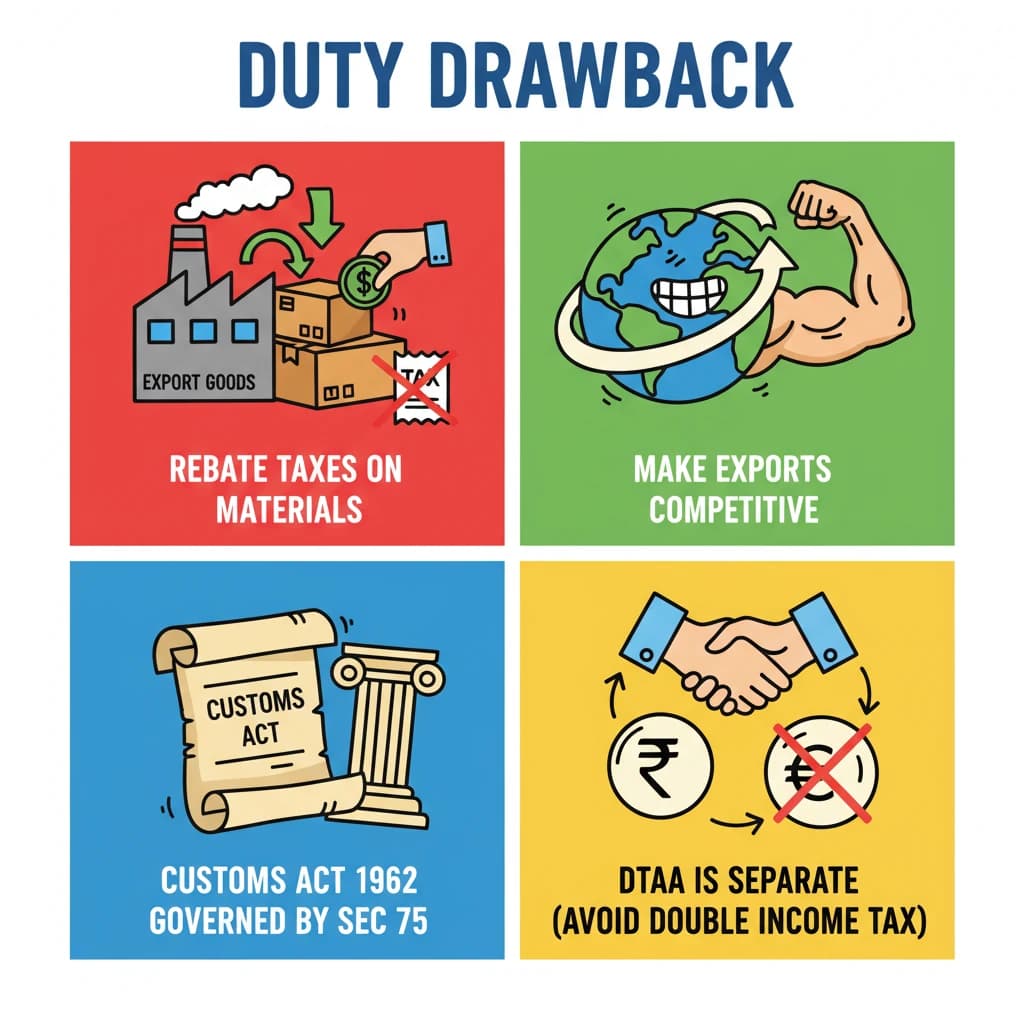
  • •Duty Drawback rebates customs/excise duties on materials used in export goods.
  • •Its purpose is to make exports competitive by neutralizing domestic taxes.
  • •It is governed by Section 75 of the Customs Act, 1962.
  • •DTAA is a separate agreement to avoid double taxation on income between countries.
  • •Both are crucial for India's export promotion and international investment strategy.

🧠 Memory Techniques
Memory Aid
98% Verified Content

📚 Reference Sources

•Customs Act, 1962 (Section 75)
•General knowledge of Double Taxation Avoidance Agreements (DTAA) and India-Mauritius DTAA

Related Topics

Loading related topics...
Explore:Economy Topics·All Subjects·Daily Current Affairs·Editorial Analysis·Previous Year Questions·UPSC GPT
What is Duty Drawback? - UPSC Economy