📖 Introduction
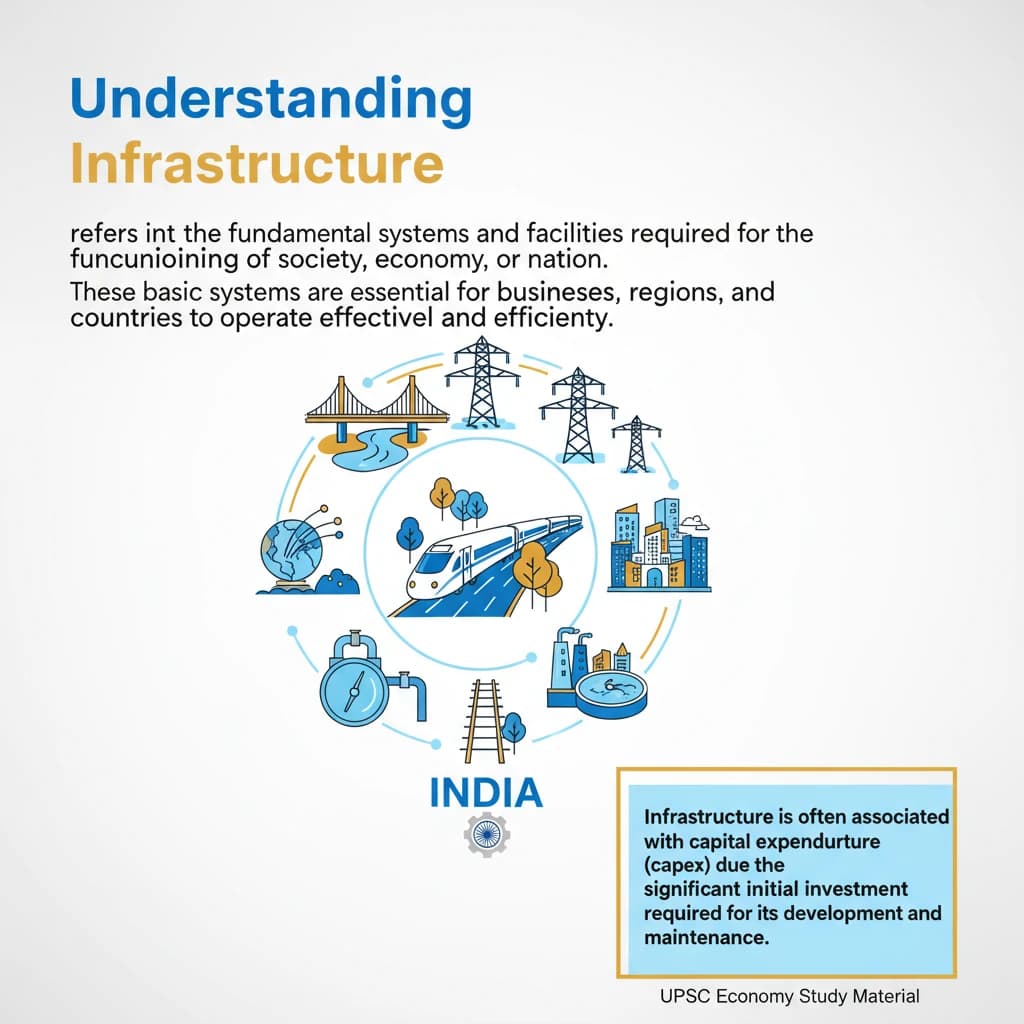
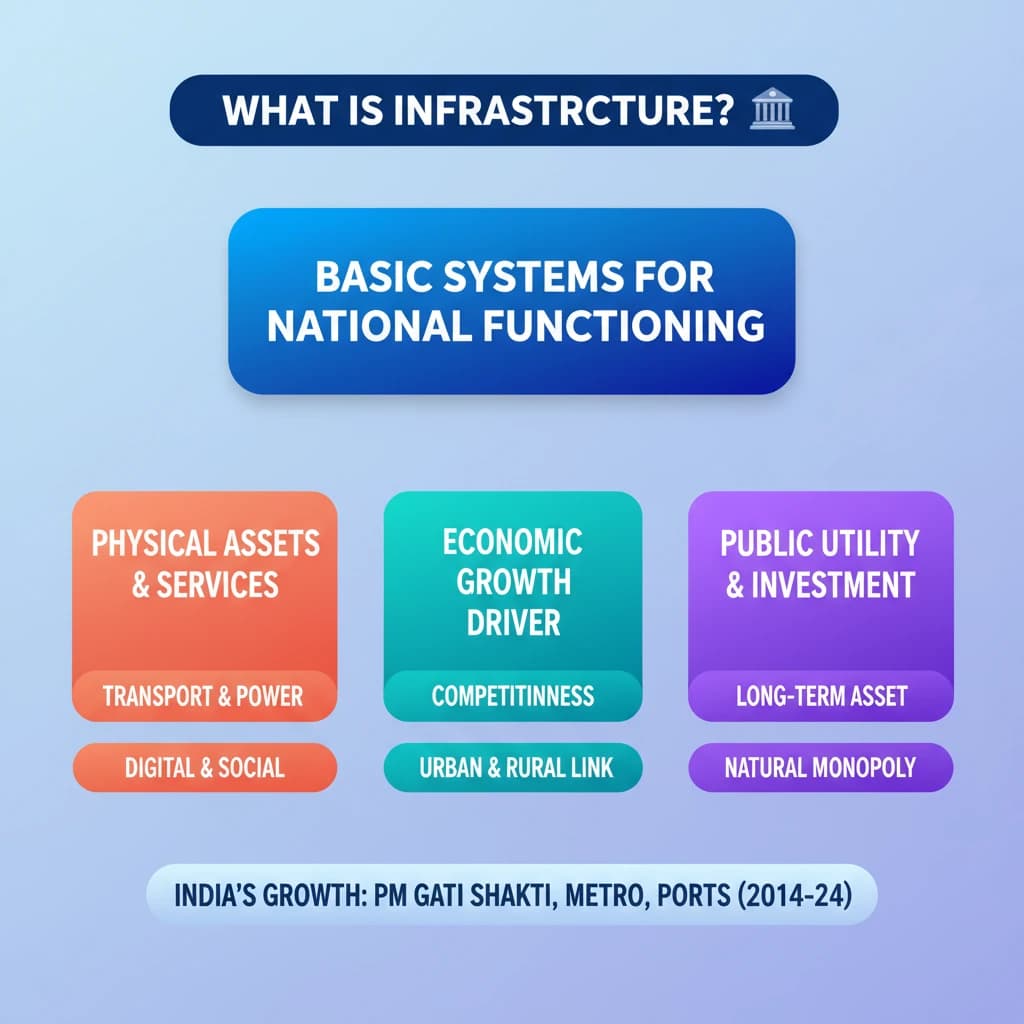
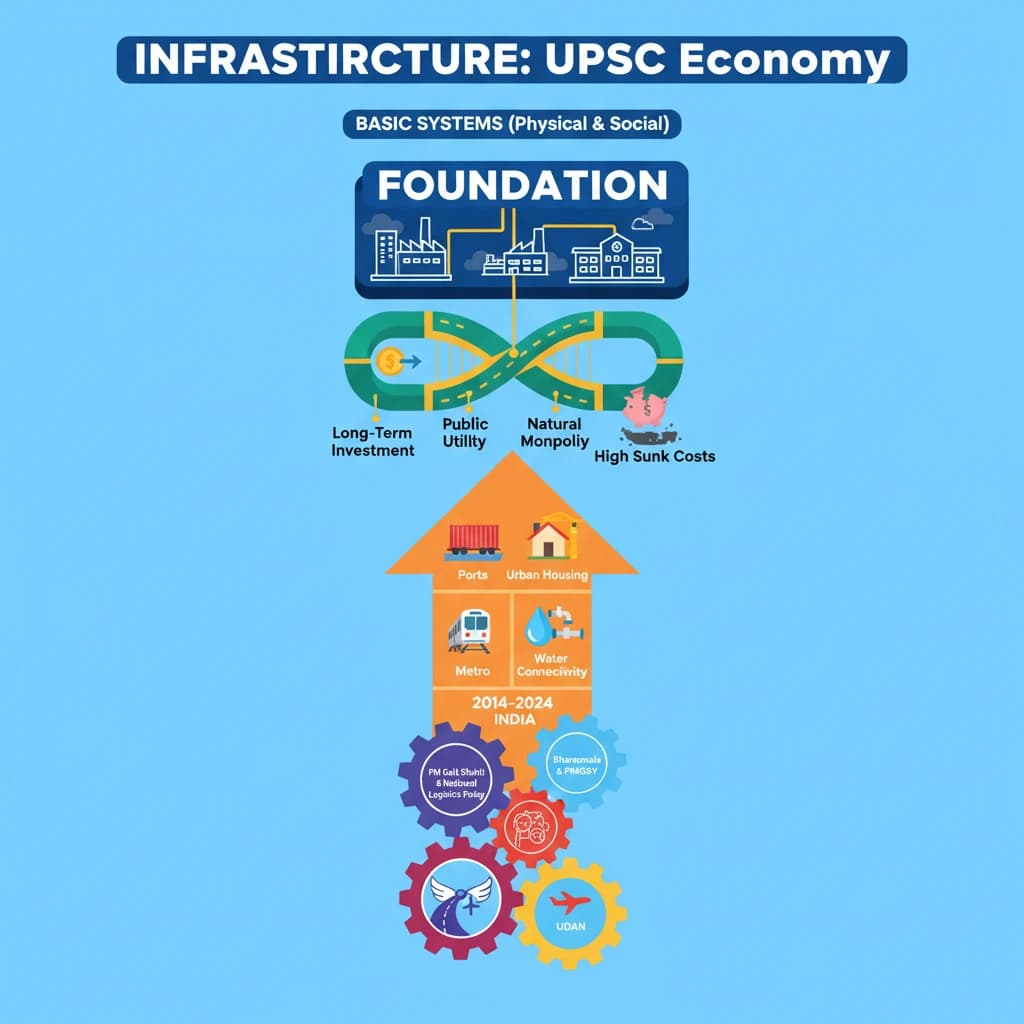
<h4>Understanding Infrastructure</h4><p><strong>Infrastructure</strong> refers to the fundamental systems and facilities required for the functioning of a society, economy, or nation.</p><p>These basic systems are essential for businesses, regions, and countries to operate effectively and efficiently.</p><div class='info-box'><p>Infrastructure is often associated with <strong>capital expenditure (capex)</strong> due to the significant initial investment required for its development and maintenance.</p></div><p>Key sectors considered part of infrastructure include <strong>power, coal, petroleum, cement, railways, ports, civil aviation, roads, cybersecurity,</strong> and <strong>telecommunications</strong>.</p><h4>Core Features of Infrastructure</h4><div class='key-point-box'><h4>Long-Term Investments</h4><p>Infrastructure projects involve substantial, <strong>large-scale investments</strong> that typically have a <strong>long lifespan</strong>. Examples include power grids and extensive transport systems.</p></div><div class='key-point-box'><h4>Public Utilities and Works</h4><p>This category encompasses essential <strong>public utilities</strong> such as electricity and water supply, alongside critical <strong>public works</strong> like roads and railways.</p></div><div class='key-point-box'><h4>Natural Monopoly Characteristics</h4><p>Many infrastructure sectors exhibit characteristics of a <strong>natural monopoly</strong>. The high initial costs make it economically inefficient for multiple competitors to enter the market, as seen with power grids.</p></div><div class='key-point-box'><h4>Non-Tradable Services</h4><p>Services provided by certain infrastructure, like water and electricity, are generally <strong>non-tradable across international borders</strong> due to their physical nature and delivery mechanisms.</p></div><div class='key-point-box'><h4>Public and Private Good Aspects</h4><p>Infrastructure often serves as a <strong>public good</strong>, benefiting society broadly. However, its usage typically involves <strong>charges or fees</strong>, giving it elements of a private good.</p></div><div class='key-point-box'><h4>High-Sunk Costs</h4><p>A significant feature is the presence of <strong>high-sunk costs</strong>. Once capital is invested in infrastructure projects, these resources are often specific and cannot be easily recovered or repurposed, regardless of the project's success or failure.</p></div><h4>Infrastructure as a Public Service</h4><p>When viewed as a public service, infrastructure often displays a <strong>non-rival nature</strong>. This means that one person's consumption of the service does not diminish its availability for others.</p><p>However, unlike pure public goods, these services usually involve <strong>price exclusion</strong>, meaning they are provided on a paid basis.</p><div class='info-box'><p><strong>Social Infrastructure:</strong> Beyond physical assets, infrastructure also includes vital <strong>social sector facilities</strong> such as <strong>hospitals</strong> and <strong>schools</strong>. While crucial, these typically do not possess the natural monopoly characteristics found in economic infrastructure.</p></div><h4>Recent Progress in Key Infrastructure Sectors (2014-2024)</h4><h4>Shipping and Ports Development</h4><p>India's maritime sector has seen substantial growth, enhancing its global shipping presence.</p><div class='info-box'><ul><li>India currently operates <strong>12 major ports</strong> and <strong>217 minor/intermediate ports</strong>.</li><li><strong>Cargo handling capacity</strong> increased significantly from <strong>800.5 MT in 2014</strong> to <strong>1,630 MT in 2024</strong>, representing an approximate <strong>87% rise</strong>.</li><li>This expansion has elevated India's <strong>International Shipment ranking</strong> to <strong>22nd</strong> in 2024, a notable improvement from its <strong>44th rank in 2014</strong>.</li></ul></div><h4>Urban Affairs and Housing Initiatives</h4><p>Government missions have driven considerable progress in urban development and housing provisions.</p><div class='info-box'><ul><li>Under the <strong>Smart Cities Mission (SCM)</strong>, approximately <strong>91% of projects</strong> have reached completion.</li><li>The <strong>Swachh Bharat Mission-Urban 2.0</strong> has led to a <strong>97% increase</strong> in urban waste collection between <strong>2014-15 and 2024-25</strong>.</li><li>During the same period, <strong>waste processing</strong> capabilities improved dramatically, rising from <strong>18% to 78%</strong>.</li><li>Between <strong>2015 and 2024</strong>, a total of <strong>118.64 lakh houses</strong> were approved under the <strong>Pradhan Mantri Awas Yojana-Urban (PMAY-U)</strong>.</li></ul></div><h4>Metro Rail Expansion</h4><p>India's metro network has witnessed rapid expansion, connecting more urban centers.</p><div class='info-box'><ul><li>The country's total <strong>metro network</strong> grew from <strong>248 km in 2014</strong> to <strong>893 km in 2024</strong>.</li><li>The rate of commissioning new metro lines increased from <strong>0.68 km/month</strong> to <strong>6 km/month</strong>.</li><li>The number of cities with operational metro systems expanded from <strong>5 to 23</strong> during this decade.</li></ul></div><h4>Jal Jeevan Mission and Tap Water Connections</h4><p>The <strong>Jal Jeevan Mission</strong> has significantly boosted rural access to safe drinking water.</p><div class='info-box'><ul><li>Rural tap water coverage surged from <strong>3.23 crore (17%) households</strong> to <strong>15.44 crore (79.74%) households</strong> by <strong>February 2025</strong>.</li></ul></div><h4>Key Government Initiatives for Infrastructure Development</h4><p>The Indian government has launched several flagship programs to accelerate infrastructure growth across various sectors.</p><div class='key-point-box'><h4>PM Gati Shakti National Master Plan (NMP)</h4><p>The <strong>PM Gati Shakti National Master Plan</strong> is an integrated approach for multi-modal connectivity infrastructure. It has successfully onboarded <strong>44 Central Ministries</strong> and <strong>36 States/UTs</strong> to streamline planning and execution.</p></div><div class='key-point-box'><h4>National Logistics Policy</h4><p>Aimed at improving logistics efficiency, the <strong>National Logistics Policy</strong> has yielded positive results. India's ranking in the <strong>World Bank Logistics Performance Index (LPI)</strong> improved by <strong>6 places</strong>, moving from <strong>44th in 2018</strong> to <strong>38th out of 139 countries in 2023</strong>.</p></div><div class='key-point-box'><h4>Bharatmala Pariyojana</h4><p>This ambitious highway development program focuses on optimizing the efficiency of freight and passenger movement. A total of <strong>18,926 km of roads</strong> were completed under the project by <strong>November 2024</strong>.</p></div><div class='key-point-box'><h4>Pradhan Mantri Gramin Sadak Yojana (PMGSY)</h4><p>The <strong>PMGSY</strong> continues to enhance rural connectivity. In <strong>2024-25</strong>, an impressive <strong>7,71,955 km of rural roads</strong> were completed under this scheme.</p></div><div class='key-point-box'><h4>Regional Connectivity Scheme (RCS) - UDAN</h4><p>The <strong>UDAN (Ude Desh ka Aam Naagrik) scheme</strong> aims to make air travel affordable and widespread. So far, <strong>619 RCS routes</strong> have commenced operations, connecting <strong>88 airports</strong>, including <strong>13 heliports</strong> and <strong>2 water aerodromes</strong>.</p></div>