Loading page, please wait…
Vaidra Logo
Vaidra

Top 4 items + smart groups

UPSC GPT
New
Current Affairs
Daily Solutions
Daily Puzzle
Mains Evaluator

Version 2.0.0 • Built with ❤️ for UPSC aspirants

Loading...
Loading...
Loading...
Loading...
Loading...
Loading...
Loading...
Loading...
Loading...
Loading...
Loading...
Loading...
Loading...
Back
All Subjects

Topics

0 topics • 0 completed

Loading topics...
Loading...
Loading...
Loading...
Loading...
Loading...
Overall Progress0%

India-Indonesia Relations - UPSC Economy

What is India-Indonesia Relations in UPSC Economy?

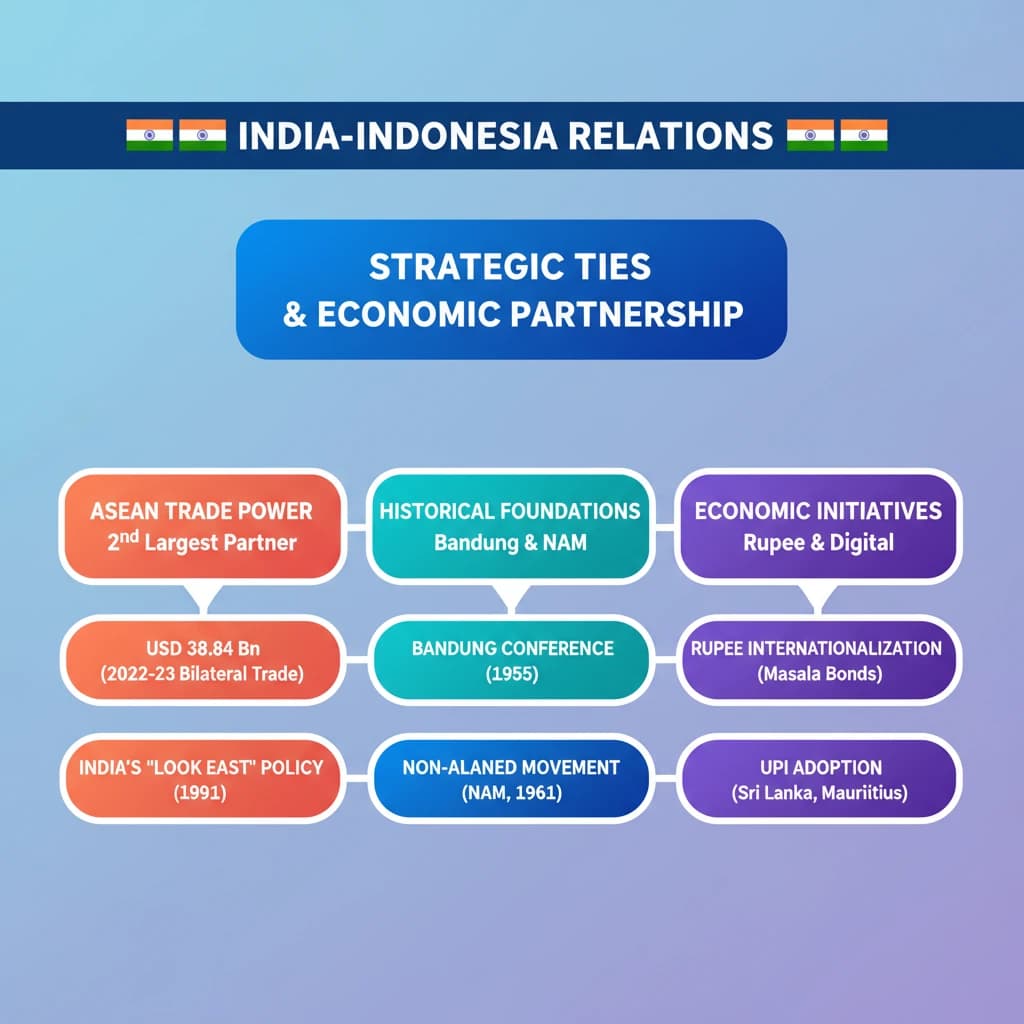
India-Indonesia Relations is a key topic under Economy for UPSC Civil Services Examination. Key points include: Indonesia is India's second-largest trading partner in the ASEAN region, with bilateral trade reaching USD 38.84 billion in 2022-23.. Both nations were key proponents of the Bandung Conference (1955) and founders of the Non-Aligned Movement (1961).. India's 'Look East Policy' (1991) significantly boosted bilateral relations with Indonesia.. Understanding this topic is essential for both UPSC Prelims and Mains preparation.

Why is India-Indonesia Relations important for UPSC exam?

India-Indonesia Relations is a Medium-level topic in UPSC Economy. It is tested in both Prelims (factual MCQs) and Mains (analytical answer writing). Previous year UPSC questions have frequently covered aspects of India-Indonesia Relations, making it essential for comprehensive IAS preparation.

How to prepare India-Indonesia Relations for UPSC?

To prepare India-Indonesia Relations for UPSC: (1) Study the comprehensive notes covering all key concepts on Vaidra. (2) Practice previous year questions on this topic. (3) Connect it with current affairs using daily updates. (4) Revise using key takeaways and mind maps available for Economy. (5) Write practice answers linking India-Indonesia Relations to related GS Paper topics.

Key takeaways of India-Indonesia Relations for UPSC

  • Indonesia is India's second-largest trading partner in the ASEAN region, with bilateral trade reaching USD 38.84 billion in 2022-23.
  • Both nations were key proponents of the Bandung Conference (1955) and founders of the Non-Aligned Movement (1961).
  • India's 'Look East Policy' (1991) significantly boosted bilateral relations with Indonesia.
  • Efforts to internationalize the Rupee include liberalizing capital markets (e.g., Masala Bonds) and promoting digital payment systems.
  • UPI has been adopted by countries like Sri Lanka and Mauritius, showcasing India's digital payment leadership.
India-Indonesia Relations

India-Indonesia Relations

Medium⏱️ 7 min read✓ 95% Verified
economy

📖 Introduction

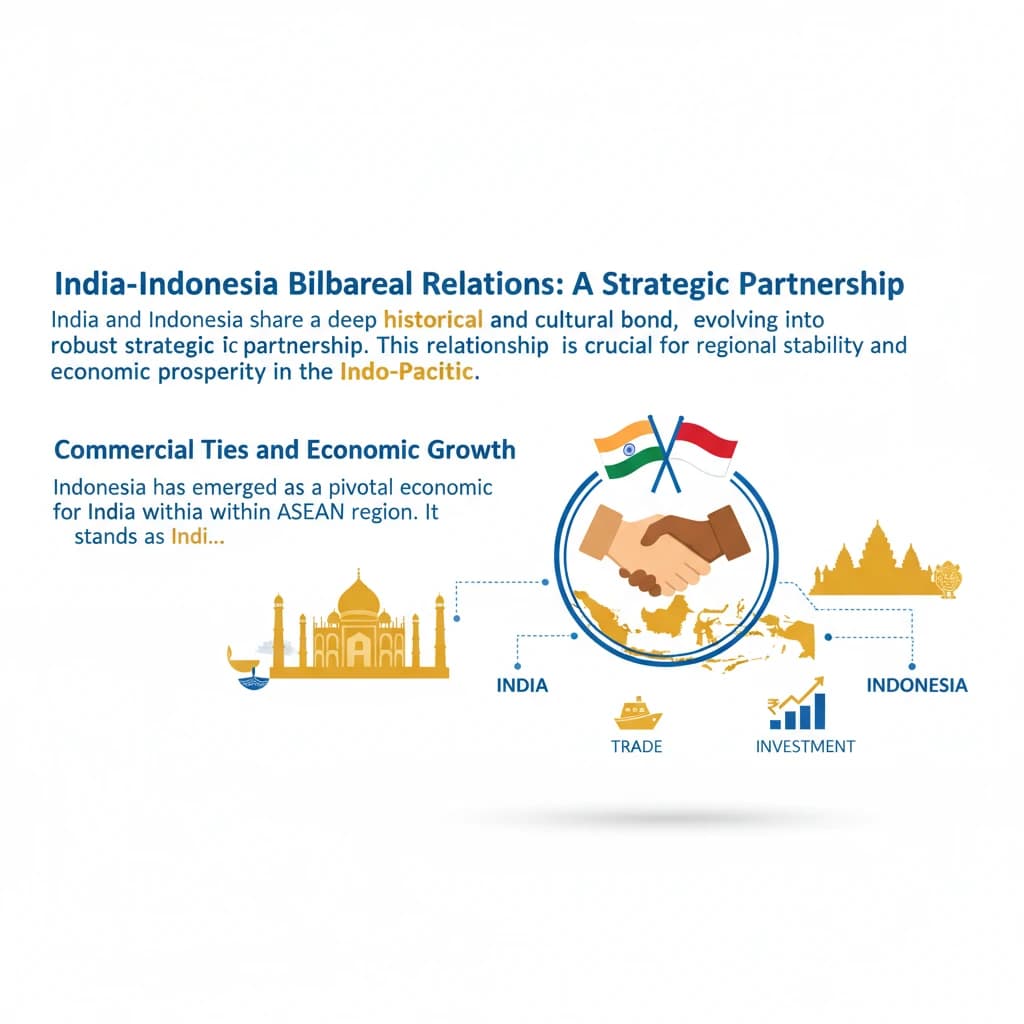
<h4>India-Indonesia Bilateral Relations: A Strategic Partnership</h4><p>India and <strong>Indonesia</strong> share a deep historical and cultural bond, evolving into a robust strategic partnership. This relationship is crucial for regional stability and economic prosperity in the <strong>Indo-Pacific</strong>.</p><h4>Commercial Ties and Economic Growth</h4><p><strong>Indonesia</strong> has emerged as a pivotal economic partner for India within the <strong>ASEAN</strong> region. It stands as India's <strong>second-largest trading partner</strong> in this vital bloc, underscoring the strength of their commercial engagement.</p><div class='info-box'><p><strong>Bilateral Trade Growth:</strong></p><ul><li><strong>2005-06:</strong> USD <strong>4.3 billion</strong></li><li><strong>2022-23:</strong> USD <strong>38.84 billion</strong></li></ul><p>This significant increase reflects growing economic interdependence and opportunities.</p></div><h4>Political and Strategic Alignment</h4><p>Both nations historically championed the cause of independence for <strong>Asian</strong> and <strong>African</strong> countries. This shared vision laid the foundation for key international movements and policies.</p><div class='key-point-box'><p><strong>Foundational Collaborations:</strong></p><ul><li><strong>Bandung Conference (1955):</strong> A landmark event promoting Afro-Asian solidarity.</li><li><strong>Non-Aligned Movement (NAM, 1961):</strong> A crucial platform for newly independent states to assert autonomy during the Cold War.</li></ul></div><p>Since India's adoption of the <strong>‘Look East Policy’</strong> in <strong>1991</strong>, bilateral relations have witnessed rapid and comprehensive development. This policy shift prioritized engagement with Southeast Asian nations, including Indonesia.</p><h4>Internationalisation of the Indian Rupee</h4><p>India is actively pursuing strategies to enhance the global acceptance and usage of the <strong>Indian Rupee</strong>. This initiative aims to reduce reliance on foreign currencies for international transactions and boost India's financial influence.</p><h4>Capital Market Liberalisation</h4><p>A key effort involves liberalizing India's capital markets to make the <strong>Rupee</strong> more accessible and attractive internationally. This includes expanding the range of financial products available.</p><div class='info-box'><p><strong>Rupee-Denominated Instruments:</strong></p><ul><li>India has increased the availability of financial instruments denominated in <strong>Rupees</strong>.</li><li>A prominent example is the <strong>Masala Bond</strong>, which allows Indian entities to raise capital from international markets in <strong>Rupees</strong>.</li></ul></div><h4>Promotion of Digital Payment Systems</h4><p>India is leveraging its advanced digital infrastructure to promote the <strong>Rupee</strong> globally. Digital payment systems are playing a significant role in facilitating cross-border transactions.</p><div class='exam-tip-box'><p><strong>UPSC Insight: UPI's Global Footprint</strong></p><p>Initiatives like the <strong>Unified Payments Interface (UPI)</strong> have significantly facilitated digital transactions in <strong>Rupees</strong>. Notably, countries such as <strong>Sri Lanka</strong> and <strong>Mauritius</strong> have already adopted <strong>UPI</strong>, demonstrating its growing international acceptance and India's leadership in digital payments. This showcases India's <strong>soft power</strong> in the financial tech domain.</p></div>
Concept Diagram

💡 Key Takeaways

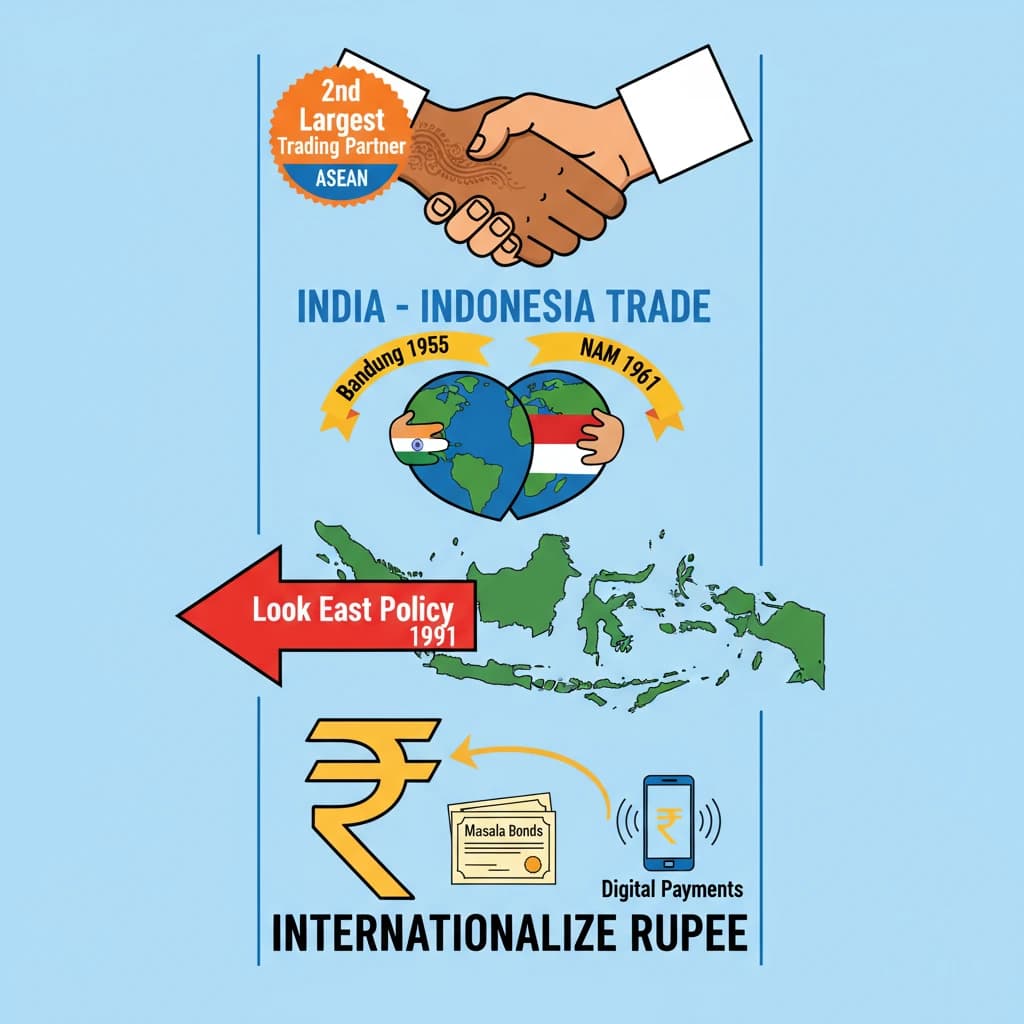
  • •Indonesia is India's second-largest trading partner in the ASEAN region, with bilateral trade reaching USD 38.84 billion in 2022-23.
  • •Both nations were key proponents of the Bandung Conference (1955) and founders of the Non-Aligned Movement (1961).
  • •India's 'Look East Policy' (1991) significantly boosted bilateral relations with Indonesia.
  • •Efforts to internationalize the Rupee include liberalizing capital markets (e.g., Masala Bonds) and promoting digital payment systems.
  • •UPI has been adopted by countries like Sri Lanka and Mauritius, showcasing India's digital payment leadership.

🧠 Memory Techniques
Memory Aid
95% Verified Content

📚 Reference Sources

•Ministry of External Affairs (MEA), Government of India reports
•Reserve Bank of India (RBI) publications on financial market reforms

Related Topics

Loading related topics...
Explore:Economy Topics·All Subjects·Daily Current Affairs·Editorial Analysis·Previous Year Questions·UPSC GPT
India-Indonesia Relations - UPSC Economy