Loading page, please wait…
Vaidra Logo
Vaidra

Top 4 items + smart groups

UPSC GPT
New
Current Affairs
Daily Solutions
Daily Puzzle
Mains Evaluator

Version 2.0.0 • Built with ❤️ for UPSC aspirants

Loading...
Loading...
Loading...
Loading...
Loading...
Loading...
Loading...
Loading...
Loading...
Loading...
Loading...
Loading...
Loading...

30th Anniversary of World Trade Organisation (WTO) - UPSC Economy

What is 30th Anniversary of World Trade Organisation (WTO) in UPSC Economy?

30th Anniversary of World Trade Organisation (WTO) is a key topic under Economy for UPSC Civil Services Examination. Key points include: WTO marked its 30th anniversary on Jan 1, 2025, succeeding GATT.. Formed under the Marrakesh Agreement (1994) after the Uruguay Round (1986-94).. Headquartered in Geneva, with 166 members covering 98% of global trade.. Understanding this topic is essential for both UPSC Prelims and Mains preparation.

Why is 30th Anniversary of World Trade Organisation (WTO) important for UPSC exam?

30th Anniversary of World Trade Organisation (WTO) is a Medium-level topic in UPSC Economy. It is tested in both Prelims (factual MCQs) and Mains (analytical answer writing). Previous year UPSC questions have frequently covered aspects of 30th Anniversary of World Trade Organisation (WTO), making it essential for comprehensive IAS preparation.

How to prepare 30th Anniversary of World Trade Organisation (WTO) for UPSC?

To prepare 30th Anniversary of World Trade Organisation (WTO) for UPSC: (1) Study the comprehensive notes covering all key concepts on Vaidra. (2) Practice previous year questions on this topic. (3) Connect it with current affairs using daily updates. (4) Revise using key takeaways and mind maps available for Economy. (5) Write practice answers linking 30th Anniversary of World Trade Organisation (WTO) to related GS Paper topics.

Key takeaways of 30th Anniversary of World Trade Organisation (WTO) for UPSC

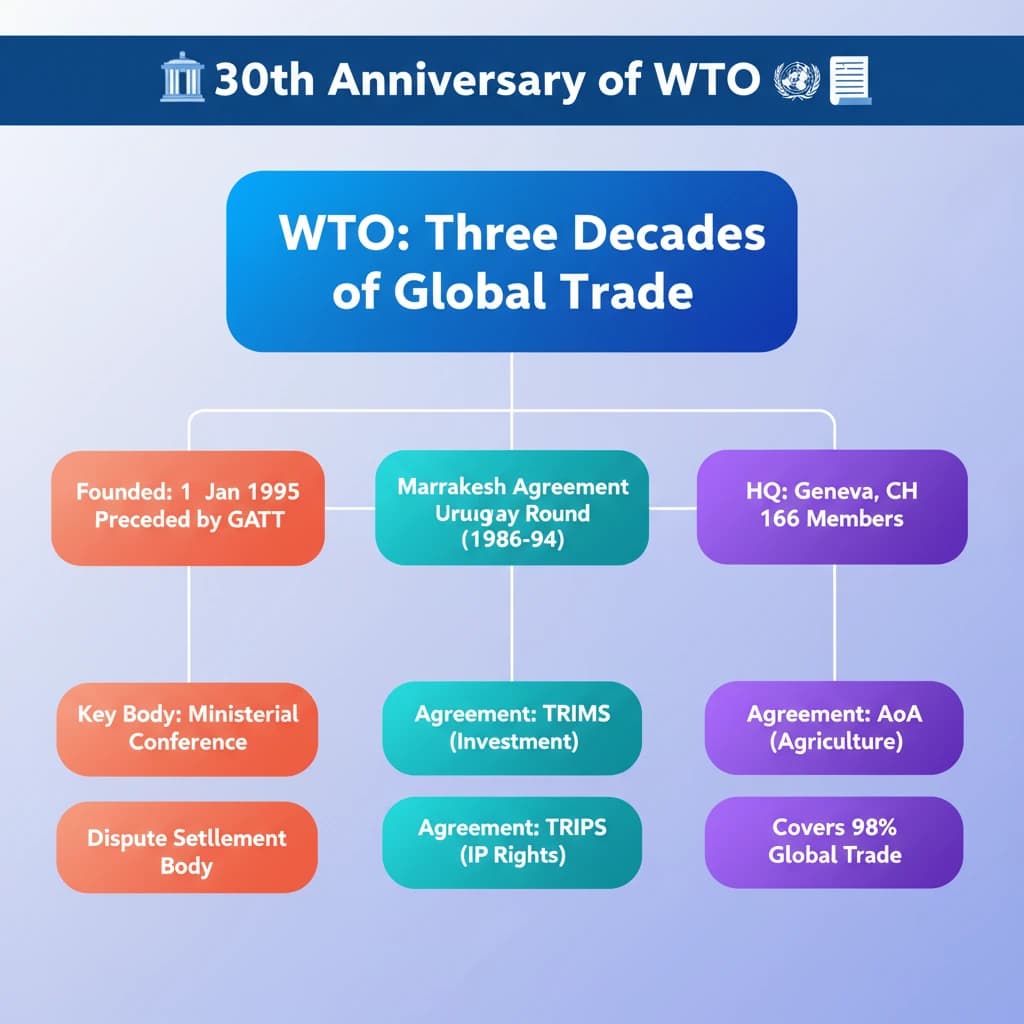
  • WTO marked its 30th anniversary on Jan 1, 2025, succeeding GATT.
  • Formed under the Marrakesh Agreement (1994) after the Uruguay Round (1986-94).
  • Headquartered in Geneva, with 166 members covering 98% of global trade.
  • Key bodies: Ministerial Conference (highest authority) and Dispute Settlement Body (resolves disputes).
  • Major agreements include TRIMS, TRIPS, and AoA, governing investment, intellectual property, and agriculture respectively.
30th Anniversary of World Trade Organisation (WTO)

30th Anniversary of World Trade Organisation (WTO)

Medium⏱️ 8 min read✓ 98% Verified
economy

📖 Introduction

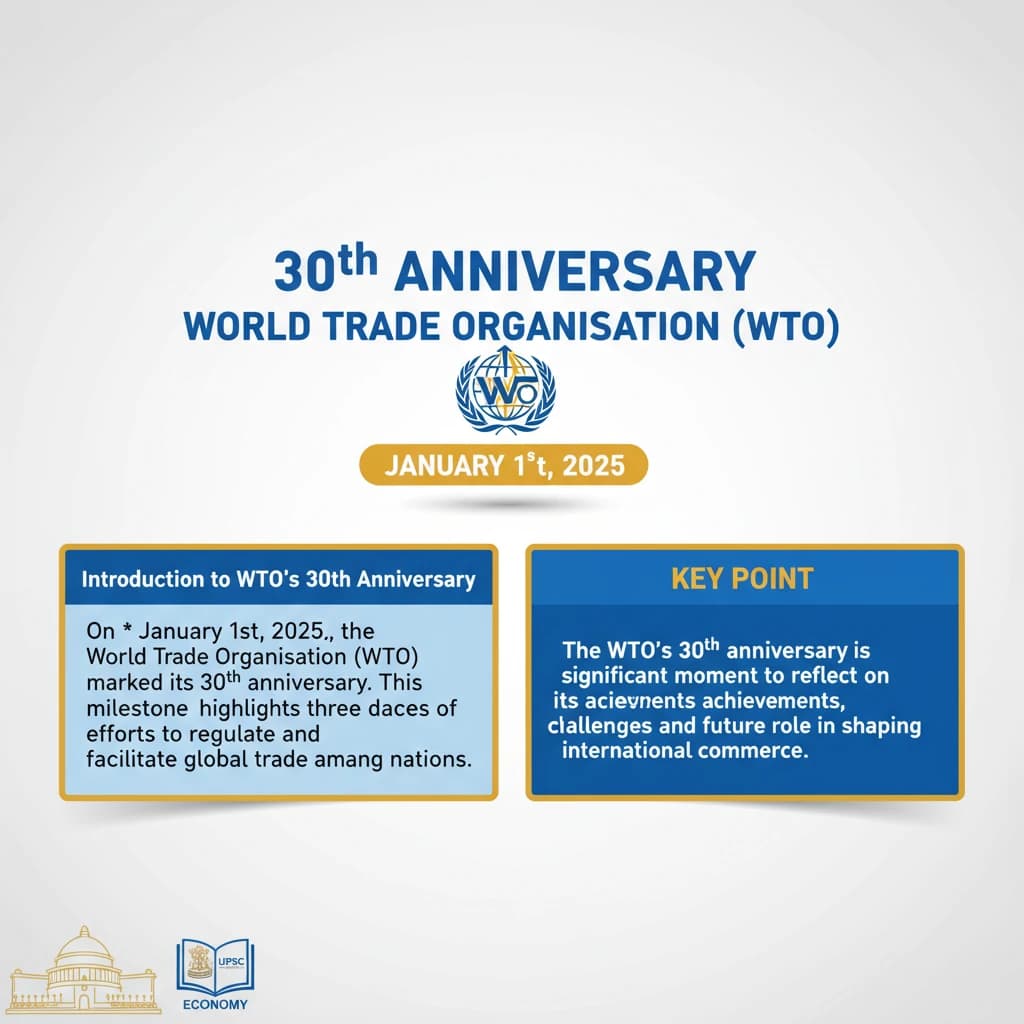
<h4>Introduction to WTO's 30th Anniversary</h4><p>On <strong>January 1st, 2025</strong>, the <strong>World Trade Organisation (WTO)</strong> marked its <strong>30th anniversary</strong>. This milestone highlights three decades of efforts to regulate and facilitate global trade among nations.</p><div class='key-point-box'><p>The <strong>WTO's 30th anniversary</strong> is a significant moment to reflect on its achievements, challenges, and future role in shaping international commerce.</p></div><h4>What is the WTO?</h4><p>The <strong>World Trade Organisation (WTO)</strong> is a pivotal <strong>international institution</strong> established to formulate and enforce rules governing global trade. Its primary objective is to ensure that trade flows as smoothly, predictably, and freely as possible.</p><div class='info-box'><p><strong>Definition:</strong> The <strong>WTO</strong> is an international body that regulates global trade rules and provides a forum for trade negotiations and dispute resolution.</p></div><h4>Evolution from GATT to WTO</h4><p>The <strong>WTO</strong> officially came into existence on <strong>January 1st, 1995</strong>. It succeeded the <strong>General Agreement on Tariffs and Trade (GATT)</strong>, which had been the primary framework for regulating world trade since <strong>1948</strong>.</p><p>The transition from <strong>GATT</strong> to <strong>WTO</strong> was the culmination of extensive multilateral trade negotiations. These discussions were known as the <strong>Uruguay Round</strong>, which spanned from <strong>1986 to 1994</strong>.</p><p>The creation of the <strong>WTO</strong> was formally established under the <strong>Marrakesh Agreement</strong>. This agreement was signed on <strong>April 15th, 1994</strong>, by <strong>123 countries</strong>, laying the legal foundation for the new organization.</p><h4>Key Features and Structure</h4><p>The <strong>WTO's headquarters</strong> are located in <strong>Geneva, Switzerland</strong>. It boasts a broad membership, comprising <strong>166 countries</strong>, which collectively account for approximately <strong>98% of global trade</strong>.</p><div class='info-box'><p><strong>WTO at a Glance:</strong><ul><li><strong>Headquarters:</strong> 📍 <strong>Geneva, Switzerland</strong></li><li><strong>Members:</strong> 166 countries</li><li><strong>Global Trade Coverage:</strong> 98%</li></ul></p></div><p>The organization operates through several key bodies that facilitate its functions of decision-making and dispute resolution.</p><ul><li><strong>Ministerial Conference (MC):</strong> This is the <strong>highest decision-making authority</strong> within the WTO. It meets at least once every two years.</li><li><strong>Dispute Settlement Body (DSB):</strong> The <strong>DSB</strong> is responsible for resolving trade disputes between member countries. It ensures adherence to WTO agreements.</li></ul><h4>Important WTO Agreements</h4><p>The <strong>WTO</strong> framework encompasses several crucial agreements that govern various aspects of international trade, aiming for a fair and equitable global trading system.</p><ul><li><strong>TRIMS (Trade-Related Investment Measures):</strong> This agreement restricts certain investment measures that are inconsistent with GATT rules, particularly those that distort or restrict trade.</li><li><strong>TRIPS (Trade-Related Aspects of Intellectual Property Rights):</strong> This agreement sets minimum standards for the protection and enforcement of intellectual property rights (IPR) among member countries.</li><li><strong>AoA (Agreement on Agriculture):</strong> The <strong>AoA</strong> aims to reform trade in agriculture and reduce trade-distorting agricultural policies, including subsidies and tariffs.</li></ul><div class='exam-tip-box'><p><strong>UPSC Insight:</strong> Understanding the evolution from <strong>GATT to WTO</strong> and the functions of its <strong>key bodies</strong> like the <strong>DSB</strong>, along with major agreements like <strong>TRIPS</strong> and <strong>AoA</strong>, is crucial for <strong>GS Paper II (International Relations)</strong> and <strong>GS Paper III (Indian Economy)</strong>. Recent Ministerial Conferences, like the <strong>13th MC</strong>, often feature prominently in current affairs questions.</p></div>
Concept Diagram

💡 Key Takeaways

  • •WTO marked its 30th anniversary on Jan 1, 2025, succeeding GATT.
  • •Formed under the Marrakesh Agreement (1994) after the Uruguay Round (1986-94).
  • •Headquartered in Geneva, with 166 members covering 98% of global trade.
  • •Key bodies: Ministerial Conference (highest authority) and Dispute Settlement Body (resolves disputes).
  • •Major agreements include TRIMS, TRIPS, and AoA, governing investment, intellectual property, and agriculture respectively.

🧠 Memory Techniques

Memory Aid
98% Verified Content

📚 Reference Sources

•WTO Official Website (general information on structure, agreements, history)

Related Topics

Loading related topics...
Explore:Economy Topics·All Subjects·Daily Current Affairs·Editorial Analysis·Previous Year Questions·UPSC GPT
Back
All Subjects

Topics

0 topics • 0 completed

Loading topics...
Loading...
Loading...
Loading...
Loading...
Loading...
Overall Progress0%
30th Anniversary of World Trade Organisation (WTO) - UPSC Economy