Loading page, please wait…
Vaidra Logo
Vaidra

Top 4 items + smart groups

UPSC GPT
New
Current Affairs
Daily Solutions
Daily Puzzle
Mains Evaluator

Version 2.0.0 • Built with ❤️ for UPSC aspirants

Loading...
Loading...
Loading...
Loading...
Loading...
Loading...
Loading...
Loading...
Loading...
Loading...
Loading...
Loading...
Loading...
Back
All Subjects

Topics

0 topics • 0 completed

Loading topics...
Loading...
Loading...
Loading...
Loading...
Loading...
Overall Progress0%

MFN Status to India - UPSC Economy

What is MFN Status to India in UPSC Economy?

MFN Status to India is a key topic under Economy for UPSC Civil Services Examination. Key points include: Switzerland rescinded its unilateral MFN application in its DTAA with India.. MFN clause in DTAAs ensures automatic extension of more favorable tax terms from third-country agreements.. Double Tax Avoidance Agreements (DTAAs) prevent double taxation and promote cross-border investment.. Understanding this topic is essential for both UPSC Prelims and Mains preparation.

Why is MFN Status to India important for UPSC exam?

MFN Status to India is a Medium-level topic in UPSC Economy. It is tested in both Prelims (factual MCQs) and Mains (analytical answer writing). Previous year UPSC questions have frequently covered aspects of MFN Status to India, making it essential for comprehensive IAS preparation.

How to prepare MFN Status to India for UPSC?

To prepare MFN Status to India for UPSC: (1) Study the comprehensive notes covering all key concepts on Vaidra. (2) Practice previous year questions on this topic. (3) Connect it with current affairs using daily updates. (4) Revise using key takeaways and mind maps available for Economy. (5) Write practice answers linking MFN Status to India to related GS Paper topics.

Key takeaways of MFN Status to India for UPSC

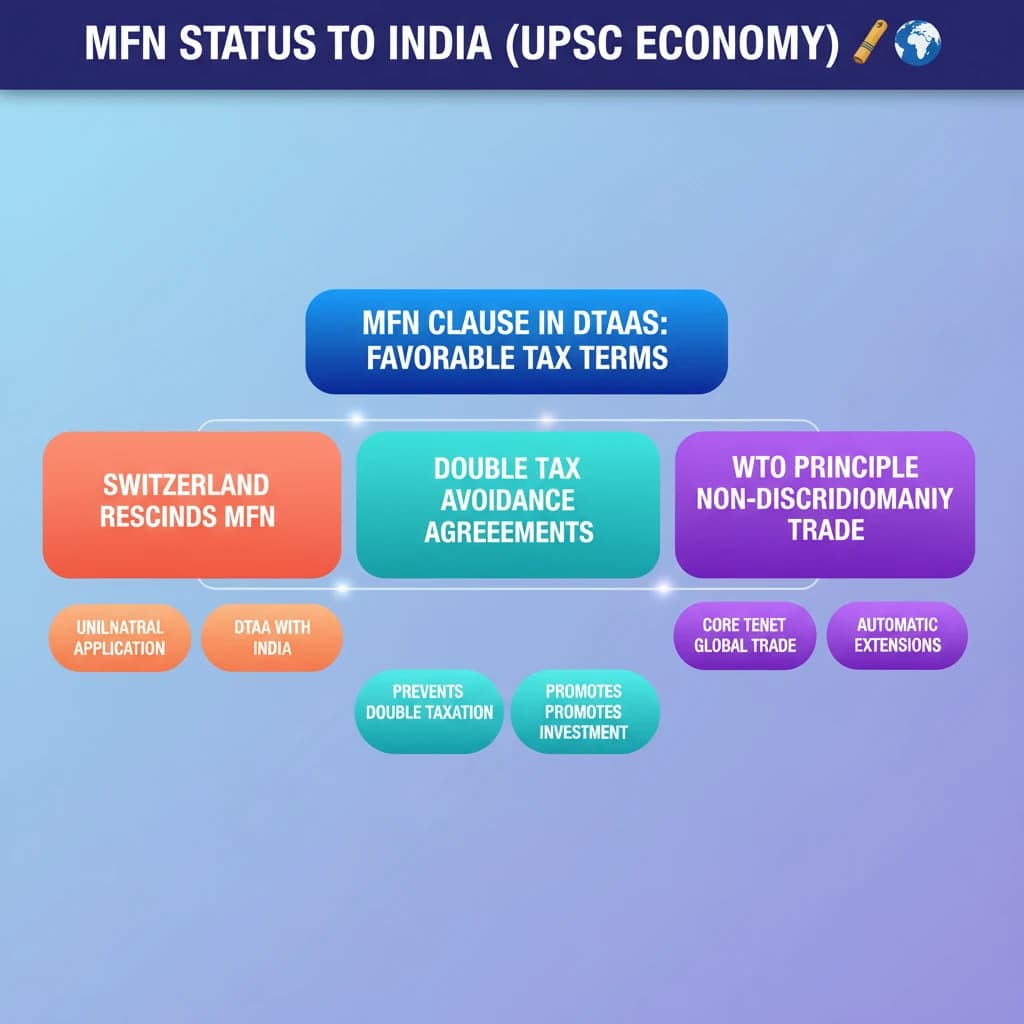
  • Switzerland rescinded its unilateral MFN application in its DTAA with India.
  • MFN clause in DTAAs ensures automatic extension of more favorable tax terms from third-country agreements.
  • Double Tax Avoidance Agreements (DTAAs) prevent double taxation and promote cross-border investment.
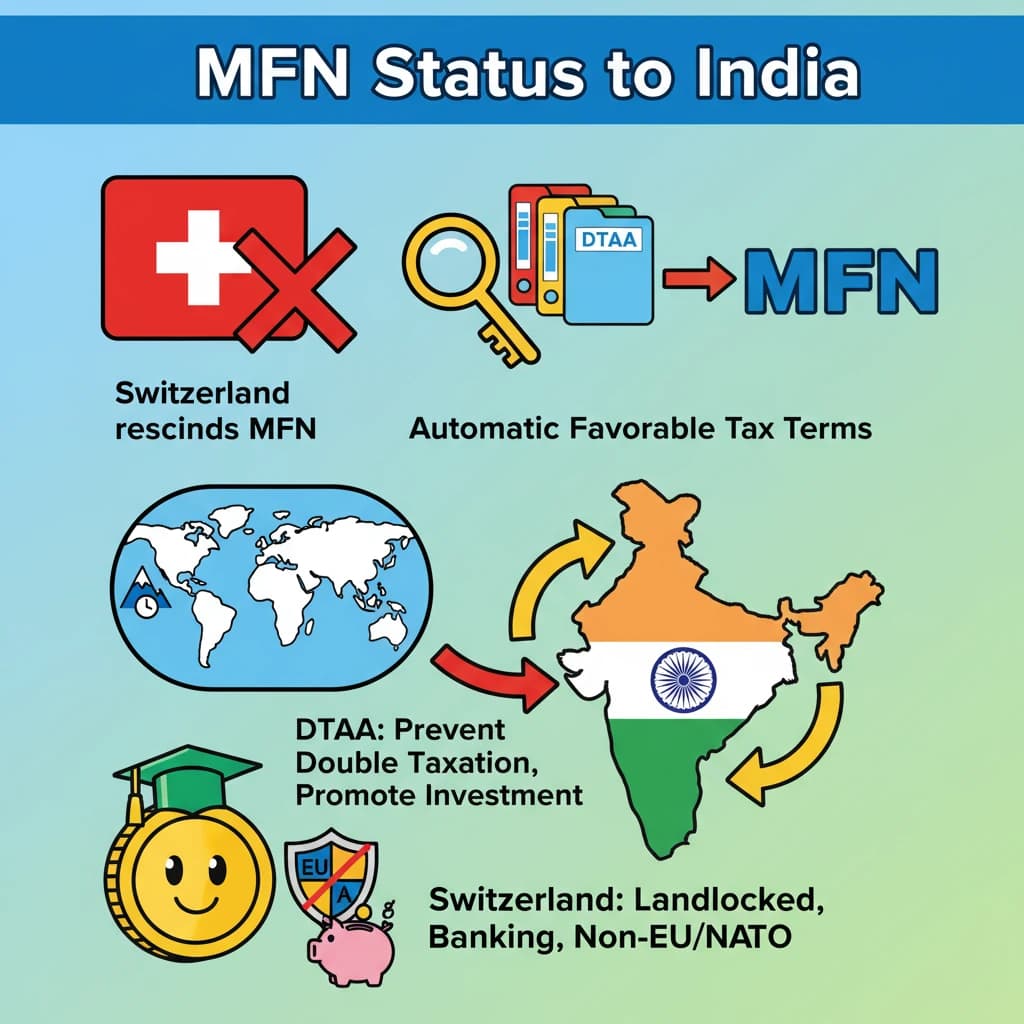
  • Switzerland is a landlocked Central European country known for its banking sector, not part of EU/NATO.
  • The MFN principle is a core tenet of the WTO, promoting non-discriminatory trade.
  • Changes in DTAA clauses can impact investment flows and bilateral economic relations.
MFN Status to India

MFN Status to India

Medium⏱️ 8 min read✓ 95% Verified
economy

📖 Introduction

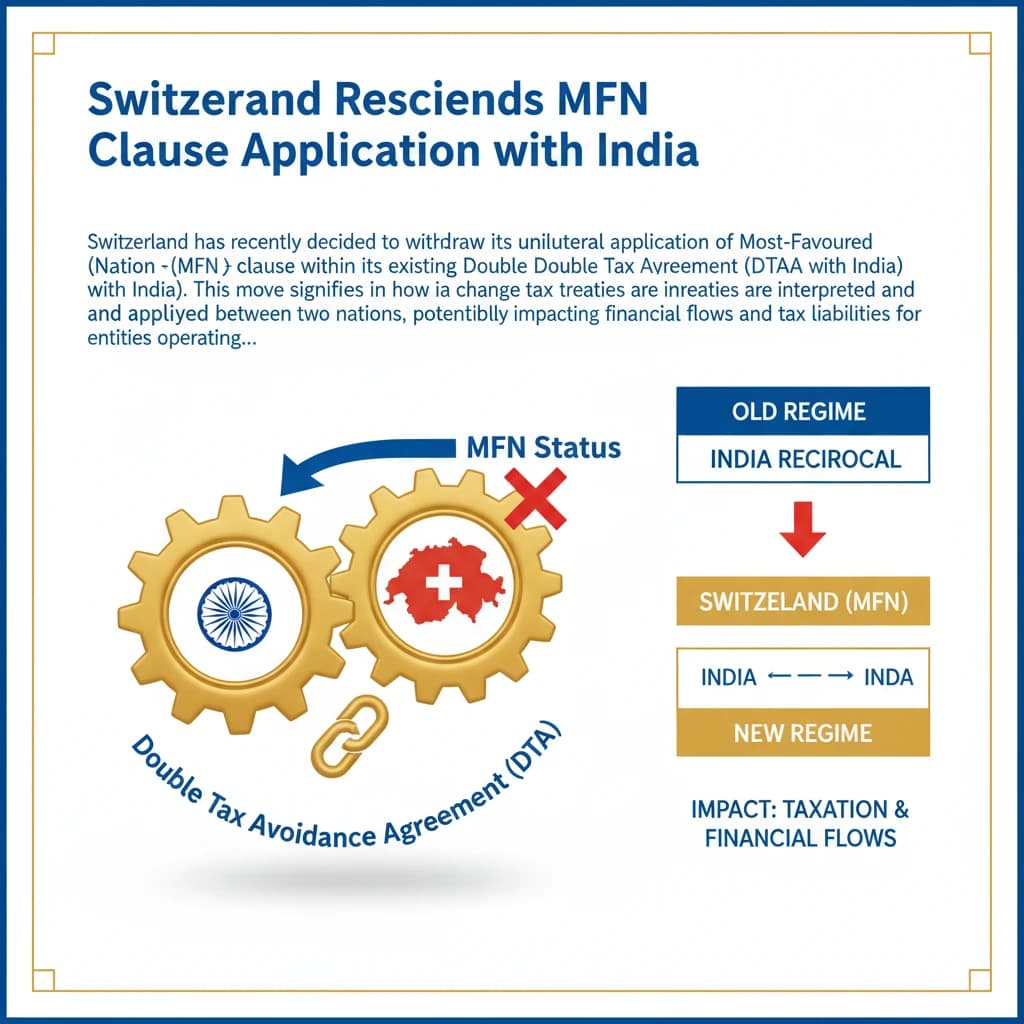
<h4>Switzerland Rescinds MFN Clause Application with India</h4><p><strong>Switzerland</strong> has recently decided to withdraw its unilateral application of the <strong>Most-Favoured-Nation (MFN) clause</strong> within its existing <strong>Double Tax Avoidance Agreement (DTAA)</strong> with <strong>India</strong>.</p><p>This move signifies a change in how tax treaties are interpreted and applied between the two nations, potentially impacting financial flows and tax liabilities for entities operating across both jurisdictions.</p><div class='key-point-box'><p>The <strong>MFN clause</strong> in a <strong>DTAA</strong> ensures that if one contracting state grants more favorable tax treatment to a third state, the same favorable treatment is automatically extended to the other contracting state.</p></div><h4>Understanding Switzerland</h4><p><strong>Switzerland</strong>, officially known as the <strong>Swiss Confederation</strong>, is a small, landlocked country located in <strong>Central Europe</strong>. It is renowned for its picturesque <strong>Alps mountains</strong>, serene lakes, and expansive valleys.</p><p>It shares borders with <strong>France</strong>, <strong>Italy</strong>, <strong>Austria</strong>, <strong>Germany</strong>, and <strong>Liechtenstein</strong>. Importantly, <strong>Switzerland</strong> is not a member of the <strong>European Union (EU)</strong> or <strong>NATO</strong>.</p><div class='info-box'><p><strong>Switzerland</strong> is historically recognized for its robust and often secretive <strong>banking sector</strong>, which has played a significant role in global finance.</p></div>
Concept Diagram

💡 Key Takeaways

  • •Switzerland rescinded its unilateral MFN application in its DTAA with India.
  • •MFN clause in DTAAs ensures automatic extension of more favorable tax terms from third-country agreements.
  • •Double Tax Avoidance Agreements (DTAAs) prevent double taxation and promote cross-border investment.
  • •Switzerland is a landlocked Central European country known for its banking sector, not part of EU/NATO.
  • •The MFN principle is a core tenet of the WTO, promoting non-discriminatory trade.
  • •Changes in DTAA clauses can impact investment flows and bilateral economic relations.

🧠 Memory Techniques
Memory Aid
95% Verified Content

📚 Reference Sources

•World Trade Organization (WTO) Official Website - MFN Principle
•Organisation for Economic Co-operation and Development (OECD) - Model Tax Convention
•Ministry of Finance, Government of India - DTAA Information
•Press Information Bureau (PIB) - India-Pakistan MFN Status

Related Topics

Loading related topics...
Explore:Economy Topics·All Subjects·Daily Current Affairs·Editorial Analysis·Previous Year Questions·UPSC GPT
MFN Status to India - UPSC Economy