Loading page, please wait…
Vaidra Logo
Vaidra

Top 4 items + smart groups

UPSC GPT
New
Current Affairs
Daily Solutions
Daily Puzzle
Mains Evaluator

Version 2.0.0 • Built with ❤️ for UPSC aspirants

Loading...
Loading...
Loading...
Loading...
Loading...
Loading...
Loading...
Loading...
Loading...
Loading...
Loading...
Loading...
Loading...
Back
All Subjects

Topics

0 topics • 0 completed

Loading topics...
Loading...
Loading...
Loading...
Loading...
Loading...
Overall Progress0%
What is an Industrial Smart City? - UPSC Economy

What is an Industrial Smart City? - UPSC Economy

What is What is an Industrial Smart City? in UPSC Economy?

What is an Industrial Smart City? is a key topic under Economy for UPSC Civil Services Examination. Key points include: Industrial Smart Cities integrate technology and data for efficient, sustainable industrial operations.. Objectives include attracting FDI, boosting manufacturing, and creating employment.. Key concepts are 'plug-and-play' infrastructure and 'walk-to-work' urban planning.. Understanding this topic is essential for both UPSC Prelims and Mains preparation.

Why is What is an Industrial Smart City? important for UPSC exam?

What is an Industrial Smart City? is a Medium-level topic in UPSC Economy. It is tested in both Prelims (factual MCQs) and Mains (analytical answer writing). Previous year UPSC questions have frequently covered aspects of What is an Industrial Smart City?, making it essential for comprehensive IAS preparation.

How to prepare What is an Industrial Smart City? for UPSC?

To prepare What is an Industrial Smart City? for UPSC: (1) Study the comprehensive notes covering all key concepts on Vaidra. (2) Practice previous year questions on this topic. (3) Connect it with current affairs using daily updates. (4) Revise using key takeaways and mind maps available for Economy. (5) Write practice answers linking What is an Industrial Smart City? to related GS Paper topics.

Key takeaways of What is an Industrial Smart City? for UPSC

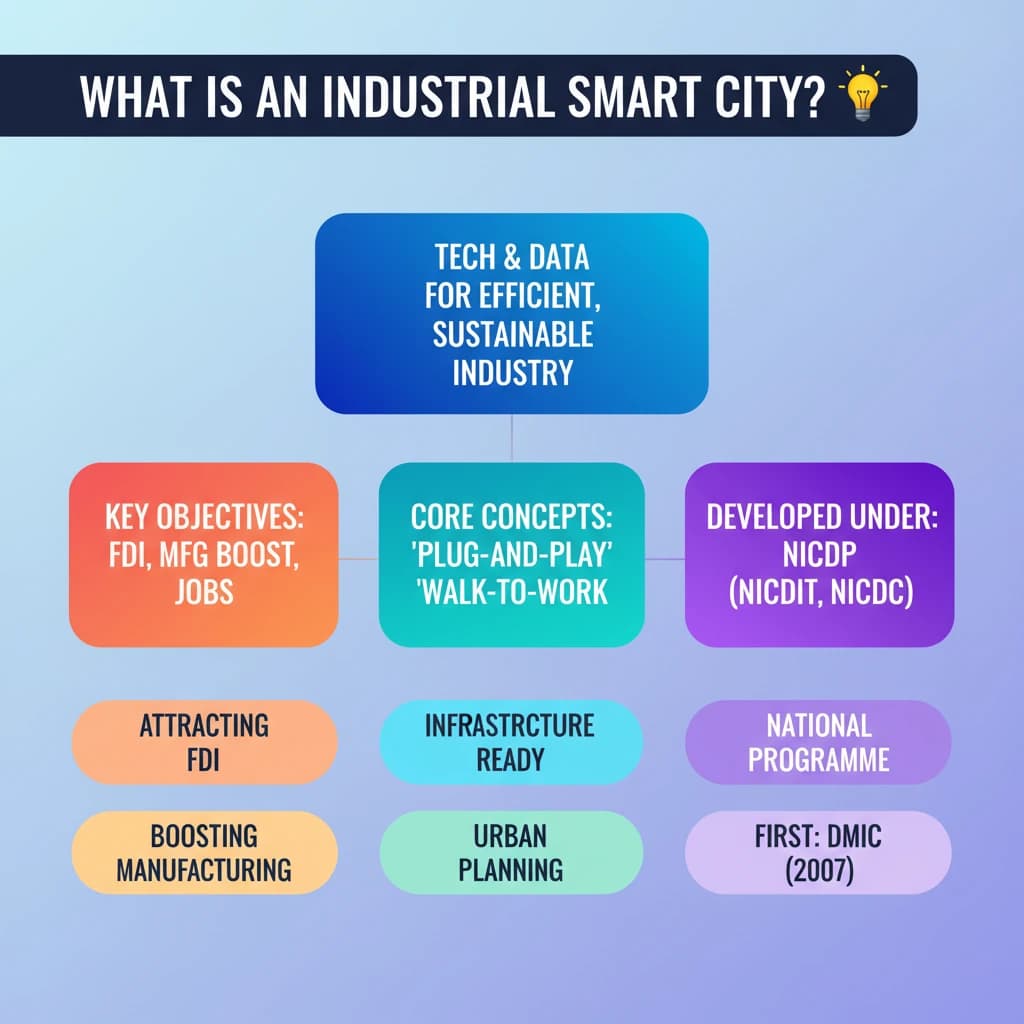
  • Industrial Smart Cities integrate technology and data for efficient, sustainable industrial operations.
  • Objectives include attracting FDI, boosting manufacturing, and creating employment.
  • Key concepts are 'plug-and-play' infrastructure and 'walk-to-work' urban planning.
  • Developed under the National Industrial Corridor Development Programme (NICDP), managed by NICDIT and NICDC.
  • The Delhi Mumbai Industrial Corridor (DMIC) approved in 2007, was the first major initiative.
What is an Industrial Smart City?

What is an Industrial Smart City?

Medium⏱️ 8 min read✓ 98% Verified
economy

📖 Introduction

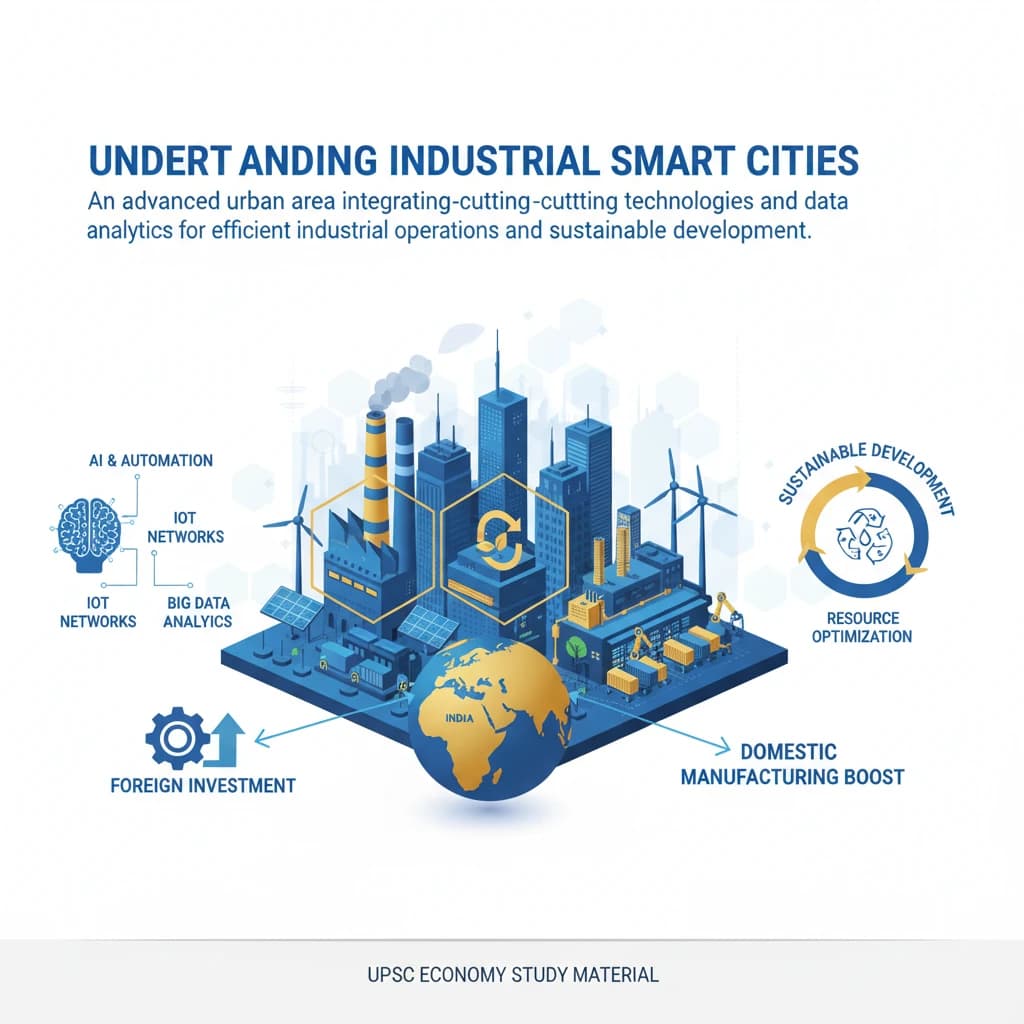
<h4>Understanding Industrial Smart Cities</h4><p>An <strong>Industrial Smart City</strong> is an advanced urban area designed to integrate cutting-edge technologies and data analytics. Its primary goal is to significantly enhance the efficiency of industrial operations while simultaneously promoting <strong>sustainable development</strong>.</p><p>These innovative cities are strategically developed to attract substantial <strong>foreign investment</strong>, bolster <strong>domestic manufacturing capabilities</strong>, and generate significant <strong>employment opportunities</strong> across various sectors.</p><div class='info-box'><p><strong>Core Definition:</strong> An <strong>Industrial Smart City</strong> leverages technology and data to optimize industrial processes and foster sustainable growth within an urban environment.</p></div><h4>Key Objectives of Industrial Smart Cities</h4><p>The development of new industrial cities in India is aimed at strengthening the nation's position within <strong>global value chains</strong>. This is achieved by offering investors ready-to-allot land, streamlining the setup process for businesses.</p><p>A crucial objective is to integrate advanced urban planning concepts such as <strong>'plug-and-play'</strong> and <strong>'walk-to-work'</strong>, which are central to modern, efficient urban ecosystems.</p><div class='key-point-box'><p><strong>Plug-and-Play Industrial Parks:</strong> These parks provide businesses with <strong>ready-to-use infrastructure</strong>, including utilities, connectivity, and pre-approved clearances, enabling immediate operational commencement.</p></div><div class='key-point-box'><p><strong>Walk-to-Work Urban Strategy:</strong> This planning approach encourages residents to live in close proximity to their workplaces. It aims to reduce reliance on private vehicles, thereby promoting <strong>walking</strong>, decreasing traffic congestion, and enhancing environmental sustainability.</p></div><h4>Roadmap for Development: The NICDP</h4><p>The development of these industrial smart cities is meticulously planned and executed under the overarching <strong>National Industrial Corridor Development Programme (NICDP)</strong>. This programme is a cornerstone of India's industrial policy.</p><p>The <strong>NICDP</strong> is designed to create advanced industrial cities that are globally competitive. Its ambition is to rival the world's leading manufacturing and investment destinations by providing a superior operational environment.</p><p>The programme actively fosters a vibrant industrial ecosystem. It achieves this by facilitating investments from both large-scale <strong>anchor industries</strong> and a multitude of <strong>Micro, Small, and Medium Enterprises (MSMEs)</strong>, ensuring balanced growth.</p><h4>Implementation and Structure</h4><p>The first significant industrial corridor under this initiative, the <strong>Delhi Mumbai Industrial Corridor (DMIC)</strong>, received approval in <strong>2007</strong>, marking a pivotal step in India's industrial infrastructure development.</p><p>The implementation of the <strong>NICDP</strong> is managed by two key entities: the <strong>National Industrial Corridor Development and Implementation Trust (NICDIT)</strong> and the <strong>National Industrial Corridor Development Corporation Limited (NICDC)</strong>.</p><p>These industrial nodes are designed to be self-sustaining urban environments. They integrate residential and commercial setups seamlessly, ensuring that living, working, and leisure facilities are all part of a cohesive plan.</p><div class='exam-tip-box'><p><strong>UPSC Insight:</strong> Understanding the difference between 'Smart City' and 'Industrial Smart City' is crucial. While both leverage technology, the latter specifically focuses on optimizing industrial output and logistics within a designated urban area, often under programs like <strong>NICDP</strong>. Questions may test the objectives and implementation bodies.</p></div>
Concept Diagram

💡 Key Takeaways

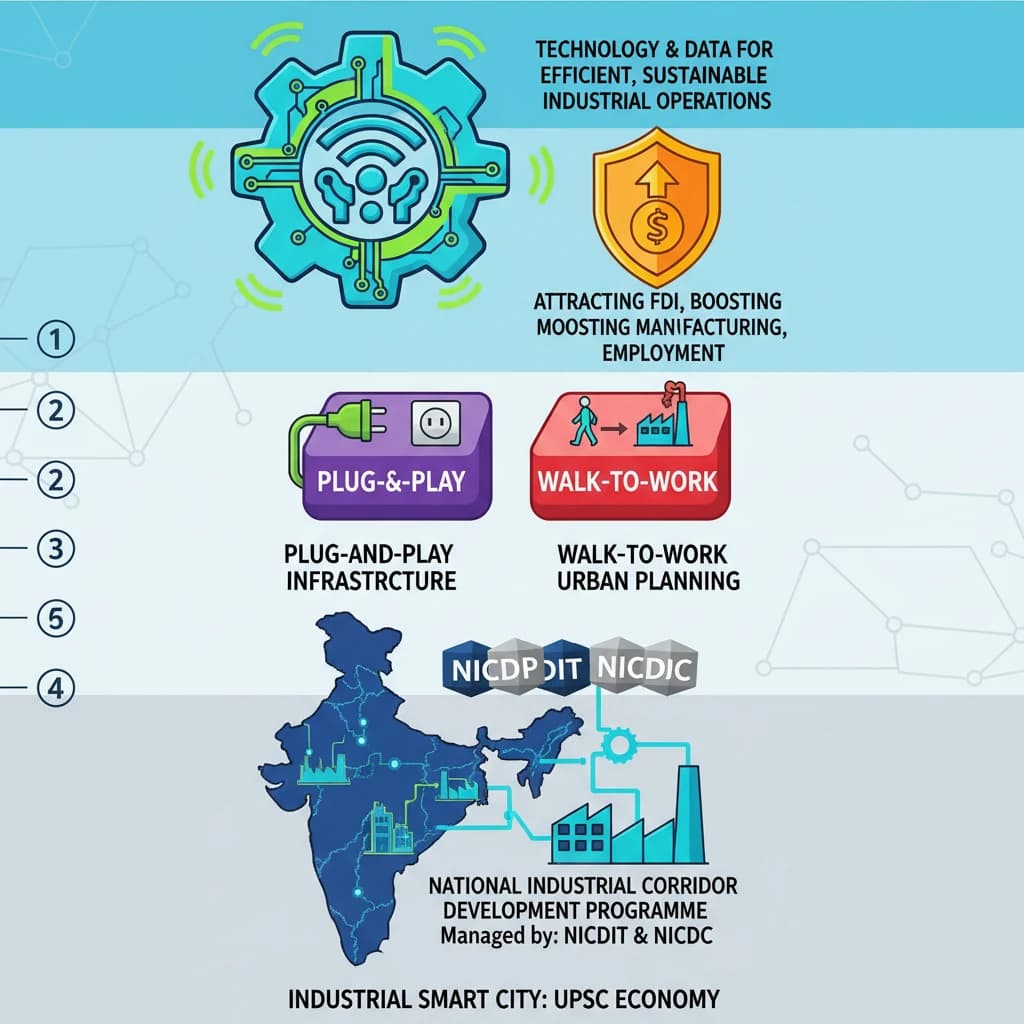
  • •Industrial Smart Cities integrate technology and data for efficient, sustainable industrial operations.
  • •Objectives include attracting FDI, boosting manufacturing, and creating employment.
  • •Key concepts are 'plug-and-play' infrastructure and 'walk-to-work' urban planning.
  • •Developed under the National Industrial Corridor Development Programme (NICDP), managed by NICDIT and NICDC.
  • •The Delhi Mumbai Industrial Corridor (DMIC) approved in 2007, was the first major initiative.

🧠 Memory Techniques
Memory Aid
98% Verified Content

Related Topics

Loading related topics...
Explore:Economy Topics·All Subjects·Daily Current Affairs·Editorial Analysis·Previous Year Questions·UPSC GPT