Loading page, please wait…
Vaidra Logo
Vaidra

Top 4 items + smart groups

UPSC GPT
New
Current Affairs
Daily Solutions
Daily Puzzle
Mains Evaluator

Version 2.0.0 • Built with ❤️ for UPSC aspirants

Loading...
Loading...
Loading...
Loading...
Loading...
Loading...
Loading...
Loading...
Loading...
Loading...
Loading...
Loading...
Loading...
Back
All Subjects

Topics

0 topics • 0 completed

Loading topics...
Loading...
Loading...
Loading...
Loading...
Loading...
Overall Progress0%

India’s 10-Year Coffee Growth Plan - UPSC Economy

What is India’s 10-Year Coffee Growth Plan in UPSC Economy?

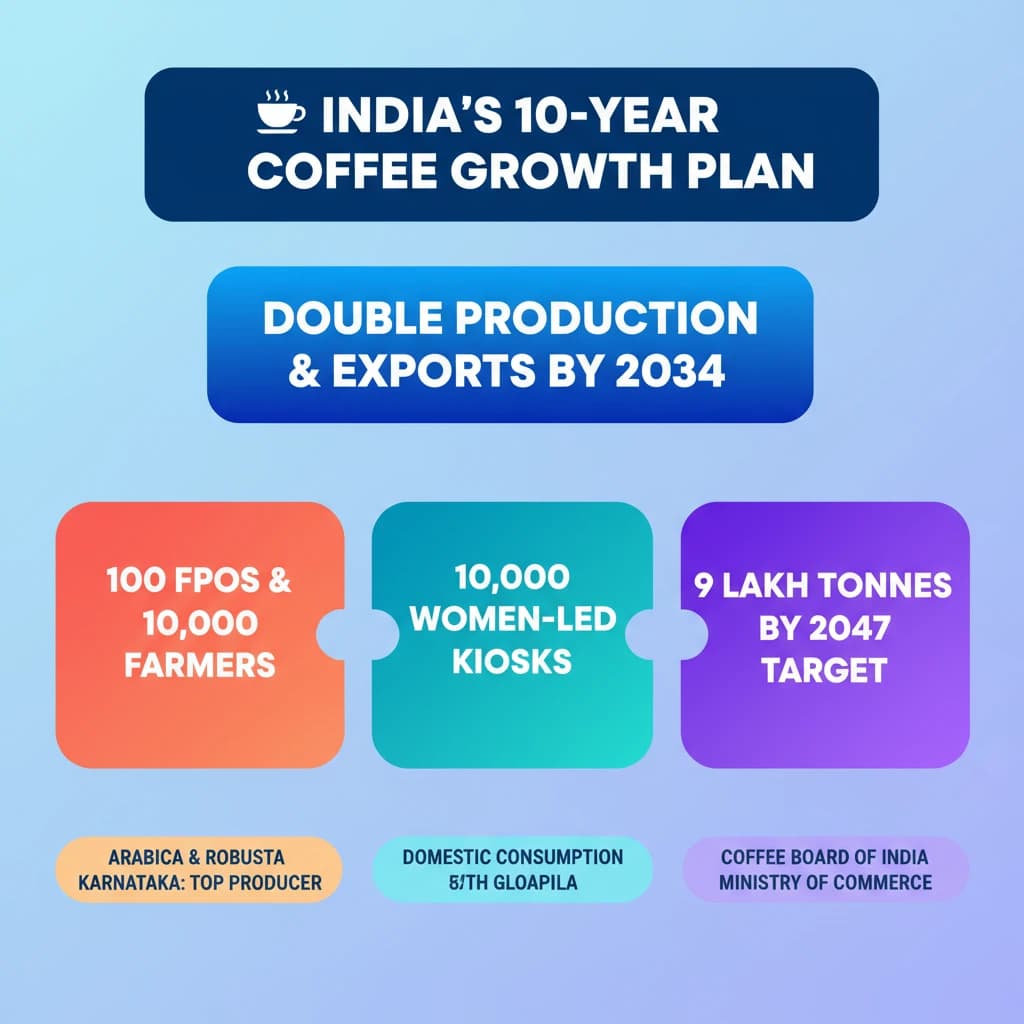
India’s 10-Year Coffee Growth Plan is a key topic under Economy for UPSC Civil Services Examination. Key points include: India's 10-Year Coffee Growth Plan aims to double production and exports by 2034.. Key strategies include 100 FPOs, 10,000 specialty coffee farmers, and 10,000 women-led coffee kiosks.. Targets domestic consumption increase to 500g per capita and production to 9 lakh tonnes by 2047.. Understanding this topic is essential for both UPSC Prelims and Mains preparation.

Why is India’s 10-Year Coffee Growth Plan important for UPSC exam?

India’s 10-Year Coffee Growth Plan is a Medium-level topic in UPSC Economy. It is tested in both Prelims (factual MCQs) and Mains (analytical answer writing). Previous year UPSC questions have frequently covered aspects of India’s 10-Year Coffee Growth Plan, making it essential for comprehensive IAS preparation.

How to prepare India’s 10-Year Coffee Growth Plan for UPSC?

To prepare India’s 10-Year Coffee Growth Plan for UPSC: (1) Study the comprehensive notes covering all key concepts on Vaidra. (2) Practice previous year questions on this topic. (3) Connect it with current affairs using daily updates. (4) Revise using key takeaways and mind maps available for Economy. (5) Write practice answers linking India’s 10-Year Coffee Growth Plan to related GS Paper topics.

Key takeaways of India’s 10-Year Coffee Growth Plan for UPSC

  • India's 10-Year Coffee Growth Plan aims to double production and exports by 2034.
  • Key strategies include 100 FPOs, 10,000 specialty coffee farmers, and 10,000 women-led coffee kiosks.
  • Targets domestic consumption increase to 500g per capita and production to 9 lakh tonnes by 2047.
  • India produces Arabica and Robusta, with Karnataka as the largest producer, ranking 8th globally.
  • Coffee Board of India is a statutory body under the Ministry of Commerce and Industry, headquartered in Bengaluru.
  • ONDC is a separate, open-source network for digital commerce, aiming to level the e-commerce playing field.
India’s 10-Year
Coffee Growth Plan

India’s 10-Year Coffee Growth Plan

Medium⏱️ 10 min read✓ 95% Verified
economy

📖 Introduction

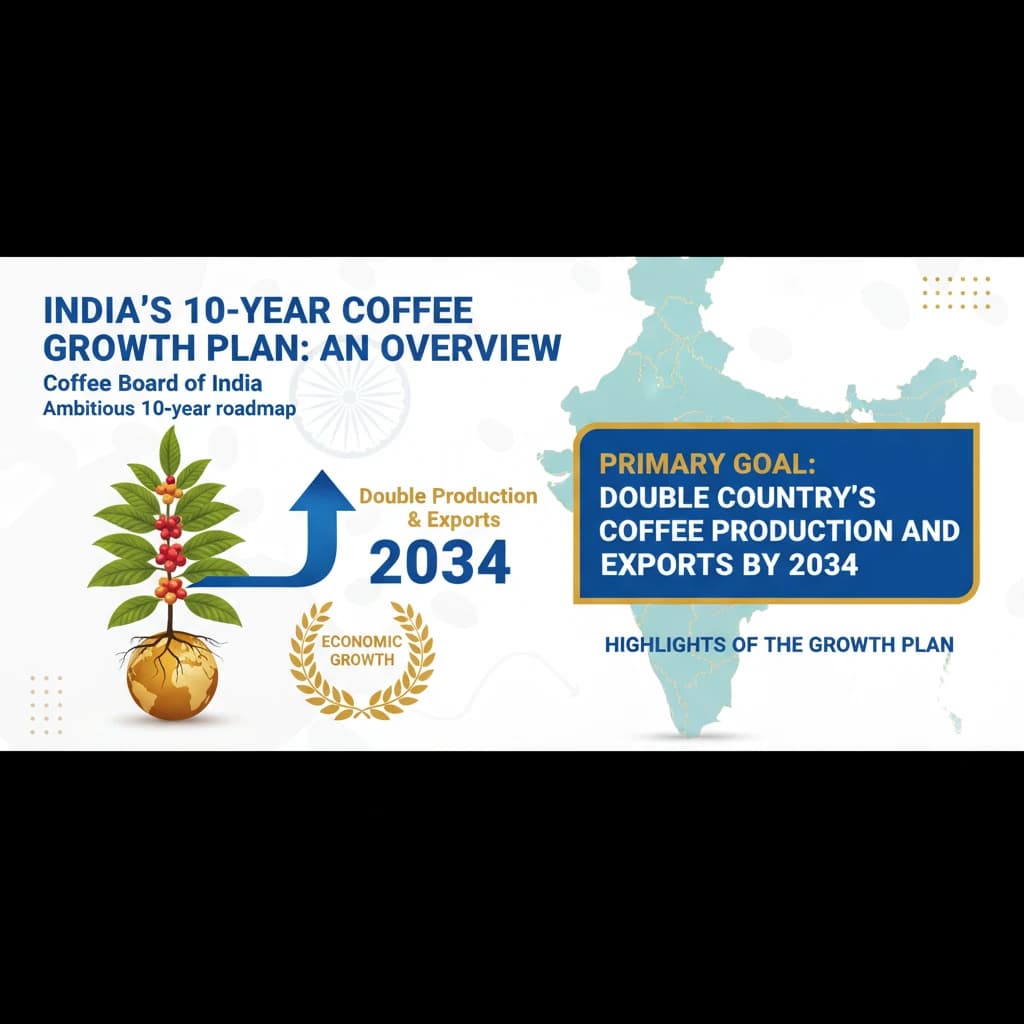
<h4>India's 10-Year Coffee Growth Plan: An Overview</h4><p>The <strong>Coffee Board of India</strong> has unveiled an ambitious <strong>10-year roadmap</strong>. This plan aims to significantly boost India's coffee sector over the next decade.</p><div class='key-point-box'><p>The primary goal is to <strong>double the country's coffee production and exports by 2034</strong>, marking a strategic push for economic growth and global market presence.</p></div><h4>Highlights of the Growth Plan</h4><p>The plan outlines several key initiatives to achieve its ambitious targets:</p><ul><li><strong>Farmer Producer Organisations (FPOs)</strong>: Establishment of <strong>100 FPOs</strong> to provide robust support to coffee growers and enhance their market access.</li><li><strong>Specialty Coffee Promotion</strong>: Identification of <strong>10,000 small farmers</strong> to cultivate <strong>specialty coffee</strong> for export markets, enabling them to command premium prices.</li><li><strong>Domestic Consumption Boost</strong>: Creation of <strong>10,000 coffee kiosks</strong>, predominantly managed by <strong>women entrepreneurs</strong>, to elevate domestic coffee consumption from <strong>107 grams to 500 grams per capita</strong>.</li></ul><div class='info-box'><p><strong>Production Target</strong>: The plan aims to nearly triple coffee production from <strong>3.7 lakh tonnes in 2024-25 to 9 lakh tonnes by 2047</strong>.</p></div><h4>Coffee in India: Key Facts</h4><p>India is a significant global player in coffee production, cultivating two main varieties:</p><ul><li><strong>Arabica</strong>: Known for its delicate aroma and flavour.</li><li><strong>Robusta</strong>: Valued for its strong flavour and higher caffeine content.</li></ul><div class='info-box'><p><strong>Largest Producer State</strong>: <strong>Karnataka</strong> consistently remains the largest coffee-producing state in India.</p><p><strong>Global Ranking</strong>: In <strong>2022-2023</strong>, India was the <strong>8th largest coffee grower</strong> globally.</p><p><strong>Export Performance</strong>: By <strong>August 2024</strong>, coffee exports from India had reached an impressive <strong>USD 1.19 billion</strong>.</p></div><h4>The Coffee Board of India</h4><p>The <strong>Coffee Board of India</strong> plays a pivotal role in the development and regulation of the Indian coffee industry.</p><div class='info-box'><p>It is a <strong>statutory organization</strong> established under the <strong>Coffee Act, 1942</strong>. It operates under the administrative control of the <strong>Ministry of Commerce and Industry</strong> and is headquartered in <strong>Bengaluru</strong>.</p></div><h4>Open Network for Digital Commerce (ONDC) - *Content from Source*</h4><p>The source material also mentions <strong>ONDC</strong>, an initiative distinct from the coffee growth plan but included in the provided text.</p><div class='key-point-box'><p><strong>ONDC</strong> is a <strong>not-for-profit organisation</strong> designed to create an <strong>open network</strong> for local digital commerce stores across various industries.</p></div><p>Similar to the <strong>Unified Payments Interface (UPI)</strong>, ONDC aims to establish a level operational playing field among diverse e-commerce platforms.</p><p>The <strong>Quality Council of India</strong> is tasked with integrating e-commerce platforms via this <strong>open-source technology network</strong>, allowing users to modify or enhance the code.</p><p><strong>Working Mechanism</strong>: ONDC functions as an <strong>open network gateway</strong> rather than a single platform like Amazon or Flipkart.</p><h4>Understanding Open Source Technology</h4><p><strong>Open source</strong> refers to technology or code that is freely available for anyone to use, redistribute, and modify.</p><div class='info-box'><p><strong>Example</strong>: The <strong>Android operating system</strong> is open-source, enabling manufacturers like <strong>Samsung, Nokia, and Xiaomi</strong> to customize it for their hardware. In contrast, <strong>iOS</strong> is closed-source and cannot be legally modified.</p></div>
Concept Diagram

💡 Key Takeaways

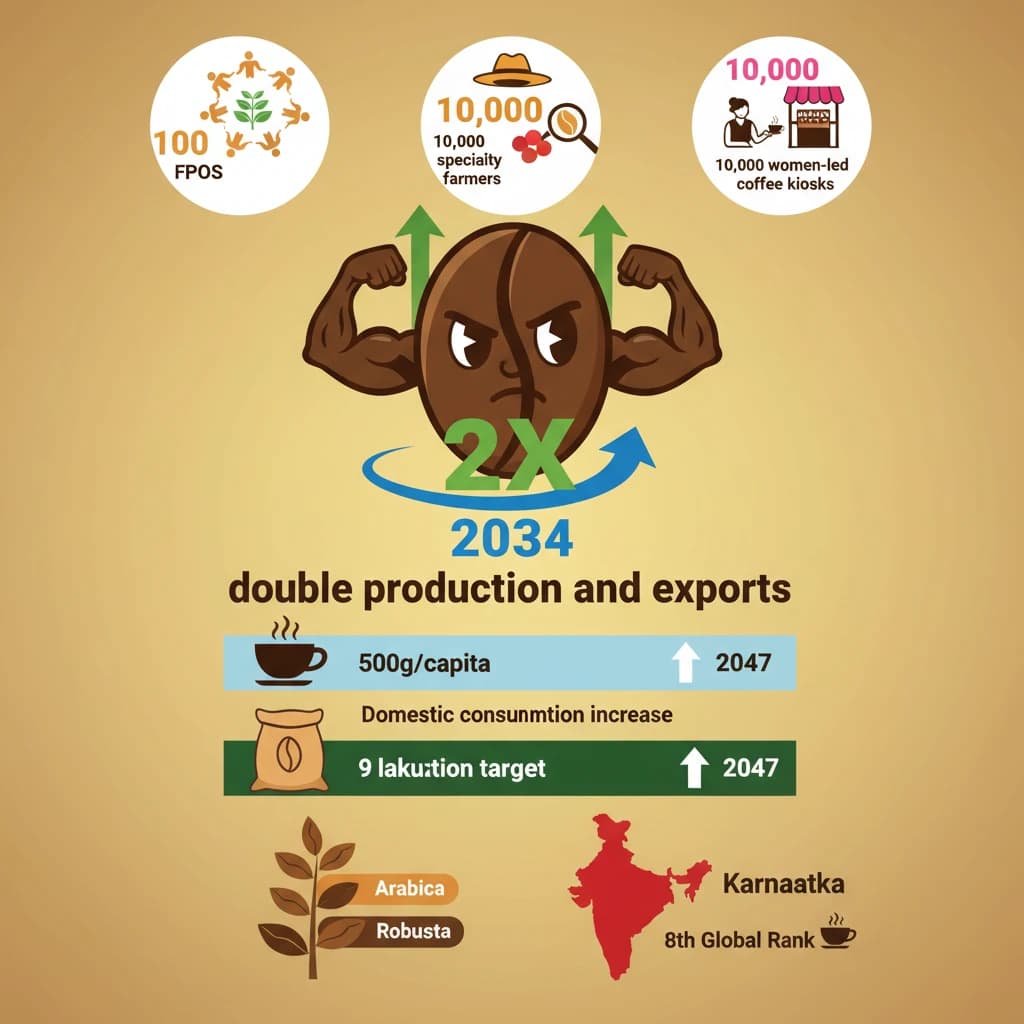
  • •India's 10-Year Coffee Growth Plan aims to double production and exports by 2034.
  • •Key strategies include 100 FPOs, 10,000 specialty coffee farmers, and 10,000 women-led coffee kiosks.
  • •Targets domestic consumption increase to 500g per capita and production to 9 lakh tonnes by 2047.
  • •India produces Arabica and Robusta, with Karnataka as the largest producer, ranking 8th globally.
  • •Coffee Board of India is a statutory body under the Ministry of Commerce and Industry, headquartered in Bengaluru.
  • •ONDC is a separate, open-source network for digital commerce, aiming to level the e-commerce playing field.

🧠 Memory Techniques
Memory Aid
95% Verified Content

📚 Reference Sources

•Coffee Board of India Official Website
•Ministry of Commerce and Industry, Government of India

Related Topics

Loading related topics...
Explore:Economy Topics·All Subjects·Daily Current Affairs·Editorial Analysis·Previous Year Questions·UPSC GPT
India’s 10-Year Coffee Growth Plan - UPSC Economy