Loading page, please wait…
Vaidra Logo
Vaidra

Top 4 items + smart groups

UPSC GPT
New
Current Affairs
Daily Solutions
Daily Puzzle
Mains Evaluator

Version 2.0.0 • Built with ❤️ for UPSC aspirants

Loading...
Loading...
Loading...
Loading...
Loading...
Loading...
Loading...
Loading...
Loading...
Loading...
Loading...
Loading...
Loading...
Back
All Subjects

Topics

0 topics • 0 completed

Loading topics...
Loading...
Loading...
Loading...
Loading...
Loading...
Overall Progress0%

What is the OECD? - UPSC Economy

What is What is the OECD? in UPSC Economy?

What is the OECD? is a key topic under Economy for UPSC Civil Services Examination. Key points include: The <strong>OECD</strong> is a Paris-headquartered intergovernmental economic organization founded in <strong>1961</strong>, promoting global economic and social well-being.. India's rising debt is primarily driven by <strong>high fiscal deficits</strong>, stemming from high expenditure, slow revenue growth, and global events.. Factors like <strong>geopolitical events</strong>, internal economy issues, government guarantees, and exchange rate fluctuations also contribute to India's debt.. Understanding this topic is essential for both UPSC Prelims and Mains preparation.

Why is What is the OECD? important for UPSC exam?

What is the OECD? is a Medium-level topic in UPSC Economy. It is tested in both Prelims (factual MCQs) and Mains (analytical answer writing). Previous year UPSC questions have frequently covered aspects of What is the OECD?, making it essential for comprehensive IAS preparation.

How to prepare What is the OECD? for UPSC?

To prepare What is the OECD? for UPSC: (1) Study the comprehensive notes covering all key concepts on Vaidra. (2) Practice previous year questions on this topic. (3) Connect it with current affairs using daily updates. (4) Revise using key takeaways and mind maps available for Economy. (5) Write practice answers linking What is the OECD? to related GS Paper topics.

Key takeaways of What is the OECD? for UPSC

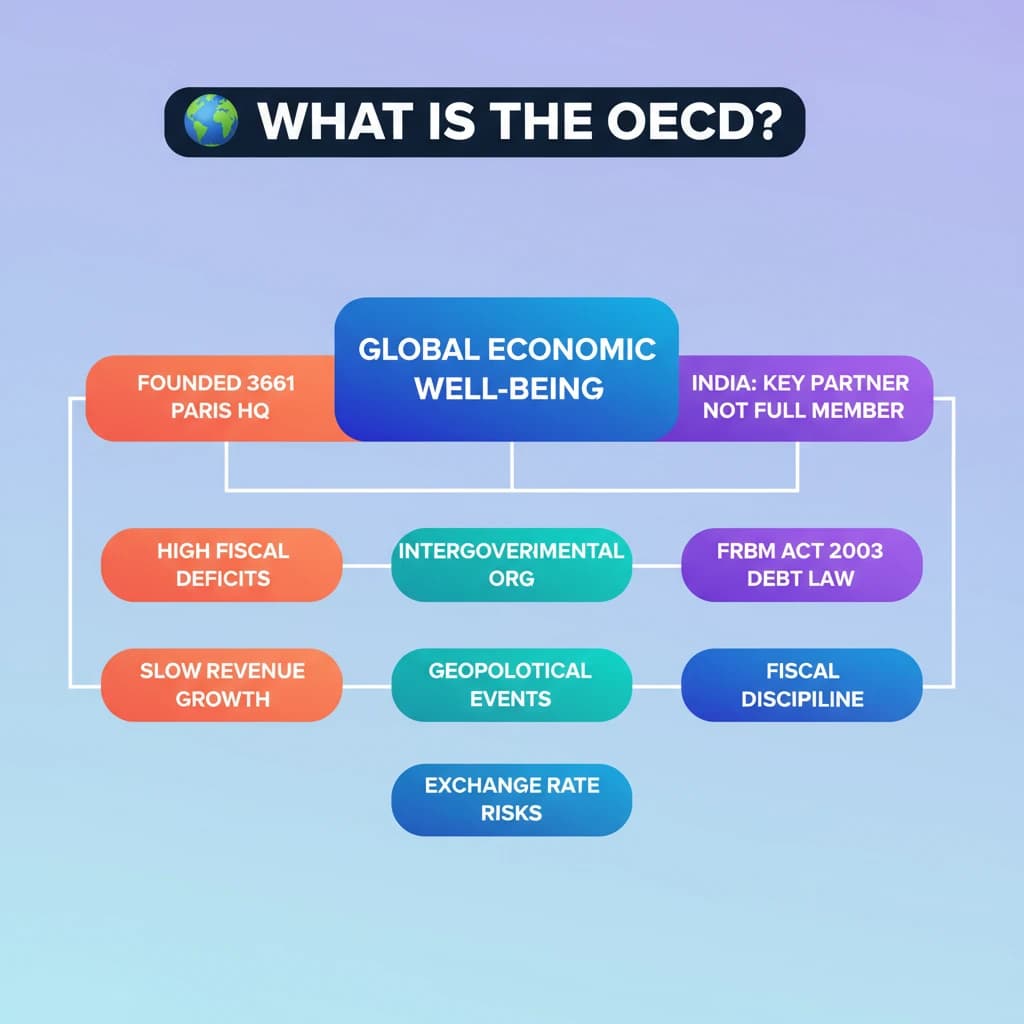
  • The <strong>OECD</strong> is a Paris-headquartered intergovernmental economic organization founded in <strong>1961</strong>, promoting global economic and social well-being.
  • India's rising debt is primarily driven by <strong>high fiscal deficits</strong>, stemming from high expenditure, slow revenue growth, and global events.
  • Factors like <strong>geopolitical events</strong>, internal economy issues, government guarantees, and exchange rate fluctuations also contribute to India's debt.
  • The <strong>Fiscal Responsibility and Budget Management Act, 2003 (FRBM Act)</strong> is India's key legislation for ensuring fiscal discipline and managing debt.
  • India is a <strong>Key Partner</strong> of the OECD, participating in its initiatives despite not being a full member.
  • Understanding these dynamics is crucial for analyzing India's economic stability and its global economic engagements.
What is the OECD?

What is the OECD?

Medium⏱️ 8 min read✓ 98% Verified
economy

📖 Introduction

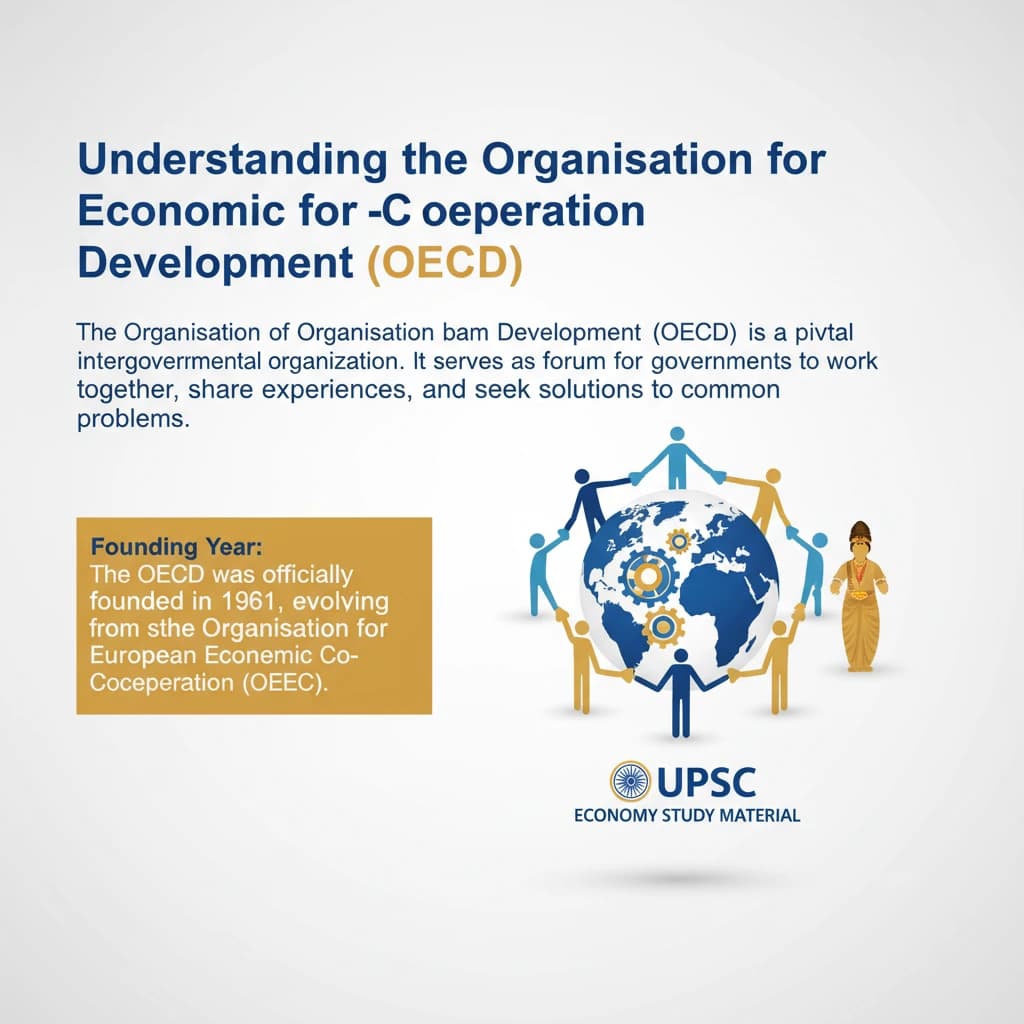
<h4>Understanding the Organisation for Economic Co-operation and Development (OECD)</h4><p>The <strong>Organisation for Economic Co-operation and Development (OECD)</strong> is a pivotal <strong>intergovernmental economic organization</strong>. It serves as a forum for governments to work together, share experiences, and seek solutions to common problems.</p><div class='info-box'><p><strong>Founding Year:</strong> The OECD was officially founded in <strong>1961</strong>, evolving from the Organisation for European Economic Co-operation (OEEC).</p><p><strong>Headquarters:</strong> Its central operations are based in <strong>Paris, France</strong>.📍</p></div><p>The primary goal of the OECD is to foster economic and social well-being worldwide. It achieves this by promoting policies that improve the economic and social conditions of people around the world.</p><h4>Factors Related to India’s Rising Debt Levels</h4><p>India, like many developing economies, faces challenges related to its public debt. Several interconnected factors contribute to the country's rising debt levels.</p><div class='key-point-box'><p><strong>High Fiscal Deficit:</strong> A persistent <strong>fiscal deficit</strong> is a primary driver of increasing debt. This occurs when the government's total expenditure exceeds its total revenue, excluding borrowings.</p></div><p>To bridge this gap, the government often resorts to borrowing, which adds to the national debt. This deficit can stem from various underlying issues:</p><ul><li><strong>High Expenditure Commitments:</strong> Significant government spending on welfare schemes, infrastructure projects, subsidies, and defense can lead to substantial outlays. These commitments, while necessary for development, can strain fiscal resources.</li><li><strong>Slow Revenue Growth:</strong> If tax collections and other non-tax revenues do not grow sufficiently to match expenditure, the fiscal deficit widens. Factors like economic slowdowns or inefficiencies in tax administration can contribute to this.</li><li><strong>Global Geopolitical Events:</strong> External shocks, such as wars, pandemics, or global economic crises, can necessitate increased government spending (e.g., stimulus packages) or reduce revenue, thereby impacting debt levels.</li><li><strong>Internal Economy and Tax Leakage:</strong> Domestic economic challenges, alongside issues like tax evasion or inefficient tax collection mechanisms, can lead to significant <strong>tax leakage</strong>, further exacerbating revenue shortfalls.</li><li><strong>Guarantees and Contingencies:</strong> Government guarantees for public sector undertakings or specific projects, while not direct debt, represent potential liabilities that could materialize, adding to the debt burden.</li><li><strong>Exchange Rate Fluctuations:</strong> For external debt, adverse <strong>exchange rate fluctuations</strong> can increase the rupee equivalent of foreign currency denominated debt, making repayment more expensive.</li></ul><h4>Legislation for Debt Management in India</h4><p>To address the challenges of fiscal discipline and debt management, India enacted a significant piece of legislation.</p><div class='info-box'><p>The <strong>Fiscal Responsibility and Budget Management Act, 2003 (FRBM Act)</strong> is a crucial law. It aims to institutionalize financial discipline, reduce fiscal deficit, and improve macro-economic management by setting targets for government debt and deficits.</p></div><div class='exam-tip-box'><p><strong>UPSC Insight:</strong> Understanding the interplay between global economic organizations like <strong>OECD</strong> and domestic fiscal policies (like the <strong>FRBM Act</strong>) is crucial for <strong>GS Paper 3 (Economy)</strong>. Be prepared to analyze their impact on India's economic stability and growth.</p></div>
Concept Diagram

💡 Key Takeaways

  • •The <strong>OECD</strong> is a Paris-headquartered intergovernmental economic organization founded in <strong>1961</strong>, promoting global economic and social well-being.
  • •India's rising debt is primarily driven by <strong>high fiscal deficits</strong>, stemming from high expenditure, slow revenue growth, and global events.
  • •Factors like <strong>geopolitical events</strong>, internal economy issues, government guarantees, and exchange rate fluctuations also contribute to India's debt.
  • •The <strong>Fiscal Responsibility and Budget Management Act, 2003 (FRBM Act)</strong> is India's key legislation for ensuring fiscal discipline and managing debt.
  • •India is a <strong>Key Partner</strong> of the OECD, participating in its initiatives despite not being a full member.
  • •Understanding these dynamics is crucial for analyzing India's economic stability and its global economic engagements.

🧠 Memory Techniques
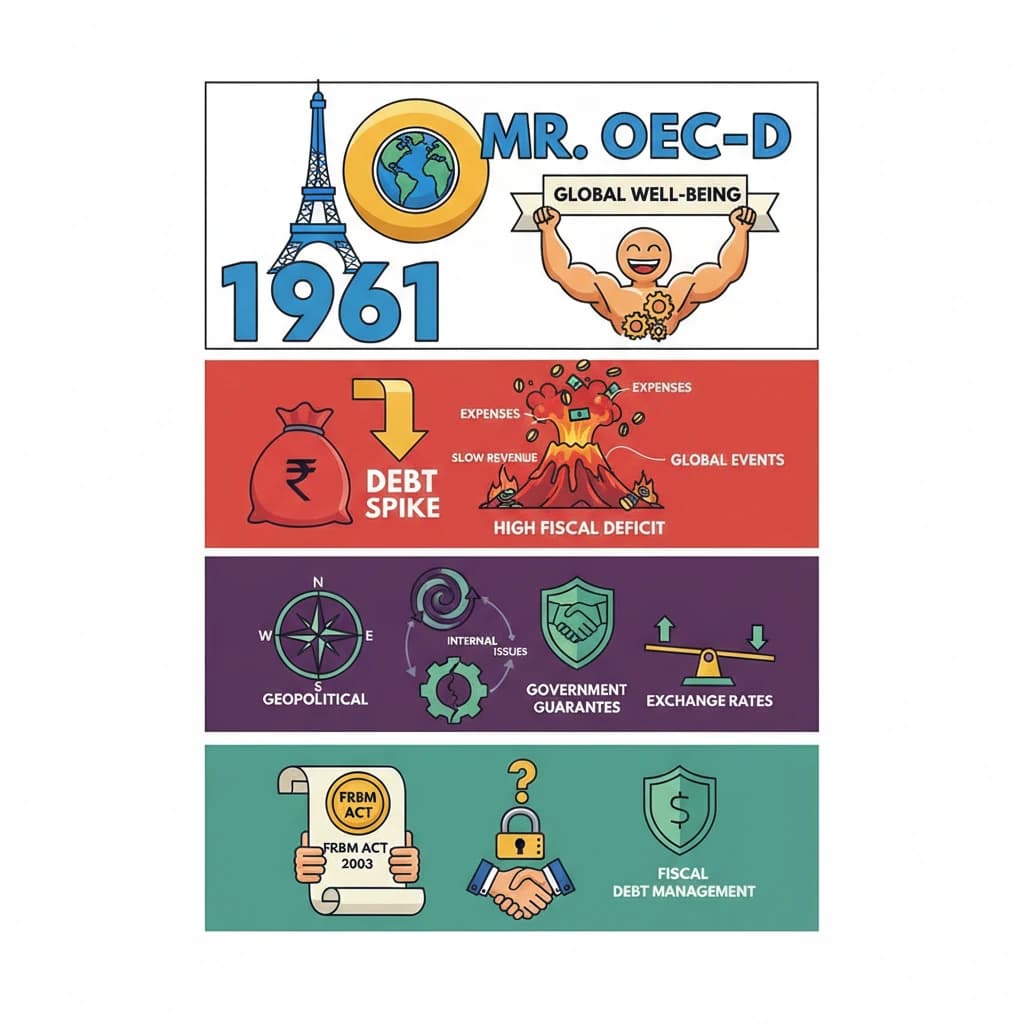
Memory Aid
98% Verified Content

📚 Reference Sources

•Official OECD Website (www.oecd.org)
•Ministry of Finance, Government of India (Union Budget documents, FRBM Act details)
•Reserve Bank of India (RBI) publications on public debt and fiscal indicators

Related Topics

Loading related topics...
Explore:Economy Topics·All Subjects·Daily Current Affairs·Editorial Analysis·Previous Year Questions·UPSC GPT
What is the OECD? - UPSC Economy