Loading page, please wait…
Vaidra Logo
Vaidra

Top 4 items + smart groups

UPSC GPT
New
Current Affairs
Daily Solutions
Daily Puzzle
Mains Evaluator

Version 2.0.0 • Built with ❤️ for UPSC aspirants

Loading...
Loading...
Loading...
Loading...
Loading...
Loading...
Loading...
Loading...
Loading...
Loading...
Loading...
Loading...
Loading...

Unified Lending Interface (ULI): Key Features & Benefits - UPSC Economy

What is Unified Lending Interface (ULI): Key Features & Benefits in UPSC Economy?

Unified Lending Interface (ULI): Key Features & Benefits is a key topic under Economy for UPSC Civil Services Examination. Key points include: ULI provides consent-based digital access to financial and non-financial customer data, including land records.. It uses common and standardised APIs for a 'plug and play' approach, simplifying data access for lenders.. Key benefits include frictionless credit, reduced appraisal time, and centralised data access.. Understanding this topic is essential for both UPSC Prelims and Mains preparation.

Why is Unified Lending Interface (ULI): Key Features & Benefits important for UPSC exam?

Unified Lending Interface (ULI): Key Features & Benefits is a Medium-level topic in UPSC Economy. It is tested in both Prelims (factual MCQs) and Mains (analytical answer writing). Previous year UPSC questions have frequently covered aspects of Unified Lending Interface (ULI): Key Features & Benefits, making it essential for comprehensive IAS preparation.

How to prepare Unified Lending Interface (ULI): Key Features & Benefits for UPSC?

To prepare Unified Lending Interface (ULI): Key Features & Benefits for UPSC: (1) Study the comprehensive notes covering all key concepts on Vaidra. (2) Practice previous year questions on this topic. (3) Connect it with current affairs using daily updates. (4) Revise using key takeaways and mind maps available for Economy. (5) Write practice answers linking Unified Lending Interface (ULI): Key Features & Benefits to related GS Paper topics.

Key takeaways of Unified Lending Interface (ULI): Key Features & Benefits for UPSC

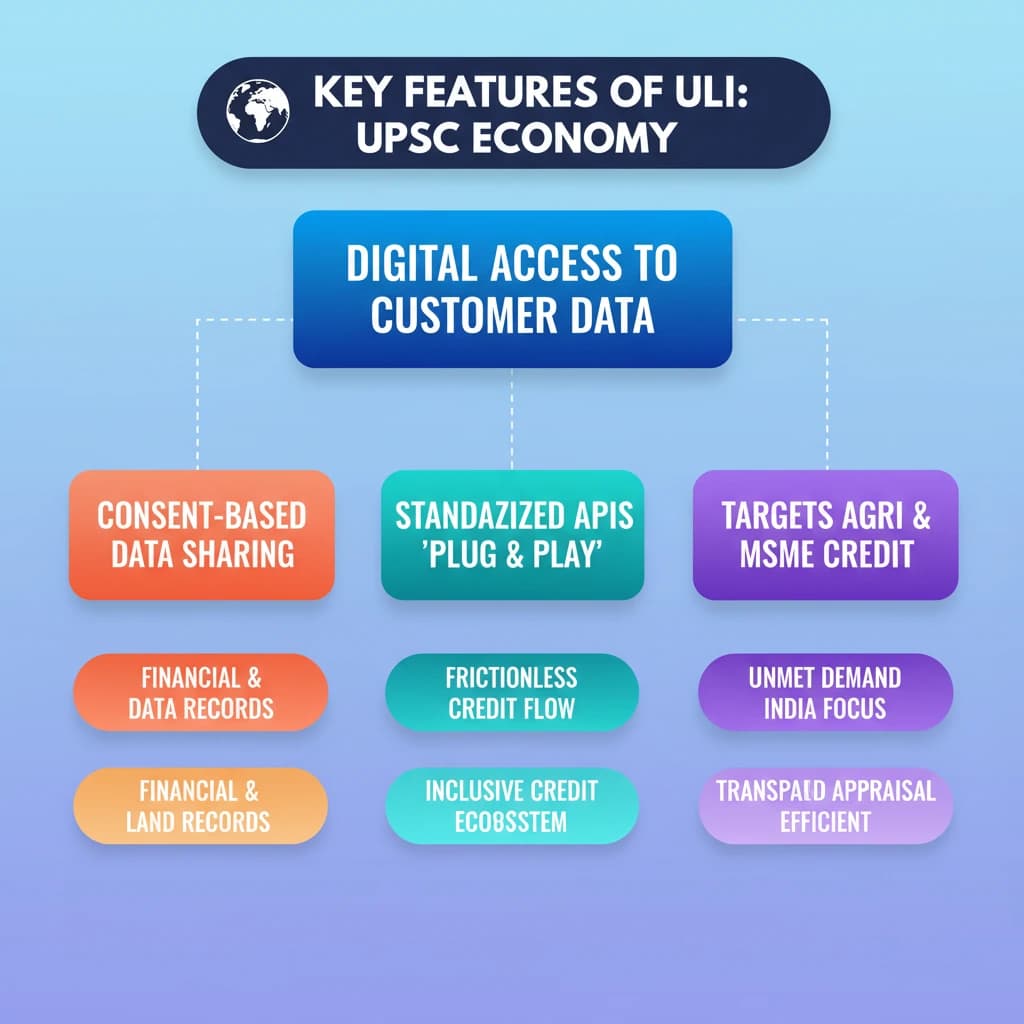
  • ULI provides consent-based digital access to financial and non-financial customer data, including land records.
  • It uses common and standardised APIs for a 'plug and play' approach, simplifying data access for lenders.
  • Key benefits include frictionless credit, reduced appraisal time, and centralised data access.
  • ULI specifically targets the unmet credit demand in agriculture and MSME sectors.
  • It is a crucial step towards a more efficient, transparent, and inclusive credit ecosystem in India.
Unified Lending Interface (ULI): Key Features & Benefits

Unified Lending Interface (ULI): Key Features & Benefits

Medium⏱️ 8 min read✓ 95% Verified
economy

📖 Introduction

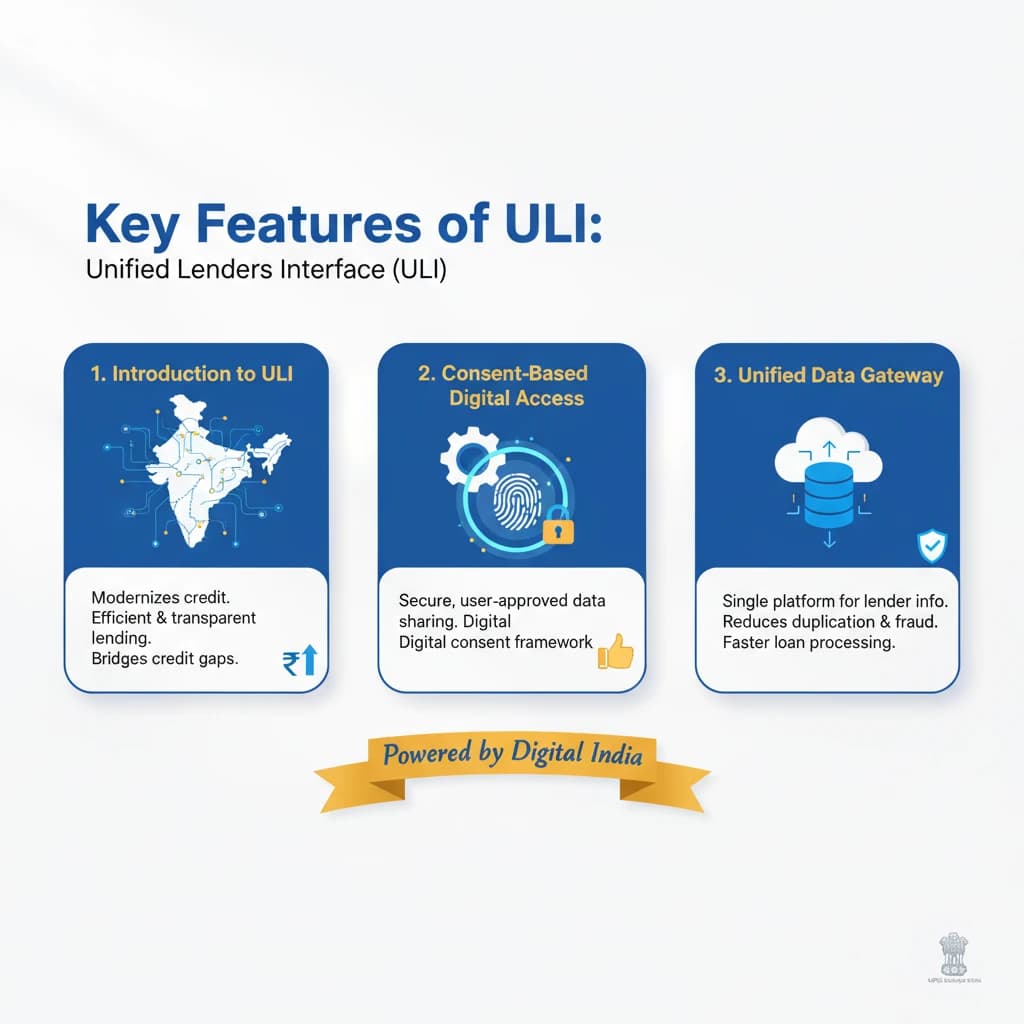
<h4>Introduction to ULI</h4><p>The <strong>Unified Lenders Interface (ULI)</strong> is a significant initiative designed to streamline and modernize the credit ecosystem in India. It aims to create a more efficient and transparent lending process.</p><p>By leveraging digital technology, <strong>ULI</strong> seeks to bridge existing gaps in credit access, particularly for underserved segments of the economy.</p><h4>Consent-Based Digital Access</h4><p>A core feature of <strong>ULI</strong> is its provision for <strong>consent-based digital access</strong> to customer data. This means lenders can access a comprehensive range of information.</p><p>This data includes both <strong>financial and non-financial data</strong>, such as crucial <strong>land records</strong>. Access is strictly governed by the customer's explicit consent, ensuring data privacy and security.</p><div class="key-point-box">The <strong>consent-based system</strong> is paramount, empowering individuals with control over their personal and financial information while facilitating legitimate credit assessment.</div><h4>Common and Standardised APIs</h4><p><strong>ULI</strong> is built upon a foundation of <strong>standardised Application Programming Interfaces (APIs)</strong>. These APIs are crucial for seamless integration across various platforms and stakeholders.</p><p>The use of standardised APIs enables a <strong>'plug and play' approach</strong>, significantly simplifying data access for lenders. This design reduces the technical complexity often associated with integrating diverse data sources.</p><div class="info-box">The <strong>'Plug and play' concept</strong> refers to ready-made facilities with essential infrastructure, such as power and network. It allows industries or systems to commence operations immediately without extensive setup.</div><h4>Potential Benefits of ULI</h4><p>The implementation of <strong>ULI</strong> is anticipated to bring about several transformative benefits for the Indian credit market.</p><ul><li><strong>Frictionless Credit:</strong> <strong>ULI</strong> aims to create a smoother and more efficient lending experience. It achieves this by minimising cumbersome paperwork, which is particularly beneficial for <strong>smaller and rural borrowers</strong>.</li><li><strong>Reduced Appraisal Time:</strong> By consolidating diverse data from multiple sources into a single platform, <strong>ULI</strong> will significantly decrease the time required for comprehensive credit evaluation and appraisal processes.</li><li><strong>Centralised Data Access:</strong> The platform offers <strong>centralised access</strong> to both <strong>financial and non-financial data</strong>. This consolidation makes information readily available and easily accessible to all participating lenders.</li><li><strong>Focus on Agriculture and MSMEs:</strong> A major objective of <strong>ULI</strong> is to address the substantial unmet demand for credit within critical sectors. These include <strong>agriculture</strong> and <strong>Micro, Small, and Medium Enterprises (MSMEs)</strong>, which are vital for economic growth.</li></ul><div class="exam-tip-box">Understanding the dual benefit of <strong>ULI</strong> – enhancing efficiency for lenders and expanding credit access for underserved sectors like <strong>agriculture</strong> and <strong>MSMEs</strong> – is crucial for Mains answers, especially in <strong>GS Paper III (Economy)</strong>.</div>
Concept Diagram

💡 Key Takeaways

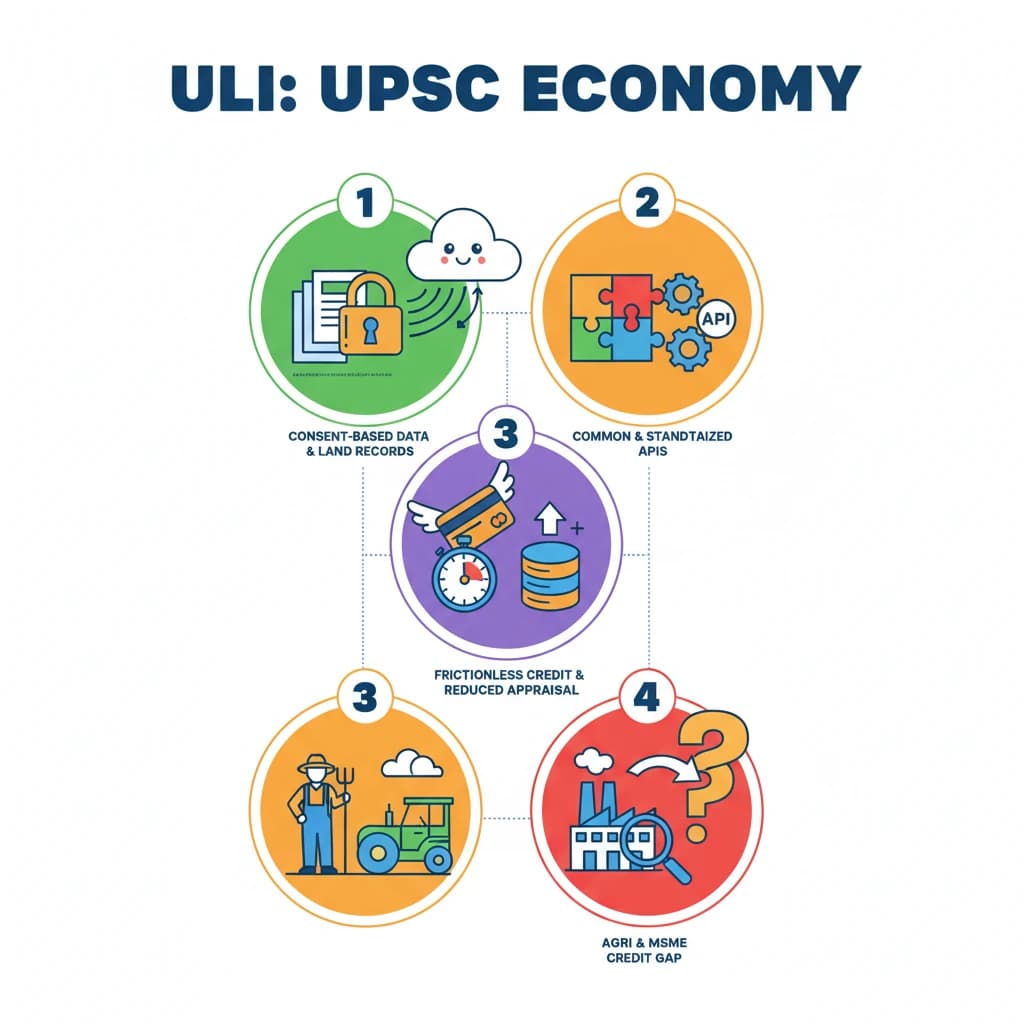
  • •ULI provides consent-based digital access to financial and non-financial customer data, including land records.
  • •It uses common and standardised APIs for a 'plug and play' approach, simplifying data access for lenders.
  • •Key benefits include frictionless credit, reduced appraisal time, and centralised data access.
  • •ULI specifically targets the unmet credit demand in agriculture and MSME sectors.
  • •It is a crucial step towards a more efficient, transparent, and inclusive credit ecosystem in India.

🧠 Memory Techniques
Memory Aid
95% Verified Content

📚 Reference Sources

•Reserve Bank of India (RBI) Publications on Digital Lending
•NITI Aayog Reports on Digital Public Infrastructure
•Ministry of Finance (Government of India) Press Releases

Related Topics

Loading related topics...
Explore:Economy Topics·All Subjects·Daily Current Affairs·Editorial Analysis·Previous Year Questions·UPSC GPT
Back
All Subjects

Topics

0 topics • 0 completed

Loading topics...
Loading...
Loading...
Loading...
Loading...
Loading...
Overall Progress0%
Unified Lending Interface (ULI): Key Features & Benefits - UPSC Economy