Loading page, please wait…
Vaidra Logo
Vaidra

Top 4 items + smart groups

UPSC GPT
New
Current Affairs
Daily Solutions
Daily Puzzle
Mains Evaluator

Version 2.0.0 • Built with ❤️ for UPSC aspirants

Loading...
Loading...
Loading...
Loading...
Loading...
Loading...
Loading...
Loading...
Loading...
Loading...
Loading...
Loading...
Loading...
Plug-in Hybrid Electric Vehicle (PHEV) - UPSC Economy
Back
All Subjects

Topics

0 topics • 0 completed

Loading topics...
Loading...
Loading...
Loading...
Loading...
Loading...
Overall Progress0%

Plug-in Hybrid Electric Vehicle (PHEV) - UPSC Economy

What is Plug-in Hybrid Electric Vehicle (PHEV) in UPSC Economy?

Plug-in Hybrid Electric Vehicle (PHEV) is a key topic under Economy for UPSC Civil Services Examination. Key points include: PHEVs combine an ICE and an electric motor, with batteries chargeable externally via a plug.. They can operate in all-electric mode for short distances or hybrid mode for extended range.. Unlike HEVs, PHEV batteries are primarily charged externally, not solely by the engine.. Understanding this topic is essential for both UPSC Prelims and Mains preparation.

Why is Plug-in Hybrid Electric Vehicle (PHEV) important for UPSC exam?

Plug-in Hybrid Electric Vehicle (PHEV) is a Medium-level topic in UPSC Economy. It is tested in both Prelims (factual MCQs) and Mains (analytical answer writing). Previous year UPSC questions have frequently covered aspects of Plug-in Hybrid Electric Vehicle (PHEV), making it essential for comprehensive IAS preparation.

How to prepare Plug-in Hybrid Electric Vehicle (PHEV) for UPSC?

To prepare Plug-in Hybrid Electric Vehicle (PHEV) for UPSC: (1) Study the comprehensive notes covering all key concepts on Vaidra. (2) Practice previous year questions on this topic. (3) Connect it with current affairs using daily updates. (4) Revise using key takeaways and mind maps available for Economy. (5) Write practice answers linking Plug-in Hybrid Electric Vehicle (PHEV) to related GS Paper topics.

Key takeaways of Plug-in Hybrid Electric Vehicle (PHEV) for UPSC

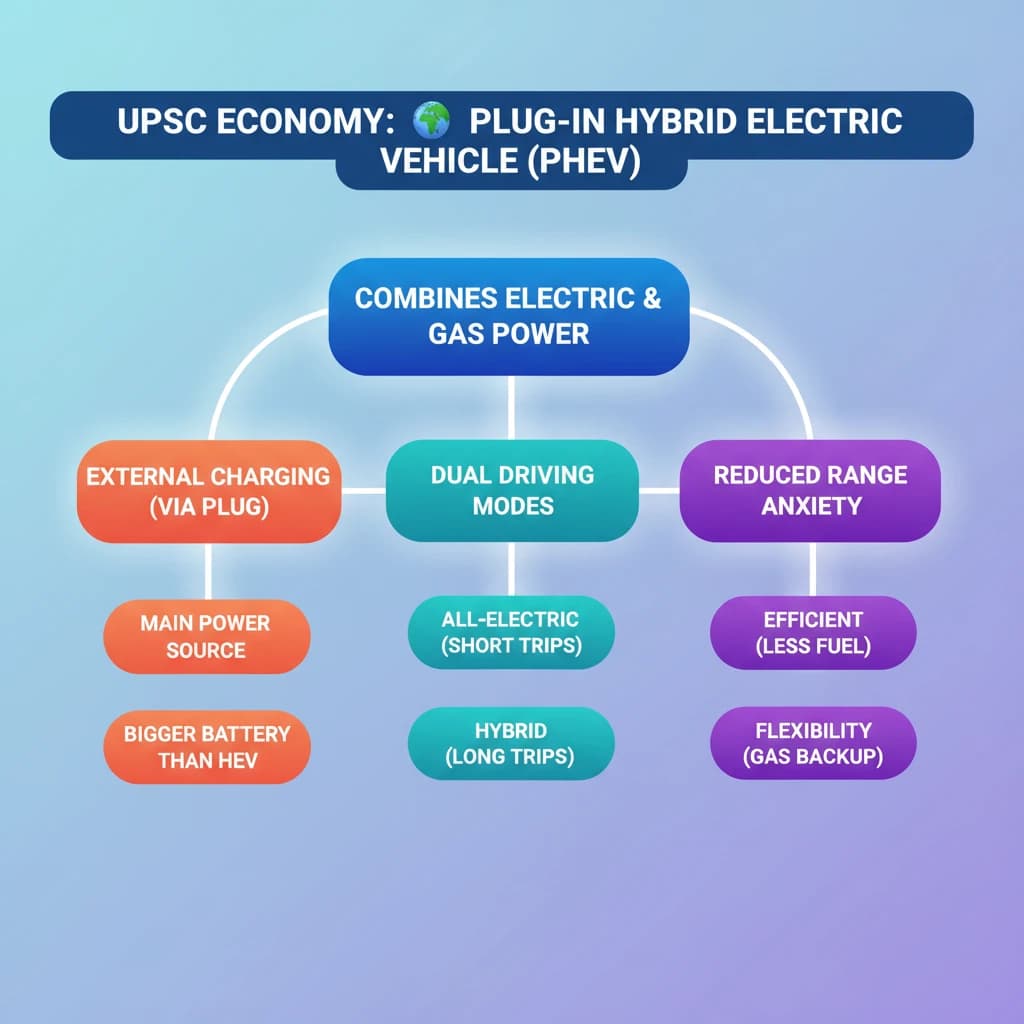
  • PHEVs combine an ICE and an electric motor, with batteries chargeable externally via a plug.
  • They can operate in all-electric mode for short distances or hybrid mode for extended range.
  • Unlike HEVs, PHEV batteries are primarily charged externally, not solely by the engine.
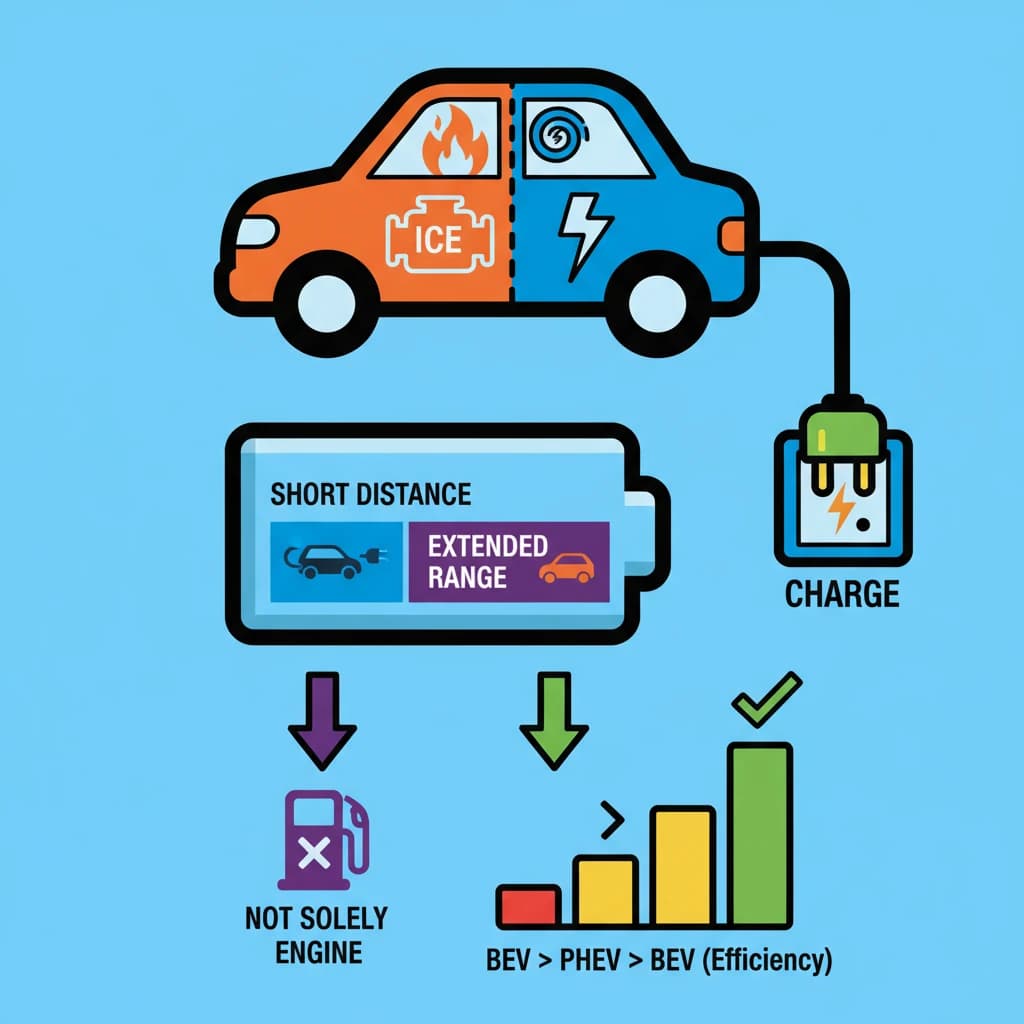
  • PHEVs are more efficient than HEVs but less efficient than pure BEVs.
  • They offer a balance of electric efficiency and conventional fuel range, reducing range anxiety.
Plug-in Hybrid Electric Vehicle (PHEV)

Plug-in Hybrid Electric Vehicle (PHEV)

Medium⏱️ 8 min read✓ 95% Verified
economy

📖 Introduction

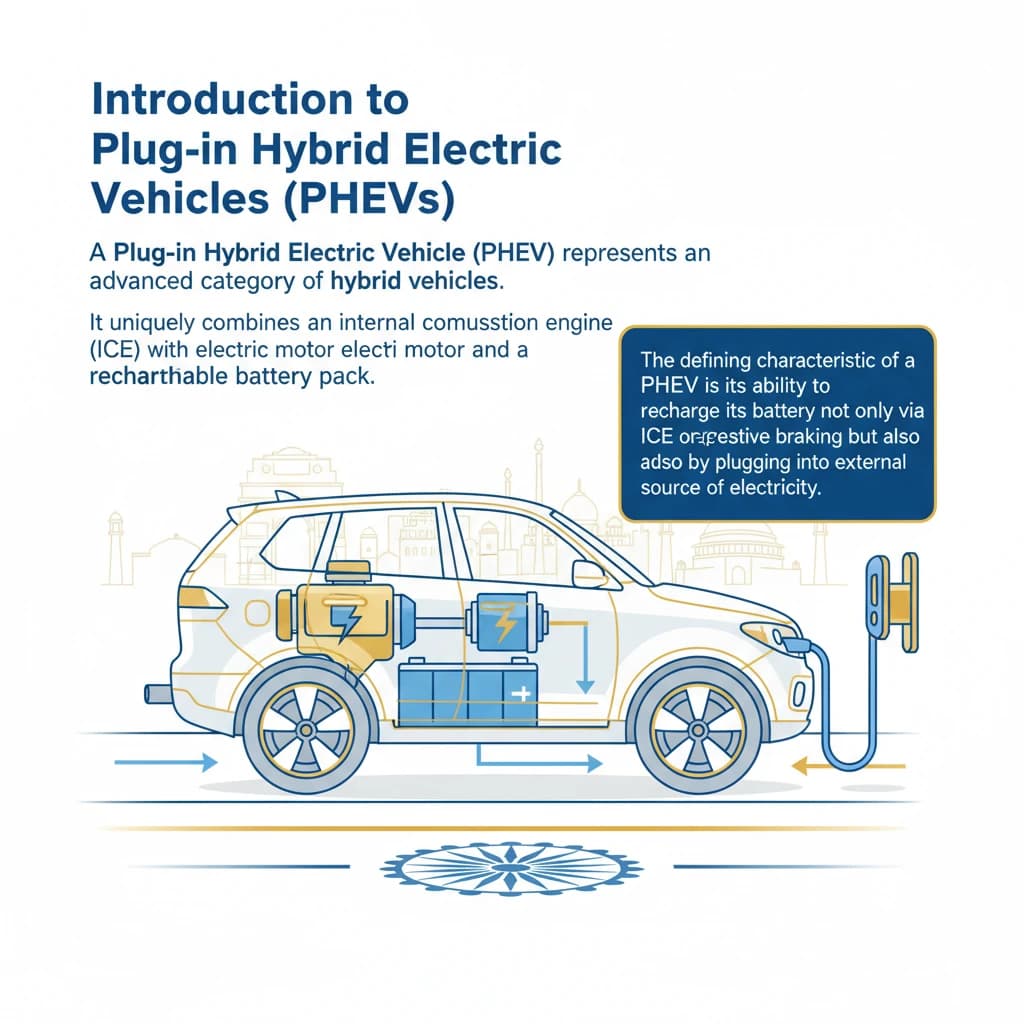
<h4>Introduction to Plug-in Hybrid Electric Vehicles (PHEVs)</h4><p>A <strong>Plug-in Hybrid Electric Vehicle (PHEV)</strong> represents an advanced category of hybrid vehicles.</p><p>It uniquely combines an <strong>internal combustion engine (ICE)</strong> with an <strong>electric motor</strong> and a <strong>rechargeable battery pack</strong>.</p><div class='info-box'><p>The defining characteristic of a PHEV is its ability to recharge its battery not only via the ICE or regenerative braking but primarily from an <strong>external electricity source</strong>, through a dedicated plug.</p></div><h4>Key Features and Charging Mechanism</h4><p>Unlike conventional <strong>Hybrid Electric Vehicles (HEVs)</strong>, PHEVs are equipped with a larger battery capacity.</p><p>This larger battery enables a significant <strong>all-electric range</strong>, allowing the vehicle to travel considerable distances solely on electric power.</p><div class='key-point-box'><p>Crucially, the PHEV's battery <strong>must be charged</strong> using an <strong>external electricity source</strong>, such as a home charging station or public charging point. It cannot be charged by the internal combustion engine alone, unlike some HEVs.</p></div><h4>Operating Modes of a PHEV</h4><p>PHEVs offer drivers flexibility by operating in at least two distinct modes, optimizing for efficiency and range.</p><ul><li><strong>All-electric Mode:</strong> In this mode, the vehicle runs entirely on its <strong>electric motor</strong>, drawing power from the battery. The internal combustion engine remains off, resulting in zero tailpipe emissions and quiet operation. This mode is ideal for shorter commutes.</li><li><strong>Hybrid Mode:</strong> When the battery's charge is depleted or when more power is required (e.g., during acceleration or at higher speeds), the PHEV seamlessly transitions to <strong>Hybrid Mode</strong>. Here, both the <strong>electric motor</strong> and the <strong>internal combustion engine</strong> work in conjunction to power the vehicle, maximizing efficiency and extending range.</li></ul><h4>Efficiency Comparison with Other EV Types</h4><p>When comparing different types of electric vehicles, PHEVs occupy an intermediate position in terms of overall efficiency.</p><div class='info-box'><p><strong>PHEVs are generally more efficient than conventional Hybrid Electric Vehicles (HEVs)</strong> due to their larger battery capacity and ability to run purely on electricity for longer durations.</p></div><div class='info-box'><p>However, <strong>PHEVs are less efficient than Battery Electric Vehicles (BEVs)</strong>. BEVs rely solely on electric power and do not carry the weight or complexity of an internal combustion engine, making them inherently more efficient in electric-only operation.</p></div><div class='exam-tip-box'><p>UPSC often asks comparative questions on different EV technologies. Understanding the distinctions in <strong>charging mechanisms</strong>, <strong>operating modes</strong>, and <strong>efficiency</strong> between HEVs, PHEVs, and BEVs is crucial for <strong>General Studies Paper 3 (Economy & Science & Technology)</strong>.</p></div>
Concept Diagram

💡 Key Takeaways

  • •PHEVs combine an ICE and an electric motor, with batteries chargeable externally via a plug.
  • •They can operate in all-electric mode for short distances or hybrid mode for extended range.
  • •Unlike HEVs, PHEV batteries are primarily charged externally, not solely by the engine.
  • •PHEVs are more efficient than HEVs but less efficient than pure BEVs.
  • •They offer a balance of electric efficiency and conventional fuel range, reducing range anxiety.

🧠 Memory Techniques
Memory Aid
95% Verified Content

📚 Reference Sources

•Ministry of Road Transport and Highways (MoRTH) reports on EVs
•FAME India Scheme documents
•International Energy Agency (IEA) reports on EV outlook

Related Topics

Loading related topics...
Explore:Economy Topics·All Subjects·Daily Current Affairs·Editorial Analysis·Previous Year Questions·UPSC GPT