Loading page, please wait…
Vaidra Logo
Vaidra

Top 4 items + smart groups

UPSC GPT
New
Current Affairs
Daily Solutions
Daily Puzzle
Mains Evaluator

Version 2.0.0 • Built with ❤️ for UPSC aspirants

Loading...
Loading...
Loading...
Loading...
Loading...
Loading...
Loading...
Loading...
Loading...
Loading...
Loading...
Loading...
Loading...

30 YEARS OF TRIPS - UPSC Economy

What is 30 YEARS OF TRIPS in UPSC Economy?

30 YEARS OF TRIPS is a key topic under Economy for UPSC Civil Services Examination. Key points include: The TRIPS Agreement, a core pillar of the WTO, recently marked its 30th anniversary, established via the Marrakesh Agreement in 1994.. It is the most comprehensive multilateral agreement on Intellectual Property Rights (IPRs), setting minimum global standards for various IP forms.. Its historical evolution traces back through the Venetian Patent Statute (1474), the Paris Convention (1883), and its integration during the Uruguay Round (1987-1994).. Understanding this topic is essential for both UPSC Prelims and Mains preparation.

Why is 30 YEARS OF TRIPS important for UPSC exam?

30 YEARS OF TRIPS is a Medium-level topic in UPSC Economy. It is tested in both Prelims (factual MCQs) and Mains (analytical answer writing). Previous year UPSC questions have frequently covered aspects of 30 YEARS OF TRIPS, making it essential for comprehensive IAS preparation.

How to prepare 30 YEARS OF TRIPS for UPSC?

To prepare 30 YEARS OF TRIPS for UPSC: (1) Study the comprehensive notes covering all key concepts on Vaidra. (2) Practice previous year questions on this topic. (3) Connect it with current affairs using daily updates. (4) Revise using key takeaways and mind maps available for Economy. (5) Write practice answers linking 30 YEARS OF TRIPS to related GS Paper topics.

Key takeaways of 30 YEARS OF TRIPS for UPSC

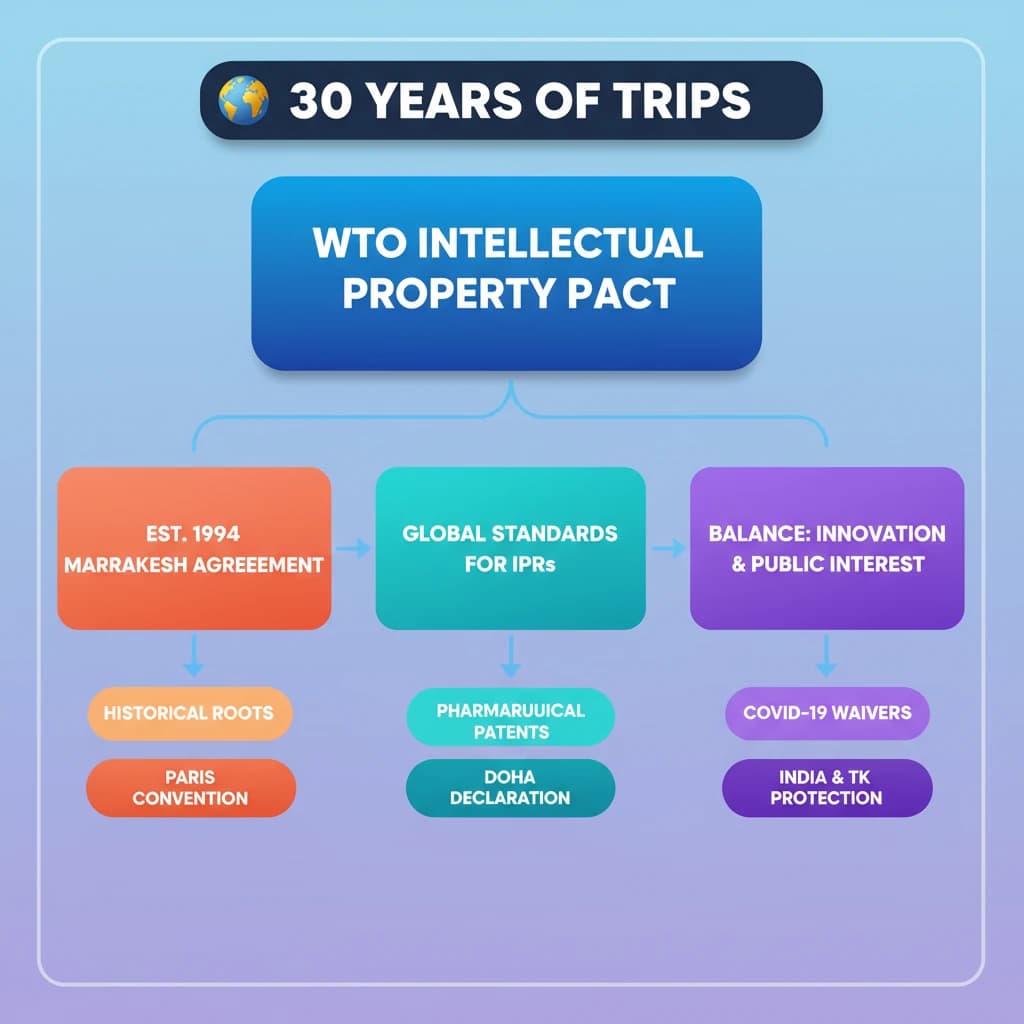
  • The TRIPS Agreement, a core pillar of the WTO, recently marked its 30th anniversary, established via the Marrakesh Agreement in 1994.
  • It is the most comprehensive multilateral agreement on Intellectual Property Rights (IPRs), setting minimum global standards for various IP forms.
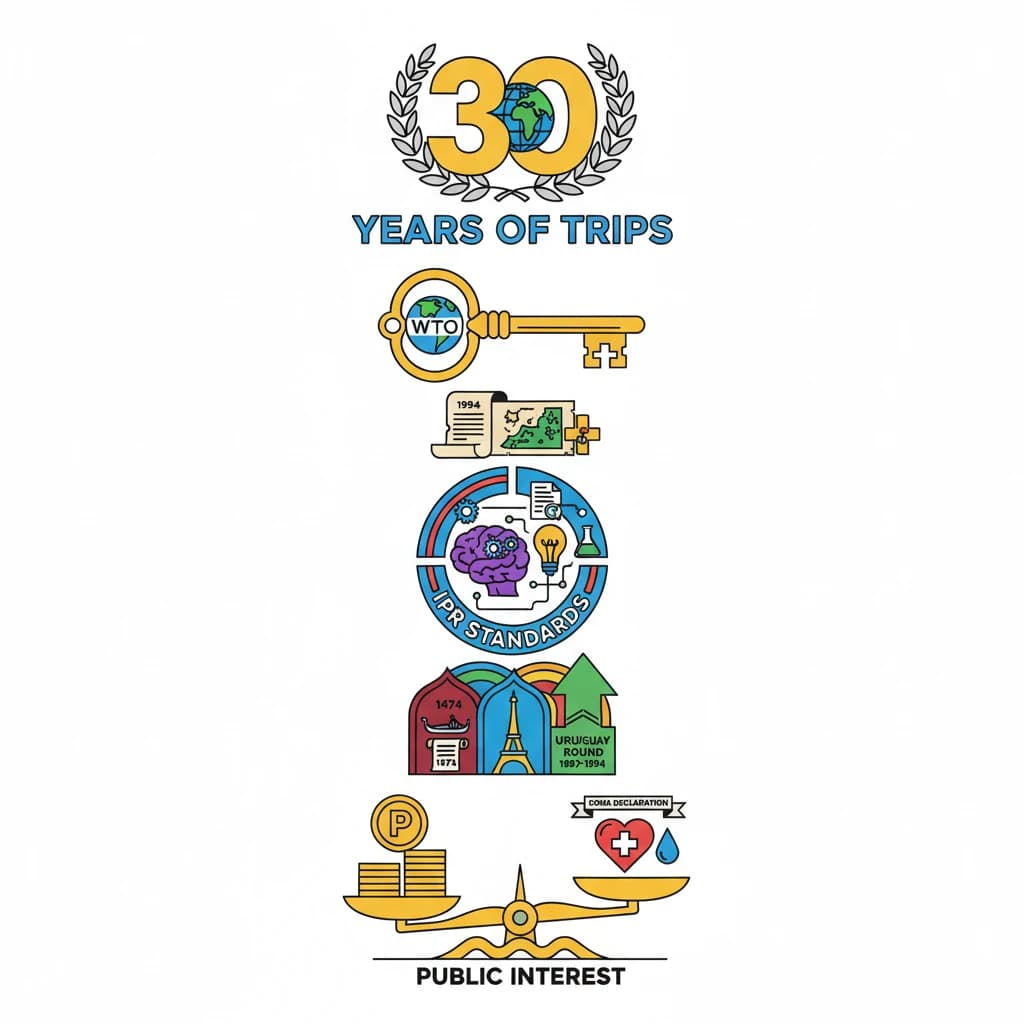
  • Its historical evolution traces back through the Venetian Patent Statute (1474), the Paris Convention (1883), and its integration during the Uruguay Round (1987-1994).
  • TRIPS aims to balance the rights of innovators with the public interest, a tension evident in debates over pharmaceutical patents and the Doha Declaration on Public Health.
  • Contemporary relevance includes discussions on COVID-19 vaccine waivers, technology transfer, and India's advocacy for traditional knowledge protection within the WTO framework.
30 YEARS OF TRIPS

30 YEARS OF TRIPS

Medium⏱️ 8 min read✓ 95% Verified
economy

📖 Introduction

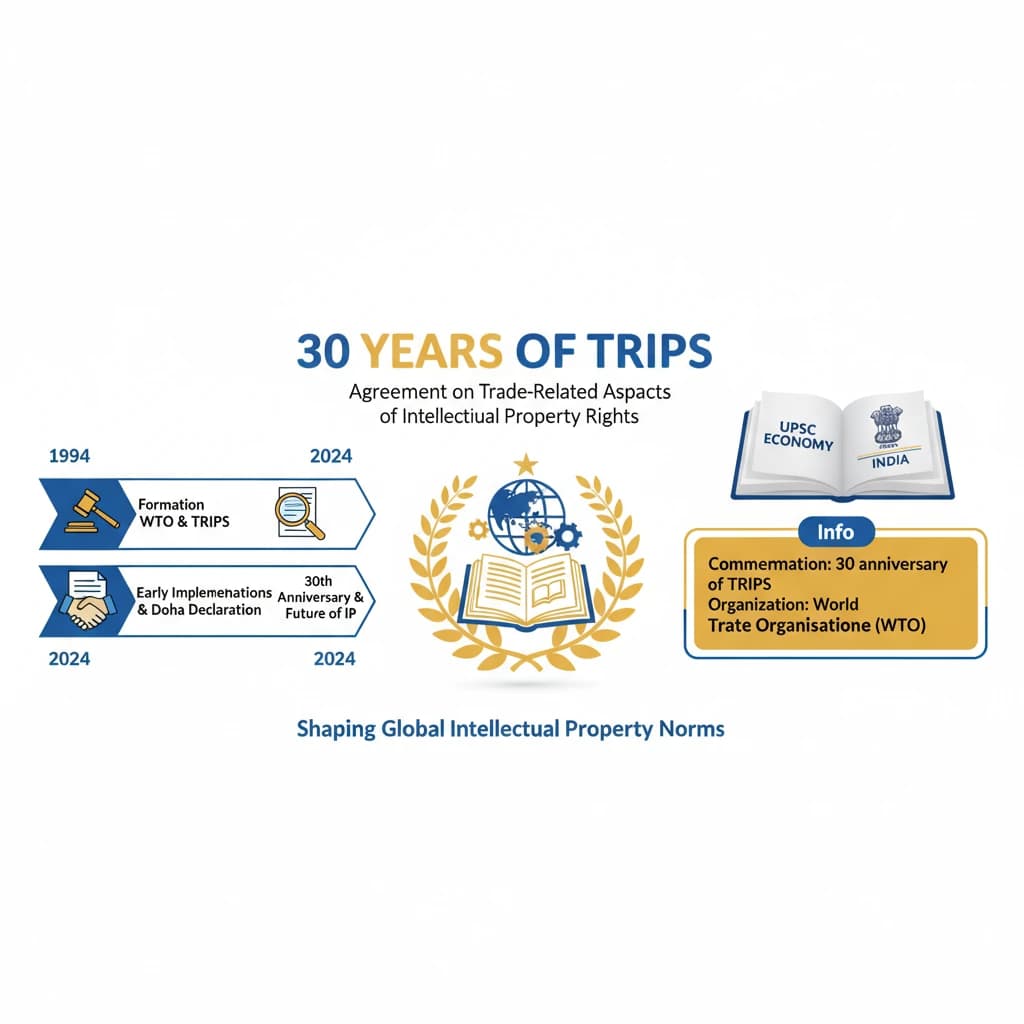
<h4>Introduction to the 30th Anniversary of TRIPS</h4><p>The <strong>World Trade Organisation (WTO)</strong> members recently commemorated the <strong>30th anniversary</strong> of the <strong>Agreement on Trade-Related Aspects of Intellectual Property Rights (TRIPS)</strong>.</p><p>This milestone highlights the enduring impact of a pivotal agreement forged three decades ago, shaping global intellectual property norms.</p><div class='info-box'><p><strong>Commemoration:</strong> 30th anniversary of the <strong>TRIPS Agreement</strong>.</p><p><strong>Organiser:</strong> <strong>World Trade Organisation (WTO)</strong> members.</p></div><h4>The Marrakesh Agreement and WTO Formation</h4><p>An important agreement made in <strong>Marrakesh</strong> helped create the <strong>WTO</strong> in <strong>1995</strong>. This foundational accord, known as the <strong>Marrakesh Agreement</strong>, also established the <strong>TRIPS Agreement</strong> as a core component.</p><p>The integration of intellectual property into the multilateral trading system through this agreement has had a long-lasting effect on global commerce and innovation.</p><h4>Understanding the TRIPS Agreement</h4><p>The <strong>WTO Agreement on TRIPS</strong> is recognised as the most <strong>comprehensive multilateral agreement</strong> on <strong>intellectual property (IP)</strong>. It sets minimum standards for the protection and enforcement of intellectual property rights.</p><div class='key-point-box'><p><strong>Key Concept:</strong> The <strong>TRIPS Agreement</strong> covers various forms of <strong>intellectual property</strong>, including patents, copyrights, trademarks, industrial designs, geographical indications, and trade secrets.</p></div><p>Its primary objective is to reduce distortions and impediments to international trade by ensuring adequate and effective protection of intellectual property rights among member countries.</p><div class='exam-tip-box'><p><strong>UPSC Insight:</strong> Understanding the origins, scope, and implications of <strong>TRIPS</strong> is fundamental for topics related to international trade, global governance, and India's position on intellectual property, frequently appearing in <strong>GS Paper II (International Relations)</strong> and <strong>GS Paper III (Economy)</strong>.</p></div>
Concept Diagram

💡 Key Takeaways

  • •The TRIPS Agreement, a core pillar of the WTO, recently marked its 30th anniversary, established via the Marrakesh Agreement in 1994.
  • •It is the most comprehensive multilateral agreement on Intellectual Property Rights (IPRs), setting minimum global standards for various IP forms.
  • •Its historical evolution traces back through the Venetian Patent Statute (1474), the Paris Convention (1883), and its integration during the Uruguay Round (1987-1994).
  • •TRIPS aims to balance the rights of innovators with the public interest, a tension evident in debates over pharmaceutical patents and the Doha Declaration on Public Health.
  • •Contemporary relevance includes discussions on COVID-19 vaccine waivers, technology transfer, and India's advocacy for traditional knowledge protection within the WTO framework.

🧠 Memory Techniques
Memory Aid
95% Verified Content

📚 Reference Sources

•Drishti IAS - '30 Years of TRIPS' summary
•World Intellectual Property Organization (WIPO) - historical documents and publications on IP law

Related Topics

Loading related topics...
Explore:Economy Topics·All Subjects·Daily Current Affairs·Editorial Analysis·Previous Year Questions·UPSC GPT
Back
All Subjects

Topics

0 topics • 0 completed

Loading topics...
Loading...
Loading...
Loading...
Loading...
Loading...
Overall Progress0%
30 YEARS OF TRIPS - UPSC Economy