Loading page, please wait…
Vaidra Logo
Vaidra

Top 4 items + smart groups

UPSC GPT
New
Current Affairs
Daily Solutions
Daily Puzzle
Mains Evaluator

Version 2.0.0 • Built with ❤️ for UPSC aspirants

Loading...
Loading...
Loading...
Loading...
Loading...
Loading...
Loading...
Loading...
Loading...
Loading...
Loading...
Loading...
Loading...
Back
All Subjects

Topics

0 topics • 0 completed

Loading topics...
Loading...
Loading...
Loading...
Loading...
Loading...
Overall Progress0%

What is Decarbonisation of the Steel Sector? - UPSC Economy

What is What is Decarbonisation of the Steel Sector? in UPSC Economy?

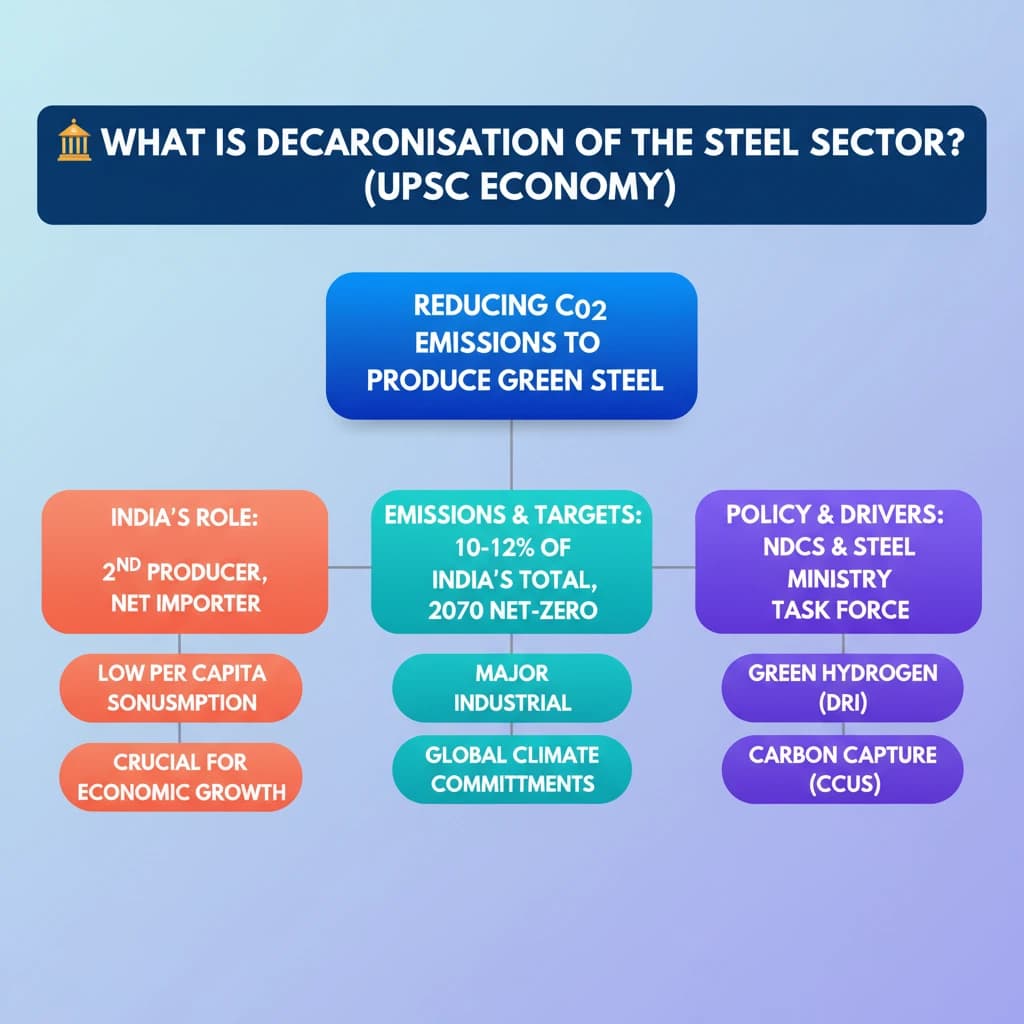
What is Decarbonisation of the Steel Sector? is a key topic under Economy for UPSC Civil Services Examination. Key points include: Decarbonisation of steel aims to reduce CO2 emissions and produce Green Steel.. India is the 2nd largest crude steel producer but a net importer, with low per capita consumption.. Steel sector contributes 10-12% of India's total emissions, making decarbonisation crucial for 2070 net-zero target.. Understanding this topic is essential for both UPSC Prelims and Mains preparation.

Why is What is Decarbonisation of the Steel Sector? important for UPSC exam?

What is Decarbonisation of the Steel Sector? is a Medium-level topic in UPSC Economy. It is tested in both Prelims (factual MCQs) and Mains (analytical answer writing). Previous year UPSC questions have frequently covered aspects of What is Decarbonisation of the Steel Sector?, making it essential for comprehensive IAS preparation.

How to prepare What is Decarbonisation of the Steel Sector? for UPSC?

To prepare What is Decarbonisation of the Steel Sector? for UPSC: (1) Study the comprehensive notes covering all key concepts on Vaidra. (2) Practice previous year questions on this topic. (3) Connect it with current affairs using daily updates. (4) Revise using key takeaways and mind maps available for Economy. (5) Write practice answers linking What is Decarbonisation of the Steel Sector? to related GS Paper topics.

Key takeaways of What is Decarbonisation of the Steel Sector? for UPSC

  • Decarbonisation of steel aims to reduce CO2 emissions and produce Green Steel.
  • India is the 2nd largest crude steel producer but a net importer, with low per capita consumption.
  • Steel sector contributes 10-12% of India's total emissions, making decarbonisation crucial for 2070 net-zero target.
  • India's NDCs and Ministry of Steel task forces are driving this transition.
  • Key technologies include green hydrogen-based DRI and Carbon Capture, Utilisation, and Storage (CCUS).
What is Decarbonisation of the Steel Sector?

What is Decarbonisation of the Steel Sector?

Medium⏱️ 9 min read✓ 95% Verified
economy

📖 Introduction

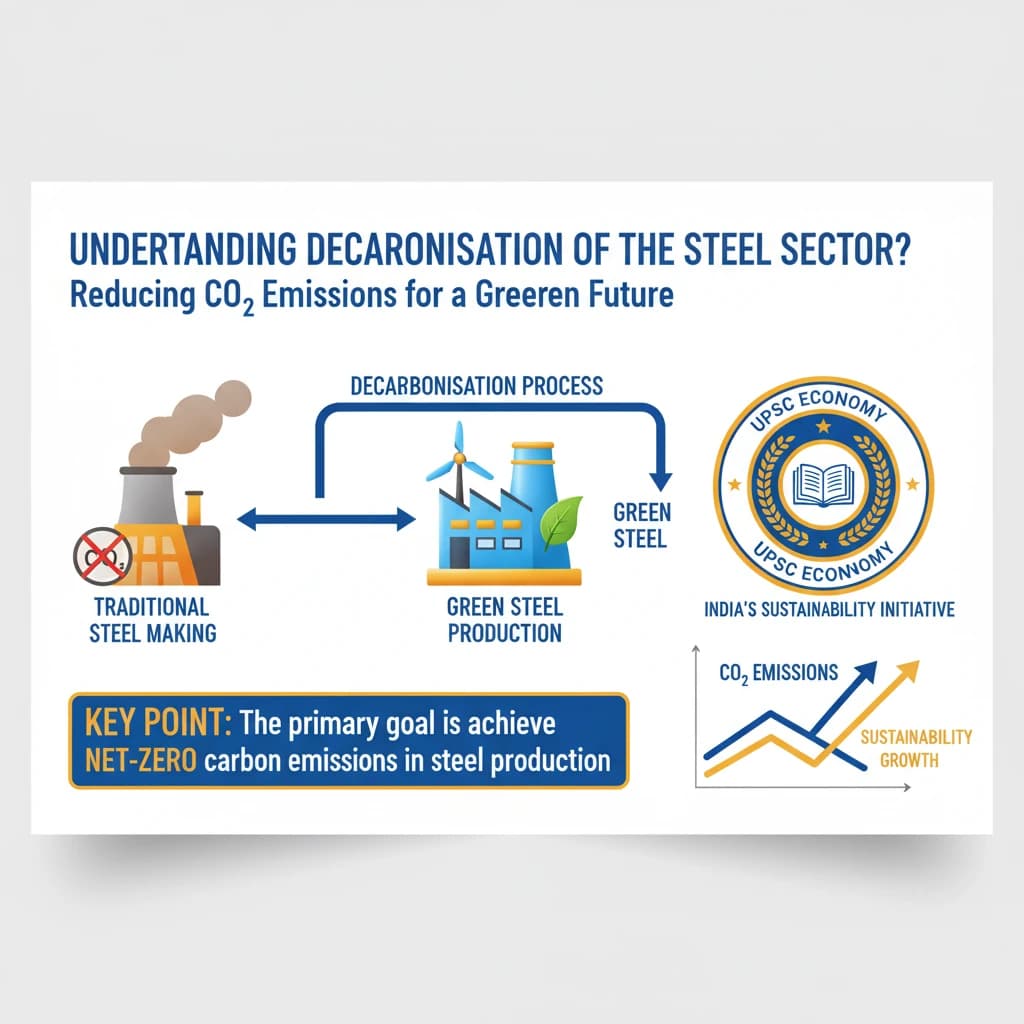
<h4>Understanding Decarbonisation of the Steel Sector</h4><p><strong>Decarbonisation of the Steel Sector</strong> refers to the critical process of reducing <strong>carbon dioxide (CO<sub>2</sub>) emissions</strong> and the overall <strong>carbon footprint</strong> associated with steel production.</p><p>This initiative is fundamental to producing <strong>Green Steel</strong>, which is manufactured with significantly lower or zero carbon emissions.</p><div class='key-point-box'><p>The primary goal is to mitigate <strong>climate change</strong> and ensure <strong>sustainability</strong> within one of the world's most energy-intensive industries.</p></div><h4>India's Steel Industry: A Global Perspective</h4><p><strong>India</strong> holds the position of the <strong>second-largest crude steel producer globally</strong>.</p><div class='info-box'><p>As of <strong>FY 2023-24</strong>, India's crude steel capacity reached <strong>179.5 million tonnes</strong>. It is also the <strong>largest producer of sponge iron</strong>, with a capacity of <strong>55 million tonnes</strong>.</p></div><p>Despite its significant production, India's <strong>per capita steel consumption</strong> is relatively low at <strong>97.7 kg (FY 2024)</strong>, compared to the global average of <strong>221.8 kg (2022)</strong>.</p><p>The <strong>National Steel Policy 2017</strong> aims to boost this consumption to <strong>160 kg by 2030</strong>, anticipating substantial growth.</p><p>Currently, India remains a <strong>net importer of steel</strong>. There was a <strong>25% increase in imports</strong> and a <strong>7% decrease in exports</strong> during the <strong>April to August (FY25)</strong> period.</p><h4>India's Commitment to Climate Action</h4><p>India is deeply committed to a <strong>low-carbon development pathway</strong>, despite its relatively small historical contribution to global <strong>Greenhouse Gas (GHG) accumulation</strong> (only <strong>4%</strong>).</p><p>This commitment is significant, especially considering India houses <strong>17% of the global population</strong>.</p><div class='info-box'><p>India's <strong>Revised Nationally Determined Contributions (NDCs)</strong> prominently feature a focus on expanding <strong>renewable energy</strong> and actively <strong>greening industrial sectors</strong>.</p></div><p>To achieve its ambitious <strong>net-zero target by 2070</strong>, the entire industrial sector, including the critical <strong>steel industry</strong>, must undergo comprehensive decarbonisation.</p><h4>Why Decarbonising Steel is Crucial for India</h4><p>The <strong>steel industry</strong> is a major contributor to India's overall emissions, accounting for approximately <strong>10-12% of the country's total emissions</strong>.</p><div class='key-point-box'><p>Therefore, its decarbonisation is not just an industrial upgrade but a fundamental requirement for India to successfully meet its national and international <strong>climate goals</strong>.</p></div><p>Recognizing this urgency, the <strong>Ministry of Steel</strong> has established <strong>14 dedicated task forces</strong>.</p><p>These task forces are focused on:</p><ul><li><strong>Incentivizing green steel production</strong>.</li><li>Enabling various <strong>decarbonisation levers</strong> (e.g., technology, policy).</li><li>Providing robust support for the sector's <strong>transition</strong> towards cleaner production methods.</li></ul>
Concept Diagram

💡 Key Takeaways

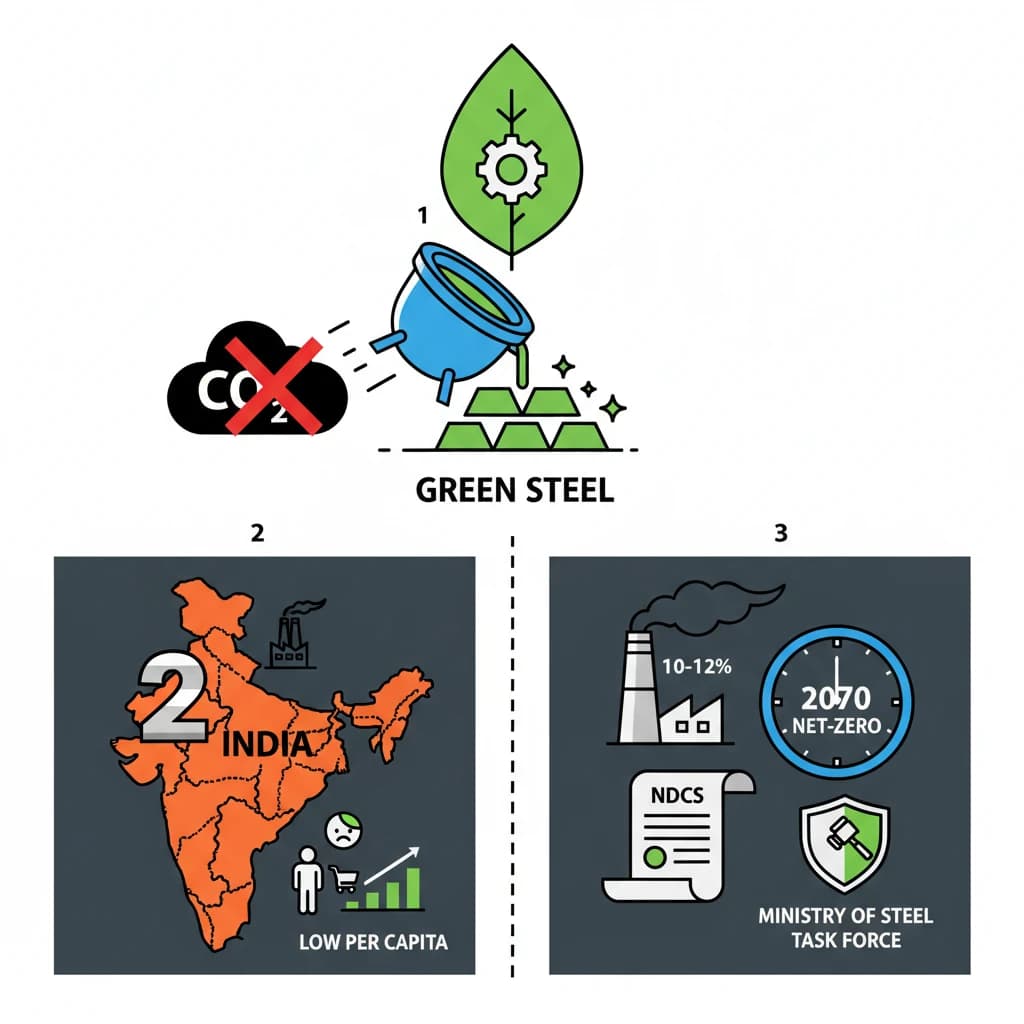
  • •Decarbonisation of steel aims to reduce CO2 emissions and produce Green Steel.
  • •India is the 2nd largest crude steel producer but a net importer, with low per capita consumption.
  • •Steel sector contributes 10-12% of India's total emissions, making decarbonisation crucial for 2070 net-zero target.
  • •India's NDCs and Ministry of Steel task forces are driving this transition.
  • •Key technologies include green hydrogen-based DRI and Carbon Capture, Utilisation, and Storage (CCUS).

🧠 Memory Techniques
Memory Aid
95% Verified Content

Related Topics

Loading related topics...
Explore:Economy Topics·All Subjects·Daily Current Affairs·Editorial Analysis·Previous Year Questions·UPSC GPT
What is Decarbonisation of the Steel Sector? - UPSC Economy