Loading page, please wait…
Vaidra Logo
Vaidra

Top 4 items + smart groups

UPSC GPT
New
Current Affairs
Daily Solutions
Daily Puzzle
Mains Evaluator

Version 2.0.0 • Built with ❤️ for UPSC aspirants

Loading...
Loading...
Loading...
Loading...
Loading...
Loading...
Loading...
Loading...
Loading...
Loading...
Loading...
Loading...
Loading...
Back
All Subjects

Topics

0 topics • 0 completed

Loading topics...
Loading...
Loading...
Loading...
Loading...
Loading...
Overall Progress0%

What is the Current Status of the National Monetisation Pipeline? - UPSC Economy

What is What is the Current Status of the National Monetisation Pipeline? in UPSC Economy?

What is the Current Status of the National Monetisation Pipeline? is a key topic under Economy for UPSC Civil Services Examination. Key points include: NMP generated Rs 3.9 trillion in 3 years (up to FY24), meeting most adjusted targets.. Coal Ministry significantly exceeded NMP targets, raising Rs 1.54 trillion against Rs 80,000 crore target.. Railways (30%), Warehousing (38%), and Civil Aviation (14%) are lagging sectors in NMP asset monetisation.. Understanding this topic is essential for both UPSC Prelims and Mains preparation.

Why is What is the Current Status of the National Monetisation Pipeline? important for UPSC exam?

What is the Current Status of the National Monetisation Pipeline? is a Medium-level topic in UPSC Economy. It is tested in both Prelims (factual MCQs) and Mains (analytical answer writing). Previous year UPSC questions have frequently covered aspects of What is the Current Status of the National Monetisation Pipeline?, making it essential for comprehensive IAS preparation.

How to prepare What is the Current Status of the National Monetisation Pipeline? for UPSC?

To prepare What is the Current Status of the National Monetisation Pipeline? for UPSC: (1) Study the comprehensive notes covering all key concepts on Vaidra. (2) Practice previous year questions on this topic. (3) Connect it with current affairs using daily updates. (4) Revise using key takeaways and mind maps available for Economy. (5) Write practice answers linking What is the Current Status of the National Monetisation Pipeline? to related GS Paper topics.

Key takeaways of What is the Current Status of the National Monetisation Pipeline? for UPSC

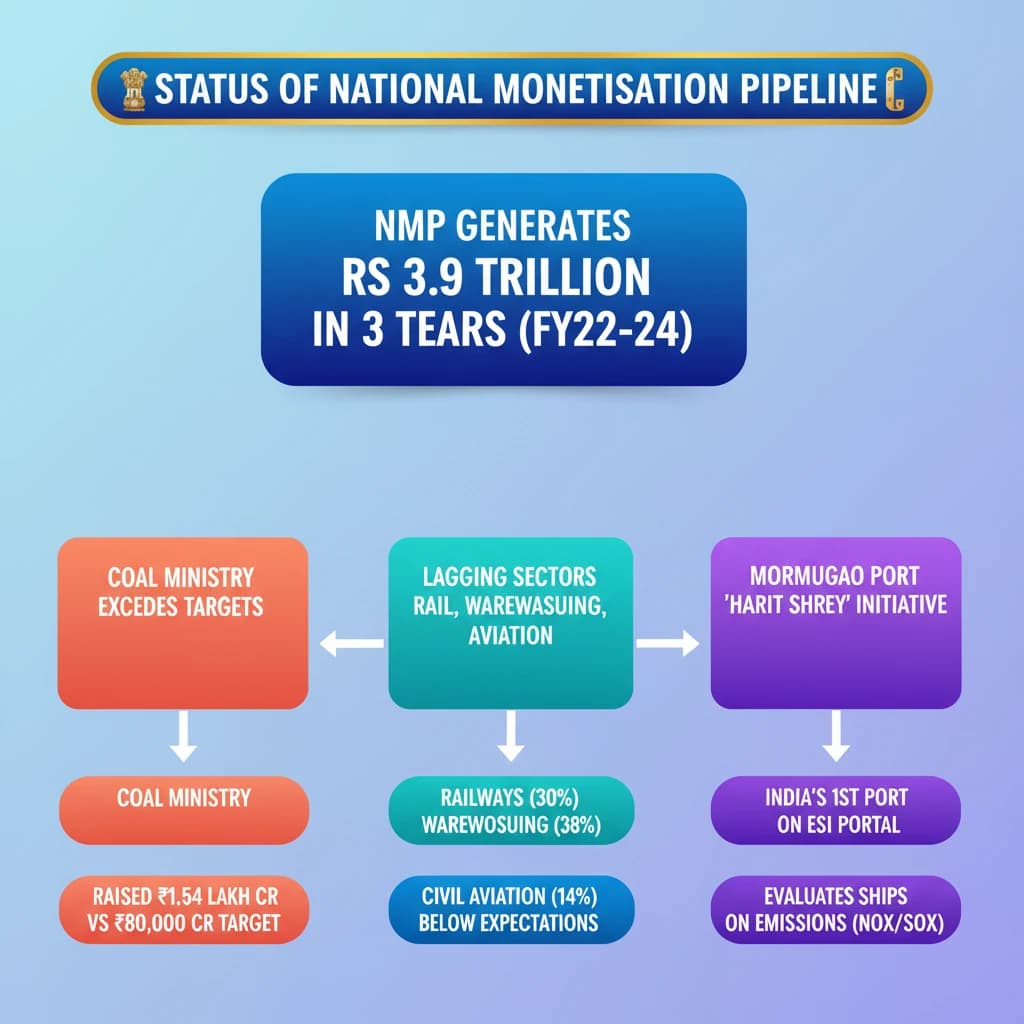
  • NMP generated Rs 3.9 trillion in 3 years (up to FY24), meeting most adjusted targets.
  • Coal Ministry significantly exceeded NMP targets, raising Rs 1.54 trillion against Rs 80,000 crore target.
  • Railways (30%), Warehousing (38%), and Civil Aviation (14%) are lagging sectors in NMP asset monetisation.
  • Mormugao Port Authority (Goa) is India's first port listed on the Environmental Ship Index (ESI) portal for its Harit Shrey programme.
  • ESI evaluates ships on NOx/SOx emissions and GHG reporting, administered by IAPH, promoting voluntary green shipping.
  • Mormugao Port, a Major Port since 1964, is now focused on green transition with initiatives like Harit Shrey.
What is the Current Status
of the National Monetisation Pipeline?

What is the Current Status of the National Monetisation Pipeline?

Medium⏱️ 8 min read✓ 95% Verified
economy

📖 Introduction

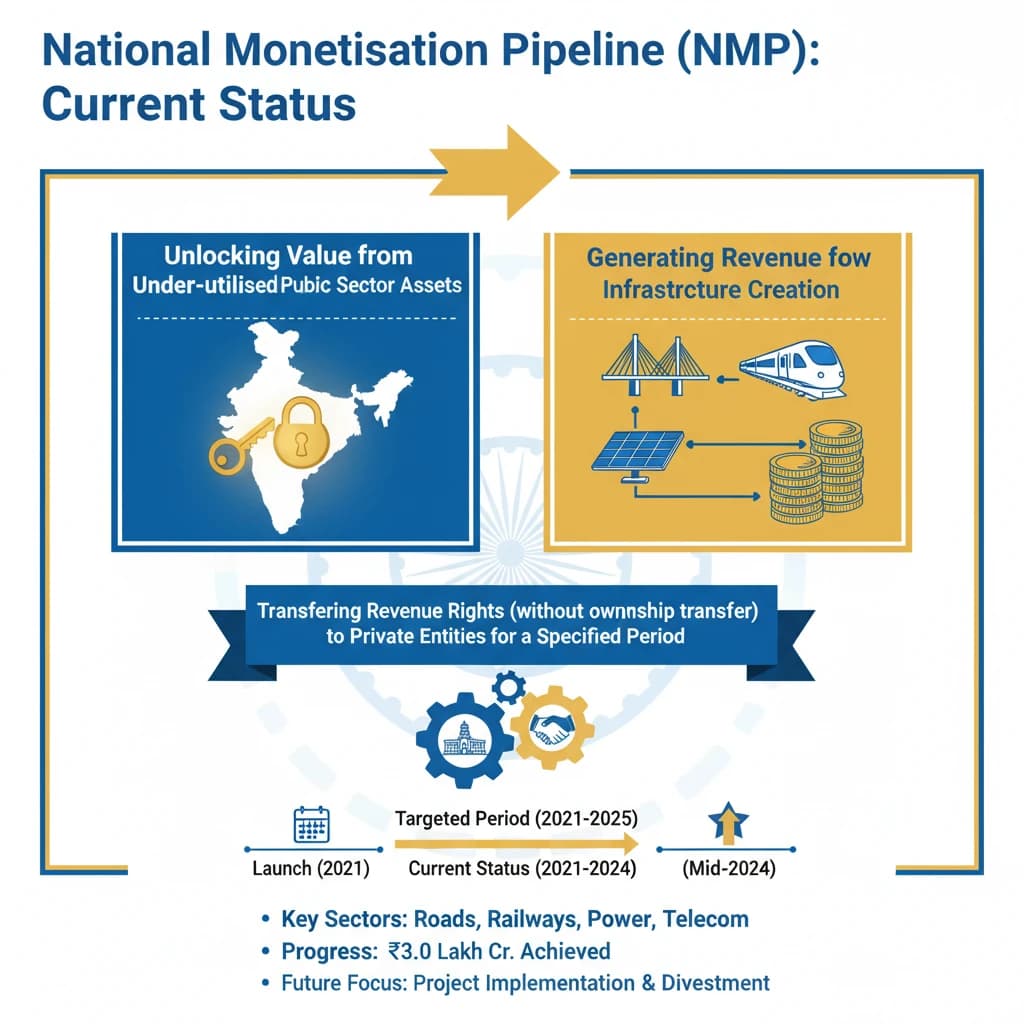
<h4>National Monetisation Pipeline (NMP): Current Status</h4><p>The <strong>National Monetisation Pipeline (NMP)</strong> is a strategic initiative by the Government of India aimed at unlocking value from under-utilised public sector assets. Its primary goal is to generate revenue for creating new infrastructure across various sectors.</p><p>This approach involves transferring revenue rights of government-owned assets to private entities for a specified period, critically without transferring the underlying ownership of these assets.</p><div class='info-box'><p><strong>Revenue Generation:</strong></p><ul><li>Generated <strong>Rs 3.9 trillion</strong> in the first three years (up to <strong>FY24</strong>).</li><li>Achieved most of its adjusted targets, against an original target of <strong>Rs 4.3 trillion</strong> for this period.</li></ul></div><h4>Successful Monetisation Sectors</h4><p>Several sectors have demonstrated exceptional performance under the <strong>NMP</strong>, significantly exceeding their initial monetisation targets. This success underscores the potential for effective value creation from public assets.</p><div class='info-box'><p><strong>Ministry of Coal:</strong></p><ul><li>Raised an impressive <strong>Rs 1.54 trillion</strong>, far exceeding its four-year target of <strong>Rs 80,000 crore</strong>.</li><li>Additionally, mines have been monetised to the tune of <strong>Rs 42,000 crore</strong>, surpassing the revised target of <strong>Rs 7,500 crore</strong>.</li></ul></div><h4>Lagging Sectors in NMP</h4><p>Despite overall progress in the <strong>NMP</strong>, some key sectors have fallen short of their monetisation goals. These areas require focused attention and strategic interventions to improve performance.</p><ul><li><strong>Railways:</strong> Monetised assets worth only <strong>Rs 20,417 crore</strong> over the past three years, meeting just <strong>30%</strong> of its revised target.</li><li><strong>Warehousing:</strong> Achieved <strong>38%</strong> of its target, amounting to <strong>Rs 8,000 crore</strong>.</li><li><strong>Civil Aviation:</strong> Lagged significantly, having monetised only <strong>14%</strong> of its targeted <strong>Rs 2,600 crore</strong> asset base.</li></ul><div class='exam-tip-box'><p><strong>UPSC Insight:</strong> Understanding both successful and lagging sectors provides a balanced perspective for Mains answers on economic reforms and infrastructure development. Citing specific figures enhances the credibility of your arguments.</p></div><h4>Mormugao Port and Environmental Ship Index (ESI)</h4><p>The <strong>Mormugao Port Authority (MPA)</strong> in <strong>Goa</strong> has achieved a significant environmental milestone. It became the first Indian port to be listed on the <strong>Environmental Ship Index (ESI)</strong> portal.</p><p>This notable recognition is specifically for <strong>MPA’s Harit Shrey programme</strong> and has been acknowledged by the <strong>International Association of Ports and Harbours (IAPH)</strong>.</p><div class='info-box'><p><strong>Related Development:</strong> The government also plans to limit the development of <strong>inland waterway terminals (IWTs)</strong> near major ports. This measure aims to safeguard the economic interests of these established ports.</p></div><h4>What is the Environmental Ship Index (ESI)?</h4><p>The <strong>Environmental Ship Index (ESI)</strong> is a crucial system designed to evaluate and reward ships based on their environmental performance. It particularly focuses on their efforts in reducing air emissions.</p><div class='key-point-box'><p><strong>Core Function:</strong> <strong>ESI</strong> quantifies seagoing ships that demonstrate superior performance in reducing <strong>air emissions</strong> compared to the current emission standards set by the <strong>International Maritime Organization (IMO)</strong>.</p></div><p>The <strong>2023 IMO greenhouse gas (GHG) Strategy</strong> sets an ambitious target: a reduction in the <strong>carbon intensity</strong> of international shipping by at least <strong>40% by 2030</strong>.</p><div class='info-box'><p><strong>Origin and Administration:</strong></p><ul><li>The <strong>ESI Initiative</strong> commenced on <strong>1st January 2011</strong>.</li><li>Its database is administered under the authority of the <strong>International Association of Ports and Harbours (IAPH)</strong>.</li></ul></div><h4>ESI Evaluation Criteria and Characteristics</h4><p>The <strong>ESI</strong> employs specific criteria to assess environmental performance and includes broader reporting mechanisms for vessel emissions.</p><ul><li><strong>Evaluation Criteria:</strong> It primarily assesses the emissions of <strong>nitrogen oxides (NOx)</strong> and <strong>sulphur oxides (SOx)</strong> released by ships.</li><li><strong>Additional Reporting:</strong> The index also includes a reporting scheme for <strong>greenhouse gas emissions</strong> from vessels.</li></ul><div class='key-point-box'><p><strong>Main Characteristics of ESI:</strong></p><ul><li><strong>Port-Centric System:</strong> Designed specifically as a system from ports to ports, facilitating direct engagement.</li><li><strong>Voluntary Participation:</strong> Allows shipowners to voluntarily demonstrate the environmental performance of their vessels.</li><li><strong>Applicability:</strong> Can be applied universally to all types of seagoing ships, regardless of their size or specific function.</li><li><strong>Automated Calculation:</strong> The index scores are automatically calculated and continuously maintained.</li><li><strong>Incentives:</strong> Ports and authorities often offer incentives, such as reduced port fees or priority berthing, to ships with higher <strong>ESI scores</strong>.</li></ul></div>
Concept Diagram

💡 Key Takeaways

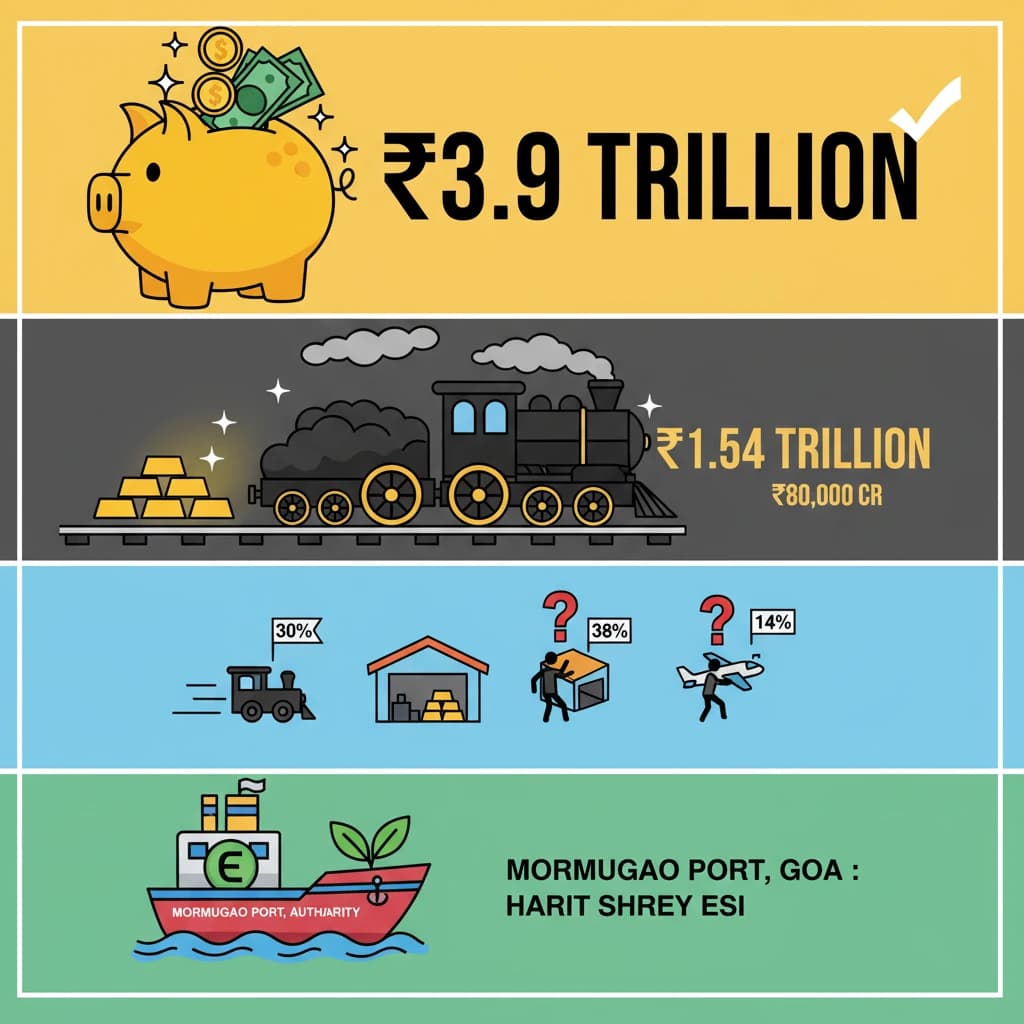
  • •NMP generated Rs 3.9 trillion in 3 years (up to FY24), meeting most adjusted targets.
  • •Coal Ministry significantly exceeded NMP targets, raising Rs 1.54 trillion against Rs 80,000 crore target.
  • •Railways (30%), Warehousing (38%), and Civil Aviation (14%) are lagging sectors in NMP asset monetisation.
  • •Mormugao Port Authority (Goa) is India's first port listed on the Environmental Ship Index (ESI) portal for its Harit Shrey programme.
  • •ESI evaluates ships on NOx/SOx emissions and GHG reporting, administered by IAPH, promoting voluntary green shipping.
  • •Mormugao Port, a Major Port since 1964, is now focused on green transition with initiatives like Harit Shrey.

🧠 Memory Techniques
Memory Aid
95% Verified Content

Related Topics

Loading related topics...
Explore:Economy Topics·All Subjects·Daily Current Affairs·Editorial Analysis·Previous Year Questions·UPSC GPT
What is the Current Status of the National Monetisation Pipeline? - UPSC Economy