Loading page, please wait…
Vaidra Logo
Vaidra

Top 4 items + smart groups

UPSC GPT
New
Current Affairs
Daily Solutions
Daily Puzzle
Mains Evaluator

Version 2.0.0 • Built with ❤️ for UPSC aspirants

Loading...
Loading...
Loading...
Loading...
Loading...
Loading...
Loading...
Loading...
Loading...
Loading...
Loading...
Loading...
Loading...
Back
All Subjects

Topics

0 topics • 0 completed

Loading topics...
Loading...
Loading...
Loading...
Loading...
Loading...
Overall Progress0%
India’s Transition Towards Workforce Formalization - UPSC Economy

India’s Transition Towards Workforce Formalization - UPSC Economy

What is India’s Transition Towards Workforce Formalization in UPSC Economy?

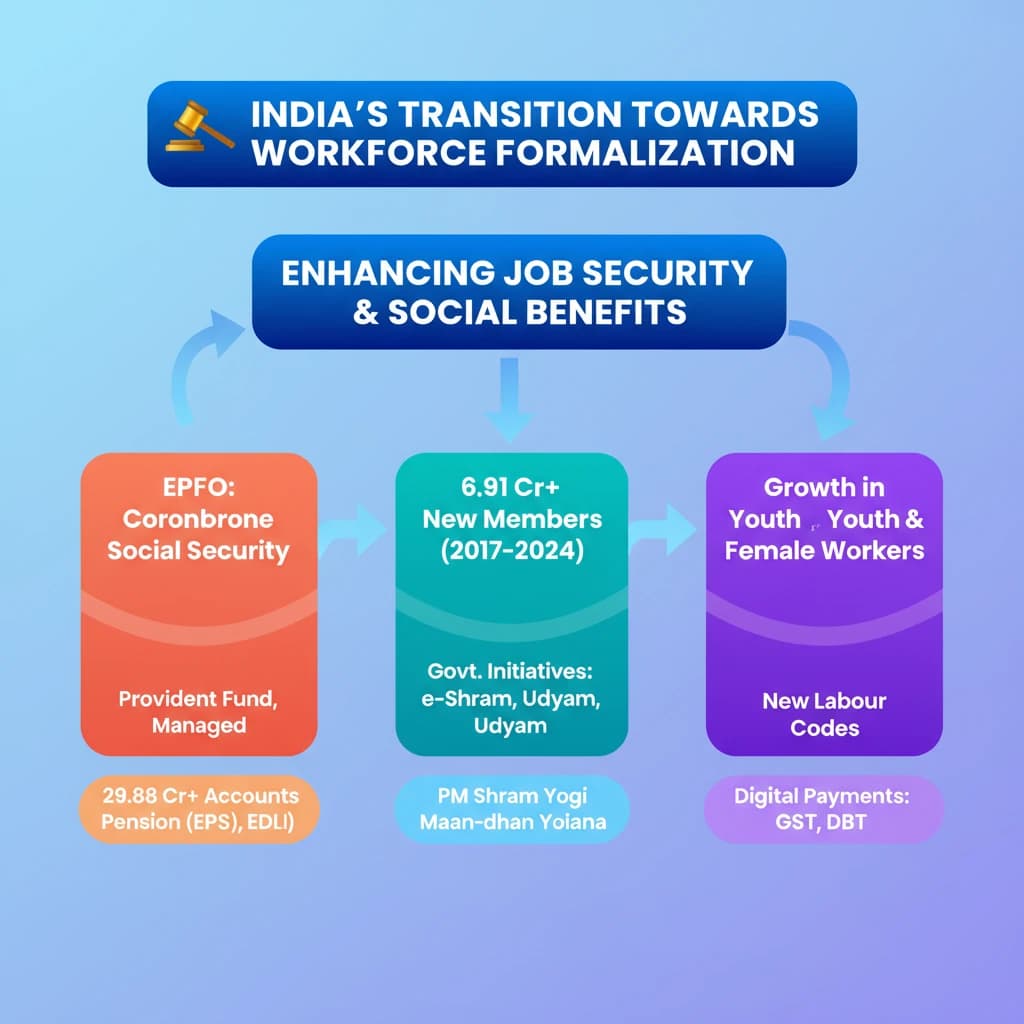
India’s Transition Towards Workforce Formalization is a key topic under Economy for UPSC Civil Services Examination. Key points include: India is experiencing a significant transition towards workforce formalization, enhancing job security and social benefits.. EPFO is a crucial institution, managing over 29.88 crore accounts and providing retirement funds, pensions (EPS), and insurance (EDLI).. EPFO has seen substantial growth, with over 6.91 crore new members (2017-2024), including a notable increase in youth and female workers.. Understanding this topic is essential for both UPSC Prelims and Mains preparation.

Why is India’s Transition Towards Workforce Formalization important for UPSC exam?

India’s Transition Towards Workforce Formalization is a Medium-level topic in UPSC Economy. It is tested in both Prelims (factual MCQs) and Mains (analytical answer writing). Previous year UPSC questions have frequently covered aspects of India’s Transition Towards Workforce Formalization, making it essential for comprehensive IAS preparation.

How to prepare India’s Transition Towards Workforce Formalization for UPSC?

To prepare India’s Transition Towards Workforce Formalization for UPSC: (1) Study the comprehensive notes covering all key concepts on Vaidra. (2) Practice previous year questions on this topic. (3) Connect it with current affairs using daily updates. (4) Revise using key takeaways and mind maps available for Economy. (5) Write practice answers linking India’s Transition Towards Workforce Formalization to related GS Paper topics.

Key takeaways of India’s Transition Towards Workforce Formalization for UPSC

  • India is experiencing a significant transition towards workforce formalization, enhancing job security and social benefits.
  • EPFO is a crucial institution, managing over 29.88 crore accounts and providing retirement funds, pensions (EPS), and insurance (EDLI).
  • EPFO has seen substantial growth, with over 6.91 crore new members (2017-2024), including a notable increase in youth and female workers.
  • Government initiatives like e-Shram, Udyam Portal, PM Shram Yogi Maan-dhan Yojana, and new Labour Codes are driving formalization.
  • Digital payment systems like GST and DBT also contribute by promoting transparency in economic transactions.
  • Challenges like gender inequality in formal employment persist due to socio-cultural constraints and lack of support services.
India’s Transition Towards Workforce Formalization

India’s Transition Towards Workforce Formalization

Medium⏱️ 7 min read✓ 98% Verified
economy

📖 Introduction

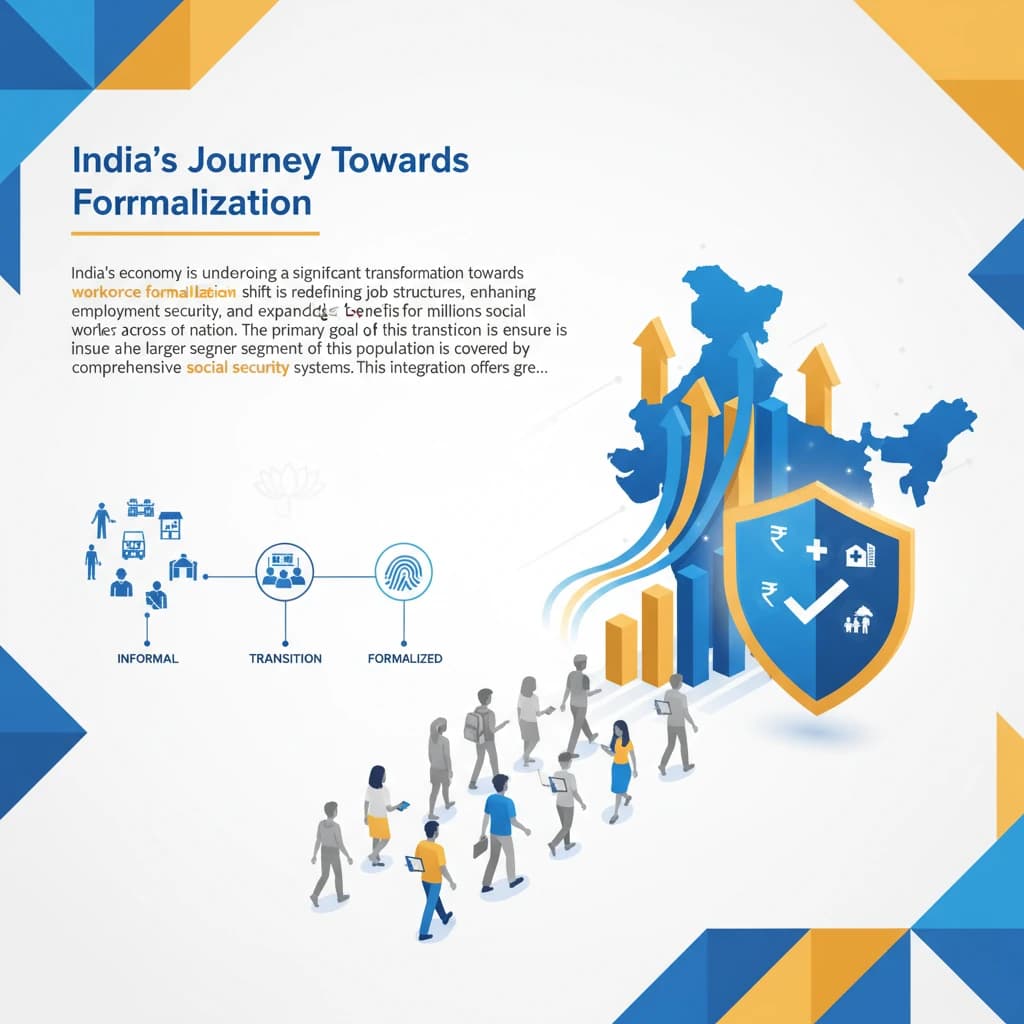
<h4>India's Journey Towards Workforce Formalization</h4><p>India's economy is undergoing a significant transformation towards <strong>workforce formalization</strong>. This shift is redefining job structures, enhancing employment security, and expanding social benefits for millions of workers across the nation.</p><p>The primary goal of this transition is to ensure a larger segment of the population is covered by comprehensive <strong>social security systems</strong>. This integration offers greater economic stability and a more secure future for individuals and their families.</p><div class='key-point-box'><p>This formalization drive, significantly supported by the <strong>Employee’s Provident Fund Organisation (EPFO)</strong>, plays a crucial role in boosting economic stability by bringing more workers under its protective social security umbrella.</p></div><h4>Understanding EPFO and its Role</h4><p>The <strong>Employee’s Provident Fund Organisation (EPFO)</strong> stands as one of the world’s largest social security organizations. It is dedicated to providing a wide array of social security benefits to millions of workers throughout India.</p><div class='info-box'><p><strong>Establishment:</strong> EPFO was established under the <strong>Employees’ Provident Funds & Miscellaneous Provisions Act of 1952</strong>.</p><p><strong>Reach:</strong> As per EPFO’s Annual Report 2022-23, it manages over <strong>29.88 crore accounts</strong>, highlighting its extensive reach and the vast scale of financial transactions it oversees.</p><p><strong>Administrative Control:</strong> The EPFO operates under the administrative control of the <strong>Ministry of Labour & Employment, Government of India</strong>.</p></div><h4>Key Benefits Provided by EPFO</h4><p>EPFO ensures long-term financial security for its members through several crucial schemes and provisions:</p><ul><li><strong>Retirement Funds:</strong> Provides a robust system for retirement savings.</li><li><strong>Insurance:</strong> Offers insurance coverage under the <strong>Employees’ Deposit Linked Insurance (EDLI) Scheme, 1976</strong>.</li><li><strong>Monthly Pensions:</strong> Facilitates monthly pension payouts via the <strong>Employees’ Pension Scheme (EPS), 1995</strong>.</li><li><strong>Partial Withdrawals:</strong> Allows partial withdrawals under the <strong>Employees’ Provident Fund (EPF) Scheme, 1952</strong>, for emergencies, education, or home purchases, making it a versatile financial tool.</li></ul><h4>EPFO's Contribution to Increased Formalization</h4><p>EPFO data clearly illustrates a significant surge in workforce formalization:</p><ul><li><strong>Membership Growth:</strong> From <strong>2017 to 2024</strong>, over <strong>6.91 crore members</strong> joined EPFO.</li><li><strong>Record New Registrations:</strong> The fiscal year <strong>2022-23</strong> witnessed a record <strong>1.38 crore new members</strong> registering.</li><li><strong>Steady Monthly Additions:</strong> In <strong>July 2024</strong> alone, nearly <strong>20 lakh new members</strong> were added, indicating a consistent increase in monthly registrations.</li><li><strong>Fund Transfers:</strong> Many members consistently transfer their funds when changing jobs, ensuring uninterrupted access to their social security benefits.</li><li><strong>Youth and First-time Job Seekers:</strong> A substantial portion of new EPFO members are <strong>youth</strong>, with many being <strong>first-time job seekers</strong>, signifying a growing formal entry into the workforce.</li><li><strong>Inclusive Workforce:</strong> An increasing number of <strong>female workers</strong> are registering with EPFO, reflecting a positive trend towards a more inclusive and formalized workforce.</li></ul><div class='key-point-box'><p>These recent EPFO registration figures underscore the expansion of <strong>formal jobs</strong> in India, providing more employees with essential benefits such as <strong>job security, retirement savings, and insurance</strong>.</p></div><h4>Addressing Gender Inequality in Formal Employment</h4><p>Despite progress, <strong>women</strong> continue to face disproportionate barriers to securing formal employment. These challenges are multifaceted and include:</p><ul><li><strong>Socio-cultural Constraints:</strong> Traditional societal norms and expectations.</li><li><strong>Lack of Childcare Services:</strong> Insufficient support systems for working mothers.</li><li><strong>Gender Bias:</strong> Prejudices and discrimination prevalent in the workplace.</li></ul><h4>India’s Initiatives for Workforce Formalization</h4><p>The Government of India has launched several key initiatives to accelerate the formalization of its workforce:</p><ul><li><strong>e-Shram Portal:</strong> A national database for unorganized workers to avail social security benefits.</li><li><strong>Udyam Portal:</strong> Simplifies registration for Micro, Small, and Medium Enterprises (MSMEs), encouraging formal business operations.</li><li><strong>Pradhan Mantri Shram Yogi Maan-dhan Yojana:</strong> A pension scheme for unorganized workers.</li></ul><h4>Labour Reforms for Formalization</h4><p>The government has undertaken significant <strong>labour reforms</strong> to modernize archaic laws and promote formal employment:</p><ul><li><strong>Social Security Code, 2020:</strong> Consolidates laws relating to social security.</li><li><strong>Industrial Relations Code, 2020:</strong> Simplifies regulations concerning trade unions, industrial disputes, and standing orders.</li><li><strong>Occupational Safety, Health and Working Conditions Code, 2020:</strong> Focuses on safety, health, and working conditions of workers.</li></ul><div class='key-point-box'><p>These <strong>labour codes</strong> aim to simplify existing labour laws, enhance working conditions, and streamline the process for businesses to hire formally, thereby reducing informality.</p></div><h4>Government Digital Payment Systems</h4><p>Government initiatives like <strong>Goods and Services Tax (GST)</strong> and <strong>Direct Benefit Transfer (DBT)</strong> are instrumental in reducing informality. They encourage businesses to operate with greater transparency and contribute effectively to the tax system, fostering a more formalized economy.</p>
Concept Diagram

💡 Key Takeaways

  • •India is experiencing a significant transition towards workforce formalization, enhancing job security and social benefits.
  • •EPFO is a crucial institution, managing over 29.88 crore accounts and providing retirement funds, pensions (EPS), and insurance (EDLI).
  • •EPFO has seen substantial growth, with over 6.91 crore new members (2017-2024), including a notable increase in youth and female workers.
  • •Government initiatives like e-Shram, Udyam Portal, PM Shram Yogi Maan-dhan Yojana, and new Labour Codes are driving formalization.
  • •Digital payment systems like GST and DBT also contribute by promoting transparency in economic transactions.
  • •Challenges like gender inequality in formal employment persist due to socio-cultural constraints and lack of support services.

🧠 Memory Techniques

Memory Aid
98% Verified Content

📚 Reference Sources

•EPFO’s Annual Report 2022-23 (as cited in source)

Related Topics

Loading related topics...
Explore:Economy Topics·All Subjects·Daily Current Affairs·Editorial Analysis·Previous Year Questions·UPSC GPT