Loading page, please wait…
Vaidra Logo
Vaidra

Top 4 items + smart groups

UPSC GPT
New
Current Affairs
Daily Solutions
Daily Puzzle
Mains Evaluator

Version 2.0.0 • Built with ❤️ for UPSC aspirants

Loading...
Loading...
Loading...
Loading...
Loading...
Loading...
Loading...
Loading...
Loading...
Loading...
Loading...
Loading...
Loading...
Back
All Subjects

Topics

0 topics • 0 completed

Loading topics...
Loading...
Loading...
Loading...
Loading...
Loading...
Overall Progress0%

Jan Poshan Kendras - UPSC Economy

What is Jan Poshan Kendras in UPSC Economy?

Jan Poshan Kendras is a key topic under Economy for UPSC Civil Services Examination. Key points include: Jan Poshan Kendras are renovated Fair Price Shops (FPS) launched as a pilot project in 4 states.. Dual aim: enhance nutritional offerings under PMGKAY and improve income for ration dealers.. They sell diverse nutrition-rich items like pulses and dairy, beyond subsidised grains.. Understanding this topic is essential for both UPSC Prelims and Mains preparation.

Why is Jan Poshan Kendras important for UPSC exam?

Jan Poshan Kendras is a Medium-level topic in UPSC Economy. It is tested in both Prelims (factual MCQs) and Mains (analytical answer writing). Previous year UPSC questions have frequently covered aspects of Jan Poshan Kendras, making it essential for comprehensive IAS preparation.

How to prepare Jan Poshan Kendras for UPSC?

To prepare Jan Poshan Kendras for UPSC: (1) Study the comprehensive notes covering all key concepts on Vaidra. (2) Practice previous year questions on this topic. (3) Connect it with current affairs using daily updates. (4) Revise using key takeaways and mind maps available for Economy. (5) Write practice answers linking Jan Poshan Kendras to related GS Paper topics.

Key takeaways of Jan Poshan Kendras for UPSC

  • Jan Poshan Kendras are renovated Fair Price Shops (FPS) launched as a pilot project in 4 states.
  • Dual aim: enhance nutritional offerings under PMGKAY and improve income for ration dealers.
  • They sell diverse nutrition-rich items like pulses and dairy, beyond subsidised grains.
  • Key features include 50% space for nutritional products, SIDBI loans, and partnerships with AMUL, Udaan, JumboTail.
  • Government plans to convert 100,000 FPS into 'nutri-hubs' in the next three years.
  • Integrates digital tools for transparency and operational efficiency in PDS.
Jan Poshan Kendras

Jan Poshan Kendras

Medium⏱️ 8 min read✓ 95% Verified
economy

📖 Introduction

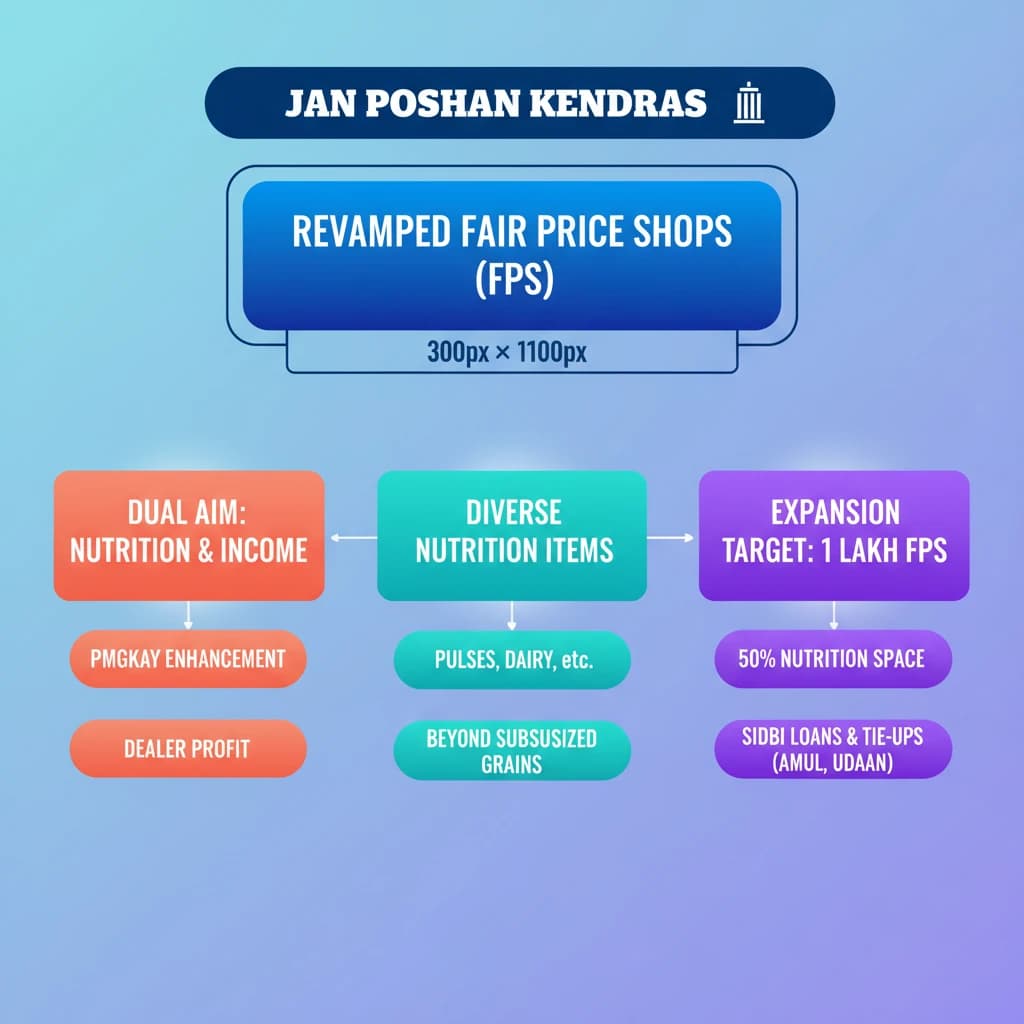
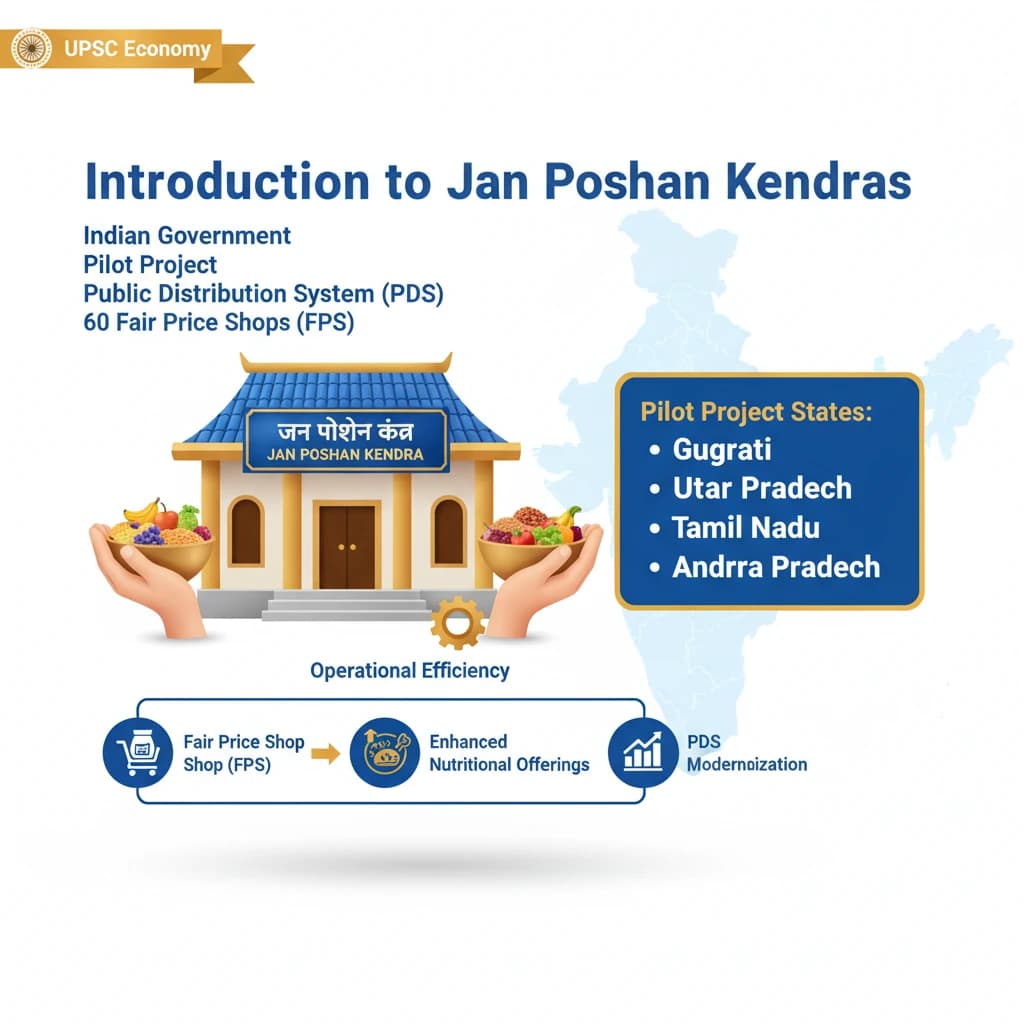
<h4>Introduction to Jan Poshan Kendras</h4><p>The <strong>Indian government</strong> has launched a significant <strong>pilot project</strong> aimed at enhancing nutritional offerings and operational efficiency within the <strong>Public Distribution System (PDS)</strong>. This initiative involves the renovation and transformation of <strong>60 Fair Price Shops (FPS)</strong>.</p><div class='info-box'><p>The pilot project is being implemented across four key states:</p><ul><li><strong>Gujarat</strong></li><li><strong>Rajasthan</strong></li><li><strong>Telangana</strong></li><li><strong>Uttar Pradesh</strong></li></ul><p>These selected <strong>FPS</strong> are being converted into "<strong>Jan Poshan Kendras</strong>".</p></div><h4>Dual Objectives of the Initiative</h4><p>The primary goal of transforming <strong>FPS</strong> into <strong>Jan Poshan Kendras</strong> is twofold. Firstly, it seeks to improve the availability of nutritious food items for beneficiaries receiving rations under the <strong>Pradhan Mantri Garib Kalyan Anna Yojana (PMGKAY)</strong>.</p><p>Secondly, the initiative aims to address the income challenges faced by <strong>ration dealers</strong>. By allowing them to sell additional items beyond subsidised grains, it creates new revenue streams for these crucial community touchpoints.</p><div class='key-point-box'><p>The project also incorporates the introduction of several <strong>new digital tools and support systems</strong>. These are designed to significantly enhance both the <strong>transparency</strong> and <strong>operational efficiency</strong> of the revamped <strong>Fair Price Shops</strong>.</p></div><h4>The 'Poshan' Component and Income Generation</h4><p>Under the "<strong>Poshan</strong>" aspect of this initiative, <strong>Fair Price Shops</strong> will expand their inventory. They will begin selling a wider range of items in addition to the standard subsidised grains.</p><p>This expansion directly tackles the income stability of <strong>ration dealers</strong>. Given the high footfall at these outlets, there is substantial scope for generating additional income, benefiting both the dealers and the local economy.</p><div class='info-box'><p>Currently, India has approximately <strong>0.54 million FPSs</strong>. These shops collectively distribute an average of <strong>60-70 million tonnes of food grain annually</strong> under <strong>PMGKAY</strong>.</p><p>This free distribution benefits over <strong>800 million beneficiaries</strong>, highlighting the extensive reach and potential impact of the <strong>FPS network</strong>.</p></div><p>The government has an ambitious long-term vision to further scale this initiative. It aims to convert around <strong>100,000 fair price shops</strong> into "<strong>nutri-hubs</strong>" within the next three years, significantly expanding the reach of nutritional offerings.</p><h4>Key Features of Jan Poshan Kendras</h4><p>The transformed <strong>Jan Poshan Kendras</strong> are designed to offer a more diverse and nutrition-rich selection of food items. This goes beyond the traditional subsidised grains, focusing on holistic dietary improvement.</p><ul><li><strong>Diverse Nutritional Offerings:</strong> These Kendras will provide items such as <strong>pulses</strong> and various <strong>dairy products</strong>, supplementing the basic grain entitlements.</li><li><strong>Space Allocation:</strong> A significant portion, specifically <strong>50% of the space</strong> within these Kendras, will be dedicated to storing and displaying nutritional products. The remaining space will be utilized for other essential household items.</li><li><strong>Financial Support:</strong> To facilitate their transformation and ongoing operations, <strong>FPSs</strong> will receive crucial financial assistance. This includes access to <strong>loans</strong> and <strong>invoice financing</strong> from the <strong>Small Industries Development Bank of India (SIDBI)</strong>.</li><li><strong>Strategic Collaborations:</strong> The initiative involves partnerships with key organizations to ensure a steady supply of quality products. For instance, <strong>AMUL</strong> is collaborating for dairy products.</li><li><strong>B2B eCommerce Integration:</strong> To streamline sourcing and supply chains, the project leverages <strong>Business-to-Business (B2B) eCommerce platforms</strong> such as <strong>Udaan</strong> and <strong>JumboTail</strong>.</li></ul><div class='exam-tip-box'><p>For <strong>UPSC Mains GS-II</strong> (Governance) and <strong>GS-III</strong> (Economy, Food Security), understanding the dual benefits of <strong>Jan Poshan Kendras</strong> – improving nutrition and empowering <strong>FPS dealers</strong> – is crucial. Note the role of <strong>digital tools</strong> and <strong>financial inclusion (SIDBI)</strong> in modernizing the PDS.</p></div>
Concept Diagram

💡 Key Takeaways

  • •Jan Poshan Kendras are renovated Fair Price Shops (FPS) launched as a pilot project in 4 states.
  • •Dual aim: enhance nutritional offerings under PMGKAY and improve income for ration dealers.
  • •They sell diverse nutrition-rich items like pulses and dairy, beyond subsidised grains.
  • •Key features include 50% space for nutritional products, SIDBI loans, and partnerships with AMUL, Udaan, JumboTail.
  • •Government plans to convert 100,000 FPS into 'nutri-hubs' in the next three years.
  • •Integrates digital tools for transparency and operational efficiency in PDS.

🧠 Memory Techniques
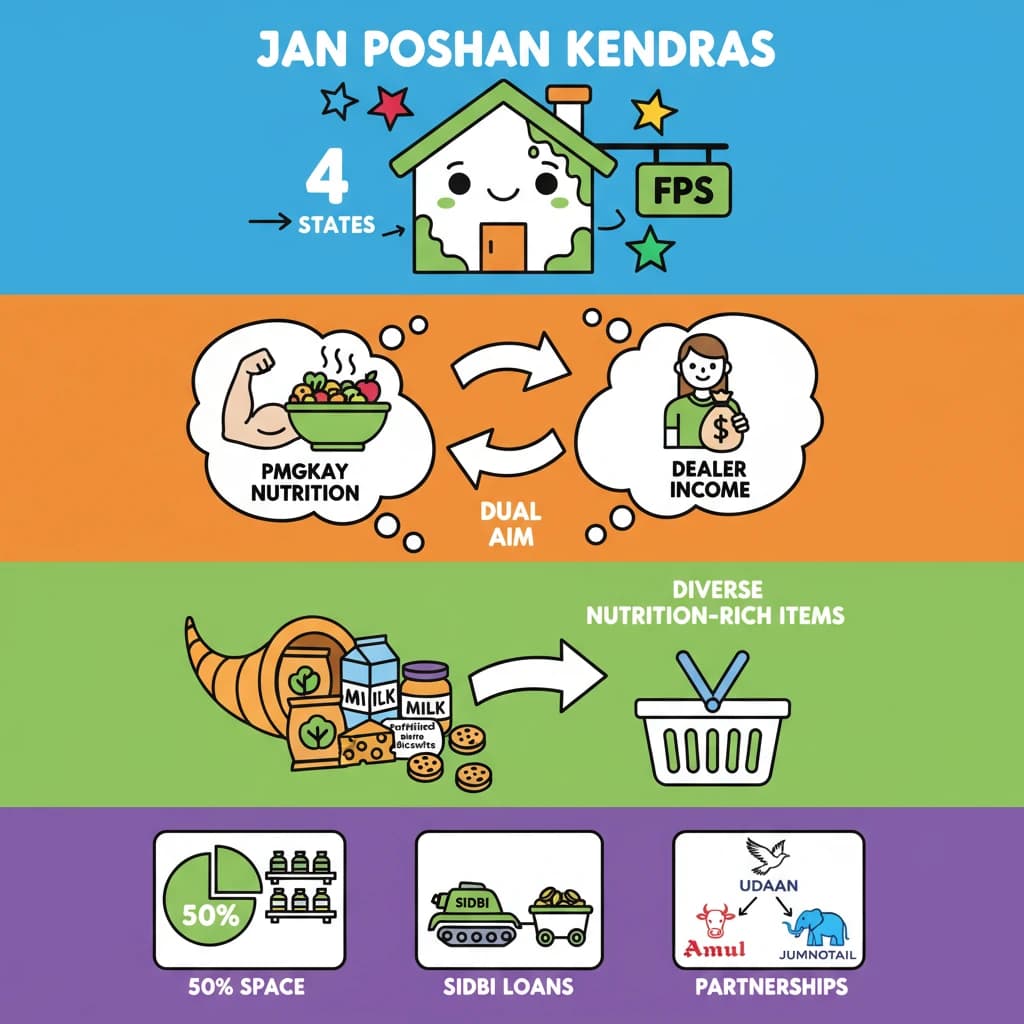
Memory Aid
95% Verified Content

Related Topics

Loading related topics...
Explore:Economy Topics·All Subjects·Daily Current Affairs·Editorial Analysis·Previous Year Questions·UPSC GPT
Jan Poshan Kendras - UPSC Economy