Loading page, please wait…
Vaidra Logo
Vaidra

Top 4 items + smart groups

UPSC GPT
New
Current Affairs
Daily Solutions
Daily Puzzle
Mains Evaluator

Version 2.0.0 • Built with ❤️ for UPSC aspirants

Loading...
Loading...
Loading...
Loading...
Loading...
Loading...
Loading...
Loading...
Loading...
Loading...
Loading...
Loading...
Loading...
Developments on Inland Waterways - UPSC Economy
Back
All Subjects

Topics

0 topics • 0 completed

Loading topics...
Loading...
Loading...
Loading...
Loading...
Loading...
Overall Progress0%

Developments on Inland Waterways - UPSC Economy

What is Developments on Inland Waterways in UPSC Economy?

Developments on Inland Waterways is a key topic under Economy for UPSC Civil Services Examination. Key points include: India is developing 111 National Waterways (NWs) spanning over 20,000 km.. Around 50 Inland Water Transport (IWT) routes are currently operational.. Cargo traffic via IWTs increased significantly from 29.16 MT (FY15) to 133.03 MT (FY24).. Understanding this topic is essential for both UPSC Prelims and Mains preparation.

Why is Developments on Inland Waterways important for UPSC exam?

Developments on Inland Waterways is a Medium-level topic in UPSC Economy. It is tested in both Prelims (factual MCQs) and Mains (analytical answer writing). Previous year UPSC questions have frequently covered aspects of Developments on Inland Waterways, making it essential for comprehensive IAS preparation.

How to prepare Developments on Inland Waterways for UPSC?

To prepare Developments on Inland Waterways for UPSC: (1) Study the comprehensive notes covering all key concepts on Vaidra. (2) Practice previous year questions on this topic. (3) Connect it with current affairs using daily updates. (4) Revise using key takeaways and mind maps available for Economy. (5) Write practice answers linking Developments on Inland Waterways to related GS Paper topics.

Key takeaways of Developments on Inland Waterways for UPSC

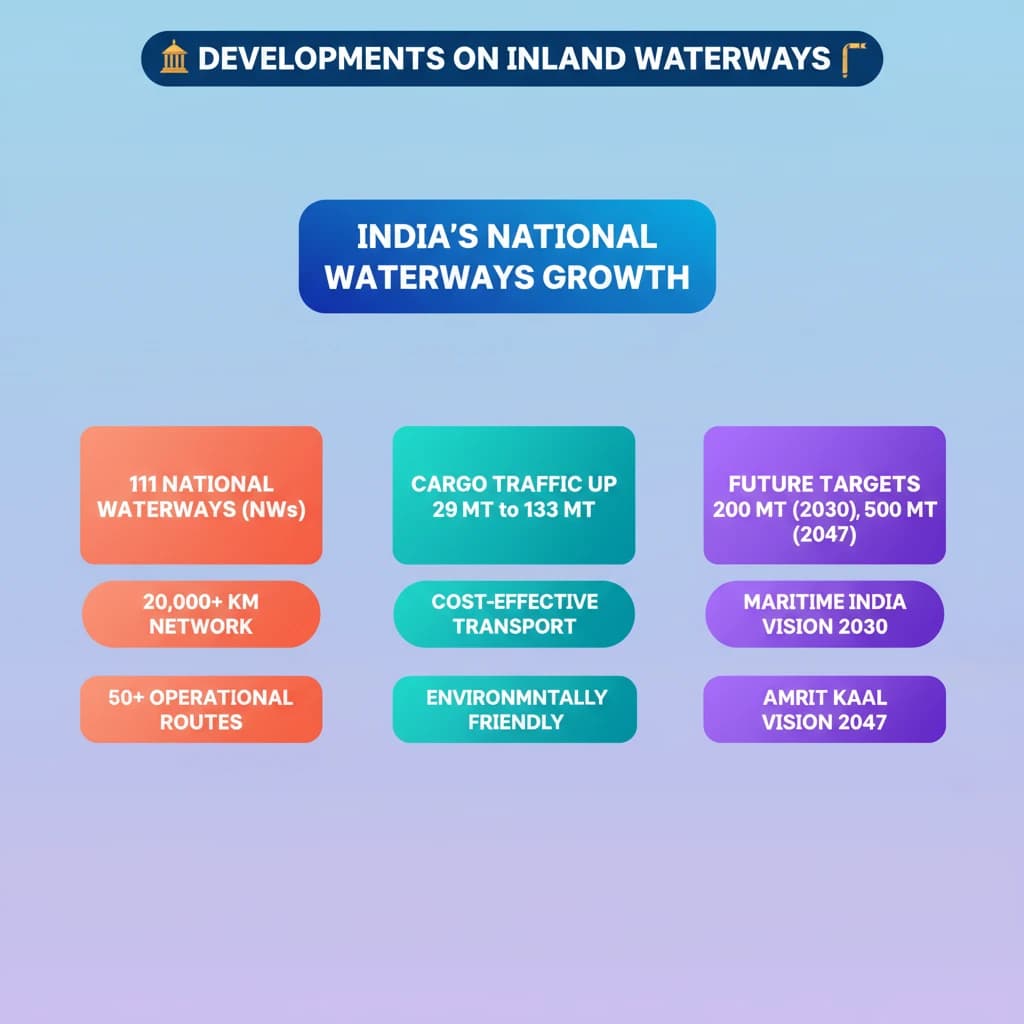
  • India is developing 111 National Waterways (NWs) spanning over 20,000 km.
  • Around 50 Inland Water Transport (IWT) routes are currently operational.
  • Cargo traffic via IWTs increased significantly from 29.16 MT (FY15) to 133.03 MT (FY24).
  • Future targets aim for 200 MT by 2030 (Maritime India Vision 2030) and 500 MT by 2047 (Maritime Amrit Kaal Vision 2047).
  • IWTs offer cost-effective, environmentally friendly, and congestion-reducing transport solutions.
Developments on Inland Waterways

Developments on Inland Waterways

Medium⏱️ 7 min read✓ 95% Verified
economy

📖 Introduction

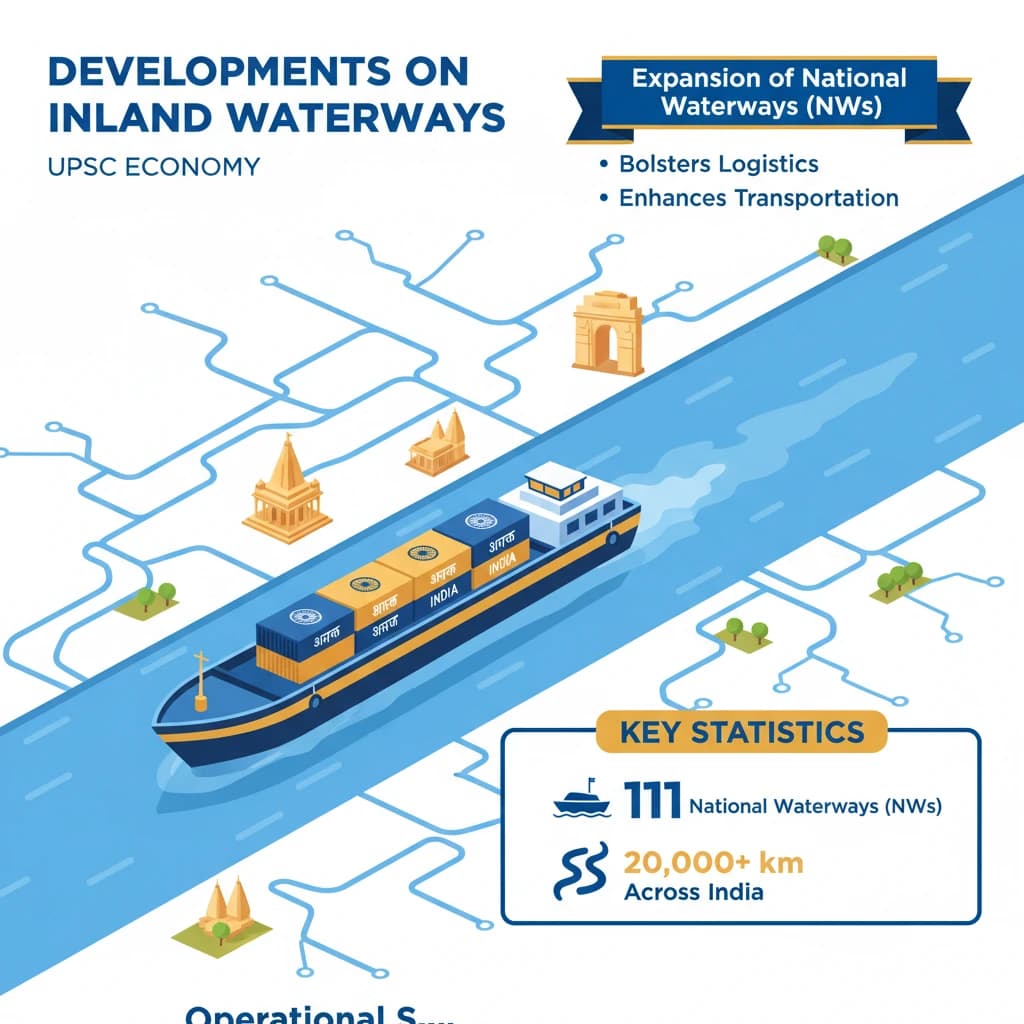
<h4>Expansion of National Waterways (NWs)</h4><p>India is actively pursuing the development of its <strong>inland waterways network</strong>. This initiative aims to bolster the country's logistics and transportation capabilities.</p><div class='info-box'><p>Currently, <strong>111 National Waterways (NWs)</strong> are under various stages of development. These waterways collectively span an impressive length of over <strong>20,000 kilometres</strong> across the nation.</p></div><h4>Operational Status of Inland Water Transport (IWT)</h4><p>The operationalisation of these waterways is a gradual process, with a significant number already facilitating cargo movement.</p><div class='info-box'><p>Approximately <strong>50 Inland Water Transport (IWT)</strong> routes are presently operational, contributing to the country's freight movement.</p></div><h4>Remarkable Cargo Traffic Growth</h4><p>The focus on inland waterways has led to substantial growth in cargo traffic over the past decade, highlighting their increasing importance.</p><div class='info-box'><p>Cargo transported via inland waterways surged from <strong>29.16 million tonnes</strong> in <strong>FY15</strong> to a remarkable <strong>133.03 million tonnes</strong> by <strong>FY24</strong>. This represents a significant increase, underscoring the potential of this mode of transport.</p></div><h4>Ambitious Future Targets for IWT</h4><p>The government has set ambitious targets for further expanding the role of inland waterways in India's logistics framework.</p><div class='key-point-box'><p>Under the <strong>Maritime India Vision 2030</strong>, the goal is to elevate cargo traffic through inland waterways to <strong>200 million tonnes</strong> by <strong>2030</strong>. The long-term vision, <strong>Maritime Amrit Kaal Vision 2047</strong>, aims even higher, targeting <strong>500 million tonnes</strong> by <strong>2047</strong>.</p></div><div class='exam-tip-box'><p>Remember these specific targets and visions (<strong>Maritime India Vision 2030</strong>, <strong>Maritime Amrit Kaal Vision 2047</strong>) as they are crucial for Mains answers, especially in <strong>GS Paper 3 (Economy)</strong> and <strong>GS Paper 1 (Geography/Infrastructure)</strong>.</p></div>
Concept Diagram

💡 Key Takeaways

  • •India is developing 111 National Waterways (NWs) spanning over 20,000 km.
  • •Around 50 Inland Water Transport (IWT) routes are currently operational.
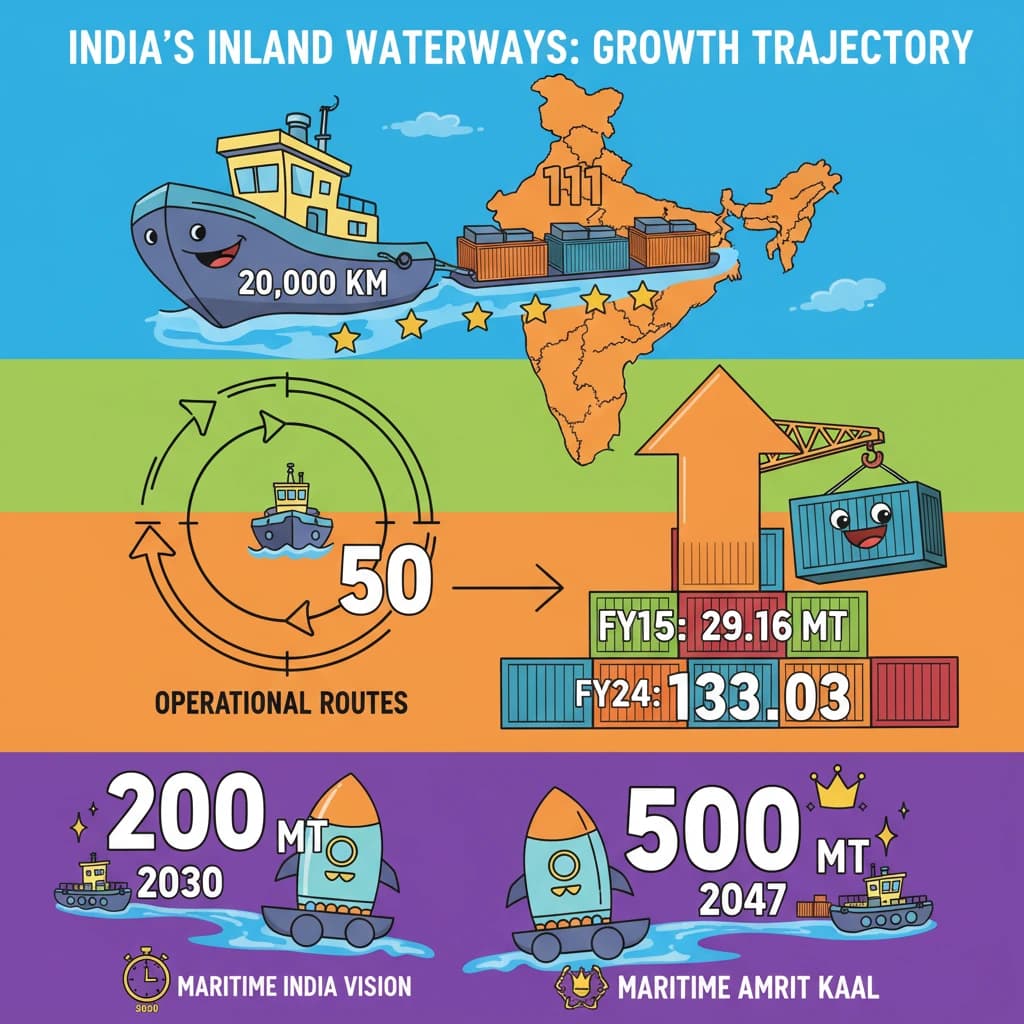
  • •Cargo traffic via IWTs increased significantly from 29.16 MT (FY15) to 133.03 MT (FY24).
  • •Future targets aim for 200 MT by 2030 (Maritime India Vision 2030) and 500 MT by 2047 (Maritime Amrit Kaal Vision 2047).
  • •IWTs offer cost-effective, environmentally friendly, and congestion-reducing transport solutions.

🧠 Memory Techniques
Memory Aid
95% Verified Content

📚 Reference Sources

•Ministry of Ports, Shipping and Waterways, Government of India Annual Reports
•Inland Waterways Authority of India (IWAI) Official Website

Related Topics

Loading related topics...
Explore:Economy Topics·All Subjects·Daily Current Affairs·Editorial Analysis·Previous Year Questions·UPSC GPT