Loading page, please wait…
Vaidra Logo
Vaidra

Top 4 items + smart groups

UPSC GPT
New
Current Affairs
Daily Solutions
Daily Puzzle
Mains Evaluator

Version 2.0.0 • Built with ❤️ for UPSC aspirants

Loading...
Loading...
Loading...
Loading...
Loading...
Loading...
Loading...
Loading...
Loading...
Loading...
Loading...
Loading...
Loading...
Back
All Subjects

Topics

0 topics • 0 completed

Loading topics...
Loading...
Loading...
Loading...
Loading...
Loading...
Overall Progress0%

What are Government Securities (G-Sec)? - UPSC Economy

What is What are Government Securities (G-Sec)? in UPSC Economy?

What are Government Securities (G-Sec)? is a key topic under Economy for UPSC Civil Services Examination. Key points include: G-Secs are tradable debt instruments issued by Central/State Governments to borrow funds.. They are considered risk-free (gilt-edged) due to sovereign guarantee.. Types include short-term (Treasury Bills, Cash Management Bills) and long-term (Dated G-Secs, State Development Loans).. Understanding this topic is essential for both UPSC Prelims and Mains preparation.

Why is What are Government Securities (G-Sec)? important for UPSC exam?

What are Government Securities (G-Sec)? is a Medium-level topic in UPSC Economy. It is tested in both Prelims (factual MCQs) and Mains (analytical answer writing). Previous year UPSC questions have frequently covered aspects of What are Government Securities (G-Sec)?, making it essential for comprehensive IAS preparation.

How to prepare What are Government Securities (G-Sec)? for UPSC?

To prepare What are Government Securities (G-Sec)? for UPSC: (1) Study the comprehensive notes covering all key concepts on Vaidra. (2) Practice previous year questions on this topic. (3) Connect it with current affairs using daily updates. (4) Revise using key takeaways and mind maps available for Economy. (5) Write practice answers linking What are Government Securities (G-Sec)? to related GS Paper topics.

Key takeaways of What are Government Securities (G-Sec)? for UPSC

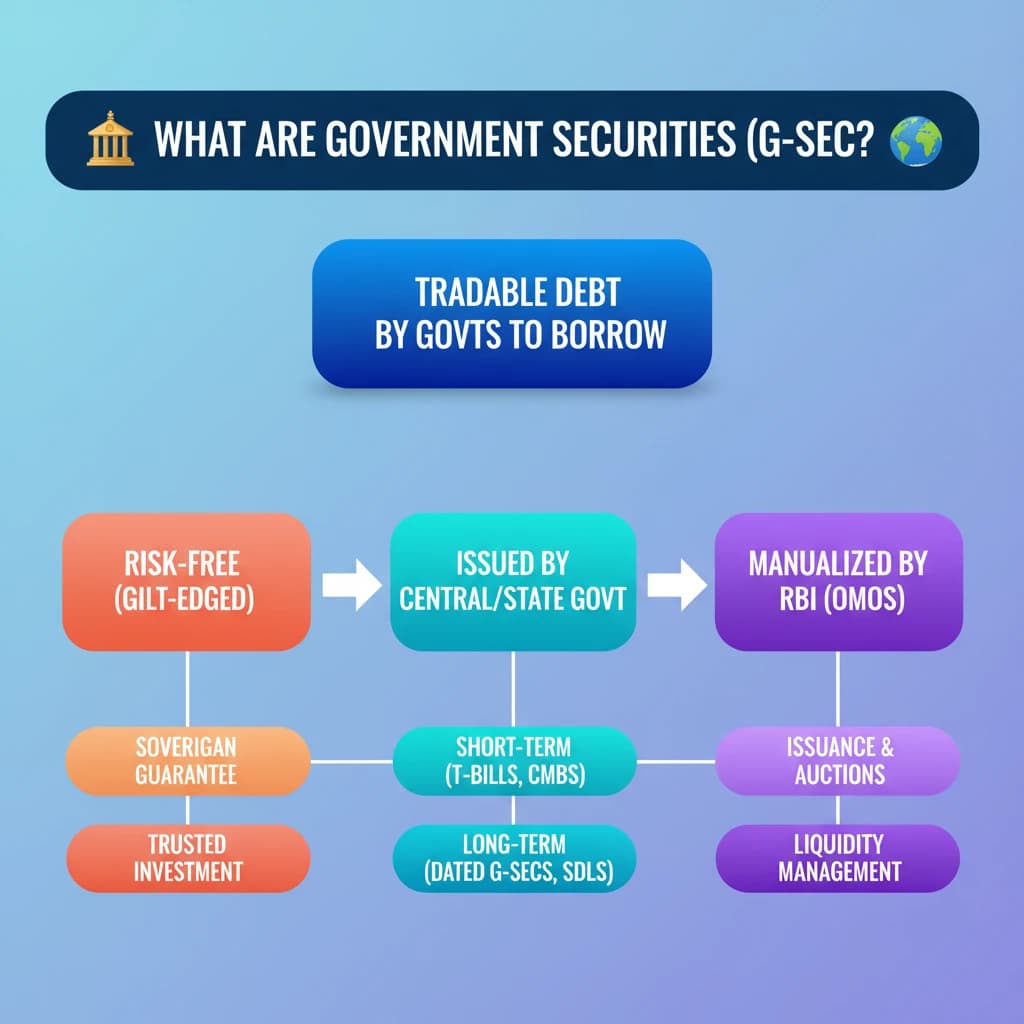
  • G-Secs are tradable debt instruments issued by Central/State Governments to borrow funds.
  • They are considered risk-free (gilt-edged) due to sovereign guarantee.
  • Types include short-term (Treasury Bills, Cash Management Bills) and long-term (Dated G-Secs, State Development Loans).
  • T-bills and CMBs are zero-coupon, issued at a discount; Dated G-Secs and SDLs pay half-yearly interest.
  • RBI manages G-Sec issuance and uses Open Market Operations (OMOs) for liquidity management in the economy.
What are Government Securities (G-Sec)?

What are Government Securities (G-Sec)?

Medium⏱️ 8 min read✓ 95% Verified
economy

📖 Introduction

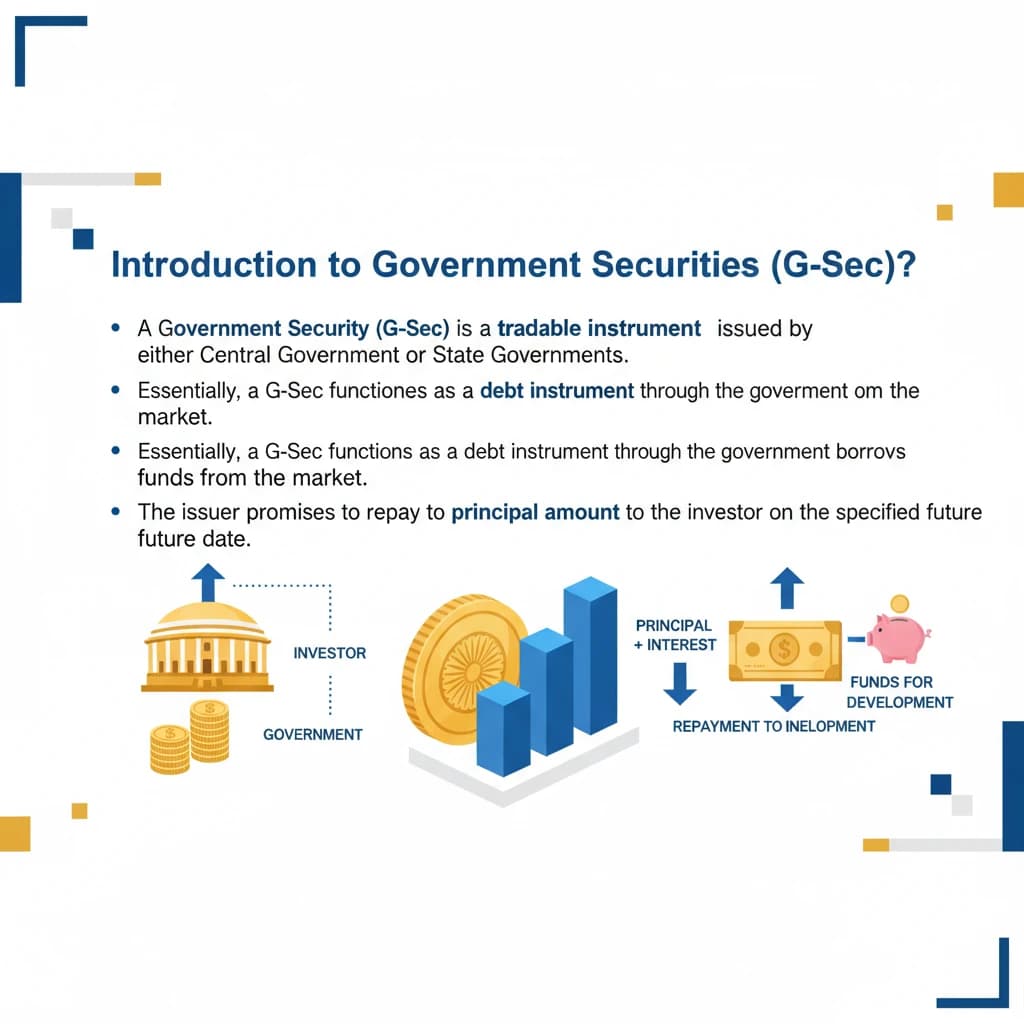
<h4>Introduction to Government Securities (G-Sec)</h4><p>A <strong>Government Security (G-Sec)</strong> is a <strong>tradable instrument</strong> issued by either the <strong>Central Government</strong> or <strong>State Governments</strong>.</p><p>Essentially, a <strong>G-Sec</strong> functions as a <strong>debt instrument</strong> through which the government borrows funds from the market.</p><p>The issuer promises to repay the <strong>principal amount</strong> to the investor on a specified future date, known as the <strong>maturity date</strong>.</p><div class='key-point-box'><p><strong>G-Secs</strong> are widely regarded as <strong>risk-free instruments</strong> due to the sovereign guarantee, earning them the classification of <strong>gilt-edged securities</strong>.</p></div><h4>Classification by Tenor: Short-term vs. Long-term</h4><p><strong>Government Securities</strong> are broadly categorized based on their maturity period or <strong>tenor</strong>.</p><ul><li><strong>Short-term G-Secs</strong>: These instruments typically have a maturity period of less than one year. <strong>Treasury Bills (T-bills)</strong> are prime examples.</li><li><strong>Long-term G-Secs</strong>: These are commonly referred to as <strong>Government Bonds</strong> and have maturities ranging from one year up to 40 years.</li></ul><h4>Issuers of Government Securities</h4><p>Both the <strong>Central Government</strong> and <strong>State Governments</strong> are authorized to issue <strong>Government Securities</strong>, albeit with some distinctions.</p><div class='info-box'><ul><li>The <strong>Central Government</strong> issues both <strong>Treasury Bills (T-bills)</strong> and <strong>Dated G-Secs (Government Bonds)</strong>.</li><li><strong>State Governments</strong> primarily issue their market borrowings through instruments known as <strong>State Development Loans (SDLs)</strong>.</li></ul></div><h4>Types of Government Securities (G-Sec)</h4><h4>Treasury Bills (T-bills)</h4><p><strong>Treasury Bills (T-bills)</strong> are quintessential <strong>short-term G-Secs</strong>, issued for maturities of 91 days, 182 days, or 364 days.</p><div class='info-box'><p>They are known as <strong>zero-coupon securities</strong> because they do not pay any periodic interest (coupon). Instead, they are issued at a <strong>discount</strong> to their face value and redeemed at their <strong>face value</strong> upon maturity.</p></div><p>The return to the investor is the difference between the face value and the discounted issue price.</p><h4>Cash Management Bills (CMBs)</h4><p>Introduced in <strong>2010</strong>, <strong>Cash Management Bills (CMBs)</strong> are another form of <strong>short-term instrument</strong>.</p><div class='info-box'><p>These are issued by the <strong>Government of India</strong> in consultation with the <strong>Reserve Bank of India (RBI)</strong> to address temporary mismatches in the government's cash flow.</p></div><p>Like T-bills, <strong>CMBs</strong> are also <strong>zero-coupon securities</strong>, issued at a discount and redeemed at face value.</p><h4>Dated G-Secs (Government Bonds)</h4><p><strong>Dated G-Secs</strong> are <strong>long-term securities</strong> that carry a specified <strong>coupon rate (interest rate)</strong>.</p><p>This interest is paid on the <strong>face value</strong> of the security, typically on a <strong>half-yearly basis</strong>.</p><div class='info-box'><p>The <strong>tenor</strong> of <strong>dated securities</strong> generally ranges from <strong>5 years to 40 years</strong>, making them suitable for long-term investment horizons.</p></div><p>The coupon rate can be either <strong>fixed</strong> or <strong>floating</strong>, depending on the terms of issuance.</p><h4>State Development Loans (SDLs)</h4><p><strong>State Development Loans (SDLs)</strong> are debt instruments issued by <strong>State Governments</strong> to raise funds from the market.</p><p>These are similar to <strong>dated G-Secs</strong> issued by the Central Government, carrying a <strong>fixed or floating coupon rate</strong> and having varying maturities.</p><div class='exam-tip-box'><p>Understanding <strong>SDLs</strong> is crucial for topics related to <strong>fiscal federalism</strong> and <strong>state finances</strong> in <strong>UPSC Mains Paper III</strong>.</p></div><h4>Issue Mechanism and Role of RBI</h4><p>The <strong>Reserve Bank of India (RBI)</strong> plays a pivotal role in the issuance and management of <strong>Government Securities</strong>.</p><p>The <strong>RBI</strong> conducts <strong>Open Market Operations (OMOs)</strong> for the sale or purchase of <strong>G-Secs</strong>.</p><div class='info-box'><ul><li>When the <strong>RBI sells G-Secs</strong> in the market, it effectively <strong>removes liquidity</strong> from the financial system.</li><li>Conversely, when the <strong>RBI buys back G-Secs</strong>, it <strong>infuses liquidity</strong> into the market.</li></ul></div><p>These <strong>OMOs</strong> are a key tool for the <strong>RBI</strong> to manage <strong>money supply conditions</strong> and influence <strong>interest rates</strong> in the economy.</p>
Concept Diagram

💡 Key Takeaways

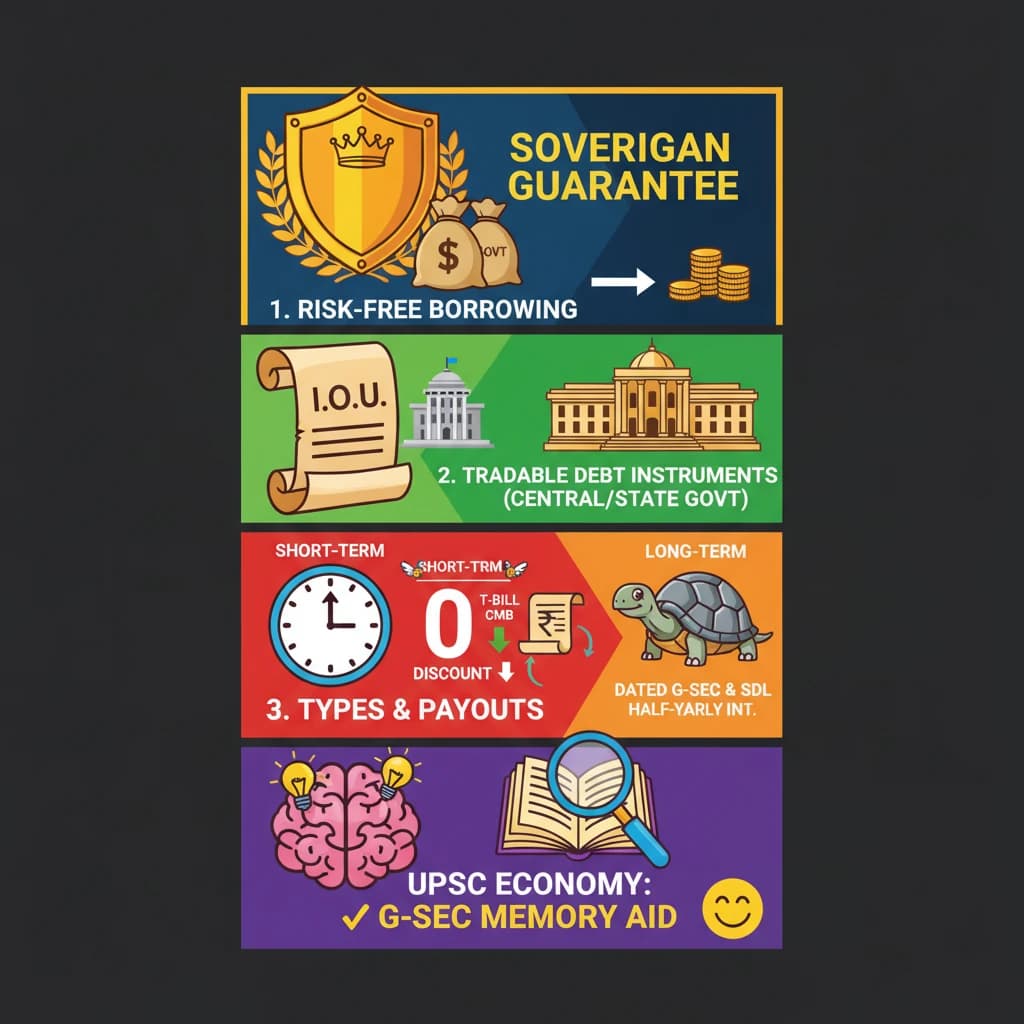
  • •G-Secs are tradable debt instruments issued by Central/State Governments to borrow funds.
  • •They are considered risk-free (gilt-edged) due to sovereign guarantee.
  • •Types include short-term (Treasury Bills, Cash Management Bills) and long-term (Dated G-Secs, State Development Loans).
  • •T-bills and CMBs are zero-coupon, issued at a discount; Dated G-Secs and SDLs pay half-yearly interest.
  • •RBI manages G-Sec issuance and uses Open Market Operations (OMOs) for liquidity management in the economy.

🧠 Memory Techniques
Memory Aid
95% Verified Content

Related Topics

Loading related topics...
Explore:Economy Topics·All Subjects·Daily Current Affairs·Editorial Analysis·Previous Year Questions·UPSC GPT
What are Government Securities (G-Sec)? - UPSC Economy