Loading page, please wait…
Vaidra Logo
Vaidra

Top 4 items + smart groups

UPSC GPT
New
Current Affairs
Daily Solutions
Daily Puzzle
Mains Evaluator

Version 2.0.0 • Built with ❤️ for UPSC aspirants

Loading...
Loading...
Loading...
Loading...
Loading...
Loading...
Loading...
Loading...
Loading...
Loading...
Loading...
Loading...
Loading...
Back
All Subjects

Topics

0 topics • 0 completed

Loading topics...
Loading...
Loading...
Loading...
Loading...
Loading...
Overall Progress0%
Evolution in Cross-Border Remittances - UPSC Economy

Evolution in Cross-Border Remittances - UPSC Economy

What is Evolution in Cross-Border Remittances in UPSC Economy?

Evolution in Cross-Border Remittances is a key topic under Economy for UPSC Civil Services Examination. Key points include: Cross-border remittances evolved from slow, manual demand drafts to instant digital transfers.. NEFT (mid-2000s) introduced secure, direct online transfers operated by RBI.. IMPS (2010) by NPCI brought near real-time (under 3 mins) 24x7 transfers.. Understanding this topic is essential for both UPSC Prelims and Mains preparation.

Why is Evolution in Cross-Border Remittances important for UPSC exam?

Evolution in Cross-Border Remittances is a Medium-level topic in UPSC Economy. It is tested in both Prelims (factual MCQs) and Mains (analytical answer writing). Previous year UPSC questions have frequently covered aspects of Evolution in Cross-Border Remittances, making it essential for comprehensive IAS preparation.

How to prepare Evolution in Cross-Border Remittances for UPSC?

To prepare Evolution in Cross-Border Remittances for UPSC: (1) Study the comprehensive notes covering all key concepts on Vaidra. (2) Practice previous year questions on this topic. (3) Connect it with current affairs using daily updates. (4) Revise using key takeaways and mind maps available for Economy. (5) Write practice answers linking Evolution in Cross-Border Remittances to related GS Paper topics.

Key takeaways of Evolution in Cross-Border Remittances for UPSC

  • Cross-border remittances evolved from slow, manual demand drafts to instant digital transfers.
  • NEFT (mid-2000s) introduced secure, direct online transfers operated by RBI.
  • IMPS (2010) by NPCI brought near real-time (under 3 mins) 24x7 transfers.
  • UPI for FIR (recent) revolutionized remittances, making them as simple as domestic UPI payments.
  • This evolution boosts India's digital economy, financial inclusion, and foreign exchange reserves.
Evolution in Cross-Border Remittances

Evolution in Cross-Border Remittances

Medium⏱️ 6 min read✓ 98% Verified
economy

📖 Introduction

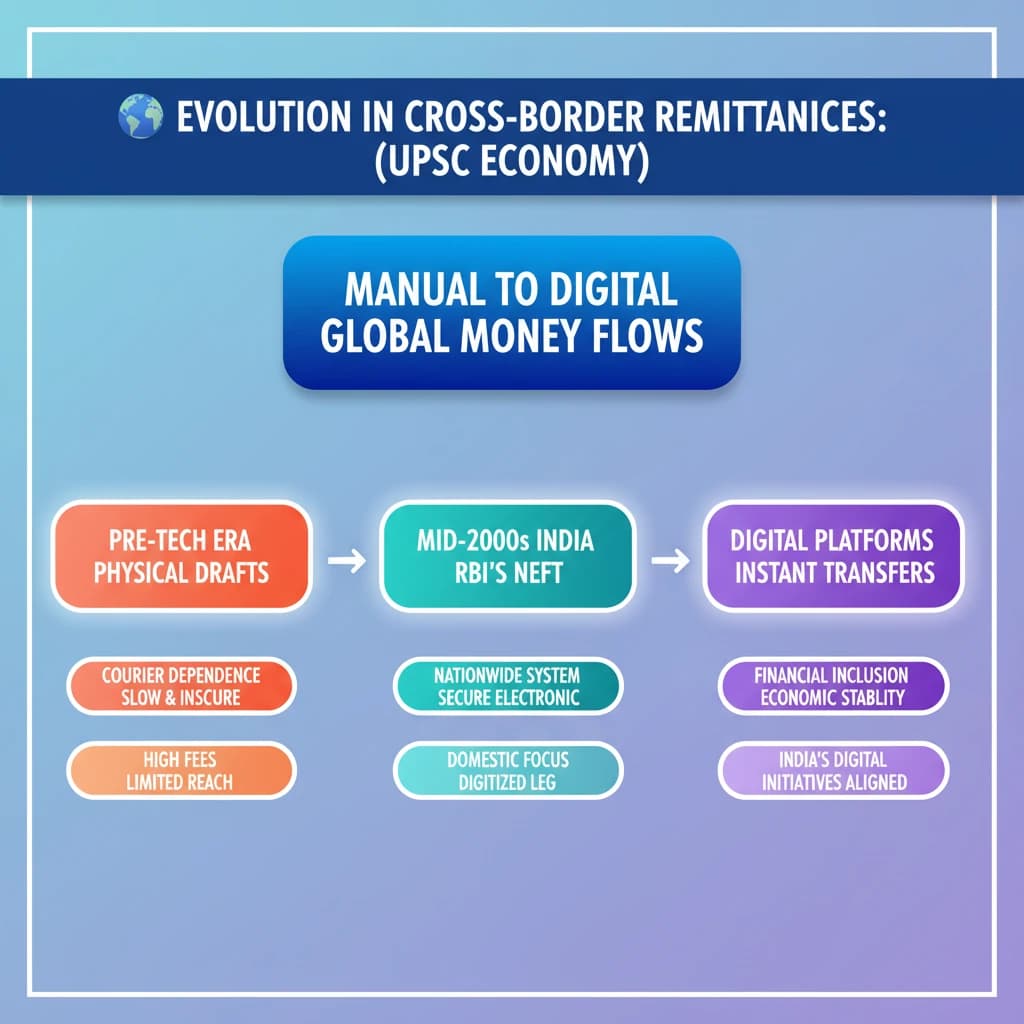
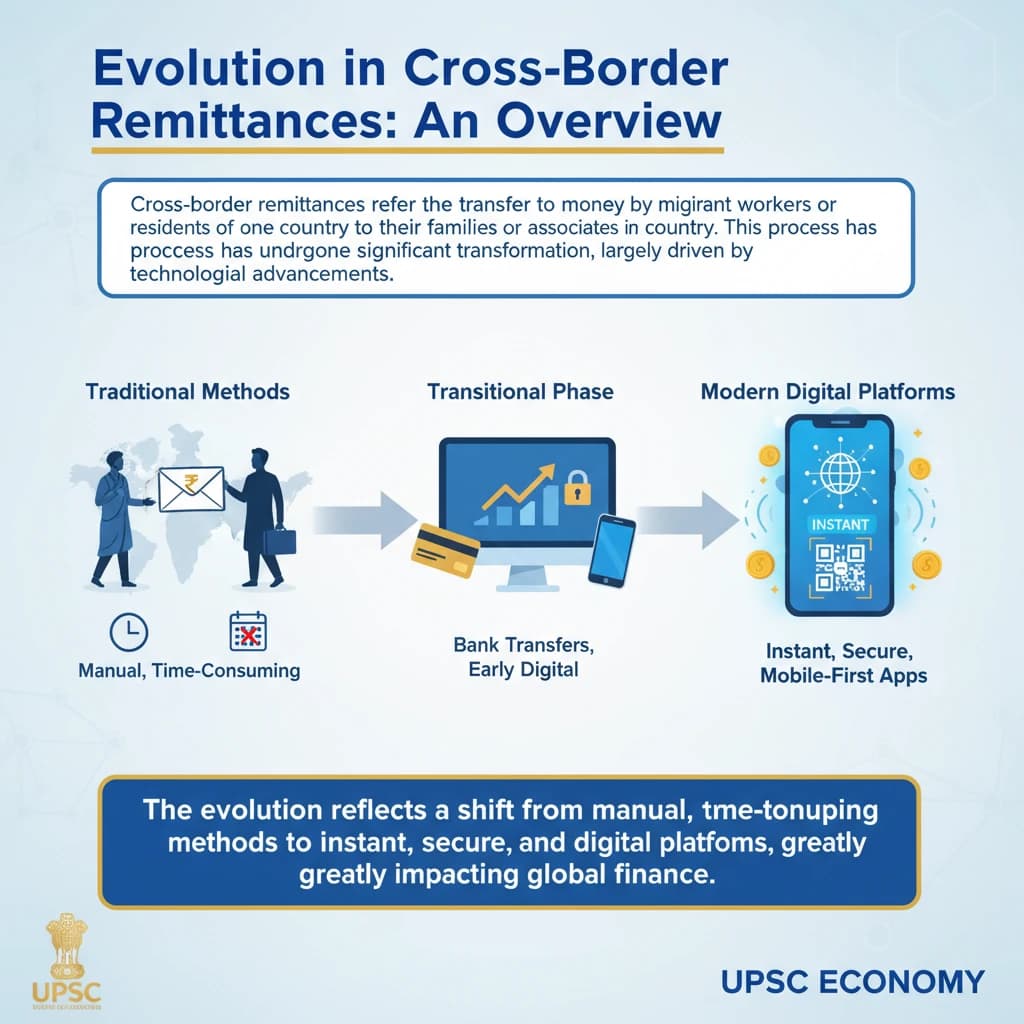
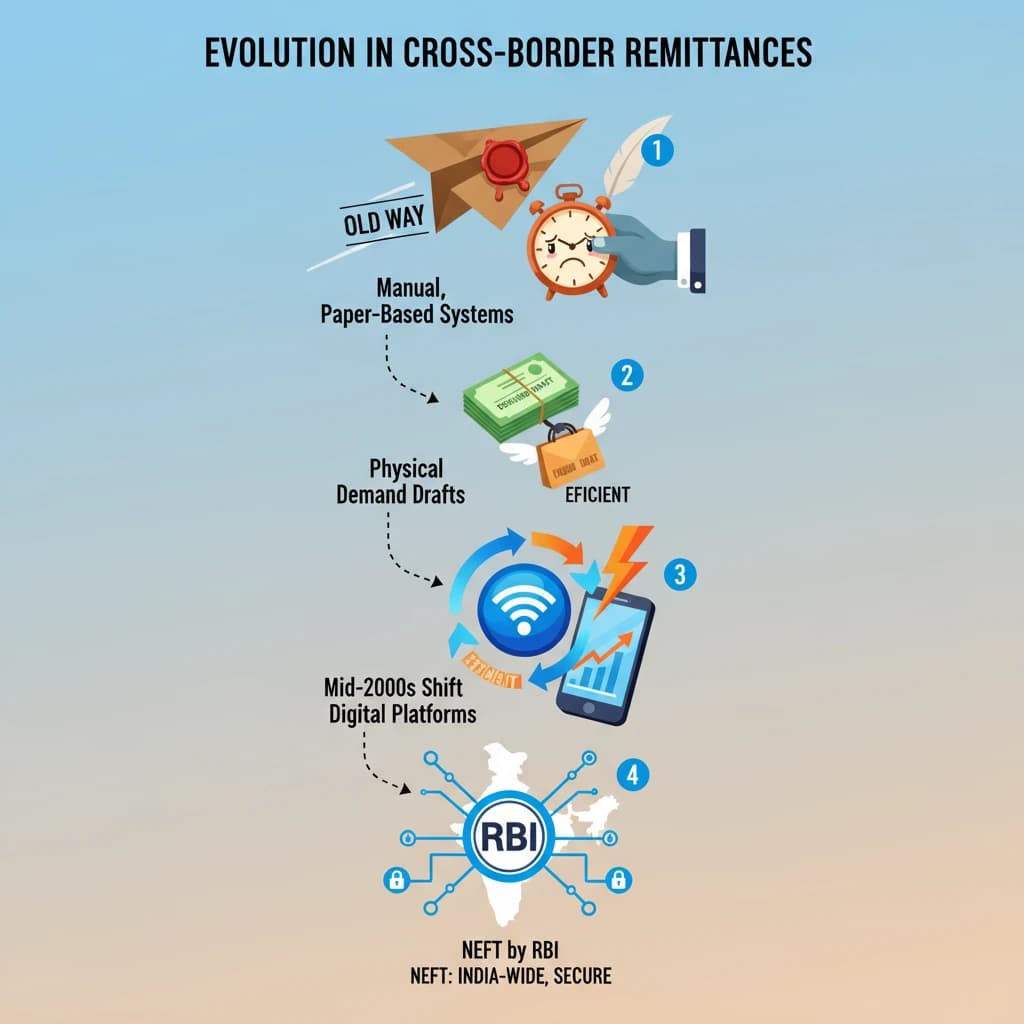
<h4>The Evolution of Cross-Border Remittances in India</h4><p>The landscape of <strong>cross-border remittances</strong> to India has undergone a significant transformation, driven primarily by technological advancements. This evolution has moved from traditional, time-consuming methods to instant, digital transfers, greatly benefiting <strong>Non-Resident Indians (NRIs)</strong> and the Indian economy.</p><div class='key-point-box'><p><strong>Remittances</strong> are funds sent by expatriates to their home country. India is one of the largest recipients of remittances globally, making their efficient transfer crucial.</p></div><h4>The Pre-Technology Era of Remittances</h4><p>Before the advent of widespread digital technology, the process of sending money to India was largely manual and slow. <strong>Non-Resident Indians (NRIs)</strong> relied on conventional banking instruments.</p><p>They typically used <strong>demand drafts</strong>, which were drawn on <strong>federal banks</strong>. These physical instruments then had to be dispatched to India, often through a <strong>courier service</strong>, for the recipient to encash them.</p><div class='info-box'><p><strong>Process in Pre-Tech Era:</strong></p><ul><li><strong>NRI</strong> obtains a <strong>demand draft</strong> from a bank.</li><li>The physical draft is sent to India via <strong>courier</strong>.</li><li>Recipient presents the draft to a bank for <strong>encashment</strong>.</li><li>This process was time-consuming and involved significant logistical effort.</li></ul></div><h4>Introduction of Online Remittances: NEFT</h4><p>The mid-2000s marked a pivotal shift with the launch of <strong>National Electronic Fund Transfer (NEFT)</strong>. This system introduced a secure and direct way to transfer funds digitally to bank accounts across India.</p><p><strong>NEFT</strong> revolutionized the process by eliminating the need for physical instruments and couriers, making transfers faster and more reliable.</p><div class='info-box'><p><strong>Key Facts about NEFT:</strong></p><ul><li><strong>Launched:</strong> Mid-2000s</li><li><strong>Purpose:</strong> Direct and secure transfers to accounts in India.</li><li><strong>Nature:</strong> Nation-wide centralised payment system.</li><li><strong>Ownership & Operation:</strong> <strong>Reserve Bank of India (RBI)</strong>.</li></ul></div><h4>Enhancing Speed with IMPS Integration</h4><p>Further improvements in remittance efficiency came with the introduction of the <strong>Immediate Payment Service (IMPS)</strong>. This service significantly reduced the time taken for fund credits.</p><p>Launched by the <strong>National Payments Corporation of India (NPCI)</strong>, <strong>IMPS</strong> enabled near real-time transfers, with credits typically completed in under <strong>3 minutes</strong>.</p><div class='info-box'><p><strong>IMPS Features:</strong></p><ul><li><strong>Launch:</strong> By <strong>NPCI</strong>.</li><li><strong>Speed:</strong> Credits completed in under <strong>3 minutes</strong>.</li><li><strong>Availability:</strong> 24x7, including holidays.</li><li><strong>Impact:</strong> Enhanced efficiency and immediacy of fund transfers.</li></ul></div><h4>Revolutionizing Remittances with UPI for FIR</h4><p>The latest and most significant innovation in cross-border remittances is the integration of the <strong>Unified Payments Interface (UPI)</strong> for <strong>Foreign Inward Remittance (FIR)</strong>. This has profoundly streamlined the entire process.</p><p><strong>UPI for FIR</strong> leverages the robust and user-friendly <strong>UPI</strong> platform, making it exceptionally easy for <strong>NRIs</strong> to send money directly to beneficiaries' <strong>UPI IDs</strong> or bank accounts in India.</p><div class='exam-tip-box'><p><strong>UPSC Insight:</strong> Understand the chronological evolution and the specific contributions of <strong>NEFT</strong>, <strong>IMPS</strong>, and <strong>UPI</strong>. Questions often test the features and impact of these payment systems on financial inclusion and economic growth. Focus on keywords like <strong>'centralised'</strong>, <strong>'immediate'</strong>, and <strong>'streamlined'</strong>.</p></div>
Concept Diagram

💡 Key Takeaways

  • •Cross-border remittances evolved from slow, manual demand drafts to instant digital transfers.
  • •NEFT (mid-2000s) introduced secure, direct online transfers operated by RBI.
  • •IMPS (2010) by NPCI brought near real-time (under 3 mins) 24x7 transfers.
  • •UPI for FIR (recent) revolutionized remittances, making them as simple as domestic UPI payments.
  • •This evolution boosts India's digital economy, financial inclusion, and foreign exchange reserves.

🧠 Memory Techniques
Memory Aid
98% Verified Content

📚 Reference Sources

•Reserve Bank of India (RBI) official publications on NEFT and IMPS
•National Payments Corporation of India (NPCI) official website for IMPS and UPI

Related Topics

Loading related topics...
Explore:Economy Topics·All Subjects·Daily Current Affairs·Editorial Analysis·Previous Year Questions·UPSC GPT