Loading page, please wait…
Vaidra Logo
Vaidra

Top 4 items + smart groups

UPSC GPT
New
Current Affairs
Daily Solutions
Daily Puzzle
Mains Evaluator

Version 2.0.0 • Built with ❤️ for UPSC aspirants

Loading...
Loading...
Loading...
Loading...
Loading...
Loading...
Loading...
Loading...
Loading...
Loading...
Loading...
Loading...
Loading...
Back
All Subjects

Topics

0 topics • 0 completed

Loading topics...
Loading...
Loading...
Loading...
Loading...
Loading...
Overall Progress0%

Government Initiatives for MSMEs, Digital Payments & Financial Inclusion - UPSC Economy

What is Government Initiatives for MSMEs, Digital Payments & Financial Inclusion in UPSC Economy?

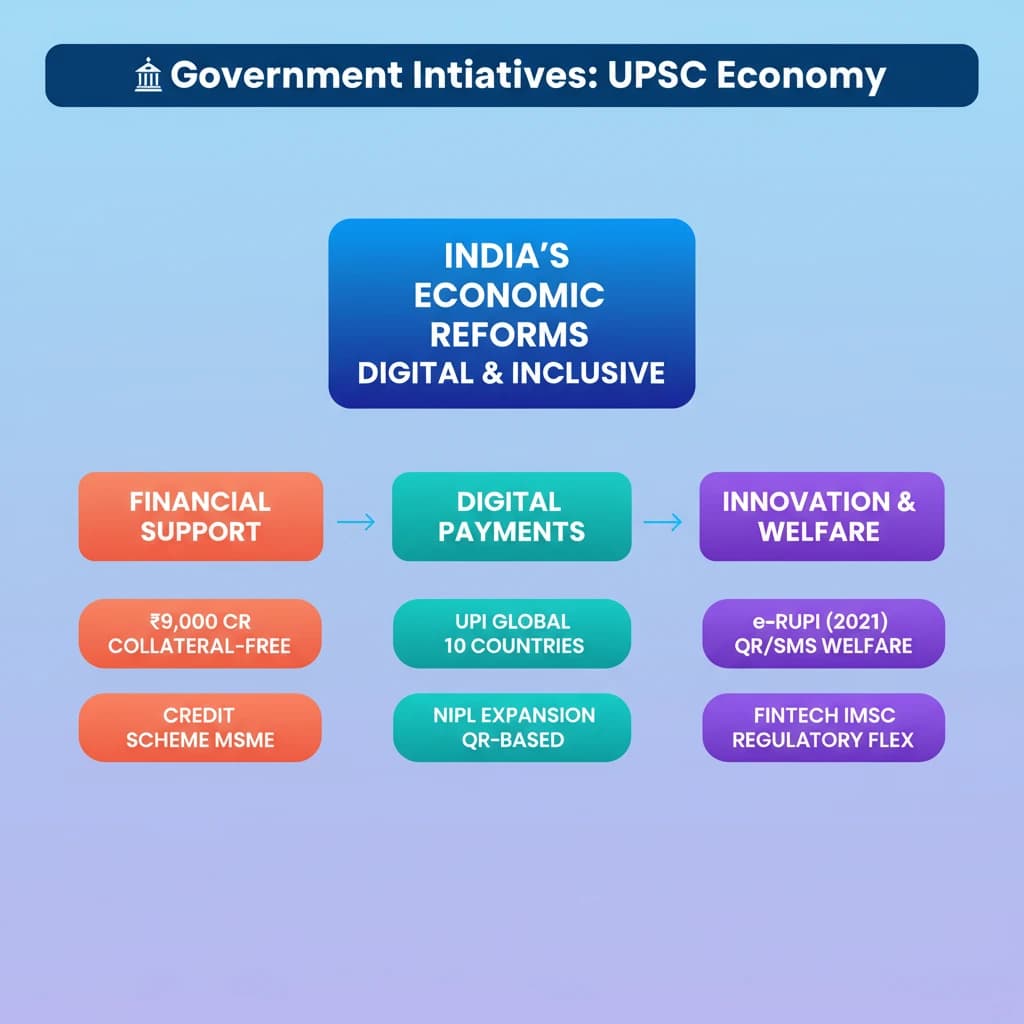
Government Initiatives for MSMEs, Digital Payments & Financial Inclusion is a key topic under Economy for UPSC Civil Services Examination. Key points include: Credit Guarantee Scheme (2023 revamp) provides Rs 9,000 cr for collateral-free MSME loans.. NIPL expanded QR-based UPI payments to 10 countries, enhancing global digital transactions.. e-RUPI (Aug 2021) offers QR/SMS-based one-time digital payment solutions for targeted welfare.. Understanding this topic is essential for both UPSC Prelims and Mains preparation.

Why is Government Initiatives for MSMEs, Digital Payments & Financial Inclusion important for UPSC exam?

Government Initiatives for MSMEs, Digital Payments & Financial Inclusion is a Medium-level topic in UPSC Economy. It is tested in both Prelims (factual MCQs) and Mains (analytical answer writing). Previous year UPSC questions have frequently covered aspects of Government Initiatives for MSMEs, Digital Payments & Financial Inclusion, making it essential for comprehensive IAS preparation.

How to prepare Government Initiatives for MSMEs, Digital Payments & Financial Inclusion for UPSC?

To prepare Government Initiatives for MSMEs, Digital Payments & Financial Inclusion for UPSC: (1) Study the comprehensive notes covering all key concepts on Vaidra. (2) Practice previous year questions on this topic. (3) Connect it with current affairs using daily updates. (4) Revise using key takeaways and mind maps available for Economy. (5) Write practice answers linking Government Initiatives for MSMEs, Digital Payments & Financial Inclusion to related GS Paper topics.

Key takeaways of Government Initiatives for MSMEs, Digital Payments & Financial Inclusion for UPSC

  • Credit Guarantee Scheme (2023 revamp) provides Rs 9,000 cr for collateral-free MSME loans.
  • NIPL expanded QR-based UPI payments to 10 countries, enhancing global digital transactions.
  • e-RUPI (Aug 2021) offers QR/SMS-based one-time digital payment solutions for targeted welfare.
  • Financial inclusion programs (DAY-NRLM, DBT, APY) accelerate digital transition for rural citizens.
  • IMSC (2018, DEA) addresses fintech development and regulatory flexibility.
  • Joint Working Groups foster fintech collaboration and UPI international connectivity.
Government Initiatives for MSMEs, Digital Payments & Financial Inclusion

Government Initiatives for MSMEs, Digital Payments & Financial Inclusion

Medium⏱️ 8 min read✓ 95% Verified
economy

📖 Introduction

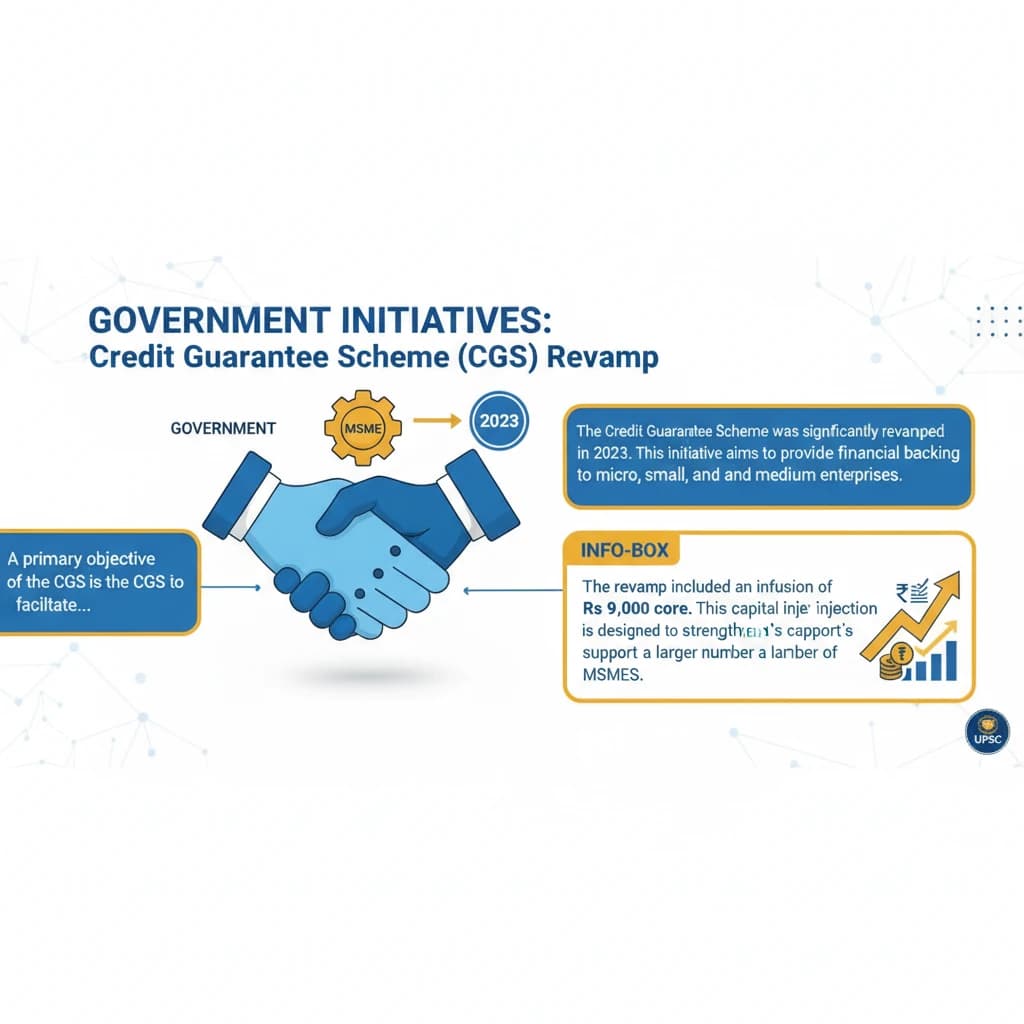
<h4>Credit Guarantee Scheme (CGS) Revamp</h4><p>The <strong>Credit Guarantee Scheme</strong> was significantly revamped in <strong>2023</strong>. This initiative aims to provide crucial financial backing to micro, small, and medium enterprises.</p><div class='info-box'><p>The revamp included an infusion of <strong>Rs 9,000 crore</strong>. This capital injection is designed to strengthen the scheme's capacity to support a larger number of MSMEs.</p></div><p>A primary objective of the CGS is to facilitate <strong>collateral-free loans</strong> for <strong>MSMEs</strong>. This reduces the burden on small businesses, enabling easier access to credit for growth and expansion.</p><h4>International Payments via NPCI International Payments (NIPL)</h4><p><strong>NPCI International Payments (NIPL)</strong>, the international arm of the National Payments Corporation of India, has been actively expanding its global footprint. This expansion is crucial for promoting India's indigenous payment technologies worldwide.</p><div class='info-box'><p>NIPL has forged a strategic partnership with <strong>Liquid Group</strong>. This collaboration is instrumental in enabling the use of <strong>QR-based UPI payments</strong> in multiple international markets.</p></div><p>The partnership extends <strong>UPI payment</strong> capabilities to <strong>10 countries</strong>. These nations include <strong>Malaysia, Thailand, Philippines, Vietnam, Singapore, Cambodia, South Korea, Japan, Taiwan, and Hong Kong</strong>, enhancing convenience for Indian travelers and businesses.</p><h4>e-RUPI: Digital Voucher System</h4><p><strong>e-RUPI</strong> represents a significant step towards a more efficient and targeted digital payment ecosystem in India. It was introduced to streamline welfare delivery and specific-purpose payments.</p><div class='info-box'><p>Launched in <strong>August 2021</strong>, <strong>e-RUPI</strong> functions as a <strong>digital payment solution</strong>. It operates primarily through <strong>QR codes</strong> or <strong>SMS strings</strong>, making it accessible even on basic mobile phones.</p></div><p>This system facilitates <strong>one-time payments</strong> for specific purposes. It ensures that funds are utilized for their intended objective, enhancing transparency and reducing leakages in welfare schemes.</p><h4>Accelerating Financial Inclusion</h4><p>Government programs have played a pivotal role in accelerating <strong>financial inclusion</strong> across India. These initiatives aim to bring a wider population, especially in rural areas, into the formal financial system.</p><div class='key-point-box'><p>Key programs driving this change include <strong>Deendayal Antyodaya Yojana - National Rural - Livelihoods Mission (DAY-NRLM)</strong>, <strong>Direct Benefit Transfer (DBT)</strong>, and <strong>Atal Pension Yojana (APY)</strong>.</p></div><p>These initiatives have significantly boosted the <strong>digital transition</strong>. They have enabled more citizens to access and utilize <strong>digital financial services</strong>, fostering economic empowerment.</p><h4>Inter-Ministerial Steering Committee (IMSC)</h4><p>To navigate the evolving landscape of financial technology, a dedicated committee was established. This body focuses on strategic oversight and policy coordination for fintech development.</p><div class='info-box'><p>The <strong>Inter-Ministerial Steering Committee (IMSC)</strong> was established in <strong>2018</strong>. It operates under the aegis of the <strong>Department of Economic Affairs (DEA)</strong>.</p></div><p>The IMSC's mandate includes addressing various <strong>fintech development issues</strong>. It also works to enhance <strong>regulatory flexibility</strong>, ensuring that regulations keep pace with technological advancements.</p><h4>Joint Working Groups (JWGs) for Fintech Collaboration</h4><p>International collaboration is vital for advancing fintech and digital payment systems. <strong>Joint Working Groups</strong> serve as a mechanism to foster such partnerships.</p><div class='key-point-box'><p>These <strong>JWGs</strong> are designed to promote <strong>fintech collaboration</strong> between India and other nations. They facilitate discussions and initiatives aimed at mutual growth and technological integration.</p></div><p>Their key functions include facilitating <strong>faster remittances</strong> and exploring direct connectivity. Specifically, they work on linking <strong>India’s UPI</strong> with various <strong>international payment platforms</strong>, simplifying cross-border transactions.</p>
Concept Diagram

💡 Key Takeaways

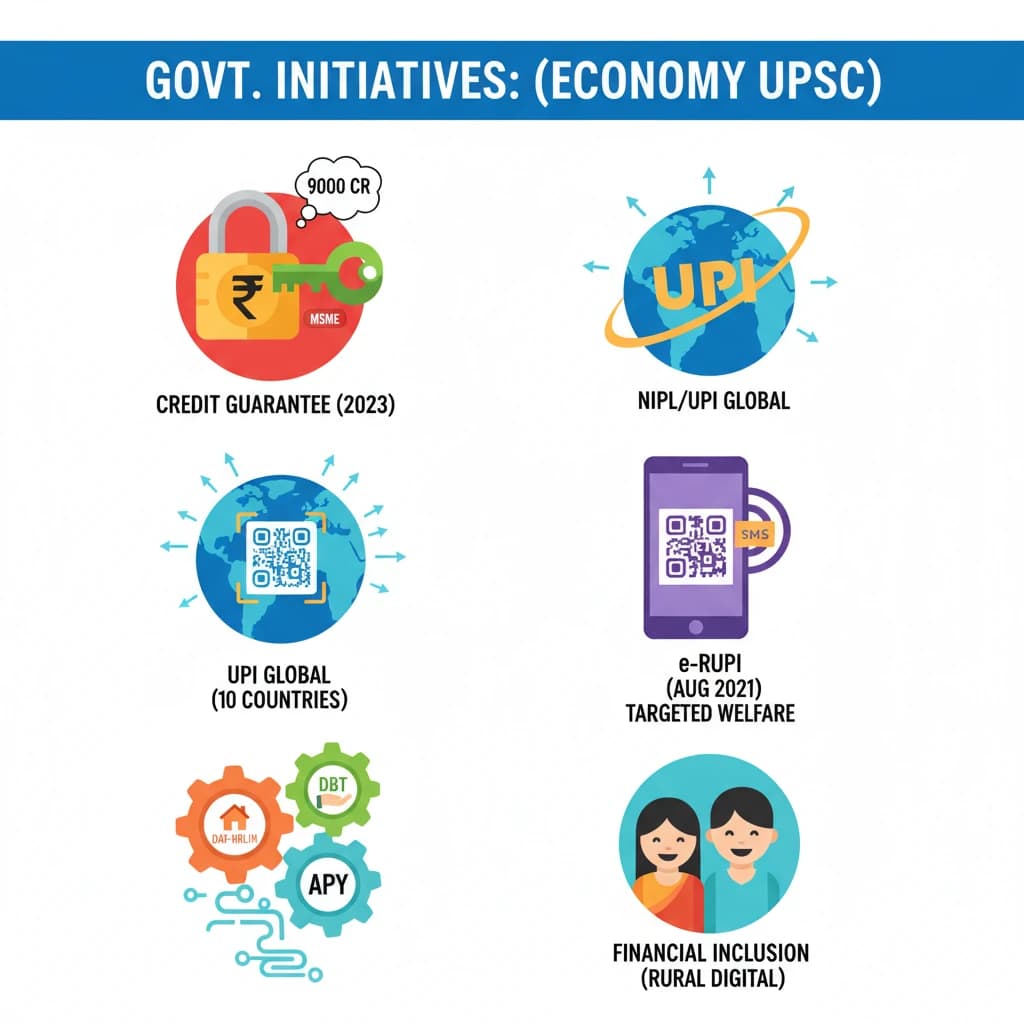
  • •Credit Guarantee Scheme (2023 revamp) provides Rs 9,000 cr for collateral-free MSME loans.
  • •NIPL expanded QR-based UPI payments to 10 countries, enhancing global digital transactions.
  • •e-RUPI (Aug 2021) offers QR/SMS-based one-time digital payment solutions for targeted welfare.
  • •Financial inclusion programs (DAY-NRLM, DBT, APY) accelerate digital transition for rural citizens.
  • •IMSC (2018, DEA) addresses fintech development and regulatory flexibility.
  • •Joint Working Groups foster fintech collaboration and UPI international connectivity.

🧠 Memory Techniques
Memory Aid
95% Verified Content

Related Topics

Loading related topics...
Explore:Economy Topics·All Subjects·Daily Current Affairs·Editorial Analysis·Previous Year Questions·UPSC GPT
Government Initiatives for MSMEs, Digital Payments & Financial Inclusion - UPSC Economy