Loading page, please wait…
Vaidra Logo
Vaidra

Top 4 items + smart groups

UPSC GPT
New
Current Affairs
Daily Solutions
Daily Puzzle
Mains Evaluator

Version 2.0.0 • Built with ❤️ for UPSC aspirants

Loading...
Loading...
Loading...
Loading...
Loading...
Loading...
Loading...
Loading...
Loading...
Loading...
Loading...
Loading...
Loading...
Back
All Subjects

Topics

0 topics • 0 completed

Loading topics...
Loading...
Loading...
Loading...
Loading...
Loading...
Overall Progress0%

Gross Value Added (GVA) - UPSC Economy

What is Gross Value Added (GVA) in UPSC Economy?

Gross Value Added (GVA) is a key topic under Economy for UPSC Civil Services Examination. Key points include: GVA measures the value added by producers to goods and services.. It is calculated as Total Output minus Intermediate Consumption.. GVA provides a sectoral view of economic growth, unlike GDP's aggregate view.. Understanding this topic is essential for both UPSC Prelims and Mains preparation.

Why is Gross Value Added (GVA) important for UPSC exam?

Gross Value Added (GVA) is a Medium-level topic in UPSC Economy. It is tested in both Prelims (factual MCQs) and Mains (analytical answer writing). Previous year UPSC questions have frequently covered aspects of Gross Value Added (GVA), making it essential for comprehensive IAS preparation.

How to prepare Gross Value Added (GVA) for UPSC?

To prepare Gross Value Added (GVA) for UPSC: (1) Study the comprehensive notes covering all key concepts on Vaidra. (2) Practice previous year questions on this topic. (3) Connect it with current affairs using daily updates. (4) Revise using key takeaways and mind maps available for Economy. (5) Write practice answers linking Gross Value Added (GVA) to related GS Paper topics.

Key takeaways of Gross Value Added (GVA) for UPSC

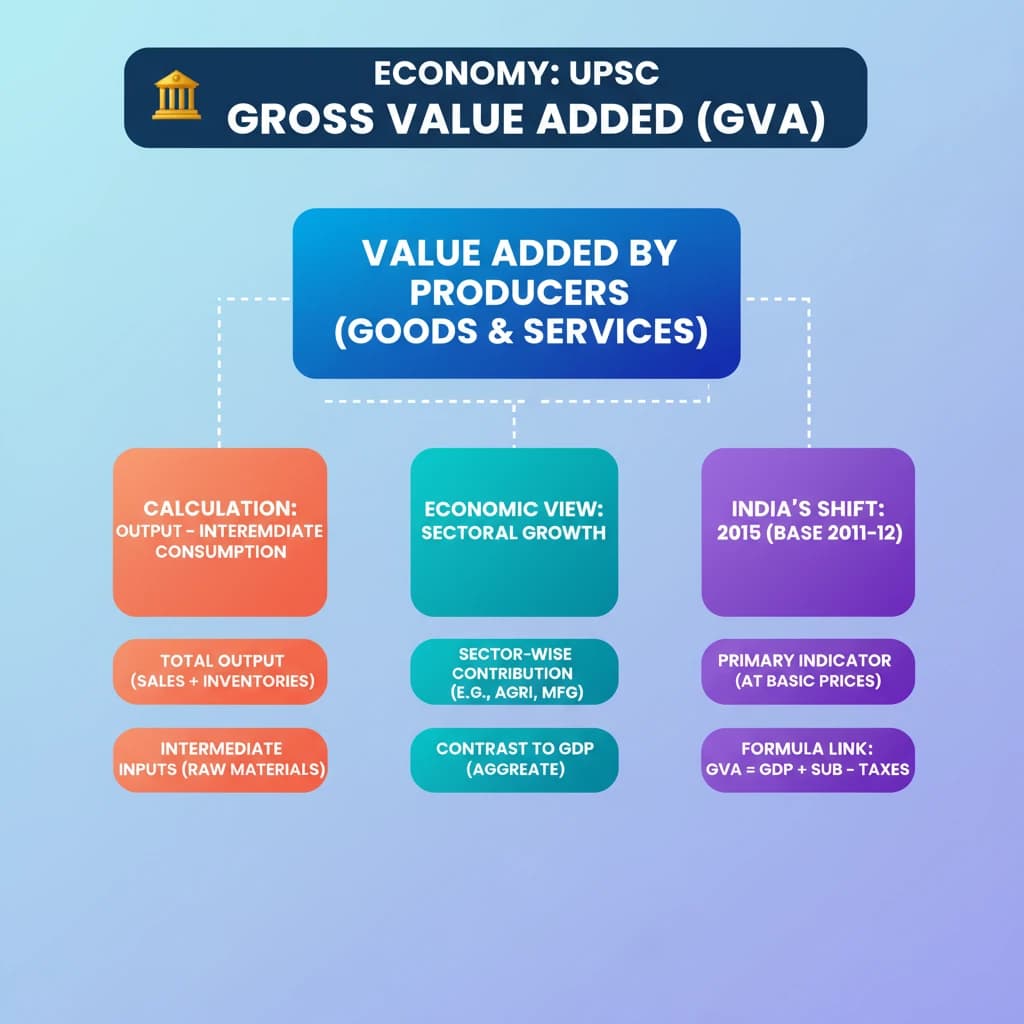
  • GVA measures the value added by producers to goods and services.
  • It is calculated as Total Output minus Intermediate Consumption.
  • GVA provides a sectoral view of economic growth, unlike GDP's aggregate view.
  • The formula linking GVA and GDP is: GVA = GDP + Subsidies on Products – Taxes on Products.
  • India shifted to using GVA at basic prices as a primary economic indicator in 2015 (base year 2011-12).
  • GVA is crucial for policymaking, sectoral analysis, and RBI's monetary policy decisions.
Gross Value Added (GVA)

Gross Value Added (GVA)

Medium⏱️ 7 min read✓ 98% Verified
economy

📖 Introduction

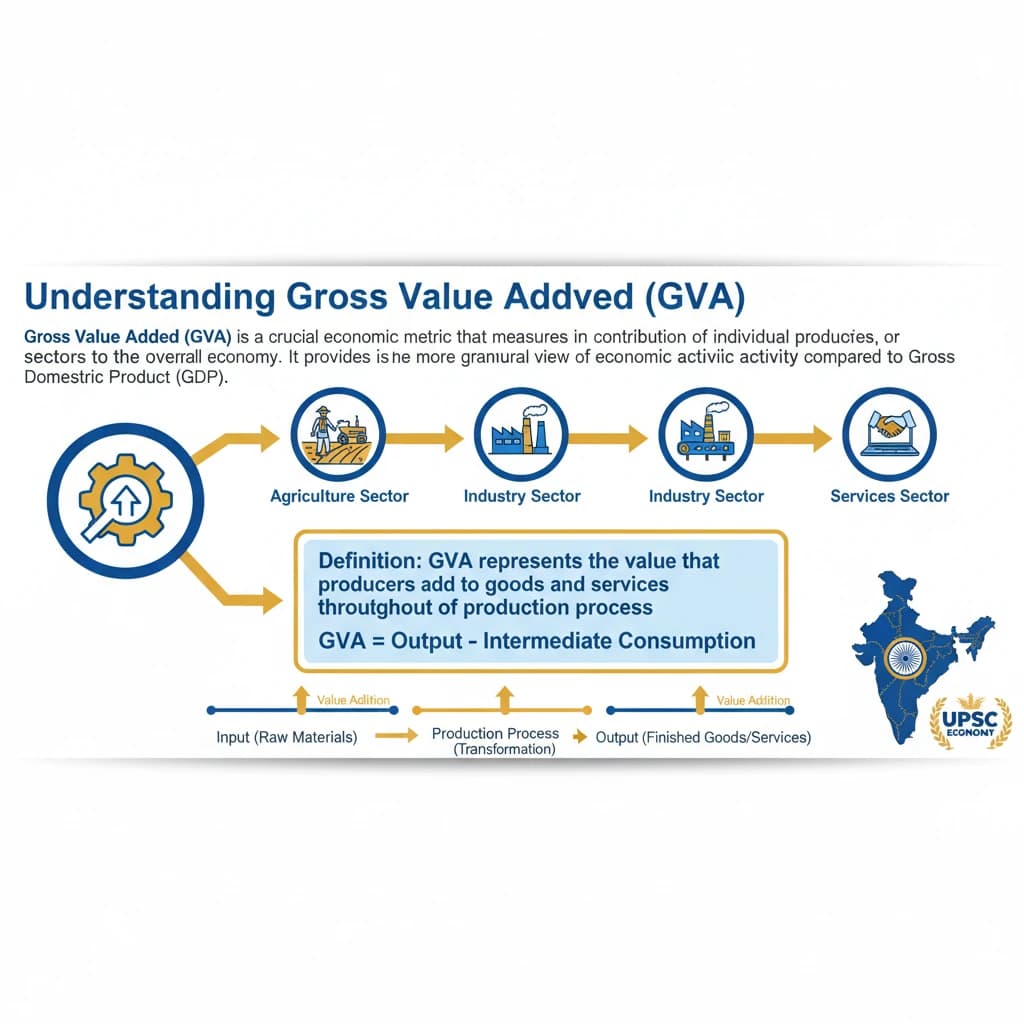
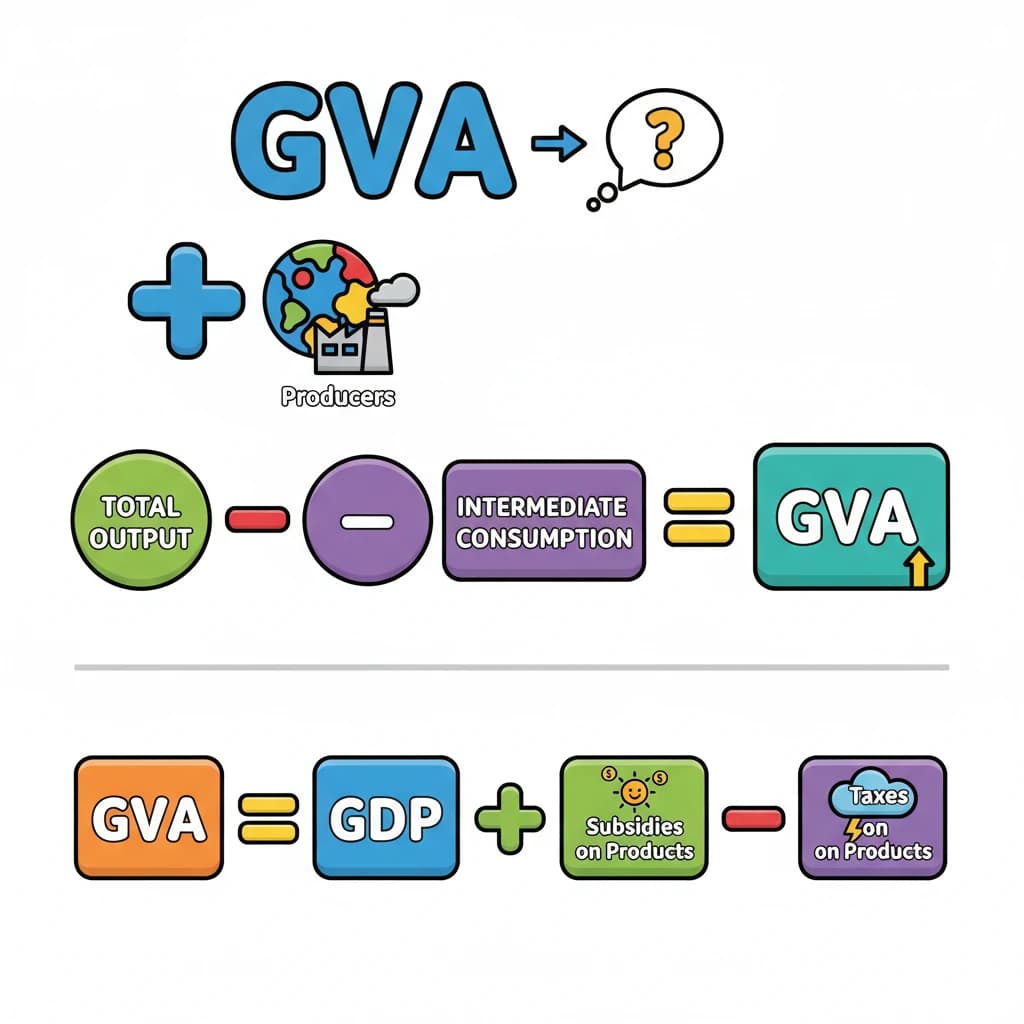
<h4>Understanding Gross Value Added (GVA)</h4><p><strong>Gross Value Added (GVA)</strong> is a crucial economic metric that measures the contribution of individual producers, industries, or sectors to the overall economy. It provides a more granular view of economic activity compared to <strong>Gross Domestic Product (GDP)</strong>.</p><div class='info-box'><p><strong>Definition:</strong> <strong>GVA</strong> represents the value that producers add to goods and services throughout the <strong>production process</strong>. It quantifies the output generated by each sector after deducting the cost of inputs.</p></div><h4>Calculation of GVA</h4><p>The calculation of <strong>GVA</strong> is fundamental to understanding its nature. It focuses on the value created at each stage of production, rather than just the final output price.</p><div class='info-box'><p><strong>Basic Formula:</strong> GVA is calculated by subtracting the <strong>cost of inputs</strong> (also known as <strong>intermediate consumption</strong>) from the <strong>total output</strong> generated by a sector or economy.</p><ul><li><strong>Total Output:</strong> This includes the value of all goods and services produced.</li><li><strong>Intermediate Consumption:</strong> These are goods and services used up in the process of producing other goods and services (e.g., raw materials, fuel).</li></ul></div><h4>GVA and GDP: The Relationship</h4><p><strong>GVA</strong> is intricately linked with <strong>Gross Domestic Product (GDP)</strong>, which is the total monetary value of all finished goods and services produced within a country's borders in a specific time period.</p><div class='key-point-box'><p><strong>Key Relationship:</strong> GVA is a key component of GDP. The difference primarily lies in how indirect taxes and subsidies are treated.</p></div><div class='info-box'><p><strong>GVA-GDP Formula:</strong> The relationship between GVA and GDP can be expressed as:</p><p><strong>GVA = GDP + subsidies on products – taxes on products</strong></p><p>Conversely, <strong>GDP = GVA + taxes on products – subsidies on products</strong>.</p></div><h4>Significance of GVA Growth Rates</h4><p>Monitoring <strong>GVA growth rates</strong> offers invaluable insights into the health and performance of different sectors within an economy. This disaggregated view is essential for informed decision-making.</p><div class='key-point-box'><p><strong>Sectoral Performance:</strong> GVA growth rates provide clear insights into the performance of specific sectors like agriculture, manufacturing, or services. This helps identify which sectors are driving or hindering <strong>economic growth</strong>.</p></div><div class='exam-tip-box'><p><strong>UPSC Insight:</strong> For UPSC Mains (<strong>GS Paper III - Economy</strong>), understanding GVA helps in analyzing economic trends, evaluating government policies, and critically assessing reports from bodies like the <strong>National Statistical Office (NSO)</strong> or the <strong>Reserve Bank of India (RBI)</strong>. It's often used in questions related to national income accounting and economic reforms.</p></div><p>This detailed sectoral analysis aids significantly in <strong>economic analysis</strong> and the formulation of targeted <strong>policymaking</strong>. Governments can use GVA data to direct resources, provide incentives, or address bottlenecks in underperforming sectors.</p>
Concept Diagram

💡 Key Takeaways

  • •GVA measures the value added by producers to goods and services.
  • •It is calculated as Total Output minus Intermediate Consumption.
  • •GVA provides a sectoral view of economic growth, unlike GDP's aggregate view.
  • •The formula linking GVA and GDP is: GVA = GDP + Subsidies on Products – Taxes on Products.
  • •India shifted to using GVA at basic prices as a primary economic indicator in 2015 (base year 2011-12).
  • •GVA is crucial for policymaking, sectoral analysis, and RBI's monetary policy decisions.

🧠 Memory Techniques
Memory Aid
98% Verified Content

📚 Reference Sources

•National Statistical Office (NSO), Ministry of Statistics and Programme Implementation (MoSPI) reports
•Reserve Bank of India (RBI) publications and policy statements
•Economic Survey of India

Related Topics

Loading related topics...
Explore:Economy Topics·All Subjects·Daily Current Affairs·Editorial Analysis·Previous Year Questions·UPSC GPT
Gross Value Added (GVA) - UPSC Economy