Loading page, please wait…
Vaidra Logo
Vaidra

Top 4 items + smart groups

UPSC GPT
New
Current Affairs
Daily Solutions
Daily Puzzle
Mains Evaluator

Version 2.0.0 • Built with ❤️ for UPSC aspirants

Loading...
Loading...
Loading...
Loading...
Loading...
Loading...
Loading...
Loading...
Loading...
Loading...
Loading...
Loading...
Loading...
Back
All Subjects

Topics

0 topics • 0 completed

Loading topics...
Loading...
Loading...
Loading...
Loading...
Loading...
Overall Progress0%

Need of Sovereign Wealth Fund for India - UPSC Economy

What is Need of Sovereign Wealth Fund for India in UPSC Economy?

Need of Sovereign Wealth Fund for India is a key topic under Economy for UPSC Civil Services Examination. Key points include: India is considering a Bharat Sovereign Wealth Fund (BSWF) to utilize dormant national wealth.. SWFs are government-owned funds from state surpluses, investing in foreign financial assets.. The Santiago Principles (2008) define SWF characteristics: government ownership, foreign investments, state surpluses.. Understanding this topic is essential for both UPSC Prelims and Mains preparation.

Why is Need of Sovereign Wealth Fund for India important for UPSC exam?

Need of Sovereign Wealth Fund for India is a Medium-level topic in UPSC Economy. It is tested in both Prelims (factual MCQs) and Mains (analytical answer writing). Previous year UPSC questions have frequently covered aspects of Need of Sovereign Wealth Fund for India, making it essential for comprehensive IAS preparation.

How to prepare Need of Sovereign Wealth Fund for India for UPSC?

To prepare Need of Sovereign Wealth Fund for India for UPSC: (1) Study the comprehensive notes covering all key concepts on Vaidra. (2) Practice previous year questions on this topic. (3) Connect it with current affairs using daily updates. (4) Revise using key takeaways and mind maps available for Economy. (5) Write practice answers linking Need of Sovereign Wealth Fund for India to related GS Paper topics.

Key takeaways of Need of Sovereign Wealth Fund for India for UPSC

  • India is considering a Bharat Sovereign Wealth Fund (BSWF) to utilize dormant national wealth.
  • SWFs are government-owned funds from state surpluses, investing in foreign financial assets.
  • The Santiago Principles (2008) define SWF characteristics: government ownership, foreign investments, state surpluses.
  • India's SWF idea gained traction in 2007-08, revived in 2010-11, and led to NIIF in 2015.
  • NIIF is India's main structured investment fund, focusing on infrastructure, similar to SWF objectives.
  • BSWF aims to unlock domestic capital for long-term strategic investments and economic growth.
Need of Sovereign Wealth Fund for India

Need of Sovereign Wealth Fund for India

Medium⏱️ 6 min read✓ 95% Verified
economy

📖 Introduction

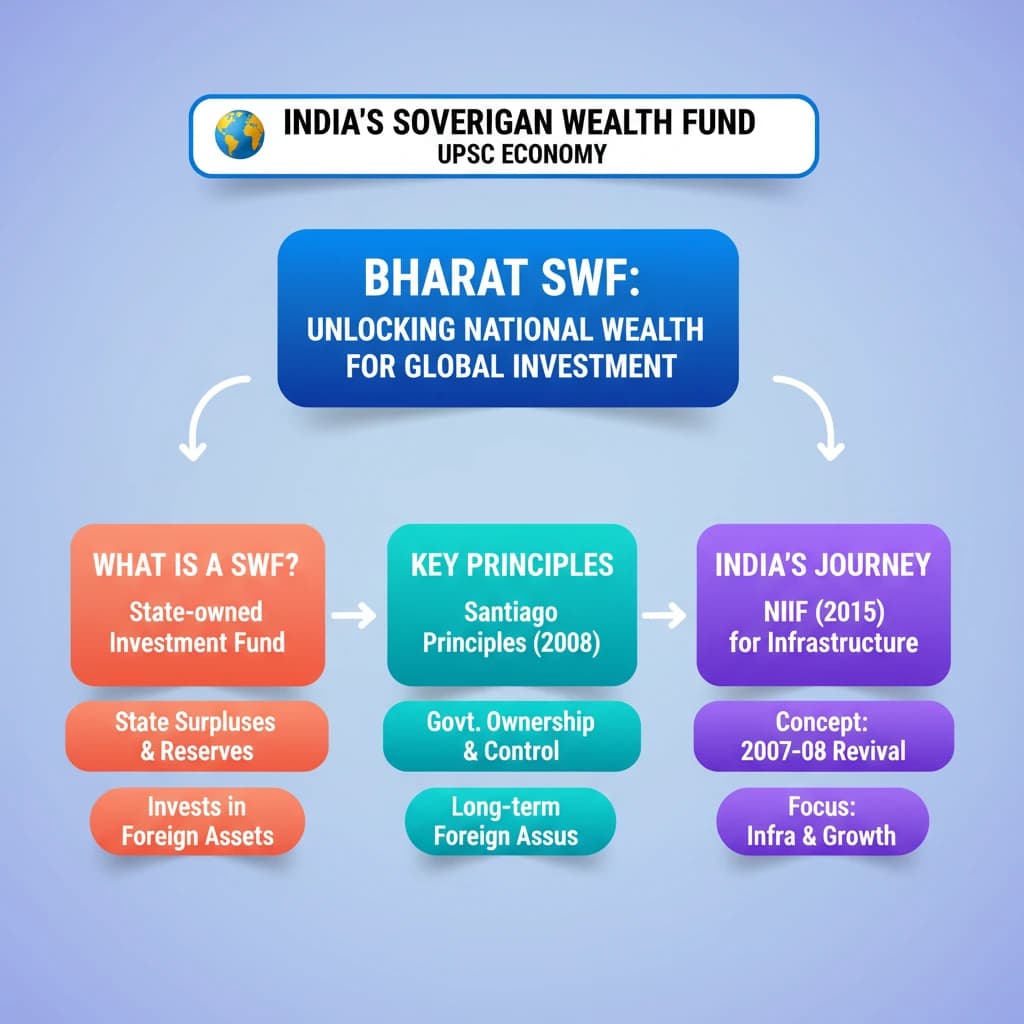
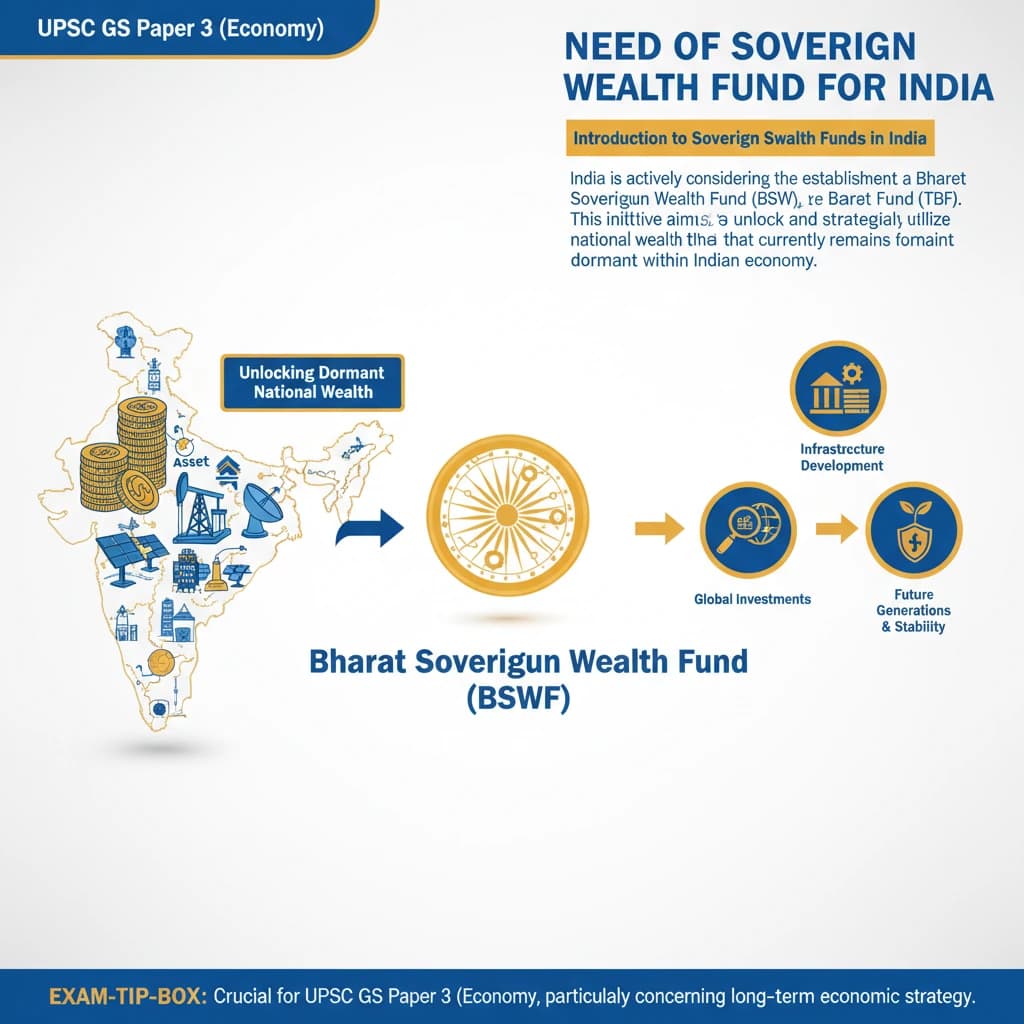
<h4>Introduction to Sovereign Wealth Funds in India</h4><p>India is actively considering the establishment of a <strong>Bharat Sovereign Wealth Fund (BSWF)</strong>, also referred to as <strong>The Bharat Fund (TBF)</strong>. This initiative aims to unlock and strategically utilize the substantial national wealth that currently remains dormant within the Indian economy.</p><div class='exam-tip-box'>This topic is crucial for <strong>UPSC GS Paper 3 (Economy)</strong>, particularly concerning long-term capital mobilization and investment strategies.</div><h4>What is a Sovereign Wealth Fund (SWF)?</h4><p>A <strong>Sovereign Wealth Fund (SWF)</strong> is a government-owned investment fund. These funds are typically established from a nation's surplus wealth, which can originate from various sources.</p><div class='info-box'><strong>Sources of SWF Funds:</strong><ul><li><strong>Natural Resources:</strong> Revenue generated from oil, gas, or mineral exports.</li><li><strong>Trade Surpluses:</strong> Excess funds accumulated from a country's favorable balance of trade.</li><li><strong>Budget Excesses:</strong> Government savings from budget surpluses.</li><li><strong>Foreign Exchange Reserves:</strong> Portions of a country's forex reserves.</li></ul></div><h4>Characteristics of Sovereign Wealth Funds</h4><p>The <strong>Santiago Principles 2008</strong> provide a globally recognized framework defining the key characteristics of SWFs. These principles ensure transparency and good governance.</p><div class='key-point-box'><strong>Key Characteristics of SWFs (as per Santiago Principles):</strong><ul><li><strong>Government Ownership:</strong> The fund must be owned by the general government, encompassing both central and sub-national governmental bodies.</li><li><strong>Foreign Financial Assets:</strong> A significant portion of its investments must be in foreign financial assets.</li><li><strong>State Surpluses:</strong> Funds are typically created from state surpluses, not borrowed capital.</li></ul></div><h4>Santiago Principles 2008 Explained</h4><p>The <strong>Santiago Principles</strong> comprise <strong>24 voluntary guidelines</strong> designed to promote best practices for SWFs. They emphasize crucial aspects such as transparency, robust governance, accountability, and prudent investment strategies.</p><div class='info-box'>The <strong>International Forum of Sovereign Wealth Funds (IFSWF)</strong>, a voluntary global organization of SWFs, established these principles in <strong>2008</strong>.</div><h4>Historical Context of SWF Discussions in India</h4><p>The idea of an SWF in India has surfaced multiple times, reflecting evolving economic conditions and policy priorities.</p><ol><li><strong>2007-08:</strong> The concept gained significant momentum due to a substantial surge in <strong>capital inflows</strong>, which exceeded <strong>USD 108 billion</strong> in a single year.</li><li><strong>Post-Global Financial Crisis 2008:</strong> The momentum for an SWF in India diminished following the global economic downturn.</li><li><strong>2010-11:</strong> The <strong>Planning Commission</strong> revitalized the SWF proposal, suggesting a fund of approximately <strong>USD 10 billion</strong>. Potential funding sources included foreign exchange reserves, Public Sector Undertakings (PSUs), or direct budget allocations.</li><li><strong>2015:</strong> India established the <strong>National Investment and Infrastructure Fund (NIIF)</strong>, which currently serves as the country's primary structured investment fund, aligning with some SWF objectives.</li></ol>
Concept Diagram

💡 Key Takeaways

  • •India is considering a Bharat Sovereign Wealth Fund (BSWF) to utilize dormant national wealth.
  • •SWFs are government-owned funds from state surpluses, investing in foreign financial assets.
  • •The Santiago Principles (2008) define SWF characteristics: government ownership, foreign investments, state surpluses.
  • •India's SWF idea gained traction in 2007-08, revived in 2010-11, and led to NIIF in 2015.
  • •NIIF is India's main structured investment fund, focusing on infrastructure, similar to SWF objectives.
  • •BSWF aims to unlock domestic capital for long-term strategic investments and economic growth.

🧠 Memory Techniques

Memory Aid
95% Verified Content

📚 Reference Sources

•International Forum of Sovereign Wealth Funds (IFSWF) - Santiago Principles
•Reports from the Ministry of Finance, Government of India on NIIF

Related Topics

Loading related topics...
Explore:Economy Topics·All Subjects·Daily Current Affairs·Editorial Analysis·Previous Year Questions·UPSC GPT
Need of Sovereign Wealth Fund for India - UPSC Economy